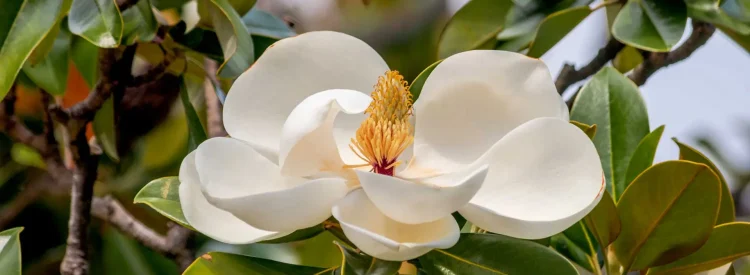
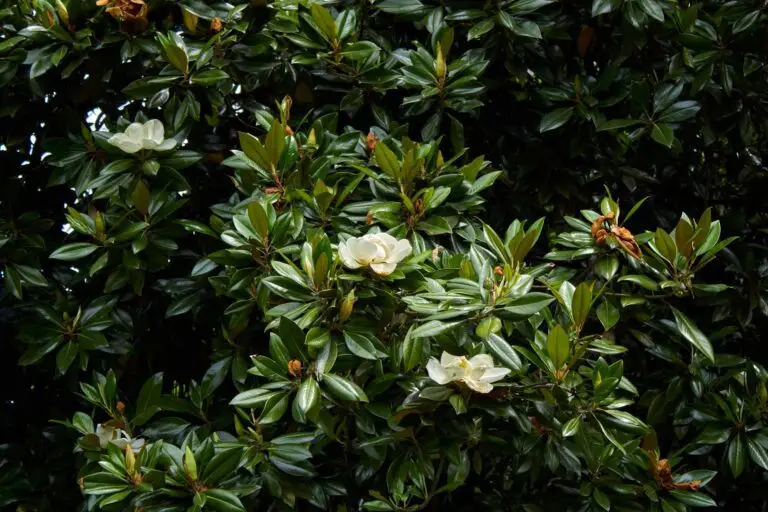
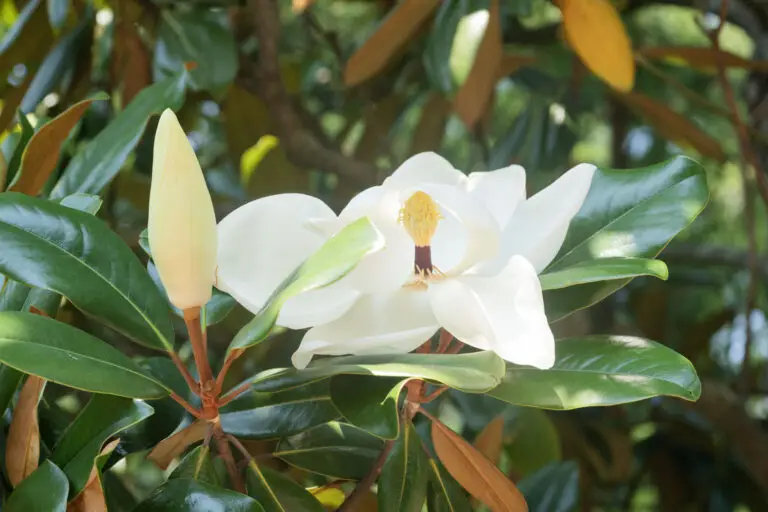
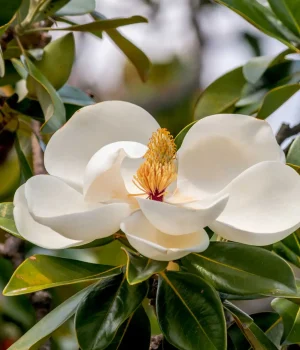
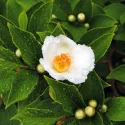
When you close your eyes and think of a magnolia tree, you’re probably imagining (and smelling) a southern magnolia. These trees have dark green, glossy leaves with a pale green or red underside. In the spring and summer, they cover themselves in scented ivory blooms with yellow centers—the classic flowers associated with a magnolia tree. After the flowers comes a red, cone-shaped fruit. They are evergreen, so they look this good year-round. Southern magnolias are native from Pennsylvania to Florida, and west to Texas. A showstopper for any yard or park.
Head to the complete guide for planting basics, species comparisons, and beginner-friendly tips.
Welcome to the world of southern magnolias (also known by their Latin nameMagnolia grandiflora). This magnificent native tree has been celebrated for centuries for its black-tie elegance and gorgeous-smelling flowers. Southern magnolias are one of the eight magnolias native to North America. In this article, we will explore how Magnolia grandiflora changes throughout the seasons, share planting tips, and celebrate this incredible native tree.
Let’s start with celebrating what southern magnolias deliver.
Is southern magnolia a good choice for my yard?
Yes, if…
You want a statement tree. Southern magnolia is big, beautiful, and makes an impression in every season.
You’re looking for year-round privacy. The dense, evergreen canopy holds its leaves all the way to the ground, creating a natural screen.
You want fragrance. The flowers smell incredible, and they bloom for weeks in late spring and summer.
You have space for a large tree (or are willing to use a compact cultivar).
Deer are a concern. They rarely browse the thick, leathery leaves.
You want a multi-generation tree. Southern magnolias live 80–120 years. Plant one and your grandkids will enjoy it.
Skip it if…
You don’t have room. The straight species can reach 80 feet tall with a 50-foot spread. That’s a big tree. (But compact cultivars like ‘Little Gem’ top out around 20 feet.)
You want a tidy yard. Southern magnolia drops thick, leathery leaves year-round, and the seed pods can be messy. Embrace the leaf litter or plan on raking.
You want to grow a lush lawn underneath it. The dense shade and shallow roots make growing grass beneath a mature magnolia nearly impossible. A shade garden is the better play.
You have frozen winters. Southern magnolia doesn’t love hard freezes. For colder areas, look at sweetbay magnolia or cucumber magnolia instead.
New to native?
Before lawns and landscaping, native plants were here. They’ve fed birds, bees, and butterflies for thousands of years—and they’ll do the same in your yard. The best part? They’re easier to grow than you think.
Southern magnolia is one of eight magnolia species native to North America, and it’s a heavy hitter for wildlife. The flowers are primarily pollinated by beetles, not bees. (More on that in the Plant Nerd Fact below.) The large, creamy blooms are loaded with protein-rich pollen that beetles have been feeding on for millions of years.
In fall, the cone-like seed pods split open to reveal bright red seeds that hang from thin threads. American robins, wood thrushes, red-eyed vireos (promise that’s a real bird), mockingbirds, and eastern kingbirds all eat these seeds. Squirrels get in on the action too. Because southern magnolia is evergreen, it also provides year-round shelter and nesting sites for birds, which is especially valuable in winter when other trees are bare.
If you live within its native range, southern magnolia has been thriving in your area for thousands of years. Every hurricane, drought, and flood, it’s been there. That’s the advantage of planting native: you’re choosing a tree that’s already built for your conditions.
Sweetbay magnolias are native all the way to Massachusetts
If you’re worried about the cold…
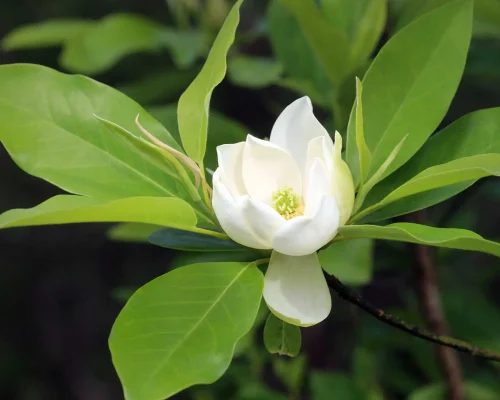
Sweetbay or cucumber magnolias are better for cold winters
Now that we’ve covered the history and native range, let’s dig into how to plant these stunning native trees.
How to grow southern magnolia
Where to plant
Full sun gives you the most flowers. Part sun works, especially in hotter climates where afternoon shade can help. Southern magnolia likes moist, well-drained, slightly acidic soil but is adaptable to clay, loam, and sandy conditions.
Give it space
This is a big tree. The straight species can reach 60–80 feet tall with a 30–50-foot spread, and the roots extend 3–4 times wider than the canopy. Plant at least 30 feet from your house, driveway, or sidewalk.
Don’t have the space? Go for a cultivar. For compact cultivars like ‘Little Gem,’ you can plant closer.
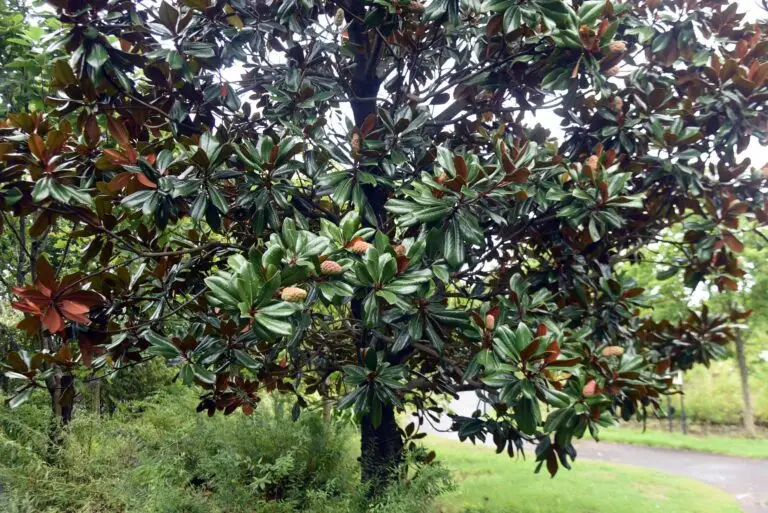
Southern magnolias grow to be big trees, reaching 60+ feet
When to plant
Fall (August through October) is ideal. Spring works too. Container-grown trees can go in anytime, but avoid planting in the heat of summer if possible.
Watering
Water deeply 2–3 times a week for the first three to six months, then weekly through the first growing season. Once established, southern magnolia is fairly self-sufficient and only needs extra water during long dry spells.
Mulching
Spread 3–4 inches of mulch around the base but keep it away from the trunk. No mulch volcanoes! This helps hold moisture, keeps roots cool, and (bonus) mimics the natural leaf litter the tree would create on its own.
Garden Recipe™
Southern Magnolia
Magnolia grandiflora
Full sun
Sun
Pretty easy
Effort
Tall Tree (50-100'+) tall 25-40 ft wide
Size
Summer - Spring
Blooms
What it needs
Sunlight
Full sun, 6+ hoursSouth- or west-facing is ideal
Water
Likes it moistPick a low spot, or plan to water often
Directions
Spacing
25-35 ftThink of each one as its own tree
Watering
Weekly for the first seasonAfter that, rain is usually enough
Notes
Comes back?
Yes, every yearGoes dormant in winter, that's normal. New growth each spring.
Butterfly host plant. Certain butterflies depend on this plant to reproduce. It's one of the specific species their caterpillars need to survive.
Southern magnolias are well paired with shade and part sun natives, like the phlox and wild geranium seen here at Morris Arboretum in PA
Pruning
Less is more. Southern magnolia has a naturally beautiful pyramidal shape. If you need to prune, do it right after flowering (late spring or early summer). Avoid heavy pruning because the wounds don’t heal well and you’ll end up with awkward water sprouts. Shape it when it’s young if you want a clean tree form.
Expect some transplant shock
Don’t panic if your newly planted magnolia drops some leaves in the first season. That’s normal. It’s adjusting. Keep watering and it’ll bounce back.
Beginner Tip
Don’t fight the leaf drop. Instead of raking every magnolia leaf, let them break down in place as a natural mulch, or use them in garden beds. Those thick, waxy leaves decompose slowly and make a great weed-suppressing layer. Nature’s free mulch!
Where southern magnolia shines in your yard
Grand specimen tree: Plant one in the front or side yard where it has room to grow into its full, pyramidal glory. This is a tree people will compliment.
Evergreen privacy screen: Southern magnolia holds its branches low to the ground, making it a natural year-round screen. Plant a row for serious privacy.
Shade tree: That dense canopy creates deep, cool shade in summer. Position it where you want relief from afternoon sun.
Near water: In nature, magnolias grow near rivers, swamps, and streams. If you have a pond, rain garden, or low-lying area, this tree is right at home.
Foundation or courtyard (compact cultivars): ‘Little Gem’ and ‘Kay Parris’ work well in tighter spaces, near patios, or flanking an entryway.
Shade garden anchor: Skip the lawn under your magnolia and plant a native shade garden instead. It’ll look better, and you’ll stop fighting a losing battle with the grass.
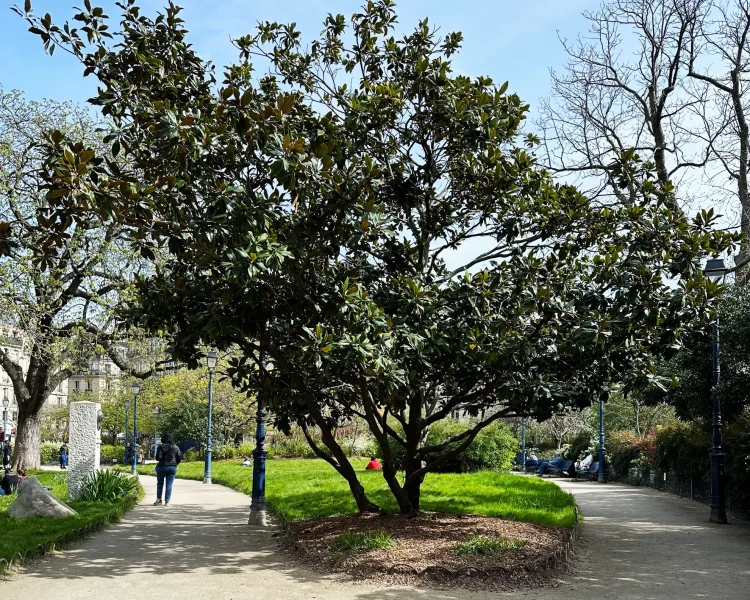
Paris public gardens feature southern magnolias in high traffic places
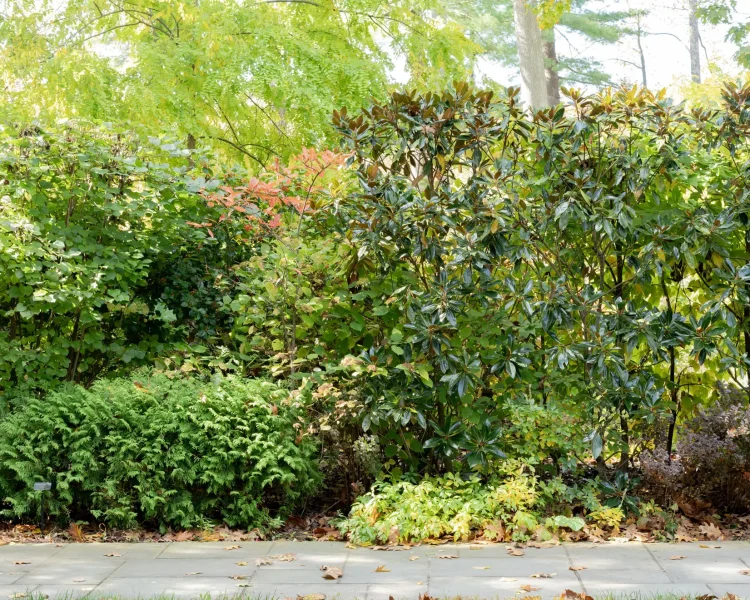
Southern magnolias can also become native plant hedge, as seen here in Stoneleigh in PA
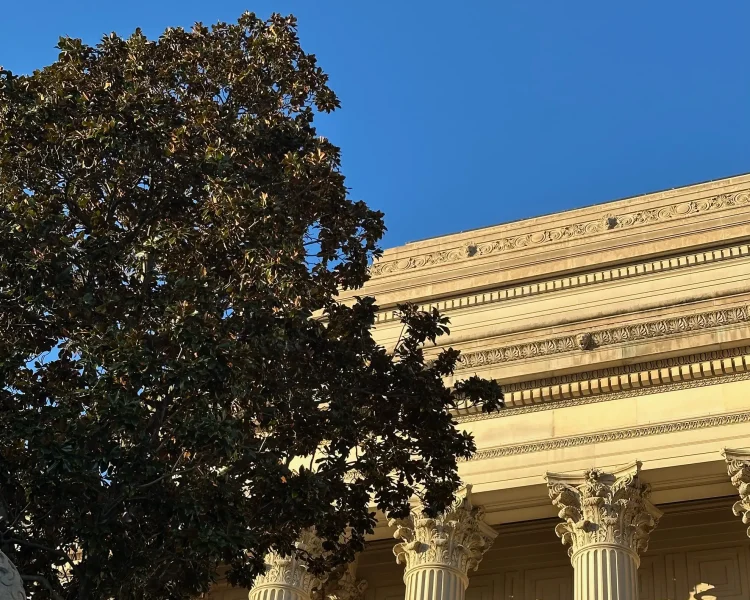
The capital in Washington D.C. has southern magnolias in front of many museums
Even in NYC, container cultivar options brighten hotel doorways
Southern magnolia cultivars
Southern magnolia has been beloved for centuries, so it’s no surprise there are 40+ cultivars out there. (A cultivar stands for cultivated variety or a plant that humans have curated—here’s a quick cultivar overview). You can always spot a cultivar when you see a cheeky marketing name in ‘single quotes.’
Here are the Southern magnolia cultivars worth knowing:
‘Little Gem’: The compact option. Tops out at 15–20 feet tall and 7–10 feet wide. Smaller flowers and leaves, but it blooms young (often within 2–3 years) and keeps flowering from late spring through fall. Resistant to magnolia scale. Perfect for smaller yards, containers, or foundation plantings.
‘Bracken’s Brown Beauty’: The cold-hardy champ. Hardy down to zone 5B, which is the widest range of any southern magnolia cultivar. Grows 30–50 feet tall with distinctive rusty-brown leaf undersides and strong limb structure. A great choice for gardeners pushing the northern edge of the range.
‘Edith Bogue’: Another cold-hardy pick, with excellent snow and ice resistance. Grows 30–50 feet tall. Good for areas that get occasional heavy wet snow.
‘D.D. Blanchard’: A classic Southern landscape pick. Grows about 50 feet tall with large, dark leaves and big fragrant flowers. More open-branched than some cultivars, which makes a nice shade tree.
‘Kay Parris’: A compact grower (20–25 feet) with huge, heavily scented flowers and strong limbs that handle ice storms well. Won the Royal Horticultural Society’s Award of Garden Merit. Great for the Carolinas and Mid-Atlantic.
Cultivar is short for CULTIvated VARieties. Cultivars are plants selected for traits like color, size, or disease resistance. Useful and sometimes stunning...but some lose the scent, shape, or timing wildlife depends on. Plant straight species when possible.
The straight species (Magnolia grandiflora with no cultivar name) typically supports the most ecologically speaking. Larger, full-sized trees produce more flowers, which means more seeds for birds and other wildlife. The flowers also offer the full pollen and nectar resources that beetles and other pollinators evolved to use. But if space or climate forces you toward a cultivar, go for it. Any native magnolia in your yard is better than a non-native alternative.
FAQs
How fast does a southern magnolia grow?
About 1–2 feet per year, which puts it in the slow-to-moderate range. It’s not a tree you plant for instant impact. But that slow, steady growth means dense wood, strong branches, and a tree that can live well over 100 years.
Can I keep a southern magnolia small?
Not the straight species. Trying to prune a full-sized southern magnolia into a small tree is a losing battle. If you want the look in a compact package, go with ‘Little Gem’ (15–20 feet) or ‘Kay Parris’ (20–25 feet).
Will the roots damage my foundation or driveway?
The risk is low as long as you plant at least 30 feet from your house. Magnolia roots are shallow and wide-spreading, but they’re relatively soft and fleshy. They’re more likely to lift a sidewalk than crack a foundation. For tight spaces, go with a smaller cultivar.
Is southern magnolia messy?
Honestly, yes. Thick leaves drop year-round, flowers shed petals, and seed pods fall in late autumn. It’s a little messy, especially if we’re evaluating it against the surgical cleanliness (and lifelessness) of a lawn.
But mess is relative.
Those leaves make excellent natural mulch
The flowers and seeds are feeding your local wildlife.
It’s a beautiful kind of messy that supports life. And with enough yards embracing native landscaping choices, it won’t look messy anymore. It will become the norm.
I'm in the Northeast. Can I plant one?
Maybe. Cold-hardy cultivars like ‘Bracken’s Brown Beauty’ and ‘Edith Bogue’ can handle zone 5B–6 with a sheltered spot.
But if hard freezes are a regular thing, you might be happier with:
Sweetbay magnolia (Magnolia virginiana), native all the way to Massachusetts, handles cold much better.
Cucumber magnolia (Magnolia acuminata) is the only magnolia native to parts of Canada.
Both are gorgeous, have iconic flowers, and have thrived in frozen winters for millions of years.
Plant Nerd Fact
Where did the name magnolia come from?
The name magnolia comes from the French botanist Pierre Magnol, who was the director of the botanical gardens in Montpellier, France, in the 1600s. The sad part? Magnol never set foot in North America, and no magnolias are native to Europe.
We’ve discussed in many articles how the names of North American native plants are often named after Europeans. It’s especially bewildering (and devastating) when you realize that Native Americans have their own names for these plants, in use for millennia.
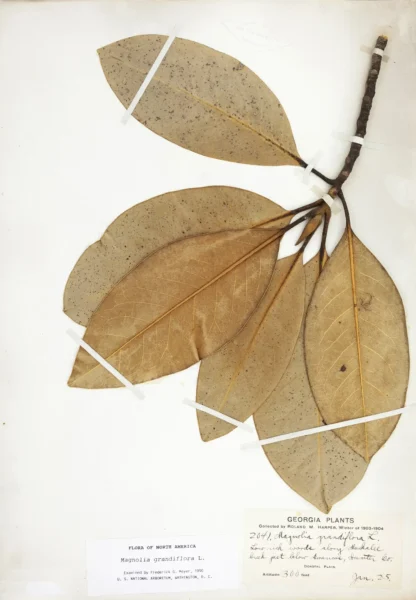
Southern magnolias show up in the earliest botanical surveys, including this one from 1904. Image from the NYBG.
One more nerd fact, about spotting southern magnolias abroad:
Southern magnolias were among the first plants to be shipped back to Europe in the 1700s. According to Monticello, “while living in Paris as Minister of France in 1786, Thomas Jefferson requested plants and seeds of the southern magnolia or bull bay magnolia be sent to him.”
Today, gigantic, beautiful southern magnolias are found in England, Spain, and Italy. All these European trees trace their heritage back to North America.
“
It’s a pretty humbling moment to stand in front of your newly planted southern magnolia and consider that you're growing something so intrinsically connected to the earth.
”
Since we brought up history, let’s go even further back in time for a few brief paragraphs:
Southern magnolia is ancient.
And not “old house” ancient. We’re talking dinosaurs-were-still-around ancient.
The magnolia family has been around for roughly 95 million years, making it one of the oldest flowering plant lineages on Earth. It’s a pretty humbling moment to stand in front of your newly planted southern magnolia and consider that you’re growing something so intrinsically connected to the earth.
When these flowers first evolved, bees didn’t exist yet. So who pollinated them?
Beetles.
And magnolias are still designed for beetle pollination today. Their thick, waxy petals can withstand clumsy beetle feet without tearing. They skip nectar entirely and instead offer massive amounts of protein-rich pollen. And here’s the wildest part: the flower opens in the morning, the beetle crawls in to feast, and then the innermost petals close at night, trapping the beetle inside. (It must be very cool to sleep snuggled inside a flower.) While trapped, the beetle gets coated in fresh pollen. The next morning, the flower opens, the beetle flies off to the next bloom, and pollination happens. A 95-million-year-old partnership, still working perfectly in your yard.
Ok, now let’s get into some plant pairings, before we close out this magnolia love letter.
Southern magnolia casts deep shade and its roots spread wide, so the best companions are shade-loving natives that can handle some competition. Think of it as building a layered garden underneath and around the canopy:
Southern magnolia is one of those trees that makes you feel like you did something right just by planting it. It’s big, it’s fragrant, it’s beautiful in every season, and it feeds wildlife while asking for almost nothing in return. Whether you’re going big with the straight species or fitting a ‘Little Gem’ into a courtyard, you’re planting something that delivers a positive impact for generations. Don’t forget to tell your kids and neighbors that its family tree goes back to the dinosaurs.
North Carolina Extension Gardener Plant Toolbox. “Magnolia grandiflora.” NC State University. Accessed 2025.
Outcalt, Kenneth W. “Magnolia grandiflora L.” In Silvics of North America, Vol. 2: Hardwoods, Agriculture Handbook 654, edited by Russell M. Burns and Barbara H. Honkala. Washington, DC: USDA Forest Service, 1990.
Vavilapalli, Rajesh, Shimat V. Joseph, and William G. Hudson. “Magnolia Scale: Biology and Management.” Circular C-1339. Athens: University of Georgia Cooperative Extension, 2024.