Plant profiles that are accurate and friendly
175 deep, beginner-friendly profiles for plants that are relatively easy to source and are great for landscaping. Every profile includes what the plant looks like in your yard, and then gets into tips and nerd storytelling.
Regional guides made for real yards
We cover seven North American regions because what works in coastal Maine is not what works in Phoenix. Pick your region, get the short list, plant something this weekend.
Shame-free answers to beginner questions
Here are the FAQs we wish we had found: will this look messy, what will the neighbors think, what is a cultivar? Count on us for an answer that is shame-free, joyful, and scientifically sound.
I felt a little lonely when I started out.
Sorry to take you back to spring 2020—but that’s where this story begins. During the dark days of COVID, I planted a patch of native plants in my suburban yard. I had no idea what I was doing, so I picked plants with marketing-polished names: sweetshrub, redbud, and cardinal flower.
Within a month, I saw my first hummingbird. It was the first one I had ever seen in my yard. I barely gave the new plants attention and they had thrived.
I went looking for books and websites to tell me what I could plant next. Everything I found was academic, buried in language that made it sound like I might make a mistake. But I knew from experience: native plants were beginner-friendly.
So I started The Plant Native as a place for others just starting out, with the info I wished I had.
If you found this site looking up a specific plant you saw in a yard or on Instagram, welcome. You are exactly who The Plant Native is for.
—EMILY (EM) LESSARD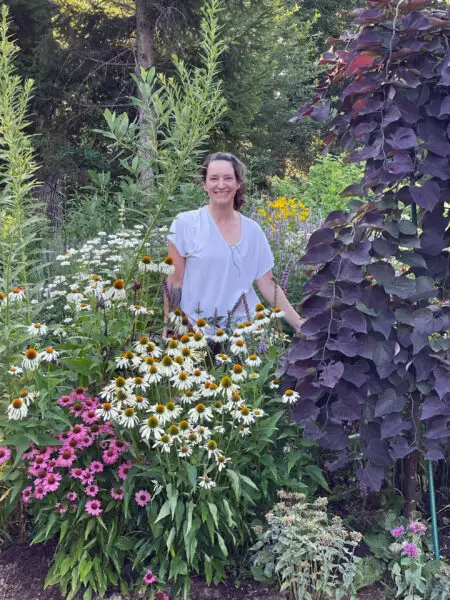
Emily Lessard, founder and editor
Hi! I'm Emily, but I go by Em. My day-job is co-CEO of Bellweather, an advertising agency I co-founded for nonprofits. I started The Plant Native in 2021 when I saw native plants needed a marketing partner. I felt the Latin botanical names and science-heavy language were standing in the way of homeowners seeing them as the easy, beautiful choices they are. I work on The Plant Native in the early mornings before the emails come in, sharing the small revelations I wished someone had shared with me when I started.
I live outside of Philadelphia on a quarter acre that I happily share with my husband John, my daughter, four chickens, and a dog named Frida. I am committed to the yard being forever, gloriously in progress. My garden is an ongoing, tumbling experiment I do mostly in pajama pants, hair in a messy bun, in full sight of my neighbors.
The Plant Native is my life’s work. I am dedicated to learning, doing, and making mistakes. You'll find me taking horticulture classes at Temple University, visiting all the arboretums I can, and reading a zillion gardening books.
I wrote a book!
Author, Plant Native: A Practical Guide to Over 100 Native Plants of North America
Quarto Publishing · February 2027I went back to college, for the third time!
Native Perennial Garden Design Certificate
Temple University · Spring 2027I'm certified!
Sustainable Landscapes-Certified Gardener
By the Pennsylvania Landscape & Nursery Association (PLNA)Get in touch!
Find me on LinkedIn
Email: hello@theplantnative.com
We name our sources.
Every profile lists the institutional and academic sources behind it: Lady Bird Johnson Wildflower Center, NC State Extension, Xerces Society, USDA, Mt. Cuba Center trial data, and peer-reviewed journals. No anonymous “experts.”
We review and revise.
Every page shows its last reviewed date. When the science updates, the page updates. When a reader catches an error, we fix it and credit them if they want the credit.
A named human is accountable for every page.
Humans verify every plant fact against our trusted sources. The byline on every page is a real person who edited and approved the piece. No anonymous AI output, no unverified facts.
We disclose who pays for this.
The site ran founder-funded from 2021 to 2026. We added Raptive ads in 2026 to pay our writers and contributors. We do not have sponsored content. The Plant Native is independently owned.
Quarto Publishing
Publisher · Plant Native - A Practical Guide to Over 100 Plants of North America - Launching Feb 2027Redfin
“Post-Winter Yard Cleanup: Essential Steps for Spring Yard Prep”Boston Globe
“Ask the Gardener: Believe it or not, spring has sprung”Real Simple
“10 Ways Native Plants Make Gardening So Much Easier and More Affordable”