
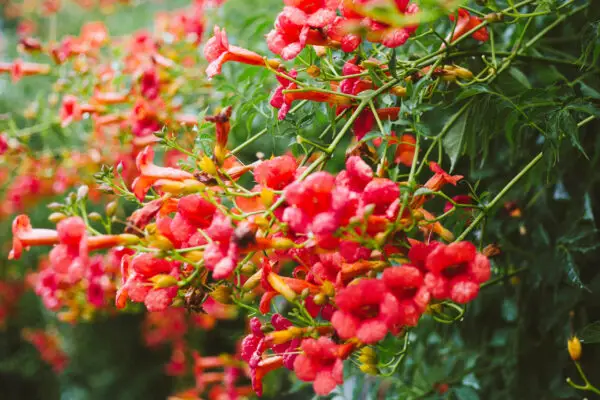
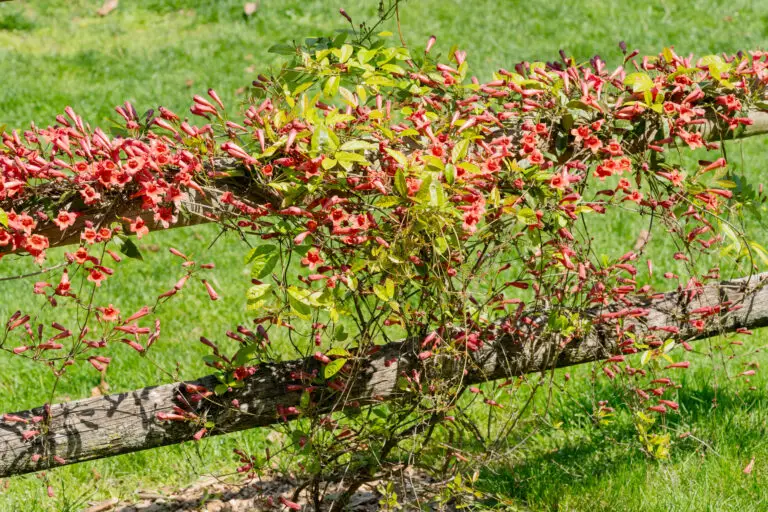
Trumpet vine (Campsis radicans) is a native vine that brings instant drama to any yard. With bright, trumpet-shaped blooms that quickly cover fences and trellises, it’s one of the easiest ways to add color and attract hummingbirds. This native vine is also as easy-going as it gets. Trumpet vine thrives in full sun to part sun, soil that is moist or dry, and even in clay. The main complaint you’ll hear is that it grows too fast! Pruning keeps it in check. In this article, we’ll cover what makes trumpet vine such an easy-going favorite, how to grow it successfully, and a few tips for keeping it in check.
Is trumpet vine right for my yard?
Plant it if…
- You want a dramatic, fast-growing native vine that brings hummingbirds.
- You have a fence, trellis, pergola, or sturdy structure that needs covering.
- You want a low-maintenance plant that will come back year after year, even if neglected.
- You’re comfortable with pruning. This plant gets big when it’s not kept in check. (No fancy tools required: all you’ll need is a $6 pair of clippers.)
- You have dry soil. Trumpet vine takes drought like a champion, so you can grow a lush vine without worrying about it shriveling in the summer.
- You want to support insects. Trumpet vine attracts bees and butterflies as pollinators while providing a habitat for ants.
Skip it if…
- You live in Rhode Island. Trumpet vine may be considered invasive in the state of Rhode Island, so consider planting a different vine.
- You want something well-behaved. This vine will spread and take over, so you’ll have to do some work if you want it to stay put.
- You don’t have a lot of space. Without space or proper support, trumpet vine can take over your garden and damage certain structures.
New to native?
Before lawns and landscaping, native plants were here. They’ve fed birds, bees, and butterflies for thousands of years—and they’ll do the same in your yard. The best part? They’re easier to grow than you think.
Where is trumpet vine native?
Trumpet vine is native to the eastern United States, as well as the Canadian province of Ontario. It can be found as far north as New York and as far south as Florida. Some sources, such as the USDA plant guide for trumpet creeper, also say it has naturalized in the New England states, as opposed to being native. It has also been introduced to some of the western United States as well. See the full range map at the USDA PLANTS Database.
Where is trumpet vine native?
Native to 29 US states, Washington, D.C., and 1 Canadian province (Ontario)
Source: USDA PLANTS Database
Is trumpet vine invasive?
Many gardeners warn against planting trumpet vine because “it’s invasive.” But here’s the truth:
Invasive = non-native + harmful.
Trumpet vine is native, so it’s not invasive.
The better word is aggressive. Trumpet vine spreads quickly and grows big; sometimes up to 30 feet in a single season once established. And a single plant can produce more than 1,000 seeds. Left on its own, it can easily take over.
However, there is a caveat to this. While right at home in some parts of North America, it has escaped cultivation in others. The Rhode Island Invasive Species Council listed trumpet vine in its 2020 list of invasive vines. According to this survey, trumpet vine is not native to Rhode Island, and it has been found in certain localized sites. While no state legislation includes trumpet vine as an invasive species, according to the invasive plant atlas, it is well-known to escape cultivation in certain areas of the United States. If you’re unsure of whether or not to plant it, we recommend contacting your local extension office. While that may seem intimidating, they’re full of plant nerds that want to help.
“
“It can be a lovely plant, as long as it always knows you're the boss.”
”
Why trumpet vine matters
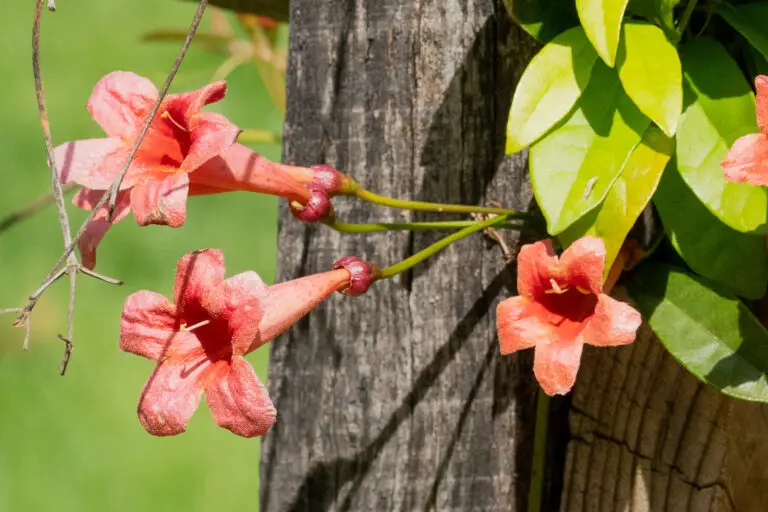
Trumpet vine may be called an aggressive vine, but this does not make it any less beautiful. The leaves are elegant, each leaflet tipped with a point like a feather quill. The flowers are dramatic and romantic, with clusters of orange trumpets forming a dense screen of color. The flowers first open around the start of summer and stay until fall, so your garden will stay bright all summer. This beauty attracts a variety of pollinators, from bees and butterflies to hummingbirds and even orioles.
Aside from attracting butterflies, trumpet vine is a larval host for the plebian sphinx moth (Paratrea plebeja). The caterpillars of this moth will hide on the underside of the leaves during the day, then come out during the night to feed. Its other host plants include passionflower (Passiflora) and lilacs (Syringa). If you have trumpet vine in your yard, you’ll have the opportunity to see these little caterpillars grow into big, beautiful moths. Pair it with coral honeysuckle (Lonicera sempervirens) to feed them as adults, too.
Trumpet vine also acts as a hotel for ants. Ants are attracted to the nectar of the flowers, living inside of them like a little hotel room. This relationship is referred to as myrmecophytic, which is a mutualistic relationship between a plant and an ant colony. You may hear that ants are living in these flowers and worry, but they’ll do no harm to your flowers. In fact, their presence may offer protection from herbivory.
Ruby-throated hummingbirds are trumpet vine’s primary pollinator
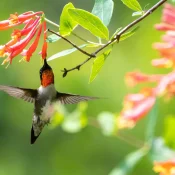
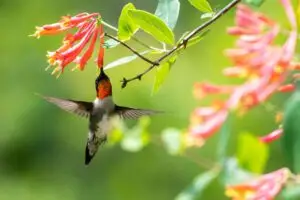
While bees and butterflies are also attracted to the nectar of trumpet vine, hummingbirds are who it was designed for. The ruby-throated hummingbird (Archilochus colubris) in particular has been observed visiting trumpet vine frequently. They collect the nectar by floral-diving, where they perch on a flower with their feet and stick their head into the flower. This is uncommon for hummingbirds, but the length of trumpet vine’s flowers makes it necessary. Unlike most hummingbird-pollinated flowers, which are the same length as a hummingbird’s beak, trumpet vine has much longer flowers. As such, the hummingbirds cannot hover while collecting nectar. When a hummingbird enters the flower, the pollen is dusted onto their head. It is then carried to the next flower, as ruby-throated hummingbirds will often visit multiple flowers at a time.
If you’ve ever wanted to catch a glimpse of a hummingbird, trumpet vine might just be your plant. The behavior of floral-diving leads them to stop for a moment; a perfect time for some amateur wildlife photography. No other plant has this relationship with hummingbirds.
How to grow trumpet vine
Where to plant
Full sun also leads to more flowers. It can live with some shade, but trumpet vine flowers best in bright sun. In terms of soil, on the other hand, this plant is not picky at all. If you have poor soil, such as an area suffering from high clay content and heavy compaction, trumpet vine is up for the challenge.
The most important thing is to give it support. Trumpet vine is a true climber. It needs a strong trellis, fence, pergola, or arbor to sprawl across. Avoid planting it directly against your house, since its aerial roots can cling tightly to walls. It also grows fast and can spread by suckers and underground runners. Plant it where it has room to roam. Otherwise, be ready to prune and pull unwanted shoots each year.
Spacing
Since it has a climbing habit, leaving trumpet vine space on the ground is not as important as it is with other plants. Giving it about 10 feet of space around the base will give it some room to grow and spread. When choosing your support, keep in mind that it can grow up to 30 feet long, so choose something large and sturdy. You can also allow it to creep across the ground for a shrubbier-looking plant.
Watering
Once established, trumpet vine is drought-tolerant and will thrive with little care. You can put the hose away; you won’t need it. Just plant it and forget about it.
When to plant
Early spring is the best time to plant trumpet vine. A fall planting can also work in warmer climates, but this plant is not especially cold hardy. You can also try seeding in fall. This will allow it to stratify, and its vigorous growth habit means it will quickly catch up to a larger plant.
Beginner Tip
Prune for control. Blooms form on new wood, so cut it back hard in late winter or early spring to encourage fresh growth and keep it manageable.
Potential challenges with trumpet vine
Structural damage
You might think that trumpet vine, with its dense blooms and large spread, would be a perfect way to cover that bland wall on the outside of your house. However, trumpet vine can actually damage your house. The suckers and rootlets it uses to climb can worm their way into little cracks and crevices, making them worse as it grows. What may have been a small crack in your siding could turn into a gaping hole. It can also get into your roof or foundation and cause damage there. Train trumpet vine on an arbor or trellis, not your home.
Contact dermatitis
Contact dermatitis refers to skin irritation that occurs when you touch certain parts of a plant. Think like poison ivy. Experts aren’t sure what the exact allergens in trumpet vine are, but the symptoms are well documented. Coming into contact with the sap of trumpet vine can cause redness, swelling, and an itching sensation. This is actually what gives it the common name of “cow-itch vine.” In order to protect yourself, be sure to wear gloves when pruning this plant and wash your hands after touching it.
Aggressive spreading
The biggest challenge you will encounter with trumpet vine is its aggressive spreading habit. It does this through two methods; prolific self-seeding and underground rhizomes. Trumpet vine can produce hundreds of seeds, with an average of 696 seeds in each pod. With that many seeds, a single trumpet vine can turn into a colony of many plants within a few years. However, trumpet vine can also overtake an area all on its own through the use of underground runners. These rhizomes, which are modified stem structures, spread underground and pop up several feet away. These new sprouts can appear in new areas of your garden without you even noticing.
However, you can keep trumpet vine in check by pruning. In the fall, you can prune it to stop seed spread. Trim vines after flowering so they don’t go to seed. In the spring, pruning provides a more abundant floral display. Trumpet vine flowers on new growth, so cutting it back hard means more flowers. As Katie Schmidt of the Dyck Arboretum in Kansas puts it, “To keep this thing [trumpet vine] in control means relentless pruning.” Or, as the New York Botanical Garden says, “It can be a lovely plant, as long as it always knows you’re the boss.”
If that’s not for you, can we recommend some other native vines?
What are some other native vines?
You’ve got quite a few options! Here are some others to consider:
Where trumpet vine shines in your yard
- Pollinator garden: Trumpet vine attracts a variety of pollinators, so pair it with some other pollinator plants to create a lively garden.
- Arbors and pergolas: Training trumpet vine along an arbor or pergola will allow it to form a dense thicket of green. In the summer, you can be surrounded by beautiful, colorful flowers.
- Trellises: A nice, sturdy trellis will give trumpet vine the freedom to climb and roam as it pleases.
- Hellstrip: As long as you can train it upward, it will thrive in a dry spot with minimal care. Since trumpet vine is a climber, it will take up very little space on the ground as long as it has somewhere to go.
- Difficult sites: Got poor soil? Trumpet vine doesn’t mind, so plant it somewhere dry and clay heavy to finally fill up that dead corner of your yard.
Trumpet vine cultivars
Trumpet vine naturally comes by a variety of colors, but there are many cultivars that offer red or yellow flowers. Other cultivars hope to slow the aggressive growth habit of this plant. Some of the most common cultivars are listed below:
- ‘Apricot’: A less aggressive cultivar that gets its name from the apricot-colored flowers.
- ‘Crimson Trumpet’: A cultivar with much redder flowers than the straight species.
- ‘Flava’: A cultivar with yellow flowers. It also has less of a suckering habit, so it is considered less aggressive than the straight species.
- ‘Praecox’: An earlier-blooming cultivar with “rich red blooms.”
Related Species
There is also another species of trumpet vine; the Chinese trumpet vine (Campsis grandiflora). This is actually one of the few occasions where the non-native vine is actually less aggressive than the native one. Unlike many other non-native vines coming from Asia, such as Chinese wisteria (Wisteria sinensis) and Japanese honeysuckle (Lonicera japonica), the Chinese trumpet vine is non-native, but not invasive.
It can also be hard to tell trumpet vine apart from other vines, especially when not in bloom. Many vines have oddly pinnate compound leaves, which refers to a collection of leaves (called leaflets) on a single leaf stalk. Here’s how to tell them apart:
- Chinese trumpet vine (Campsis grandiflora): This plant is less aggressive than our native trumpet vine, sending out less rootlets. It doesn’t grow as tall, with smoother leaves and showier flowers. We will always advocate for growing native plants, as non-natives like Chinese trumpet vine do not support local wildlife in the same way. However, you may encounter sources that recommend this as an alternative.
- Crossvine (Bignonia capreolata): The biggest way to tell crossvine apart from trumpet vine is the leaves. Though the flowers look similar, crossvine is evenly pinnate with two leaflets, while trumpet vine can have up to 13 leaflets. The leaves of crossvine also have much smoother edges.
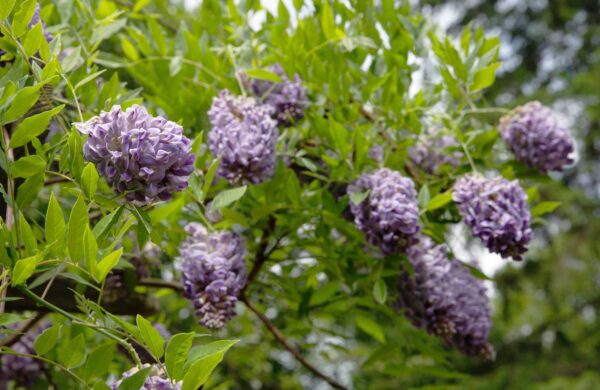
- American wisteria (Wisteria frutescens): When in flower, these two plants are easy to tell apart. However, there are still some differences that you can spot without the flowers. The most major difference is their growth habits. Trumpet vine is a clinging vine with aerial roots, while American wisteria is a twining vine that wraps counterclockwise around structures.
- Chinese wisteria (Wisteria sinensis): Many of the same tips as American wisteria can be used to tell Chinese wisteria apart from trumpet vine. However, Chinese wisteria also has alternately arranged leaves, where the leaves grow out of the stem on alternating sides. This plant is highly invasive, so you should try to remove or control it if you find it.
FAQs
Is trumpet vine poisonous to dogs or humans?
Trumpet vine does not show up on the ASPCA list of toxic plants, so it is considered a fairly safe plant for pets. However, this doesn’t mean it has no effect. In mammals, including humans and dogs, the sap can cause contact dermatitis, or skin irritation. It may cause redness and swelling, though generally not for longer than a few minutes. However, we recommend pruning with gloves to avoid this. And, of course, don’t eat it.
How many years does it take for a trumpet vine to bloom?
Trumpet vine can take several years to bloom. According to the Iowa State University Extension, it can take between 3 and 5 years after planting to flower for the first time.
Are hummingbirds attracted to trumpet vines?
Yes. Hummingbirds are actually the primary pollinators of trumpet vine, though they are not the only ones. You can tell by the tubular flowers and reddish color. If you have trumpet vine in your garden, expect to see some ruby-throated hummingbirds while it’s in bloom.
Does trumpet vine damage a house?
It absolutely can. The clinging roots it uses to latch onto surfaces it climbs can burrow into places it shouldn’t. Planting trumpet vine too close to the home can lead to damaged siding, roof tiles, and even your foundation.
Will trumpet vine destroy my fence?
It depends on what kind of fence you have. If your fence is sturdy and durable, like chain link or thick wood, it’s most likely fine to grow trumpet vine on it. However, if your fence is delicate or primarily decorative, we wouldn’t recommend planting trumpet vine nearby.
Another consideration when you’re deciding whether to plant it near a fence is your neighbors. The underground rhizomes of this plant can lead to trumpet vine popping up in your neighbor’s yard uninvited, which could be a problem.
Do deer eat trumpet vine?
Yes, but we wouldn’t worry about it. Trumpet vine grows very vigorously, so a bit of deer browse is unlikely to be a real problem. In fact, according to the Lady Bird Johnson Wildflower Center, it may even be a benefit. One of their experts, Guy Thompson, puts it best: “[Deer] love Trumpet creeper. Actually, that works out well, because Trumpet creeper tends to produce underground runners that send up shoots in areas where you don’t want them to be.”
Unless you’re actively trying to keep the deer away, you don’t have to worry about them becoming a problem. They might actually save you some work when pruning. Trumpet vine is vigorous enough that it won’t be bullied by a bit of herbivory.
A symbolic plant far from home.
Many of the most iconic plants that come to our minds are from elsewhere. Hybrid tea roses were first devised in France. The iconic saucer magnolia is a hybrid of two Chinese species. Easter lilies come from Japan. These old world plants are staples of our artistic culture, representing ideas of romance, noble intentions, or even religion. But sometimes, it can go the other way.
Trumpet vine is an example of this. While its medicinal use dates back hundreds of years, far before the first European contact, many other cultures worldwide have recognized it as an important plant. Across geographical regions, many have attributed healing or other magical properties to this plant. In China, for instance, the name “凌霄花 (ling xiao hua)” can be used to refer to both kinds of trumpet vine, C. radicans or C. grandiflora. In fact, C. radicans even appears in plant lists used in traditional Chinese medicine. The American trumpet vine is also used in folk medicine in Korea and India. Some cultures even use it for ceremonial purposes.
When we think of important plants in our global culture, we often look to the formal gardens of Europe or landscape paintings from Asia. However, our native plants hold their own in terms of cultural impact. Trumpet vine is one of them, becoming a medicinal and ceremonial plant hundreds of miles from home.
Where can I find trumpet vine?
We are not going to lie and say that finding native trumpet vine is going to be as simple as driving to your closest plant nursery. It might take a little extra energy to find this native gem, but it is worth it! Here are some recommendations for sourcing this native plant:
Where can I find seeds and plants?
Finding native plants can be challenging (we partly blame King Louis XVI.) To make it easier, we’ve assembled four sourcing ideas.
625+ native nurseries make finding one a breeze
Explore 100+ native-friendly eCommerce sites
Every state and province has a native plant society; find yours
Online Communities
Local Facebook groups are a great plant source
What pairs well with trumpet vine?
Pairings depend on the spot where it’s planted. For full-sun gardens, we recommend fall-blooming favorites to make your garden extra lively.


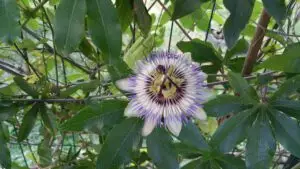
And that wraps up our beginner’s guide to trumpet vine. Yes, it’s a vigorous grower, but that’s not always a bad thing. Give it strong support and some space, and you’ll be rewarded with spectacular trumpet-shaped blooms that call in hummingbirds all summer long. Since it’s a perennial, you plant once and enjoy the show for years to come. Curious about more wildlife-friendly climbers? Check out our Beginner’s Guide to Coral Honeysuckle or our Beginner’s Guide to Passionflower Vine. Or plant a hummer paradise and read our What Are the Best Plants for Hummingbirds? Happy planting!
Sources
- American Society for the Prevention of Cruelty to Animals. “Toxic and Non-Toxic Plant List — Dogs.” aspca.org. Accessed July 18, 2026. https://www.aspca.org/pet-care/animal-poison-control/dogs-plant-list.
- Branhagen, Alan. Native Plants of the Midwest: A Comprehensive Guide to the Best 500 Species for the Garden. Portland, OR: Timber Press, 2016.
- Butterflies and Moths of North America. https://www.butterfliesandmoths.org/species_search. Accessed July 18, 2026.
- Chachalis D, Reddy KN. “Factors affecting Campsis radicans seed germination and seedling emergence.” Weed Science 48, no. 2 (2000): 212-216. https://doi.org/10.1614/0043-1745(2000)048[0212:FACRSG]2.0.CO;2.
- Charest, Alan. “Growing and Caring for Trumpet Vines.” garden.org. Accessed July 16, 2026. https://garden.org/learn/articles/view/1680/Growing-and-Caring-for-Trumpet-Vines/.
- Graves, Gary R. “Ornithophily in the Trumpet Creeper (Campsis radicans).” Ecology and Evolution 14, no. 9 (2024): 12, doi: https://doi.org/10.1002/ece3.70279. Accessed July 18, 2026.
- Graves, Keighly, Wendy Wilbur, Tom Wichman, Claire Lewis, Gail Hensen, and Ryan Klein. “Campsis radicans Trumpet Creeper, Trumpet Vine.” ask.ifas.ufl.edu. Accessed July 16, 2026. https://ask.ifas.ufl.edu/publication/FP099.
- Invasive Plant Atlas. “Trumpet Creeper.” invasiveplantatlas.org. Accessed July 16, 2026. https://www.invasiveplantatlas.org/subject.html?sub=5258.
- Iowa State University Extension and Outreach. “When does a trumpet vine bloom?” yardandgarden.extension.iastate.edu. Accessed July 18, 2026. https://yardandgarden.extension.iastate.edu/faq/when-does-trumpet-vine-bloom.
- JC Raulston Arboretum. “Campsis radicans.” jcra.ncsu.edu. Accessed July 16, 2026. https://jcra.ncsu.edu/horticulture/plant-profiles/details.php?ID=45.
- Killi, Uday Kumar, Matěj Malík, Zdeňka Navrátilová, et al. “Exploring the Biomedical Applications of Campsis radicans (woody vine): integrating traditional wisdom and Contemporary Insights.” Phytochem Rev 24, 3101–3117 (2025). https://doi.org/10.1007/s11101-024-10018-0. Accessed July 18, 2026.
- Lady Bird Johnson Wildflower Center. “Ask Mr. Smarty Plants: Friday – July 12, 2013.” wildflower.org. Accessed July 18, 2026. https://www.wildflower.org/expert/show.php?id=9626&frontpage=true.
- Lady Bird Johnson Wildflower Center. “Campsis radicans (Trumpet Creeper).” wildflower.org. Accessed July 15, 2026. https://www.wildflower.org/plants/result.php?id_plant=cara2.
- Missouri Botanical Garden. “Campsis radicans ‘Apricot.’” missouribotanicalgarden.org. Accessed July 16, 2026. https://www.missouribotanicalgarden.org/PlantFinder/PlantFinderDetails.aspx?taxonid=265476&isprofile=1&adv=campsis%20radicans.
- Native Plant Trust. “Campsis radicans – Trumpet Creeper.” gobotany.nativeplanttrust.org. Accessed July 15, 2026. https://gobotany.nativeplanttrust.org/species/campsis/radicans/.
- New York Botanical Garden. “Are Trumpet Vines Invasive in the Middle Hudson Valley? – NYBG Mertz Library Reference.” Nybg.org, May 12, 2025. https://libanswers.nybg.org/faq/223397.
- North Carolina State Extension. “Campsis grandiflora.” plants.ces.ncsu.edu. Accessed July 16, 2026. https://plants.ces.ncsu.edu/plants/campsis-grandiflora/.
- North Carolina State Extension. “Campsis radicans.” plants.ces.ncsu.edu. Accessed July 15, 2026. https://plants.ces.ncsu.edu/plants/campsis-radicans/.
- North Carolina State Extension. “Wisteria frutescens.” plants.ces.ncsu.edu. Accessed July 16, 2026. https://plants.ces.ncsu.edu/plants/wisteria-frutescens/.
- North Carolina State Extension. “Wisteria sinensis.” plants.ces.ncsu.edu. Accessed July 16, 2026. https://plants.ces.ncsu.edu/plants/wisteria-sinensis/.
- Palazzola, Elizabeth, John Bradtke, and Robyn J. Burnham. “Campsis radicans.” climbers.lsa.umich.edu. Accessed July 16, 2026. https://climbers.lsa.umich.edu/campsis-radicans/.
- Rhode Island Invasive Species Council “ Invasive Plants in Rhode Island – 2020.” rinhs.org, 2021. Accessed July 15, 2026. https://rinhs.org/wp-content/uploads/2021/10/Invasive-and-Weedy-Plants-in-RI-2020_-FINAL.pdf.
- Schmidt, Katie. “Plant Apologies: Campsis radicans – Dyck Arboretum.” Dyck Arboretum, April 5, 2023. https://dyckarboretum.org/plant-apologies-campsis-radicans/.
- Tilly, Nikki. “Trumpet Vine Care – How to Grow Trumpet Vines in the Garden,” gardeningknowhow.com, May 14, 2021. https://www.gardeningknowhow.com/ornamental/vines/trumpet-vine/growing-trumpet-vines.htm.
- University of Connecticut. “Campsis radicans.” plantdatabase.uconn.edu. Accessed July 16, 2026. https://plantdatabase.uconn.edu/detail.php?pid=79.
- USDA PLANTS Database. “Campsis radicans (L.) Seem. ex Bureau Trumpet Creeper.” plants.usda.gov. https://plants.sc.egov.usda.gov/plant-profile/cara2. Accessed July 15, 2026.
- US Forest Service. “Invasive Plants.” fs.usda.gov, 2025. https://www.fs.usda.gov/wildflowers/invasives/index.shtml.
- Wennerberg, Sarah. “Trumpet Creeper Plant Guide.” plants.sc.egov.usda.gov. https://plants.sc.egov.usda.gov/DocumentLibrary/plantguide/pdf/pg_cara2.pdf. Accessed July 15, 2026.
Other native vines

Written by
Emily Lessard
Founder & Editor, The Plant Native
Emily Lessard is the founder and editor of The Plant Native, the site that helps homeowners across North America get started with native plants. She holds a Sustainable Landscapes certificate through the Pennsylvania Landscape & Nursery Association, is finishing a Native Perennial Garden Design Certificate at Temple University, and is the author of Plant Native: A Practical Guide to Over 100 Native Plants of North America (Quarto, February 2027). She gardens outside Philadelphia in the 8.3 Southeastern Plains ecoregion.
Written by
Kat William Hiland
Contributor, Horticultural Therapist In-Training
Kat (or Liam) is a native Ohioan transplanted to Philadelphia for school. Their interest in native plants began with a fascination with floral symbolism. They discovered their love of horticulture in high school, and are now studying it at Temple University after a two year vocational program. Their favorite flower is any species of magnolia.