Do you need a tree that will grow quickly, to provide shade, a windbreak, or privacy? Here are 15+ native trees that will fill out fast, while providing benefits to native wildlife—and being adapted to local conditions.
All of these trees are native to North America and will grow at least two feet per year, and sometimes more. Scroll on to meet them.
What are fast-growing native trees?
Whether you’re looking to quickly green up a yard, provide shade to cool down a building, or block an unwanted view—you’ve come to the right place. Trees are a perfect choice.
A tree will pay back its costs quickly. It will provide free shade, noise reduction, and a dose of the peacefulness that can only come from watching leaves dance in a breeze.
And when you choose a native tree, it’ll also be adapted to local conditions, making it lower-fuss than many other options, and provide benefits for the local native wildlife and ecosystem.
But when you go to the big garden centers, you’ll wind up looking at a lot of non-native options. So we put together this guide to help you find exactly the right tree for your needs.
New to native?
Before lawns and landscaping, native plants were here. They’ve fed birds, bees, and butterflies for thousands of years—and they’ll do the same in your yard. The best part? They’re easier to grow than you think.
Here are 15 native trees that will grow at least two feet per year, and sometimes more. (Most of them grow fast when young, then slow down as they mature.)
First, let’s start with a group of trees that grow fast and have options for all of North America: birches.
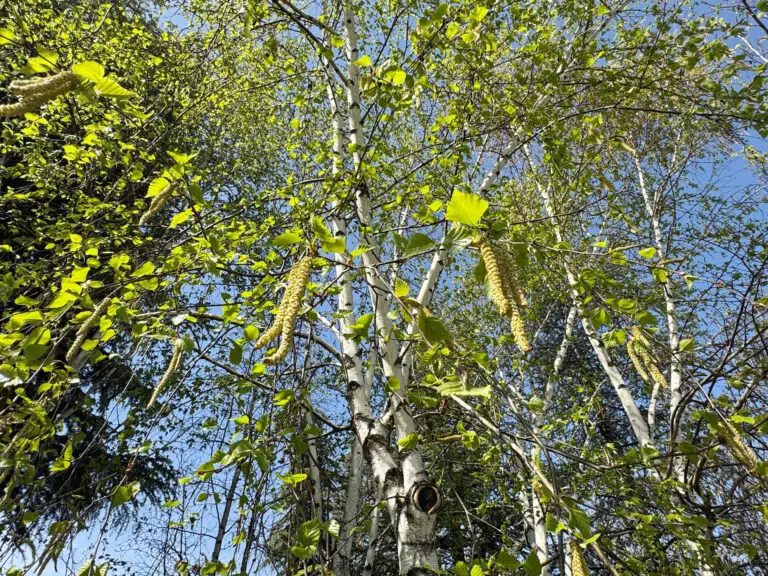
Birch
Birches are gorgeous trees, with white or silver bark that peels strikingly and looks great in every season. Prince Maximillian called river birch “the most beautiful of American trees.”
Native birches for North America include:
- River birch, which grows almost everywhere east of the Rockies
- Paper birch, which is native to the northern half of North America
- Yellow birch, which is native to the Northeast, the Great Lakes region, and along the Appalachians
- Sweet birch, which is native to the Northeast and down along the Appalachian Mountains
All birches are very fast growers. But you may want to note they are not long-lived trees; compared to others on this list, they rarely live more than 100 years.
🦋 Number of Native Pollinator Species Supported: 284
Read more in our Beginner’s Guide to Native Birches.
Now, let’s introduce other fast-growing native trees for your region. Let’s start on the East Coast and shift westward.
Northeast, Mid-Atlantic, & Midwest
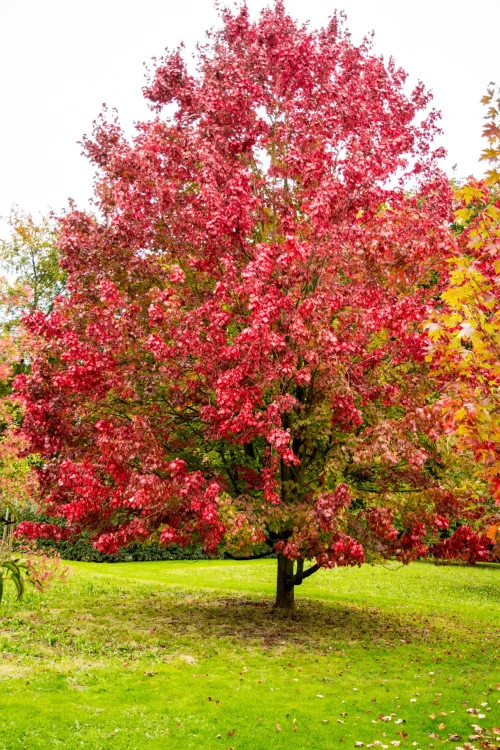
Red Maple
Acer rubrum
This fast-growing, handsome tree has deep green leaves and lovely red or yellow fall color. The small reddish spring flowers are valuable for early pollinators. It’s native to all of the East and most of the Midwest, which means that it’s not picky about soil conditions; it’s happy to grow in soil that’s sandy, clay, dry, wet, or even compacted.
With such a wide range, it can be useful to find trees that are sourced from local seeds, so that they’re adapted to your area (Florida conditions are very different from Maine’s!) But don’t worry too much if you can’t—this is a very adaptable tree.
Part to full shade
40-80 feet tall
See native range >
🦋 Number of Native Pollinator Species Supported: 238
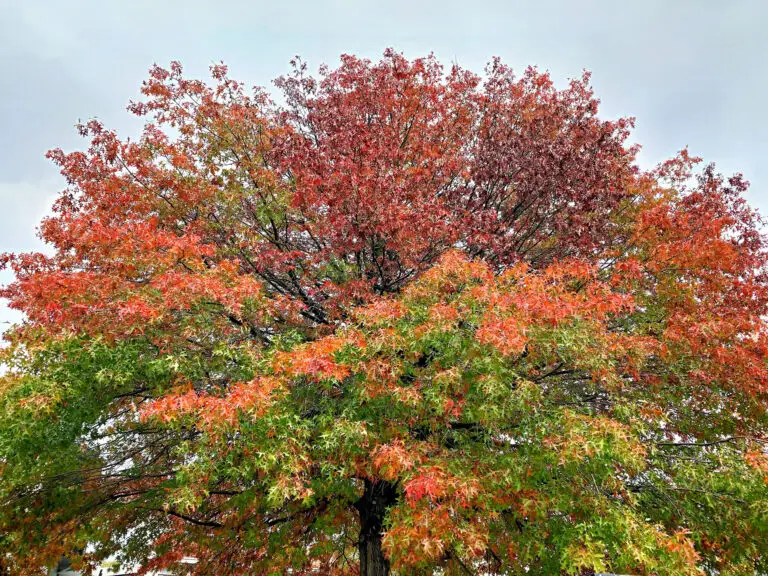
Scarlet Oak
Quercus coccinea
People sometimes think of oaks as slow-growing, but oaks in the red oak family actually grow quite fast: up to two feet per year. Scarlet oak is known for its lovely red fall color, and is a keystone plant for North America, hosting hundreds of native pollinators. There are few things you can do that are more valuable than planting a native oak.
50-80 feet tall
Full sun to part shade
See native range >
🦋 Number of Native Pollinator Species Supported: 436
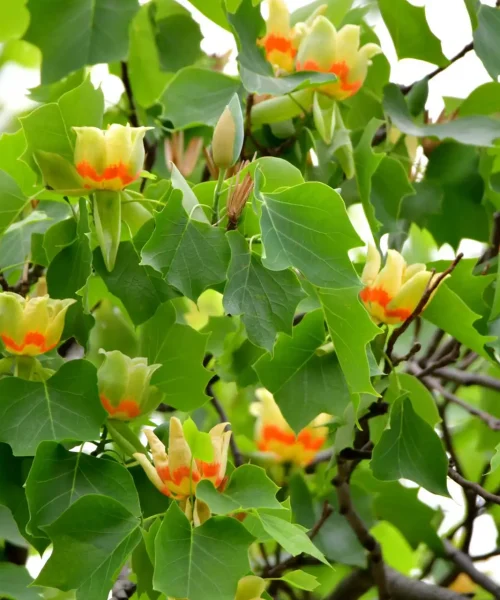
Tulip Poplar
Liriodendron tulipifera
This tree is well named—its big green leaves are shaped like tulips, and it has vase-shaped yellow flowers in the spring. Then, in the fall, the leaves turn a lovely clear yellow. It’s native to most of the East and is an important host plant for many native butterflies, including the beautiful tiger swallowtail, spicebush swallowtail, and tulip silk moth.
Tulip poplar grows very quickly, and will eventually reach a height of 70-100 feet. If you need a smaller tree, though, you can also look for smaller cultivars, like ‘Little Volunteer,’ which only tops out at 35 feet. Read more in our Beginner’s Guide to Tulip Poplar.
35-90 feet tall
Full sun to part shade
See native range >
Can’t find any of these?
Other fast-growing trees for Eastern North America and the midwestern United States include American sycamores, catalpas, Eastern cottonwoods, Box Elder, quaking aspen, and native willows such as pussy willow and black willow.
Living in the South? Here are some native trees built for southern heat.
South + Southeast
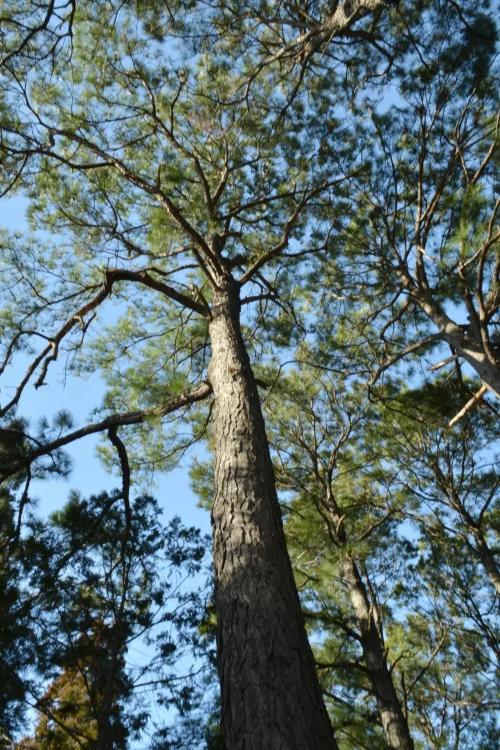
Loblolly Pine
Pinus taeda
The magnificently named Loblolly pine has nice shaggy bark and long slender needles. It is the fastest-growing of all pines, topping out at 60 to 90 feet if it’s happy.
Loblolly is a host plant for native moths and butterflies, including the majestic Imperial Moth and the pretty eastern pine elfin butterfly. It prefers medium to wet soils in full sun.
60-90 feet tall
Full sun
See native range >
🦋 Number of Native Pollinator Species Supported: 200

Southern Hackberry
Celtis laevigata
This tough tree is often planted because it can withstand lots of things thrown at it—salt, pollution, occasional flooding or drought, and even that dreaded killer of many trees, compacted soil. It’s also a good tree for wildlife, supporting many butterflies in their caterpillar stage and feeding birds with its tiny seeds (it’s sometimes called Sugarberry).
50-80 feet tall
Full sun to part shade
See native range >
🦋 Number of Native Pollinator Species Supported: 12+ butterflies
Can’t find any of these?
Other fast-growing trees for the South and Southeastern United States include American sycamores, Southern catalpas (a.k.a. catawbas), sweetbay magnolias, Eastern cottonwoods, box elder, or native willows such as black willow or Carolina willow.
Mountain West
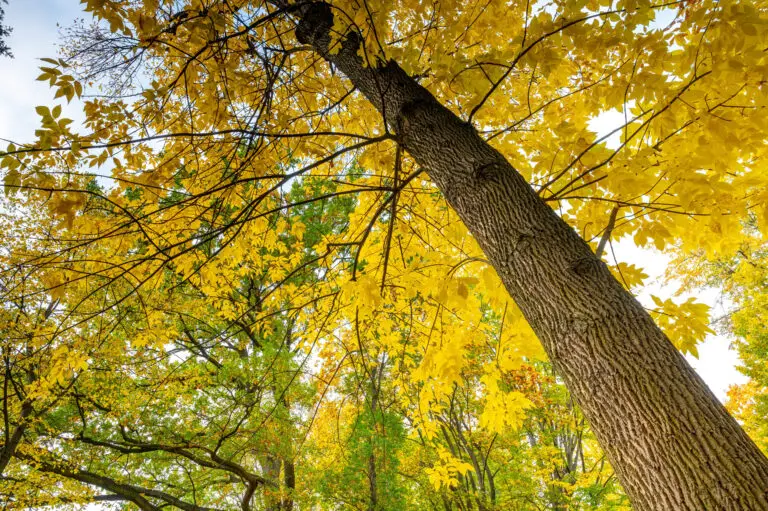
Balsam Poplar
Populus balsamifera ssp. balsamifera
Balsam poplar shoots up fast, growing up to several feet per year. It has pretty, reflective leaves that usually turn yellow in the fall. It’s known as a keystone plant, supporting many native pollinator species, and has scented resin that is sometimes used in balms or ceremonies.
Balsam poplar is native to the northern parts of the Mountain West, including Colorado, Wyoming, and Montana. It loves full sun and water, though it’ll become drought-tolerant as it grows older.
50-100 feet tall
Full sun
See native range >
🦋 Number of Native Pollinator Species Supported: 197
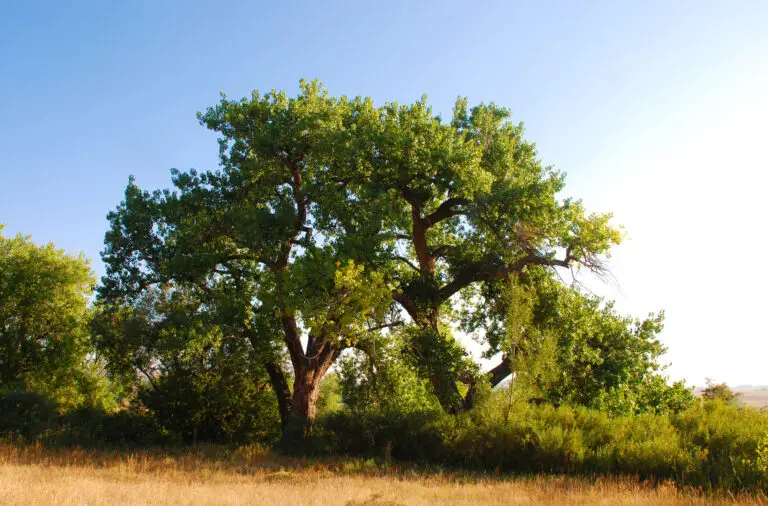
Cottonwood
With deeply grooved bark and knobbly branches, cottonwoods are very handsome trees. Their leaves flutter in even the slightest breeze—making a lovely soft rustle, and giving you a flash of the silver undersides. In fall, it has golden yellow color.
Cottonwood quickly grows and provides a welcome breath of shade in scorching summer temperatures. Al Schneider writes, “All hikers know it as body-saving relief from the unbroken sun of southwest summers.” Wildlife loves it too—it’s an important plant for species from birds to porcupines.
You may have to water this tree while it’s getting established—in the wild, you’ll often see it along streams—but it’ll be drought-tolerant as it gets older.
Note: There are several subspecies of cottonwoods, and it can be helpful to look for a tree that came from wild populations near you.
- In the Great Plains, look for plains cottonwood (you can search for its Latin name, Populus deltoides ssp. monilifera)
- Fremont cottonwood (Populus deltoides spp. fremontii) grows in California, Nevada, and Arizona
- Rio Grande cottonwood (Populus deltoides spp. wislizeni) grows in New Mexico, Utah, Arizona, Colorado, and southwestern Texas
50 feet tall
Full sun to part shade
🦋 Number of Native Pollinator Species Supported: 377
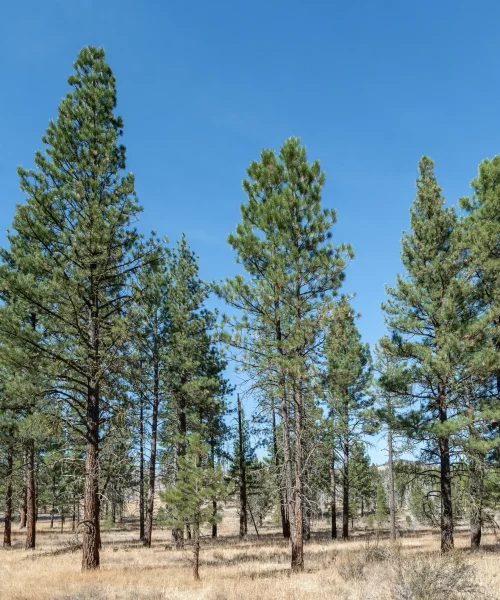
Ponderosa Pine
Pinus ponderosa
You may have smelled this magnificent pine when hiking in the West—it has a distinctive butterscotch or vanilla scent when it’s older. It doesn’t grow quite as fast as some others on this list, but it’s also very tolerant of drought, elevation, and cold. Ponderosa pine can live to hundreds of years old and is a great tree for birders: many songbirds love the seeds, including chickadees, finches, evening grosbeaks, and nuthatches.
There are several subspecies of this tree, so it can be helpful to look for trees descended from wild populations near you. You’ll need a sunny spot—it’s very intolerant of shade.
50-150+ feet tall
Full sun
See native range >
🦋 Number of Native Pollinator Species Supported: 235
Can’t find any of these?
Other fast-growing trees for this area include: quaking aspen, box elder, or native willows such as Booth’s willow or peach-leaf willow.
Southwest
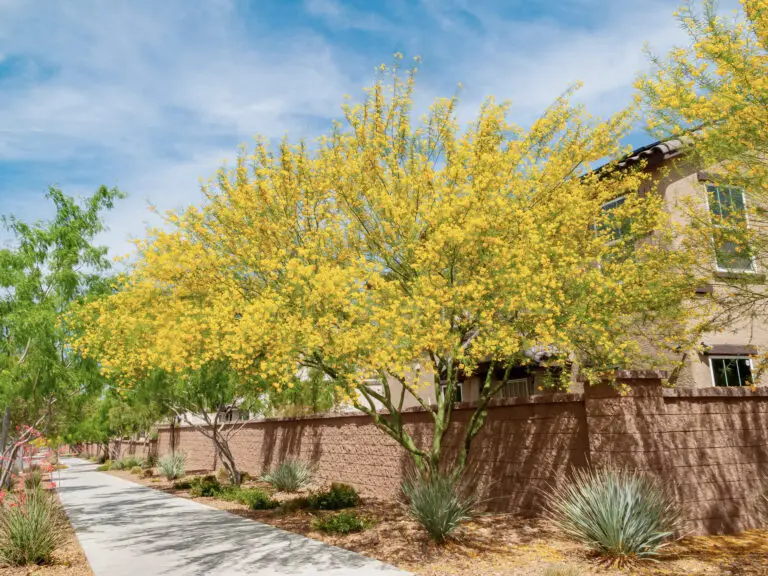
Blue Palo Verde
Parkinsonia florida
This pretty tree is native to the Sonoran Desert, so you know it’s extremely drought-tolerant. It has bright yellow flowers in the spring or after a summer rain, but its green bark makes it eye-catching year round. Palo verdes are very important trees for wildlife in the desert, creating shelter for animals and other plants.
These are moderately fast-growing but not extremely long-lived trees, often living to about 50 years old.
30-40 feet tall
See native range >
Read our Blue Palo Verde Profile.
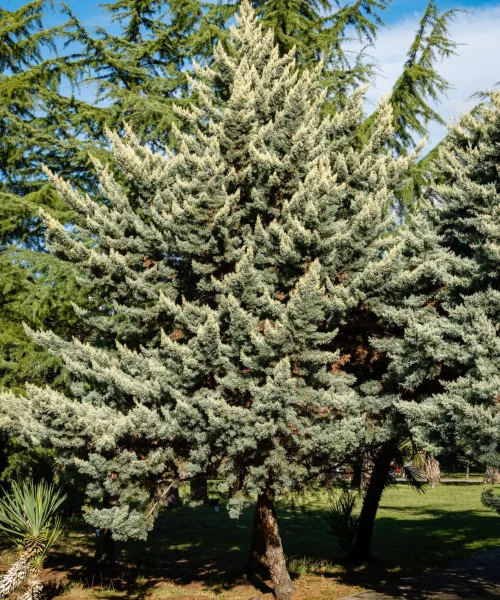
Arizona Cypress
Hesperocyparis arizonica or Cupressus arizonica
A beautiful gray-green evergreen tree with a pyramidal shape, Arizona cypress is native to the Southwest, but it’s hardy down to 0° Fahrenheit. It’s a fast-growing tree that is often used for windbreaks and privacy screens because the branches tend to grow very densely.
Because of its popularity, there are several cultivars (variations selected for unusual traits), such as ‘Carolina Sapphire,’ ‘Blue Ice,’ and ‘Blue Steel,’ which have blue-green foliage. They are all very drought-tolerant, and all need to grow in full sun.
Full sun
20-40 feet tall
See native range >
What are fast-growing native evergreen trees?
- Eastern U.S., look for Eastern white pine if you’re in the north and loblolly pine if you’re further south.
- Pacific West, look for coastal Douglas fir.
- Southwest gardens look for Arizona cypress.
How can I make a tree grow faster?
In its first year or two after transplanting, watering a tree regularly will help it get its feet (OK, roots) under it quickly. The best way to water a tree is deeply and slowly—leave a hose running at a low drip for several hours. Just make sure it doesn’t sit around in standing water for days.
Where can I find these native trees?
It’s true that it’s not always as easy as it should be to find native species. If you’re having trouble, we’ve put together a handy list of resources to help.
Where can I find seeds and plants?
Finding native plants can be challenging (we partly blame King Louis XVI.) To make it easier, we’ve assembled four sourcing ideas.
625+ native nurseries make finding one a breeze
Explore 100+ native-friendly eCommerce sites
Every state and province has a native plant society; find yours
Online Communities
Local Facebook groups are a great plant source
We hope you’ve enjoyed this tour through a few of North America’s best fast-growing trees for gardens and yards. Whether you’re looking for a windbreak, a privacy screen, shade, or noise blocking, there are tons of wonderful options that are also adapted to our conditions and provide benefits to native wildlife.
If you want to learn about fast-growing native plants for privacy but don’t need them to grow as high as trees, check out our guide to native plants (including grasses and shrubs) to block a view. And if you think your yard would look perfect with a native tree out front, visit our guide to native trees for front yards. Happy planting!
Sources
- Pacific Northwest Native Plants, Big-Leaf Maple, Acer macrophyllum
- U.S. Forest Service, Pseudotsuga menziesii var. menziesii
- North Carolina Extension, Acer rubrum (Carolina Maple, Red Maple, Scarlet Maple, Soft Maple, Swamp Maple)
- North Carolina Extension, Quercus rubra (American Red Oak, Eastern Red Oak, Mountain Red Oak, Northern Red Oak, Oaks, Red Oak)
- North Carolina Extension, Quercus coccinea (Black oak, Scarlet oak)
- North Carolina Extension, Betula nigra (Black Birch, Red Birch, River Birch, Water Birch)
- North Carolina Extension, Betula papyrifera (Canoe Birch, Kenai Birch, Mountain Paper Birch, Paperbark birch, Paper Birch, White Birch)
- North Carolina Extension, Betula alleghaniensis (Golden Birch, Swamp Birch, Yellow Birch)
- Celtis laevigata (Hackberry, Southern Hackberry, Sugarberry, Sugar Hackberry)
- Nebraska Forest Service, Pine, Ponderosa
- Calscape, red willow
- Calscape, Black Elderberry
- Calscape, Blue Palo Verde
- Calscape, black cottonwood
- University of Minnesota Urban Forestry Outreach, Balsam Poplar – Populus Balsamifera
- Missouri Botanical Garden, Populus deltoides
- Southwest Colorado Wildflowers, Populus deltoides
- U.S. Forest Service, Species: Populus deltoides
- Colorado Tree Coalition, plains cottonwood
- Arizona Native Plant Society, Palo Verde: Arizona State Tree
- Butterflies and Moths of North America, Lorquin’s Admiral Limenitis lorquini
- Butterflies and Moths of North America, Eastern Tiger Swallowtail Papilio glaucus
- Butterflies and Moths of North America, Compton Tortoiseshell Nymphalis vaualbum