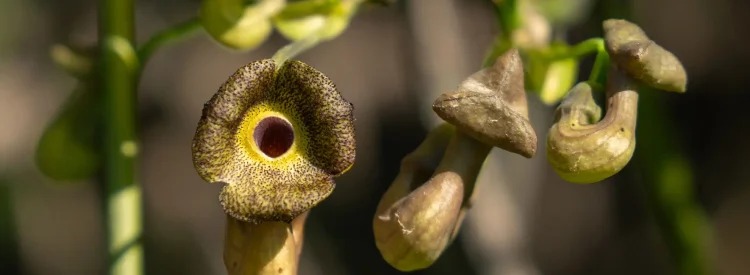
Dutchman’s pipe is a big, bold vine with enormous heart-shaped leaves that overlap to create dense, lush cover. In late spring, funny pipe-shaped flowers appear, though they’re often hidden by foliage. This vine thrives in part shade with consistent moisture, making it perfect for that tricky north-facing fence or shaded area. It’s one of the essential host plants for the pipevine swallowtail butterfly, so if you plant it, you’ll be helping to keep those iridescent blue beauties alive. Once established, it’s low-maintenance, deer-resistant, and grows fast enough for you to focus on other things.
Is Dutchman’s pipe a good choice for my yard?
Yes, if…
- You have a sturdy structure that needs covering: arbor, pergola, fence, or large trellis
- You can provide consistent moisture, especially during the first year or two
- You want fast, dense coverage that creates shade and privacy
- You’re looking for something deer won’t touch
- You have a partly shaded spot where other plants struggle
Skip it, if…
- Your site is hot, dry, and exposed
- You don’t have something sturdy for it to climb
- You want flowers that steal the show
- You need something that looks good immediately (it takes 2-3 years to really take off)
Why Dutchman’s pipe matters
Pipevine swallowtail butterflies (Battus philenor) can only survive on native Aristolochia species—and Dutchman’s pipe is one of their primary host plants in the eastern U.S. Caterpillars eat the leaves and absorb compounds that make them toxic to birds, a protection that lasts into adulthood. (Milkweed provides monarchs with similar toxic superpowers.) Other butterflies, including the spicebush swallowtail and red-spotted purple, have evolved to mimic their coloring just to borrow that “don’t eat me” signal.
The flowers serve a purpose too: they attract small flies that pollinate them. And those big overlapping leaves provide cover for birds and beneficial insects.
Historically, Dutchman’s pipe was a front-porch staple in the 1800s and early 1900s, shading verandas before air conditioning existed. Bringing it back isn’t just good for butterflies. It’s a return to practical, beautiful landscaping.
Where is Dutchman’s pipe native?
This vine is native to the Appalachian region from Pennsylvania south to Georgia and Alabama, including parts of Kentucky, Maryland, North Carolina, South Carolina, Tennessee, Virginia, and West Virginia.
A note on relatives:
There are several native pipevines. If you’re outside this native range, check whether Dutchman’s pipe or another native pipevine species is a better fit for your region. Some other pipevine options include:
- In the Midwest, woolly pipevine (Aristolochia tomentosa)
- In California, try California pipevine (A. californica)
Choosing the species native to your specific area gives local wildlife the best support.
Dutchman’s pipe throughout the seasons
Winter
Deciduous and dormant. The twining woody stems add architectural interest, becoming thick and rope-like on mature plants.
Where Dutchman’s pipe shines in your yard
Dutchman’s pipe excels at covering sturdy structures. Train it over an arbor or pergola for a living roof of shade, or let it climb a fence once established. Those overlapping leaves create solid coverage. It’s also a great solution for a dead tree, transforming it into a butterfly habitat.
This vine thrives where others struggle. A west-facing porch gets the classic treatment (this was the original Victorian use), while a shady north-side spot finally has a vine that won’t disappoint. Plant it near a patio or window where you can watch pipevine swallowtails up close.
A planting note: bring some patience (and be OK with nibbles)
Dutchman’s pipe takes 2-3 years to really get going, so be patient and keep watering. Once established, though, it grows vigorously and can use annual pruning to stay in bounds. This vine also needs consistent moisture and will sulk in dry conditions. If your site is drought-prone, choose a different plant or commit to supplemental watering.
The pipe-shaped flowers are often hidden by foliage and emit a faint carrion scent to attract fly pollinators. You probably won’t notice unless you stick your nose in one. And yes, caterpillars will eat some of the leaves. That’s the point! A healthy vine can handle it. If you want pristine foliage or pretty flowers, this is not your plant.
Those flowers are actually insect traps.
Those weird pipe-shaped flowers are actually sophisticated insect traps. The flower’s interior is lined with specialized hairs that point downward, letting small flies slide in easily but preventing escape. The flies get trapped during the flower’s female phase, bumbling around and depositing any pollen they’re already carrying. Then the flower shifts to its male phase: the hairs wilt, the anthers release fresh pollen, and the fly escapes, now dusted with pollen to carry to the next flower.
Aristolochia is one of the first flowering plant lineages to evolve this trap-and-release pollination mechanism. The flowers even emit a faint carrion-like scent to lure their fly pollinators.
Where can I find Dutchman’s pipe?
This beautiful native vine might be a little bit of a challenge to find, especially at conventional nurseries. We have a solution: visit a native nursery! Our 400+ native nursery guide helps set you up for success.
What are good pairings for Dutchman’s pipe?
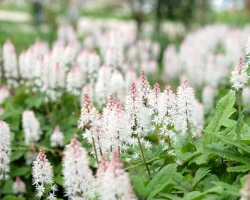
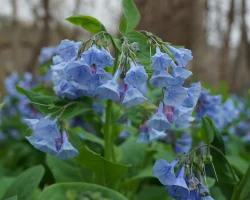
Pair it with other shade-tolerant, moisture-loving natives. Wild ginger is a close relative that makes great groundcover, and Christmas fern, foamflower, Solomon’s seal, and native sedges all thrive in similar conditions. Virginia bluebells add spring color before the vine leafs out, while wild geranium and Jacob’s ladder fill in the mid-layer. For nectar sources for adult pipevine swallowtails, add Joe Pye weed, ironweed, native phlox, or thistle in a nearby sunny spot.
Dutchman’s pipe isn’t flashy, but it’s irreplaceable. Plant it on a sturdy arbor, keep its roots moist, and give it a couple of seasons. You’ll be rewarded with a lush green curtain of heart-shaped leaves and, if you’re lucky, a front-row seat to one of the most beautiful butterflies in North America raising its next generation. For more, check out our guide to native plants for butterflies or learn why native plants matter. Happy planting!