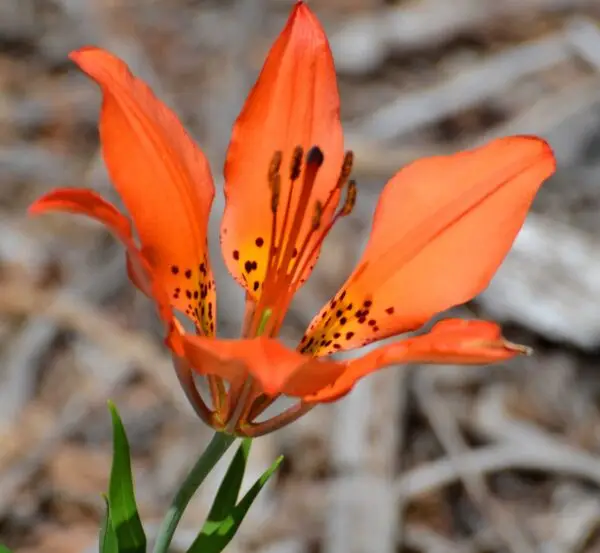
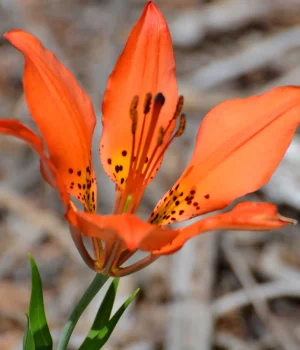
Wood lily is one of those native plants that makes you wonder why anyone bothers with non-native daylilies. It’s a true North American lily with fiery orange-red flowers that face straight up toward the sky, spotted with dark freckles at the base of each petal. At 1 to 3 feet tall, it fits easily into the front or middle of a garden bed. If you live in the eastern half of the continent, there’s a good chance this plant evolved in your neighborhood.
Head to the complete guide for planting basics, species comparisons, and beginner-friendly tips.
Is wood lily right for my yard?
Plant it if…
You want to replace non-native daylilies with something that actually belongs here. Wood lily blooms at a similar time, brings brighter color, and feeds butterflies and hummingbirds in a way that most daylily cultivars simply don’t.
You have a sunny or partly sunny spot with well-drained soil. Wood lily doesn’t need a lot of fussing. Give it decent drainage and some sun and it’ll do the rest.
You want something manageable. At 1 to 3 feet, wood lily won’t take over a border or block the view. It’s a well-behaved garden citizen.
You want to grow something with real history. Indigenous peoples across North America harvested wood lily bulbs for food and medicine for thousands of years. Planting one connects your garden to a very long story.
New to native?
Before lawns and landscaping, native plants were here. They’ve fed birds, bees, and butterflies for thousands of years—and they’ll do the same in your yard. The best part? They’re easier to grow than you think.
Your soil stays wet. Wood lily needs good drainage. Soggy soil will rot the bulbs. If you have a damp, low-lying spot, look at Turk’s cap lily instead.
You have heavy deer pressure and no way to protect young plants. Deer browse wood lily, and in some parts of the East, deer have helped push wild populations into decline.
You want a tall, dramatic background plant. Wood lily is beautiful but compact. For height, pair it with taller natives behind it.
Where is wood lily native?
Native to 36 US states, Washington, D.C., and 6 Canadian provinces (Alberta, British Columbia, Manitoba, Ontario, Quebec, Saskatchewan)
Most lilies hang their flowers downward to protect the pollen from rain. Wood lily does the opposite. Its flowers face straight up, like little orange cups, presenting their pollen and nectar to the sky.
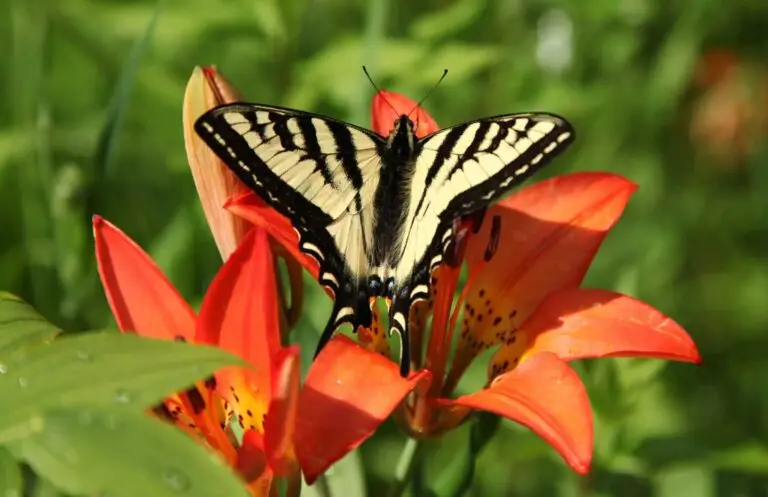
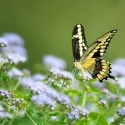
The upward-facing flowers are an adaptation for butterfly pollination. When a swallowtail lands on the open flower, its wings press against the pollen-bearing anthers, picking up pollen as it feeds. The shape of the flower is designed for that exact moment.
Food for the summer gap
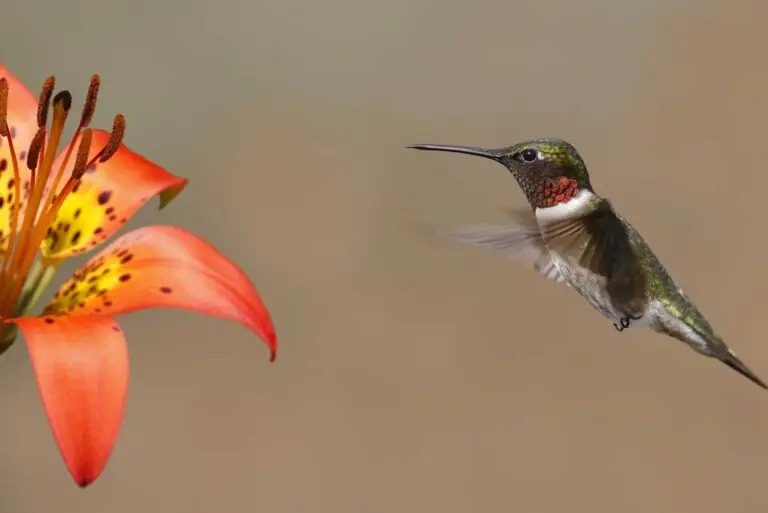
Wood lily blooms in early to midsummer, and the Morton Arboretum lists an impressive guest list: swallowtail butterflies, monarchs, great spangled fritillaries, hummingbirds, and native bees. That’s a lot of visitors for a diminutive 1-to-3-foot plant. Having something that feeds pollinators during the summer months, when many spring-blooming plants are done, makes a real difference in a garden ecosystem.
A plant in decline
Here’s a reason to plant it beyond beauty: wood lily is disappearing in parts of its range. NC State Extension notes that it’s listed as endangered in Maryland, New Mexico, Tennessee, North Carolina, and Ohio. The culprits are deer browsing, habitat loss, and people picking the flowers. Every wood lily planted in a garden is one more in the ground.
Hummingbirds love the nectar in Wood Lilies, too!
How to grow wood lily
What to plant
Bulbs or potted plants from a native plant nursery are your best bet.Prairie Moon Nursery offers both bare-root bulbs and seeds. Growing from seed requires cold stratification and patience, so bulbs or nursery-grown plants will get you blooms much sooner.
When to plant
The NC State Extension recommends planting in early spring or fall. Plant the bulb to a depth of about twice the bulb’s height. Get it in the ground before it dries out.
Where to plant
Full sun gives the best blooms, but part shade works too. The most important factor is drainage. Wood lily cannot sit in wet soil. Sandy or loamy ground in a sunny meadow, a border edge, a prairie garden, or an open woodland clearing are all good choices. Avoid low spots where water collects.
Garden Recipe™
Wood Lily
Lilium philadelphicum
Sun to part sun
Sun
Pretty easy
Effort
Short (under 3') tall 0.5-1 ft wide
Size
Summer
Blooms
What it needs
Sunlight
Full to partial sun, 4+ hoursThe more sun the better, but it can handle some shade
Water
Not pickyAverage garden conditions work fine
Directions
Spacing
8-12 inTuck them in close for a full look
Watering
Weekly for the first seasonAfter that, rain is usually enough
Notes
Comes back?
Yes, every yearGoes dormant in winter, that's normal. New growth each spring.
Native plant. This is a native plant, which means local wildlife already knows what to do with it. Just by planting it, you're giving your little corner of the ecosystem a boost.
How to plant
Plant bulbs about 4 inches deep and 6 to 12 inches apart. Water in well, then let the soil drain. A thin layer of mulch helps retain some moisture without keeping things too wet. Don’t overdo it.
Soil
Well-drained and slightly acidic to neutral (pH 5.5 to 7.5). Sandy loam is ideal. If your soil is heavy clay, work in compost to improve drainage before planting. The PFAF database notes that wood lily can handle light, medium, or heavy soils as long as drainage is good.
“
If you’re pulling out non-native daylilies and want a native substitute that blooms at the same time, wood lily is your answer. Shorter, fiercer, and feeding wildlife.
”
Where wood lily shines in your yard
Front or middle of a border: At 1 to 3 feet, wood lily is the right height for the front half of a native plant bed. Its upward-facing flowers are especially effective when you can look down into them from a path or patio.
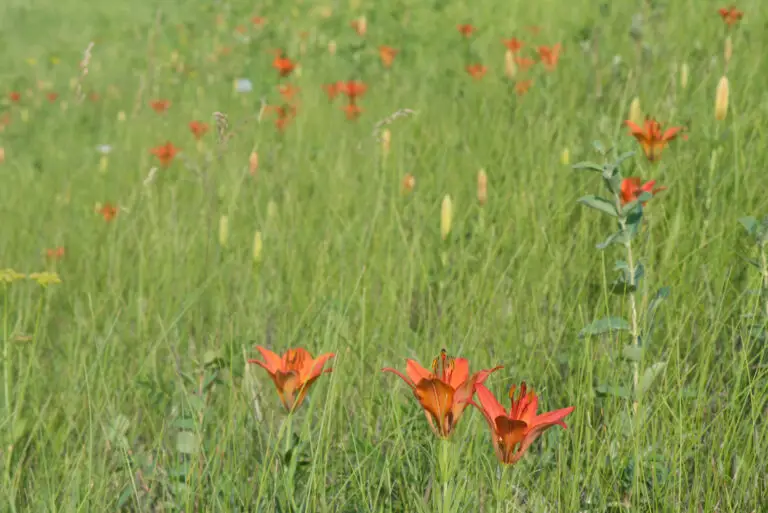
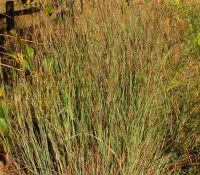
Prairie and meadow gardens: This is where wood lily grows in the wild. Scattered among native grasses like little bluestem, it looks completely at home.
The transition zone between a lawn and a tree line is perfect. Wood lily gets enough sun while the nearby trees provide a natural backdrop.
Butterfly and hummingbird gardens: The bright upward-facing flowers are easy for pollinators to land on. Plant it near a window or seating area and watch the show.
The daylily replacement bed: If you’re pulling out non-native daylilies and want a native substitute that blooms at the same time, wood lily is your answer. Shorter, fiercer, and feeding wildlife.
In nature, wood lilies are often found in sunny meadows
FAQs
Is wood lily the same as a daylily?
No. Daylilies (Hemerocallis species) are not true lilies and most are non-native. Wood lily is a true lily in the genus Lilium, native to North America. The flower structure, growth habit, and ecological value are completely different. Wood lily feeds native pollinators in ways that most daylily cultivars can’t.
How long does wood lily bloom?
Wood lilies flower up to five weeks, which is a long bloom window for a native lily. Individual flowers last about a week, and new buds open in succession.
Why is wood lily endangered in some states?
Three main reasons for their disappearance: deer browsing, habitat loss, and people picking the flowers. The Lady Bird Johnson Wildflower Center describes it as becoming less common due to over-picking, over-harvesting of the bulbs, and overgrazing. Planting nursery-grown wood lilies in your garden is a small act of conservation—and leave any wild wood lilies you find alone.
Where can I find wood lilies for my garden?
Finding a specific native plant can be challenging. Sadly, most conventional nurseries do not stock many native plants. Here are four ideas for sourcing wood lilies in your area:
Wood Lily
Where can I find seeds and plants?
Finding native plants can be challenging (we partly blame King Louis XVI.) To make it easier, we’ve assembled four sourcing ideas.
Wood lily is the native answer to every non-native daylily sitting in a garden bed and underserving the local ecosystem. It’s shorter, fiercer, and far more interesting. The upward-facing flowers practically beg to be looked at, the butterflies and hummingbirds can’t stay away, and it thrives in the kind of sunny, well-drained spot that most yards already have. Plant a few this fall, tuck some butterfly weed and little bluestem around them, and you’ve got the beginning of a native garden that looks intentional, beautiful, and alive. For more native lily options, check out our Beginner’s Guide to Native Lilies. Happy planting!
Emily Lessard is the founder and editor of The Plant Native, the site that helps homeowners across North America get started with native plants. She holds a Sustainable Landscapes certificate through the Pennsylvania Landscape & Nursery Association, is finishing a Native Perennial Garden Design Certificate at Temple University, and is the author of World of Native Plants (Quarto, February 2027). She gardens outside Philadelphia in the 8.3 Southeastern Plains ecoregion.