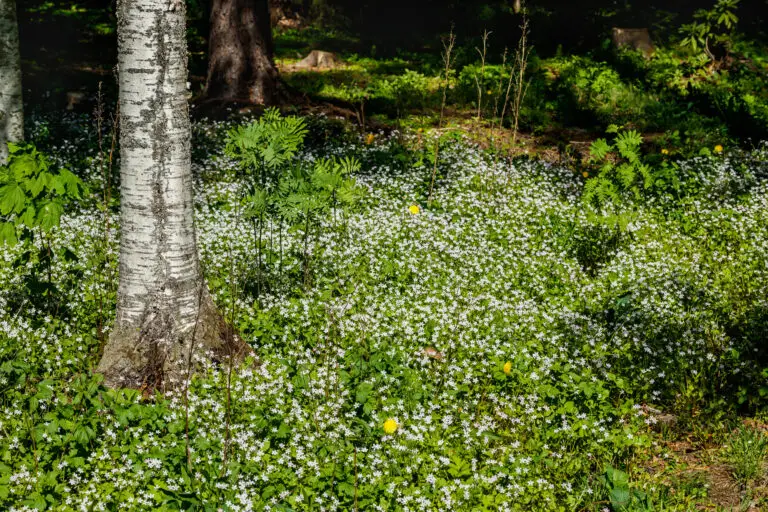
Every spring, an elite group of native plants pulls off one of the most dramatic performances in the natural world. Spring ephemerals are the flowers that emerge, bloom, get pollinated, set seed, and vanish underground, all before the trees overhead have finished leafing out. Their entire above-ground life lasts about six weeks. They’re racing a clock: the brief window of sunlight that floods the forest floor between snowmelt and canopy closure. If you’ve ever walked through a forest in late April and seen a carpet of fairy-like flowers, then returned in June to find nothing but leaf litter: that was them. Here’s how to recreate in your yard.
The briefly opened sunlight window
To understand spring ephemerals, you need to understand their real estate strategy. In a deciduous forest where the leaves fall, the floor gets sunlight for a narrow window each spring. This window opens briefly after the snow melts but before the tree canopy leafs out. That window lasts roughly six to eight weeks, depending on your region.
Spring ephemerals have evolved to cram everything into that window: photosynthesis, flowering, pollination, seed production. It’s like running an entire restaurant season—open, serve, profit, close—in a month and a half.
Placement for ephemerals is crucial
If you plant spring ephemerals under a deciduous tree, they’ll get the spring sun they need. Under an evergreen? Not enough light. In an open, sunny bed? Too much heat and competition from summer plants. They want the specific conditions of a deciduous woodland: bright spring, shady summer, leaf-litter mulch in fall.
Beginner Tip
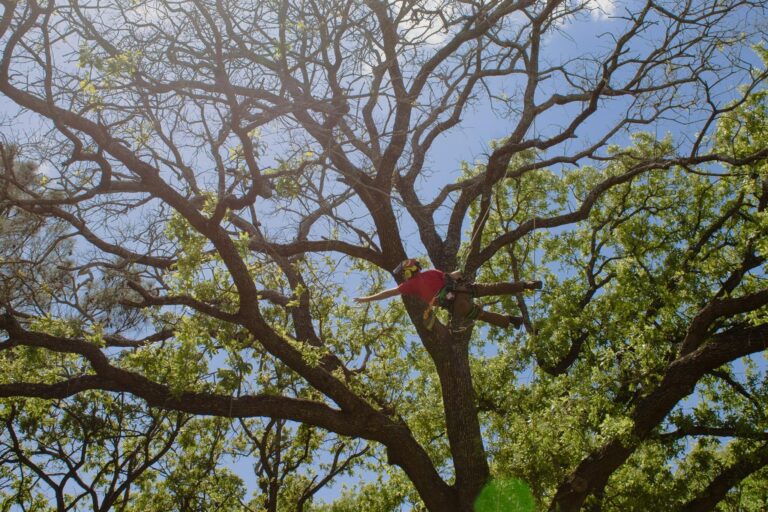
Spring ephemerals are ideal for planting under deciduous trees (oaks, maples, serviceberries) where they get the early spring sun they need. By the time the tree leaves block the light, the ephemerals are already asleep underground.
The ant connection (this is the weird part)
Here’s something most gardening resources don’t mention: a huge number of spring ephemerals rely on ants to plant their seeds. Not wind. Not birds. Ants. The process has a wonderful name (myrmecochory—good for your next Scrabble night!) and it works like this:
Tasty, fatty seed coatings
Many spring ephemeral seeds come paired with a tiny, fatty attachment called an elaiosome. It’s basically a to-go meal that ants go crazy for. Ants find the seed, get excited they found a treat, and carry the whole thing back to their underground nest. They eat the tasty, fatty attachment (but not the seed), and toss the seed into their waste pile. That waste pile is the perfect spot for the ephemeral flower seeds to grow. It’s rich in nutrients, protected from predators, and buried at just the right depth. You‘ve got to give these ephemerals the credit: this is a pretty genius way to propogate.
“
An estimated 55–60% of understory plants in these forests got to where they’re growing because an ant carried them there.
”
Ants are surprisingly excellent gardeners
Roughly a third of the understory plants in eastern North American forests depend on this ant-planted system. Trilliums, bloodroot, trout lilies, Dutchman’s breeches, hepatica, and violets all do it. An estimated 55–60% of understory plants in these forests got to where they’re growing because an ant carried them there. The ants get a snack. The plants get a planting service. It’s one of the tidiest deals in ecology.
Ok, we briefly discussed why ephemerals grow sprint-style, and now you know many have a special kinship with ants. Now, let’s meet some native ephemerals that thrive in gardens underneath deciduous trees.
Eastern North American ephemerals
The majority of spring ephemerals in the U.S. are native to eastern deciduous forests. Many of these plants have ranges that span the Northeast, Southeast, and Midwest, so rather than splitting them by region, here they are as a group.
Virginia Bluebells
Mertensia virginica
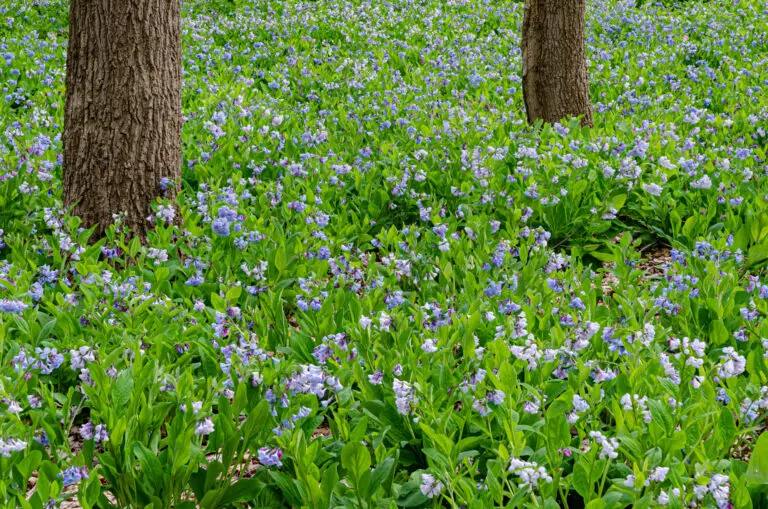
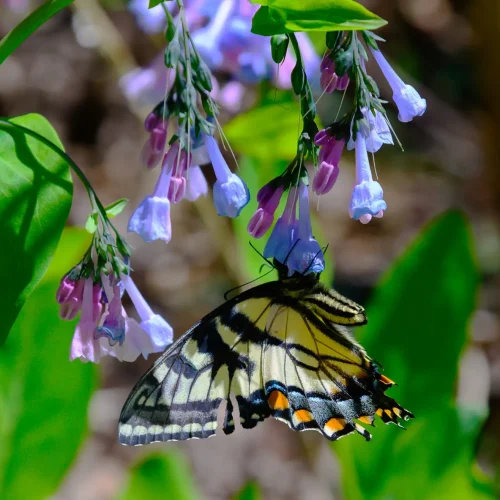
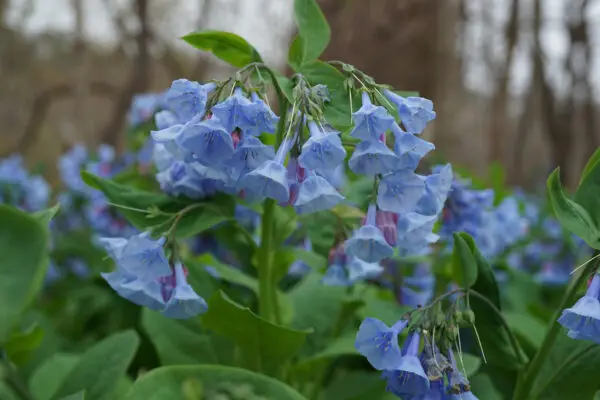
If you’ve ever seen a woodland floor that looked like someone spilled blue paint across it in April, you’ve met Virginia bluebells. They grow 12–24 inches tall, with smooth, blue-green leaves and pendulous, bell-shaped flowers that morph from pink buds to sky-blue. By early summer, the whole plant vanishes underground. Eighteen species of native bees visit these flowers, along with bumblebees, butterflies, and hummingbirds. If spring ephemerals had a prom queen, this would be her.
Read more in our Beginner’s Guide to Virginia Bluebells.
Spring Beauty
Claytonia virginica
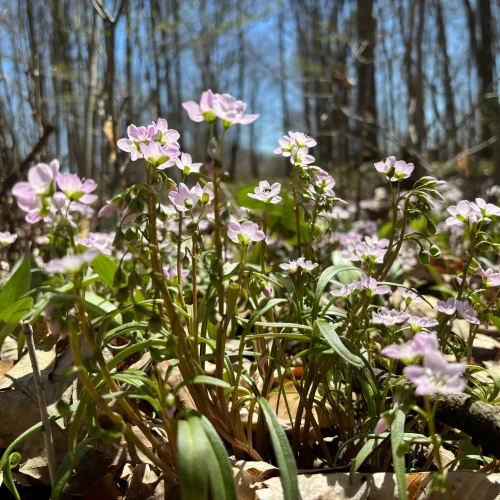
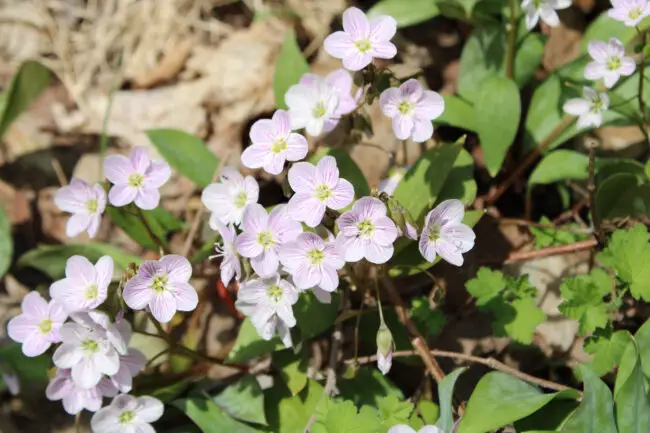
Spring beauty is one of the most widespread spring ephemerals in eastern North America, and one of the easiest to overlook. The flowers are tiny (half an inch across) with five white-to-pink petals traced with dark pink veins that serve as nectar guides for pollinators. A single plant stands just 3 to 6 inches tall. What spring beauty lacks in size, it makes up for in numbers: a healthy colony can carpet a forest floor with hundreds of blooming plants, each open only on sunny days and closing at night. The underground corm (a small, potato-like storage organ) was gathered by Indigenous peoples as a food source, earning the nickname “fairy spuds.”
Read more in our Beginner’s Guide to Spring Beauty.
Dutchman’s Breeches
Dicentra cucullaria
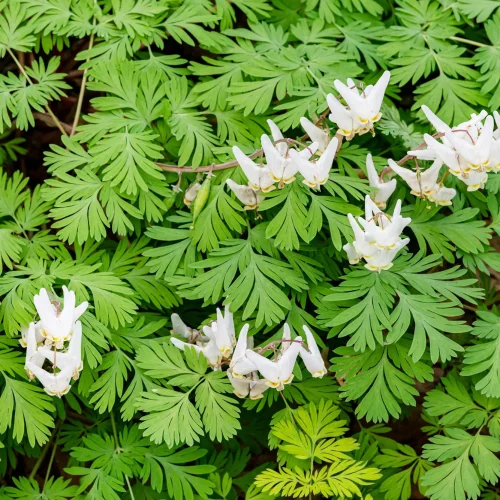
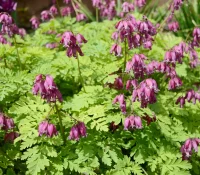
The name comes from the flowers, which look exactly like tiny white pantaloons hanging upside down on a clothesline. (Once you see it, you can’t unsee it, and it will cause you to giggle.) At about 6–10 inches tall with feathery, finely divided leaves, this plant is small but unmistakable. The flower shape isn’t just charming—it’s functional. Only bumblebees are strong enough to pry apart the outer petals and reach the nectar spurs inside, making this a specialist pollinator plant. Seeds have elaiosomes, so the ants handle dispersal.
Great White Trillium
Trillium grandiflorum
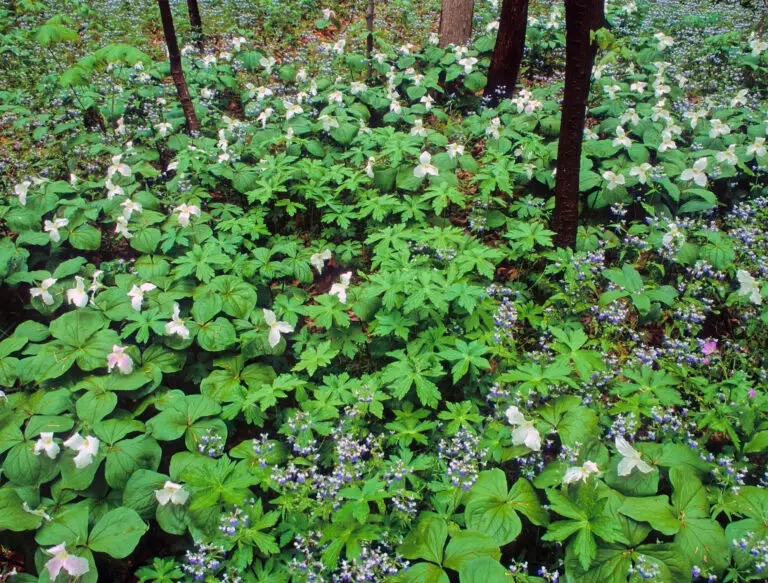
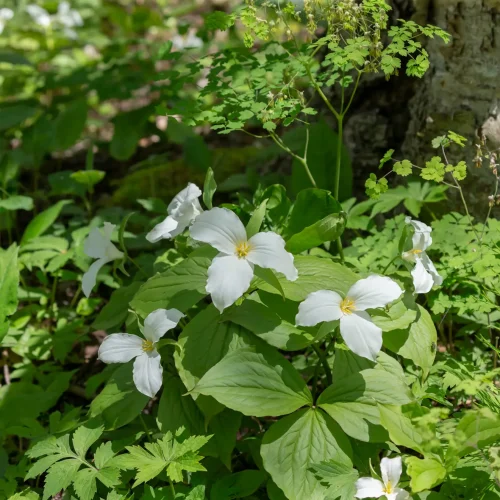
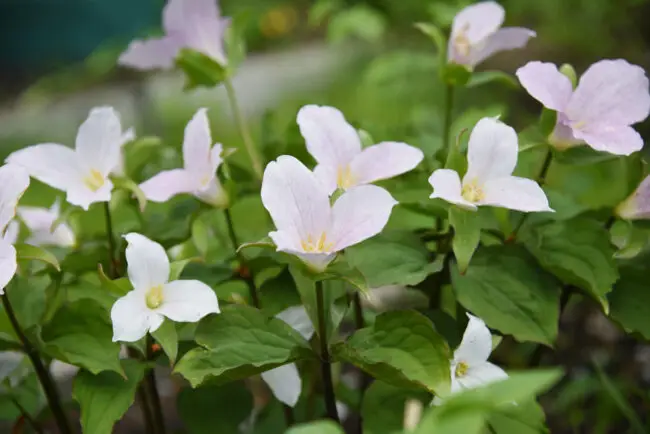
Trilliums are plants that teach you patience. It can take 7–12 years to flower from seed. Twelve years. The seeds undergo double dormancy, meaning they spend a full year underground before even sending out a root, then several more years building up to their first set of three leaves. A large population of flowering trilliums in a forest could easily be 40–50 years old. The enormous white flowers (2–4 inches across) eventually fade to pink, and the seeds get carried off by ants. If you see a trillium blooming in the woods, you’re looking at a decade of quiet work.
Read more in our Beginner’s Guide to Native Trilliums.
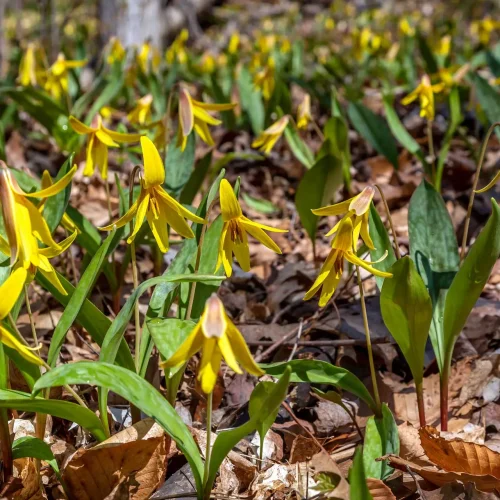
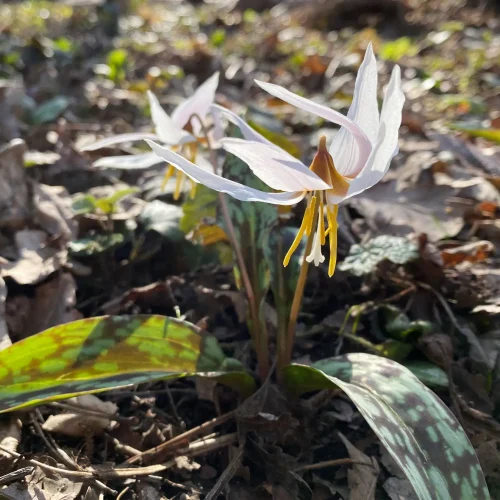
Trout Lily
Erythronium americanum
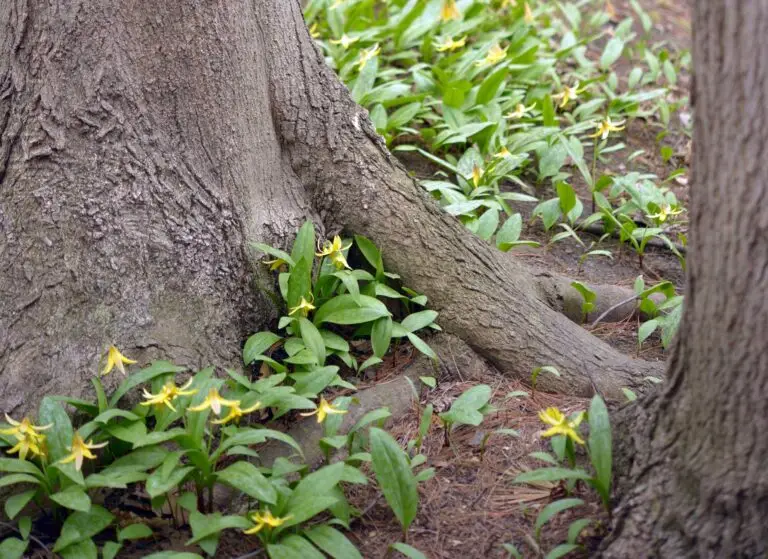
The mottled gray-green leaves of the trout lily look exactly like the speckled sides of a brook trout, which is how it got its name. Each plant sends up a single nodding yellow flower with six reflexed petals, sometimes tinged purple on the outside. Trout lilies are among the earliest spring bloomers in the Southeast, showing up as early as late February. They spread by rhizomes into colonies, and each colony is essentially a clone. Non-flowering plants send up a single leaf; when you see two leaves, that’s a plant old enough to bloom.
Read more in our Beginner’s Guide to Trout Lilies.
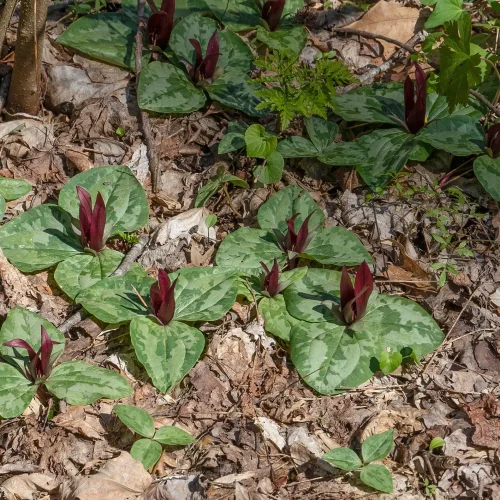
Sweet Betsy Trillium
This southeastern native is unmistakable: a whorl of three silver-marbled leaves topped with a stalkless maroon flower that smells faintly of bananas. (Some people say overripe bananas; others say it’s more of a “mushroom-banana” situation. Nobody agrees. Smell and decide for yourself.) The odd scent is deliberate: it attracts flies and gnats as pollinators, in addition to bees.
Sweet Betsy is found from Kentucky to Mississippi and the coast of South Carolina.
Read more in our Beginner’s Guide to Native Trilliums.
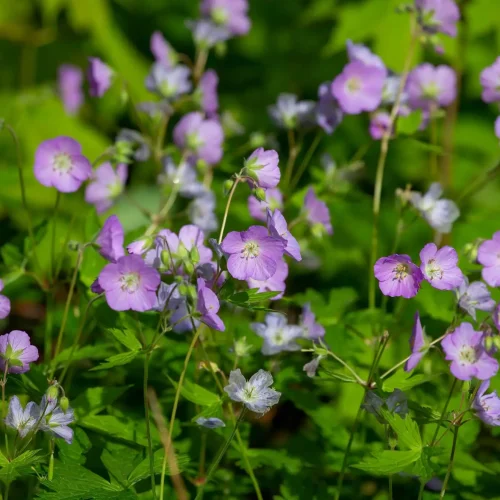
Wild Geranium
Geranium maculatum
Ok, so this plant is not technically a strict ephemeral—it can hang around into summer—but it blooms in that early spring window and is one of the first flowers available to emerging pollinators, which is why we’re sneaking it into the list.
Wild geranium stays small (12–28 inches tall) with deeply lobed leaves and clusters of rose-pink to lavender flowers, each about an inch across. The pink lines on the petals aren’t decoration: they’re nectar guides, basically runway lights for pollinators.
Read more in our Beginner’s Guide to Wild Geranium.
Western ephemerals
The Pacific Northwest has its own spring ephemeral tradition, centered in the moist conifer and mixed forests west of the Cascades. These plants follow the same playbook as their eastern cousins: race through bloom while the canopy is still thin, then retreat underground.
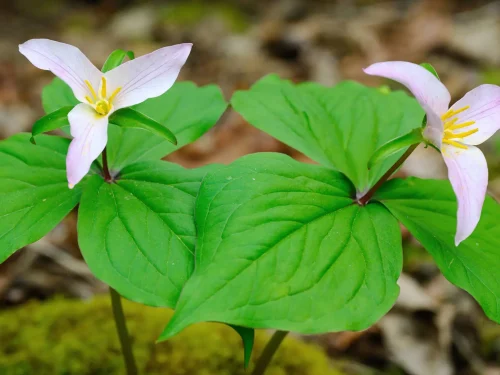
Western Wake Robin
Trillium ovatum
This is THE trillium of the Pacific Northwest. It blooms in late March to early April with white flowers that age to a deep rose-pink, sitting atop the signature whorl of three broad leaves. Like its eastern cousins, western wake robin takes years to flower from seed and relies on ants for seed dispersal. It’s the plant that tells Pacific Northwest hikers that winter is actually over. If you see white trilliums dotting the forest floor, spring is here.
Read more in our Beginner’s Guide to Native Trilliums.
Oregon Fawn Lily
Erythronium oregonum
The Pacific Northwest’s answer to the eastern trout lily, Oregon fawn lily has the same beautiful mottled leaves and nodding flowers, but in cream to white instead of yellow. It grows in moist woodlands and grasslands west of the Cascades, from southern British Columbia down through Oregon. Like the eastern species, it relies on miner bees for pollination and ants for seed dispersal. The fawn lily name comes from the spotted leaves, which look like the dappled coat of a young deer.
Sadly, spring ephemerals are disappearing
Spring ephemerals are declining across most of eastern North America, and the reasons are a depressing pile up of bummers.
The deer-and-garlic-mustard/lesser-celandine problem
White-tailed deer populations have exploded across the eastern U.S., the result of fewer natural predators and less hunting pressure. Deer love to browse on spring ephemerals, especially trilliums.
“
Here’s the kicker: deer don’t eat garlic mustard or lesser celandine. So they mow down the native ephemerals and leave the invasive competitor standing. It’s a one-two punch.
”
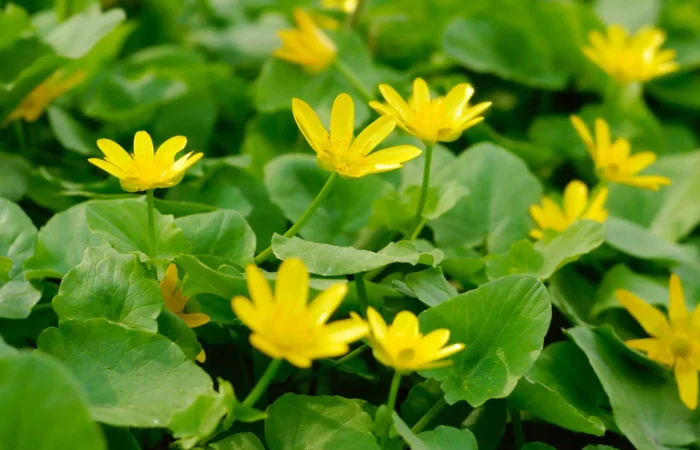
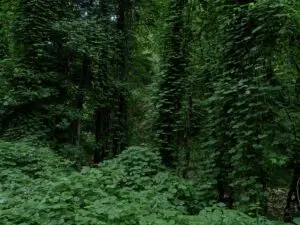
At the same time, enter runaway invasives like garlic mustard and lesser celandine. Garlic mustard and lesser celadine is aggressive invasives plants from Europe. Both have spread through the same forests.
Here’s the kicker: deer don’t eat garlic mustard or lesser celandine. So they mow down the native ephemerals and leave the invasive competitor standing. It’s a one-two punch. The native plants get eaten; the invasive that replaced them gets a free pass.
Habitat loss
Every time a forest is converted to development, the spring ephemerals that lived there are gone. And because many of these plants take years—sometimes a decade!—to flower from seed, they can’t bounce back quickly even if the habitat is restored. A trillium colony that took 50 years to establish can be wiped out in an afternoon by a bulldozer.
Climate timing mismatches
Rising temperatures are causing spring ephemerals to bloom earlier. That sounds fine until you realize their pollinators may not be shifting at the same rate. If the flowers open before the bees emerge, pollination drops. Meanwhile, trees are also leafing out earlier, but not necessarily at the same pace as the understory flowers. The carefully synchronized timing that these plants evolved over thousands of years is being scrambled. When a trillium blooms and there’s no bumblebee to pollinate it, no seed gets made. And remember: that trillium took 7–12 years to reach flowering age.
Collection and poaching
Finally, trilliums and other showy spring ephemerals are frequently dug up from wild populations. Given that a large trillium can take over a decade to flower, wild collection is devastating. Always buy spring ephemerals from nurseries that propagate their own plants, never from sellers who wild-collect. If the price seems too good to be true, it probably is.
How to grow spring ephemerals
The good news: if you have a spot under a deciduous tree with decent soil, you can grow these plants. Here’s the short version.
Location
Under deciduous trees or on the east side of buildings where they get spring sun and summer shade. Avoid areas under evergreens or in full summer sun.
Soil
Rich, woodsy soil with good drainage. If you have a spot where fallen leaves naturally accumulate, that’s your place. Don’t rake the leaves: they’re the mulch these plants evolved with, and it also helps local creatures like moths, hummingbirds, and native bees have a place to sleep over the winter.
Water
Consistent moisture in spring; they don’t need much once they go dormant in summer.
Patience
Many spring ephemerals are slow to establish. Trilliums can take years. Virginia bluebells and bloodroot are faster. Plant them and leave them alone.
Beginner Tip
Mark where you plant spring ephemerals with a small stake or label. They disappear completely by summer, and it’s easy to accidentally dig them up when you forget they’re there.
What special plants! And now you are asking…
Where can I buy native ephemerals?
You can skip the big-box nurseries entirely. If you want native ephemerals, you’ve got to head to a native plant nursery. Thankfully, we’ve got a list of 400+ right here to help you on your way:
We have an important plea to ask, for all of us native gardeners:
Source responsibly
Only buy from nurseries that propagate their own plants. Never buy wild-collected specimens. Native plant sales at botanical gardens and native plant societies are excellent sources.
What are good pairings for native ephemerals?
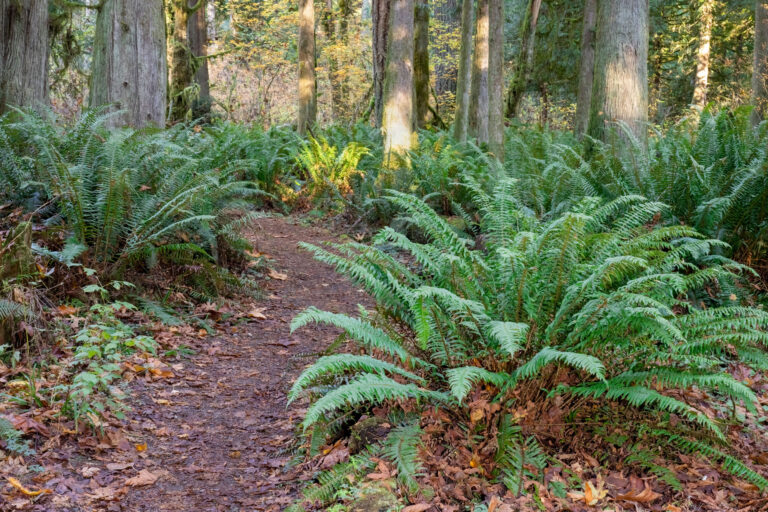
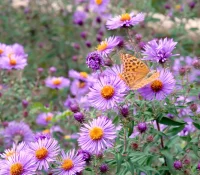
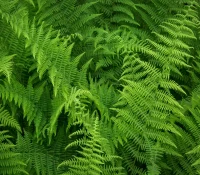
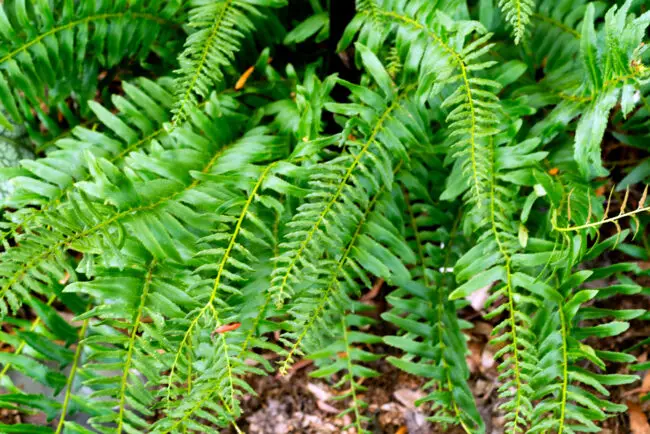
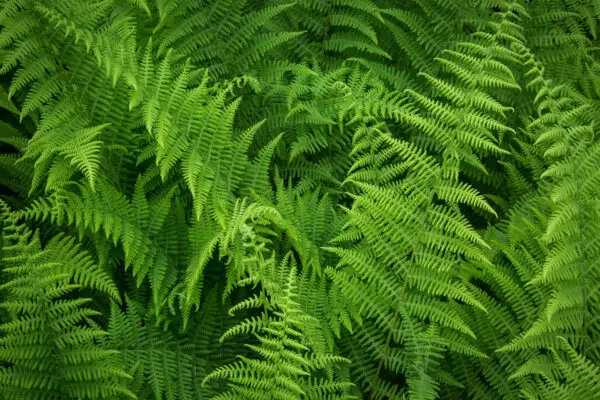
Plant with native ferns, wild ginger, shade-friendly asters, or other shade-loving natives that fill in after the ephemerals go dormant. This keeps the bed looking intentional in summer.
Spring ephemerals are proof that some of the most impressive things in nature happen fast and quiet. They sprint through an entire life cycle while the rest of the garden is still waking up. They feed the first bees and butterflies of the year. They’ve worked out a seed-dispersal deal with ants that’s been running for millions of years. And they do it all in the narrow window of light between the last frost and the first full canopy.
If you have a shady spot under a deciduous tree that’s been sitting empty, this is what it was made for. Plant some bloodroot, some Virginia bluebells, a few trilliums if you’re patient. Come April, you’ll have the shortest, most spectacular show in your yard. And then, just like that, they’ll be gone—quietly sleeping underground, already planning next year’s performance.
Check out our profiles on serviceberry, creeping phlox, and New Jersey tea for more native plants that pair beautifully with spring ephemerals. Happy planting!