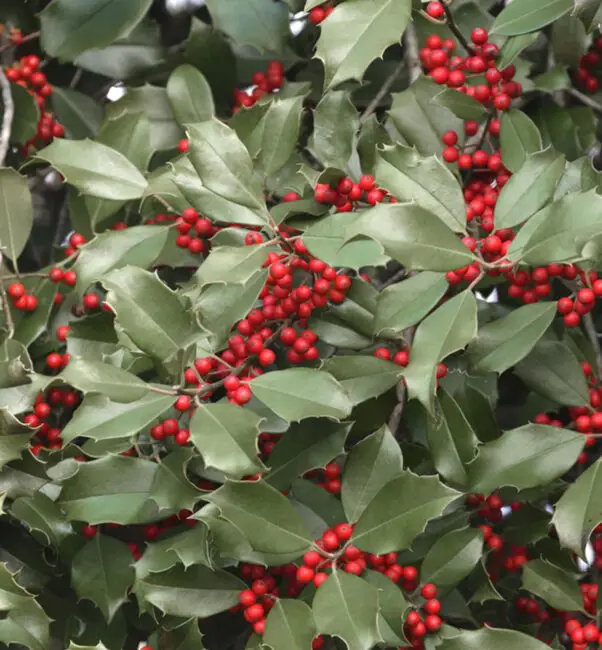
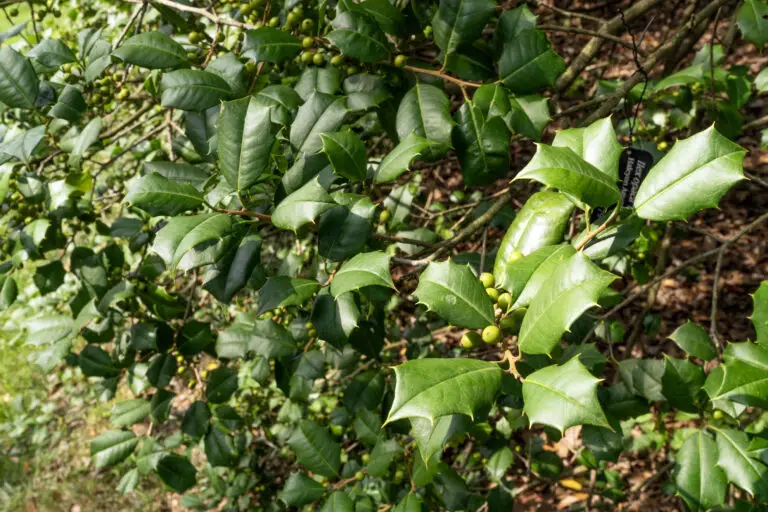
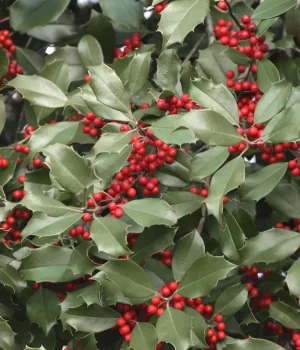
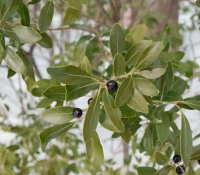
American holly (Ilex opaca) is the evergreen holly that’s actually native to North America. That matters, because when most people picture a holly, they’re imagining English holly (Ilex aquifolium) which is the one on Christmas cards. American holly does the same job, but better and without the baggage. It grows into an evergreen pyramid of spiny, dark green leaves, covers itself in bright red berries in the winter, and supports 25+ birds, a butterfly, and dozens of pollinators. Once this plant is established, it asks almost nothing of you.
You want a year-round evergreen that does real ecological work. American holly stays green through winter while feeding birds with its berries.
You want to ditch English holly. American holly fills the same visual role without the invasive risk, and it supports local wildlife that English holly simply can’t.
Deer are a headache. American holly has high deer resistance thanks to its spiny leaves. Deer generally leave it alone.
You need a privacy screen or windbreak. Its dense, pyramidal shape makes it a natural screen that works in every season.
You’re in the eastern or south-central U.S. That covers a lot of territory, from Massachusetts to Florida to Texas.
American holly is just one native option in the holly family: Ilex. (You pronounce Ilex like it’s a Marvel villain: eye-LEX.) American holly pairs beautifully with deciduous (AKA leaf-dropping) cousins like possumhaw, winterberry, and inkberry. Visit our Beginner’s Guide to Native Hollies to meet more of the native fam.
New to native?
Before lawns and landscaping, native plants were here. They’ve fed birds, bees, and butterflies for thousands of years—and they’ll do the same in your yard. The best part? They’re easier to grow than you think.
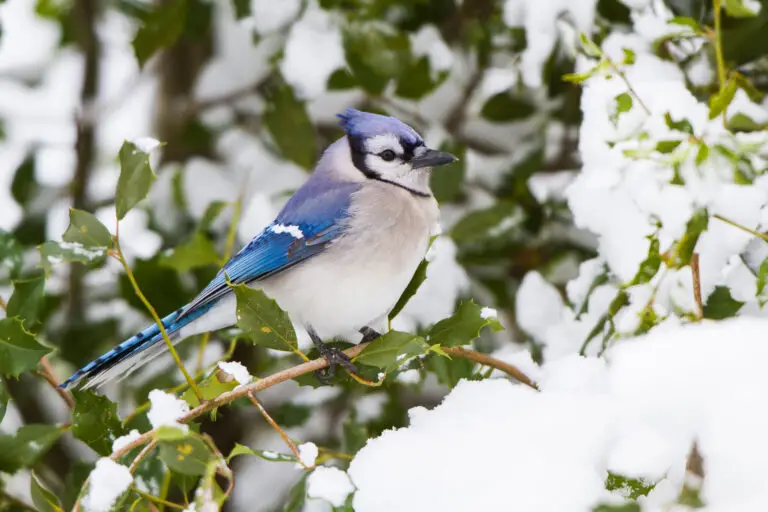
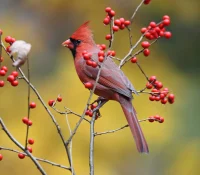
Love birds? (And who doesn't?!) American hollies are excellent for winter bird watching.
Skip it if…
Your soil is alkaline. American holly needs acidic soil (pH 5.0–6.5). In high-pH soils, it develops iron chlorosis (yellowing leaves with dark green veins) and struggles.
You need something small. Even compact cultivars reach 15–20 feet. If you want a native evergreen holly that stays shorter, look at inkberry instead.
You want instant impact. American holly is slow-growing. Plan on 1–2 feet per year and several years before it fills in.
You’re in the Pacific Northwest or Mountain West. American holly’s native range is eastern and south-central. It won’t thrive outside that region.
Why American holly matters
American holly is one of the most important native evergreens for wildlife in the eastern United States. 29+ birds snack on its berries, including icons like cedar waxwings, eastern bluebirds, and American robins. Those berries ripen in fall and persist through winter, providing a critical food source exactly when birds need it most.
Evergreen-beauty
Beyond food, American holly’s dense evergreen canopy provides year-round shelter and nesting habitat. Northern mockingbirds, American robins, and cedar waxwings nest in its branches, and its spiny leaves create a protected interior that keeps small birds safe from hawks and weather.
American hollies are host plants
It’s also a host plant for the holly azure butterfly (Celastrina idella), a specialist that lays its eggs on holly so its caterpillars can feed on the flowers and developing fruit. That’s a relationship that only works with native hollies. English holly doesn’t support it. In spring, the small greenish-white flowers are a magnet for bees, including native bees that rely on early-season nectar.
How to grow American holly
When to plant
Fall or early spring, while the tree is dormant. Water the root ball thoroughly 24 hours before planting.
Sun + Soil
Full sun gives you the most berries, but American holly handles part sun well. Soil should be moist, well-drained, and acidic (pH 5.0–6.5). This is non-negotiable: alkaline soil causes iron chlorosis and the tree will struggle.
What does acidic soil mean?
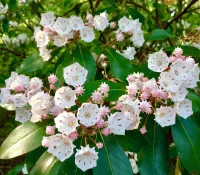
Soil pH is easier to understand if you imagine it as a spectrum from sour to sweet. Acidic soil is the sour end (think lemon). Alkaline is the sweet end (think honey). Neutral is right in the middle at pH 7. Most plants are fine in the neutral zone, but some natives actually crave the sour stuff; blueberries, mountain laurels, and ferns evolved in acidic soil and won't thrive without it. A $10 test kit from any garden center will tell you in minutes.
Hollies come in male plants and female plants, and they’re separate.
”
There are male/female hollies (and yes, it matters)
Here’s something most people don’t realize until they’ve been staring at a berry-less holly for three years:
Hollies come in male plants and female plants, and they’re separate.
Only the female grows berries.
But she can’t do it alone: she needs a male planted within about 40 feet so bees can carry pollen between them.
No male nearby, no berries.
This isn’t unique to American holly; it’s true of virtually every native holly species, from winterberry to inkberry to yaupon. The scientific term for this is dioecious (pronounced “die-EE-shus”), which just means the male and female parts live on separate plants instead of sharing one.
How can I find a male and female American holly?
The cultivar ‘Jersey Knight’ is the most common male pollinator for American holly, and one male can pollinate up to five females. You don’t need to plant him front and center: tuck him behind a fence or in a back corner. He just needs to exist within bee-flying distance. When you’re shopping, buy both at the same time so you don’t leave the nursery with only half the equation.
Beginner Tip
Before you buy female and male hollies, or if you already have a female holly that isn't making berries, look around your neighborhood before buying a male. Holly pollen travels by bee, and bees cover a lot of ground. There may already be a male within range that you didn't know about. If your holly suddenly starts berrying after years of nothing, a neighbor probably planted a male.
The University of Kentucky has a good overview video that points out some identifying features alongside lots of pictures of its flowers, berries, and mature trees, alongside an astonishing fact: Cedar waxwing flocks can strip a 35-foot-tall American holly tree of its berries in “mere minutes!”
Where American holly shines in your yard
Year-round screen or privacy hedge: Its dense evergreen habit blocks views, wind, and noise in every season. Space plants 6–8 feet apart for a solid wall of green.
Specimen tree: A single american holly in the front yard or near a window gives you four-season interest (spring flowers for pollinators, summer green, fall berry color, and winter berries against snow.)
Paired with deciduous hollies: Plant it behind possumhaw or winterberry for a layered winter scene: bare red-berried branches in front, dark evergreen behind.
Woodland edge: American holly grows naturally as an understory tree. It’s right at home at the edge of a wooded area where it gets filtered light.
Foundation planting: Compact cultivars work well near the house, especially on the north or east side where they’re sheltered from harsh afternoon sun.
Wildlife garden anchor: Its combination of berries, shelter, and nesting habitat makes it a cornerstone plant for any wildlife-focused yard.
Garden Recipe™
American Holly
Ilex opaca
Sun to part sun
Sun
Pretty easy
Effort
Tall Tree (50-100'+) tall 15-25 ft wide
Size
Spring - Summer
Blooms
What it needs
Sunlight
Full to partial sun, 4+ hoursThe more sun the better, but it can handle some shade
Directions
Spacing
15-20 ftThis one needs real breathing room
Watering
Weekly for the first seasonAfter that, rain is usually enough
Notes
Comes back?
Yes, every yearGoes dormant in winter, that's normal. New growth each spring.
Butterfly host plant. Certain butterflies depend on this plant to reproduce. It's one of the specific species their caterpillars need to survive.
What's the difference between American holly and English holly?
They look similar from a distance, but they’re very different plants.
English holly (Ilex aquifolium) has glossier, shinier leaves and a denser canopy.
American holly (Ilex opaca) has a more matte leaf and a slightly more open habit.
But here’s what matters: American holly is native to eastern North America and supports 29+ bird species, a specialist butterfly, and native pollinators. English holly does none of that, and in the Pacific Northwest, it’s actually invasive. If you’re choosing between the two, American holly is the clear pick.
Do I really need a male plant?
Yes—if you want berries. American holly is a dioecious plant, where male and female flowers are on separate trees. No male nearby means no berries.
The good news: one clearly male American holly (the cultivar ‘Jersey Knight’ is a common one) can pollinate up to five female trees within about 40 feet. Or, a neighbor’s male holly might be able to do the job. Bees can carry holly pollen up to 200 feet.
Are American holly berries poisonous?
They’re not typically fatal, but they’re definitely not edible for humans and pets. Holly berries can cause stomach upset, vomiting, and drowsiness in people, dogs, and cats. Birds process them without any issues. If you have young kids or curious pets, plant your holly where berries are out of easy reach.
How fast does American holly grow?
Slow. Expect about 1–2 feet per year under good conditions. It’s a long-term investment, not an instant screen. Buy the largest plant you can afford and give it several years to fill in. The wait is worth it.
American hollies can live for 100+ years, so think of this as a multi-generational legacy planting, not a quick win.
Can I prune American holly into a hedge?
Absolutely. American holly responds very well to shaping and can be maintained as a formal hedge or left to grow into its natural pyramid. Cultivars like ‘Greenleaf’ are especially good for hedges because they’re naturally dense and respond well to trimming. Prune once a year in late winter after the berries feed the songbirds.
Plant Nerd Fact
They might be slow growing, but American hollies have lots of fans
American holly wood is one of the whitest hardwoods on the planet. It’s so pale and fine-grained that during the Victorian era, it was commonly dyed black and used as a substitute for ebony in furniture, piano keys, violin pegs, and decorative inlays.
Native Americans had their own uses: they extracted dye from the berries and collected them for use as decorative buttons and trade items. Today, American holly is the state tree of Delaware (since 1939), and the American Holly Society has been cataloging cultivars since the 1940s; there are now over 1,000 named varieties. Not bad for a slow-growing tree.
Where can I buy American hollies?
Ready to get one (or two—a female and male) for your yard? Here are four trusted sourcing ideas to help you find what you’re looking for. (Spoiler alert: skip the big box nurseries.)
American Holly
Where can I find seeds and plants?
Finding native plants can be challenging (we partly blame King Louis XVI.) To make it easier, we’ve assembled four sourcing ideas.
We have lots of stellar, native suggestions. Pick companions that share similar growing conditions (acidic soil, moist and well-drained, sun to part sun) to create a layered, multi-season landscape:
American holly is one of those stellar plants that gives you something in every season: evergreen privacy, spring flowers for pollinators, winter berries for birds, and year-round shelter for nesting wildlife. It’s the native alternative to English holly, and it’s better in every way that counts. Pair it with possumhaw or winterberry for a layered winter berry display, tuck an inkberry hedge nearby for a shorter evergreen companion, or let it stand alone as a four-season anchor. If you’re new to native plants, our What is a native plant? page is a great place to start. And for the full story on the holly family, check out our Beginner’s Guide to Native Hollies. American holly asks for very little and gives back for over a hundred years. Happy planting!
Emily Lessard is the founder and editor of The Plant Native, the site that helps homeowners across North America get started with native plants. She holds a Sustainable Landscapes certificate through the Pennsylvania Landscape & Nursery Association, is finishing a Native Perennial Garden Design Certificate at Temple University, and is the author of Plant Native:A Practical Guide to Over 100 Native Plants of North America (Quarto, February 2027). She gardens outside Philadelphia in the 8.3 Southeastern Plains ecoregion.