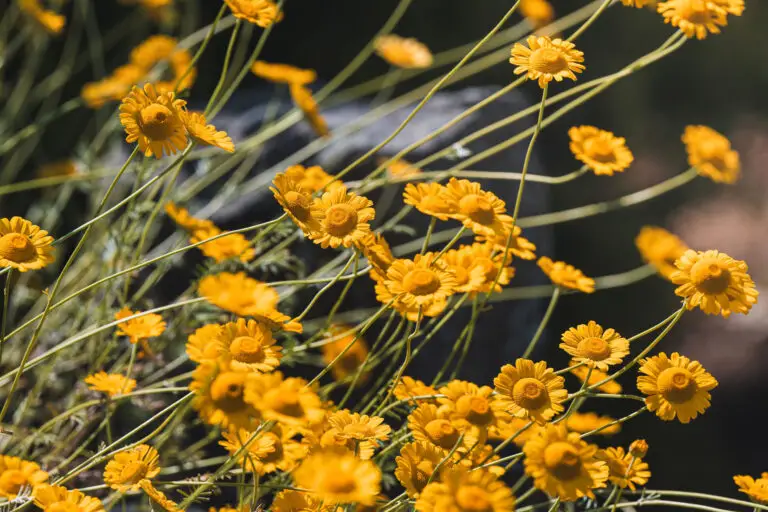
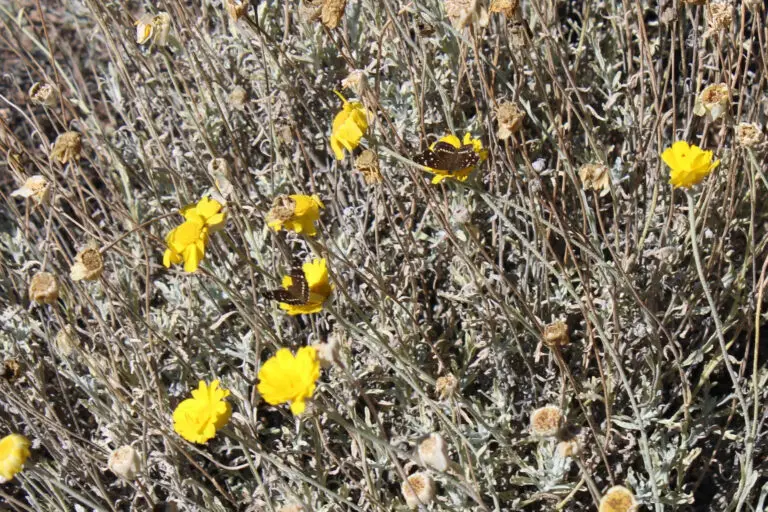
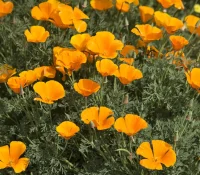
Most perennial flowers give you a few weeks of blooms and call it a season. Desert marigold gives you flowers spring through fall, and in the warmest parts of its range, it barely pauses for winter. Bright yellow daisies, dozens of them at a time, on silvery stems rising out of a low mound of soft, woolly leaves. The whole plant is covered in soft, woolly hairs that make it look almost frosted, and it thrives in the kind of conditions that kill most things you’d buy at a nursery. If you’ve ever driven through the Sonoran Desert after a rainy spring and wondered what all that yellow was: this is it.
Is desert marigold right for my yard?
Plant it if…
You live in the Southwest and want color that lasts from spring through fall without irrigation. Desert marigold delivers month after month.
Your soil is sandy, rocky, gravelly, or generally terrible. This plant was made for the spots your other plants gave up on.
You want a low-maintenance plant that reseeds itself, coming back year after year without replanting.
You’re building a xeriscape, rock garden, or desert-style planting and need reliable, long-season color at the front of the bed.
You want to attract native bees and butterflies without committing to a watering schedule.
New to native?
Before lawns and landscaping, native plants were here. They’ve fed birds, bees, and butterflies for thousands of years—and they’ll do the same in your yard. The best part? They’re easier to grow than you think.
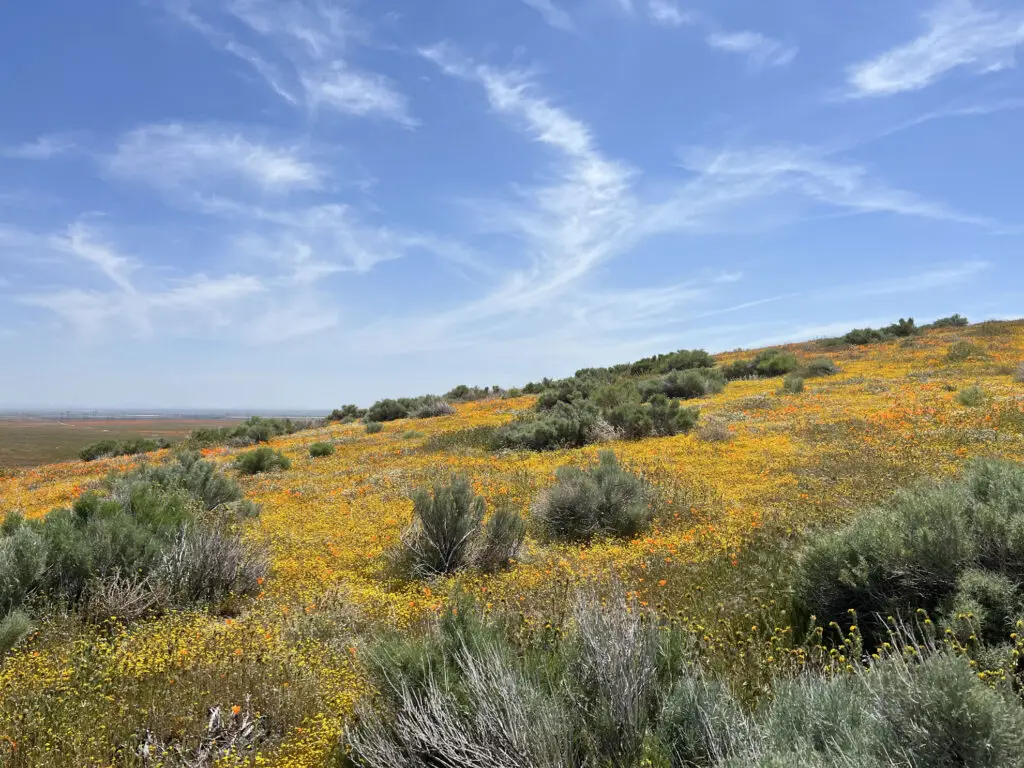
Ok, your yard might not be this big, but you can still use this for landscaping inspo!
Skip it if…
Your soil holds water. Clay, compacted earth, or any spot that stays wet after rain will rot desert marigold fast. Drainage is non-negotiable.
You’re outside its native range (see below). This is a plant of the Chihuahuan and Sonoran deserts. Humid summers east of the Mississippi will not go well.
You need a tidy, predictable border plant. Desert marigold reseeds freely and shows up where it wants. That’s part of its charm, but it’s not for everyone.
You want a long-lived perennial you plant once and never think about again. Desert marigold is short-lived (2–3 years per plant), though it keeps the colony going through self-seeding.
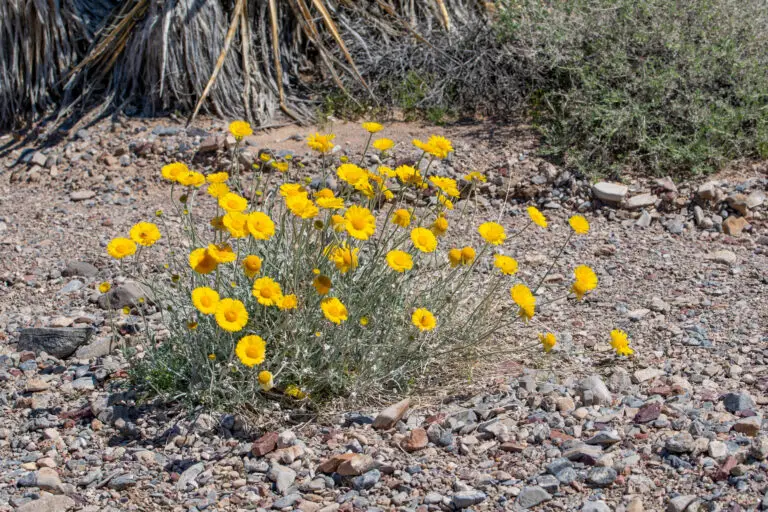
Rocky, blasting full-sun garden? This is your plant.
“
For a small bee, one desert marigold flower is a full meal.
”
Why desert marigold matters
In the desert, bloom season is not guaranteed. Rain is erratic, temperatures are extreme, and most plants flower in a short, dramatic burst and then go quiet.
Desert marigold breaks that pattern. It blooms for months: spring into summer, through the monsoon, and often into late fall. In the warmest parts of its range, it barely stops. For native bees and butterflies navigating a landscape where nectar sources can be weeks apart, a plant that keeps the kitchen open is invaluable.
According to the Lady Bird Johnson Wildflower Center, desert marigold is visited by a wide range of native pollinators, including solitary bees, small butterflies, and beneficial insects like hoverflies that help control garden pests (like aphids).
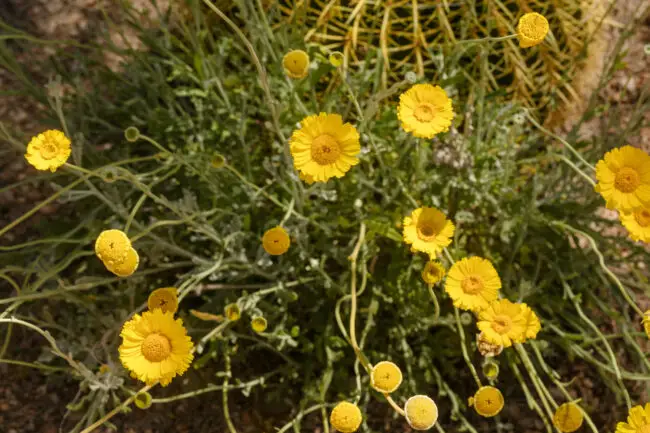
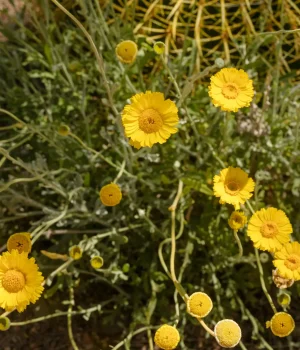
Get up close to a single flower: see all those tiny structures in the middle? Each of those is a floret, filled with food for polinators.
Each flower is actually many flowers
You have to get up close to a desert marigold to see something mind blowing. LIke all members of the Asteraceae family, its flowers are composite flowers, which means each “flower” is actually a landing pad made up of dozens of tiny individual florets, each one offering its own bit of nectar and pollen. For a small bee, one desert marigold flower is a full meal.
The seeds also matter. As blooms age and dry, they drop small seeds that are eaten by sparrows, finches, and other ground-feeding birds. In a desert landscape, every seed source counts. Desert marigold is not flashy about its wildlife value the way a milkweed or a coneflower might be, but it’s quietly holding down a multi-season job for pollinators, birds, and wildlife.
How to grow desert marigold
Where to plant
Full sun, all day, no exceptions. Desert marigold needs the hottest, driest, most exposed spot in your yard. A south- or west-facing slope is ideal.
The soil must drain fast: sandy, gravelly, or rocky ground is perfect. If you have a hellstrip, a gravel garden, a curbside strip with no irrigation, or a rocky slope that bakes in the afternoon, this is your plant. Do not enrich the soil. Do not improve it. Desert marigold performs best when you give it nothing.
When to plant
Fall is ideal across most of the Southwest, giving roots time to establish through the mild winter. Spring planting works too, as long as you avoid putting transplants into peak summer heat. If direct seeding, scatter seeds in fall to mimic natural cold treatment over winter. Expect germination in early spring.
Planting and spacing
Plant from 4-inch or 1-gallon containers, spacing 12–18 inches apart.
If seeding, scatter lightly and press seeds into the soil surface. Desert marigolds need light to germinate, so don’t bury them or feel the need to poke your finger in the dirt to hide them.
For a scattered, natural look, space loosely and let the plants fill in through reseeding. Desert marigold looks best in drifts of five or more, where the massed yellow reads from a distance.
Garden Recipe™
Desert Marigold
Baileya multiradiata
Full sun
Sun
Pretty easy
Effort
Short (under 3') tall 12-18" wide
Size
Spring - Fall
Blooms
What it needs
Sunlight
Full sun, 6+ hoursSouth- or west-facing is ideal
Water
Likes it dryPick a spot that doesn't stay soggy after rain
Directions
Spacing
12-18"About one forearm apart
Watering
Weekly for the first seasonAfter that, rain is usually enough
Notes
Comes back?
Yes, every yearGoes dormant in winter, that's normal. New growth each spring.
Low maintenance. Forgot to water? This plant won't hold it against you. Once it settles in, rain does most of the work.
Drought-tolerant
Watering
Water once at planting to settle the roots. Water every week or two during the first month. After that, in its native range, desert marigold needs essentially nothing. Rainfall is sufficient. In garden settings just outside the native range, a deep soak once a month during the driest stretches is plenty. Overwatering is the most common way to kill this plant. When in doubt, don’t water.
Fertilizer
None. Desert marigold evolved in nutrient-poor soil and thrives there. Fertilizer encourages leggy, floppy growth that looks wrong and doesn’t last. Neglect is the correct approach.
Desert marigold provides needed nectar and pollen throughout this long-running bloom cycle
Deadheading and reseeding
(“Deadheading” is a slightly macabre-sounding gardening term for cutting the flowers off after they are done blooming.)
If you want continuous bloom, deadheading spent flowers encourages more.
If you want the plant to reseed (and you probably do, since individual plants are short-lived), let some flowers go to seed through the season.
You probably already guessed that the best strategy is both. Deadhead most of the time for looks, then stop deadheading in late summer to allow seed set for next year’s plants.
Beginner Tip
Check your range before planting: Desert marigold is a Southwest native. If you’re in the eastern half of the United States or in a humid climate, this plant is not for your yard. For similar long-blooming color in other regions, look at black-eyed Susan or lanceleaf coreopsis.
Where desert marigold shines in your yard
Rock gardens and gravel gardens. In rocky, fast-draining soil, desert marigold is the anchor plant: reliable color for months in conditions that stump most things.
Hellstrips and medians. The combination of drought hardiness, low height, and long bloom season makes this one of the best hellstrip plants in the Southwest. Reflected heat? No problem.
Xeriscape and desert-inspired plantings. Desert marigold is the connective tissue in a Southwest planting: it fills gaps, ties other plants together, and keeps something in bloom while showier plants come and go.
Roadside and slope stabilization. Its ability to colonize disturbed, dry ground makes it excellent for erosion-prone slopes and roadside plantings.
Desert meadow edges. At the front of a native desert meadow, desert marigold’s low height and cheerful color provide a clean edge that reads as intentional, not weedy.
Containers on hot patios. In a large, very well-drained pot in full sun, desert marigold performs well with minimal watering. Use a gritty cactus mix and don’t overwater.
FAQs
Does desert marigold spread?
Yes, but by seed, not by runners. It reseeds freely in open, dry ground, which means new plants pop up each year. You won’t get an aggressive carpet; you’ll get a loose, naturalized drift that shifts slightly from year to year. Want to keep them in check? Pull any unwanted seedlings when small. They come up easily.
Is desert marigold toxic?
Yes, to livestock. All parts of the plant contain sesquiterpene lactones that are toxic to sheep and goats if eaten in quantity. For home gardeners with dogs or cats, the risk is low: the bitter taste deters casual nibbling.
It also has very cool potential for human medicine. A 1978 study in Lloydia by Pettit et al. isolated six of these compounds from desert marigold, several of which also showed significant antitumor activity in lab tests.
Can I grow desert marigold in a container?
Yes, if you use a large pot (at least 12 inches) with excellent drainage and a gritty, fast-draining cactus mix. Place it in the hottest, sunniest spot you have. Water sparingly. It won’t be as long-lived in a pot as in the ground, but it will bloom heavily for a season.
Why does my desert marigold look dead in July? Is it OK?
Pre-monsoon heat stress. In the driest, hottest weeks of early summer, desert marigold can look ragged, leggy, or partially dormant.
It’s not dead! Shear it back by a third, wait for monsoon rains, and watch it come back strong for fall bloom. This is normal desert plant behavior.
Is it really a marigold?
Nope. Not even close. Despite the common name, desert marigold is in the daisy family (Asteraceae) and is not related to garden marigolds (Tagetes spp.) or pot marigolds (Calendula).
The name comes from the similar flower color. If someone at the nursery tries to tell you it’s the same thing as a French marigold, smile and walk away. And then go find your people at a native plant nursery.
Plant Nerd Fact
The wool is the secret to staying cool.
You would like having leaves covered in hairs would be like wearing a wool sweater on a hot day. Not for desert marigolds.
Every leaf is covered in a thick mat of tiny white hairs called trichomes, packed so tightly the whole plant looks frosted. This frosted fuzz has two jobs:
The white color bounces sunlight away from the leaf, dropping its temperature by several degrees.
The dense mat of hairs traps a layer of still air against the surface, slowing down water evaporation, like a lid on a pot.
Researchers who’ve compared woolly-leaved desert plants to smooth-leaved ones growing right beside them have measured the difference. The fuzzy ones run cooler and lose less water. Think of it like a white linen shirt in the desert: it looks like a style choice, but it’s actually the reason the plant is still alive in July.
What pairs well with desert marigold?
Desert marigold’s low, bushy habit and preference for dry, rocky soil shapes its companions. You’re looking for plants that share those conditions and extend the bloom calendar. All of the following are native to overlapping ranges in the Southwest.
The very best places to buy native plants are the places that specialize in native plants. We’ve assembled four trusted sources to help you find your native plant people, and ideally shop local, too:
Desert Marigold
Where can I find seeds and plants?
Finding native plants can be challenging (we partly blame King Louis XVI.) To make it easier, we’ve assembled four sourcing ideas.
Desert marigold is the plant that makes desert gardening feel generous. In a landscape defined by scarcity, where rain is unpredictable and every drop counts, this plant delivers months of bright yellow bloom without asking for much in return. It fills the gaps, covers the rough spots, and keeps something beautiful happening in your yard long after flashier plants have packed it in for the season.
Ehleringer, James R., and Harold A. Mooney. “Leaf Hairs: Effects on Physiological Activity and Adaptive Value to a Desert Shrub.” Oecologia 37 (1978): 183–200. https://doi.org/10.1007/BF00344990. Accessed April 19, 2026.
Pettit, George R., Cherry L. Herald, Gerald F. Judd, Gerhard Bolliger, Lorraine D. Vanell, Elsa Lehto, and Charles P. Pase. “Antineoplastic Agents. 52. Baileya multiradiata.” Lloydia 41, no. 1 (1978): 29–36. https://pubmed.ncbi.nlm.nih.gov/565454/. Accessed April 19, 2026.
USDA PLANTS Database. “Baileya multiradiata (Desert Marigold).” U.S. Department of Agriculture, Natural Resources Conservation Service. https://plants.usda.gov/home/plantProfile?symbol=BAMU. Accessed April 19, 2026.
Emily Lessard is the founder and editor of The Plant Native, the site that helps homeowners across North America get started with native plants. She holds a Sustainable Landscapes certificate through the Pennsylvania Landscape & Nursery Association, is finishing a Native Perennial Garden Design Certificate at Temple University, and is the author of Plant Native:A Practical Guide to Over 100 Native Plants of North America (Quarto, February 2027). She gardens outside Philadelphia in the 8.3 Southeastern Plains ecoregion.