

Highlights
In April, the Sonoran Desert turns highlighter yellow. You can see it from the highways, the hillsides, the washes, and in the front yards of people who made excellent decisions. Those bright pops of color are palo verdes. For thousands of springs, they have found a way to bloom joyfully while thriving in tough desert conditions. Join the millennium-old trend that’s been waiting for you and plant one in your yard. Scroll on to meet some native palo verde species.
Why native palo verdes matter
Palo verdes are keystone trees in the Sonoran Desert in the way that oaks are keystone trees in eastern North American forests: they disproportionately support the food web around them.
- The flowers feed dozens of native bee species during a critical early-season window, before most summer flowers are open.
- The seeds are eaten by white-winged doves, Gambel’s quail, and songbirds.
- The canopy hosts nesting season activity for Lucy’s warblers, curved-bill thrashers, Gila woodpeckers, and Inca doves.
In the harsh desert, almost no seedling makes it on its own. A nurse tree is the reason a baby plant survives long enough to grow up.
Palo verde are nurse trees
This is one of the coolest stories I’ve read about plants, and it makes me wonder—yet again!—why all Americans know Spiderman’s backstory, but don’t know about nurse trees.
A nurse tree provides shelter for other baby plants, helping protect them in their early lives. Nurse trees can help protect baby plants from being eaten and shelter them during tough weather. In the harsh desert, almost no seedling makes it on its own. A nurse tree is the reason a baby plant survives long enough to grow up.
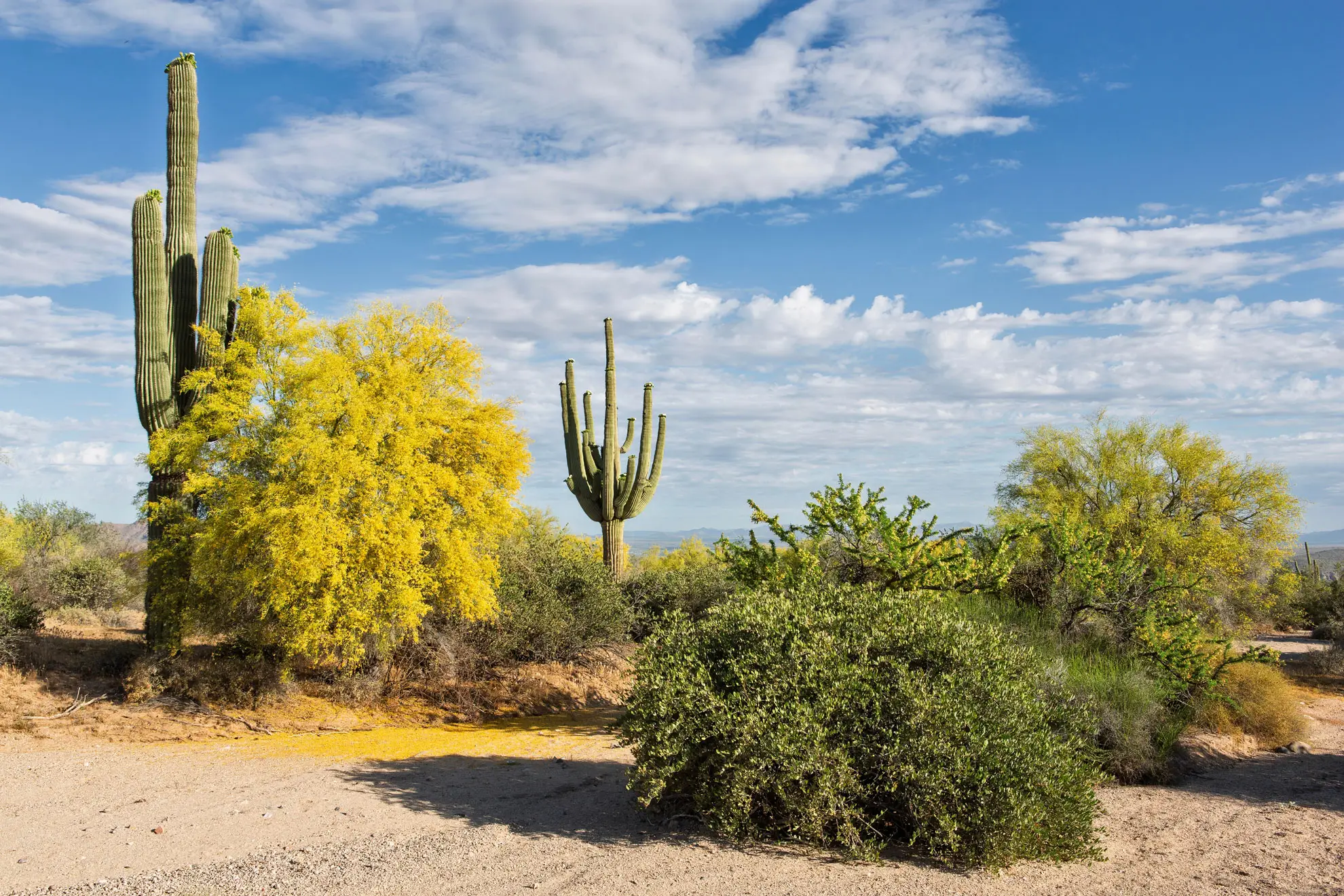
Palo verdes are nurse trees for saguaro cactuses. Saguaro cactus seeds and babies will root under palo verdes, enjoying the protected growing environment while keeping hidden from snacking. Nurse trees are documented extensively in Sonoran Desert research. “Nurse plants can be thought of as an umbrella protecting the young saguaros from drying out on hot summer days and from freezing on cold winter nights,” said Cecil Schwalbe, an ecologist emeritus with the U.S. Geological Survey.
Every saguaro you see taller than about five feet almost certainly grew up under a palo verde canopy, and specifically a foothills palo verde (more on this plant in a bit.)
Why do palo verdes have green bark?
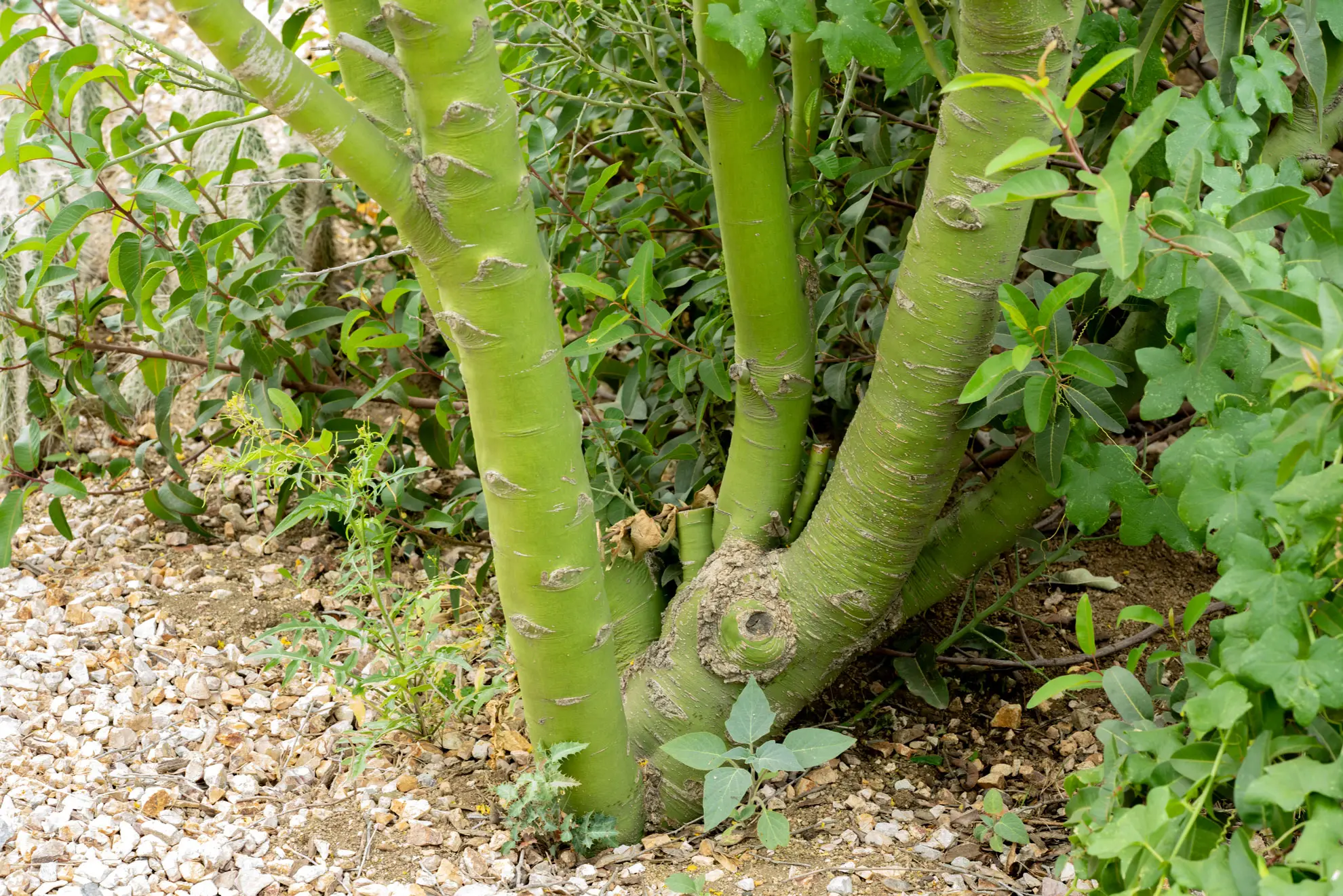
“Palo verde” is Spanish for “green stick.” This common name is pretty self-explanatory: every species in this group has green, photosynthesizing bark on its trunk and branches. This green is vivid enough to stand out against a brown desert hillside in October, even when the plant is not in bloom.
The bark is green for a reason. It is doing the same photosynthetic work that leaves on other plants do. Because photosynthesis occurs in palo verdes’ bark, it continues even when trees drop their leaves during drought. Palo verdes have essentially solved the desert water-loss problem by rethinking photosynthesis at an architectural level.
In a desert that can go months without rain, this is a significant competitive advantage. It is one of the reasons palo verdes can grow in conditions that defeat most other trees, and why these trees do not need a constant IV drop from a sprinkler.
Palo verdes have essentially solved the desert water-loss problem by rethinking photosynthesis at an architectural level.
Native palo verde species
There are several native palo verde species in North America, plus one celebrated sterile hybrid that is widely known. In a few scrolls we’ll share pictures, and here’s a quick overview:
- Blue palo verde is a big tree, the one that paints hillsides in April.
- Foothills palo verde is the slow, tough, thorny, rocky-slope cousin, made for tough desert realities.
- Texas palo verde, also called retama, is the most adaptable, growing across the broadest range, from California into Central America, east to South Carolina.
- And then there is ‘Desert Museum,’ the thornless hybrid that nurseries love and that you have almost certainly seen already.
All of them are incredible. This guide will walk you through each one.
P.S. There are other palo verdes out there. Mexican palo verde—Parkinsonia aculeata—has a native range that’s mostly in Mexico and South America, with a tiny bit of Arizona. We’re keeping it out of this article since it’s just barely in the US.
Blue palo verde
Parkinsonia florida (formerly Cercidium floridum)
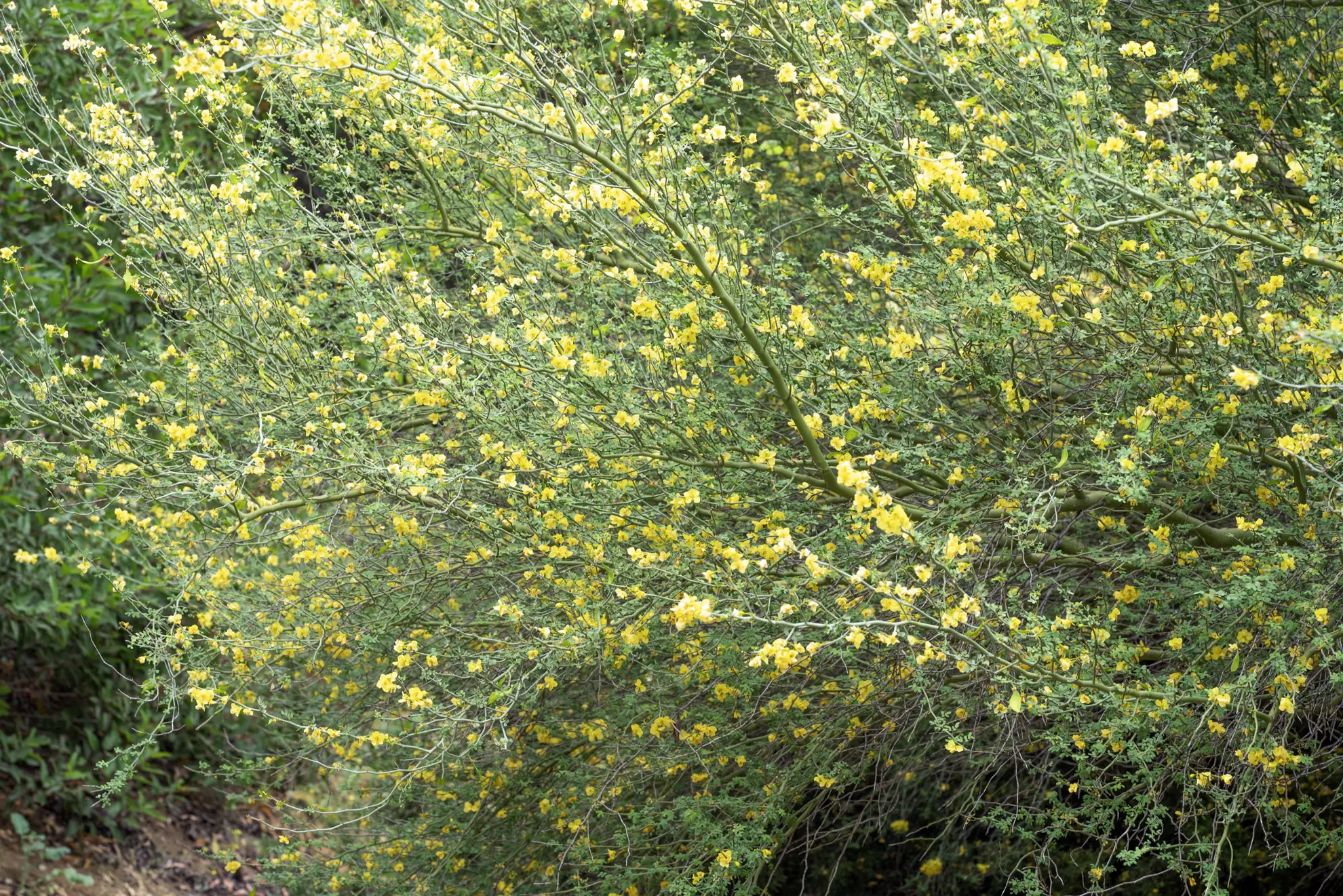
Blue palo verde is the signature tree of the Sonoran Desert wash. If you have seen photographs of the desert in April, yellow flowers everywhere, the saguaros still towering above a froth of color, the tree responsible for most of that yellow is almost certainly blue palo verde.
In bloom, it is committed: the tiny leaves and most of the green bark disappear under bright yellow flowers. A mature tree in full bloom looks like someone spent a week hand-gluing thousands of tiny flowers to the branches while you slept.
Foothills palo verde
Parkinsonia microphylla (formerly Cercidium microphyllum)
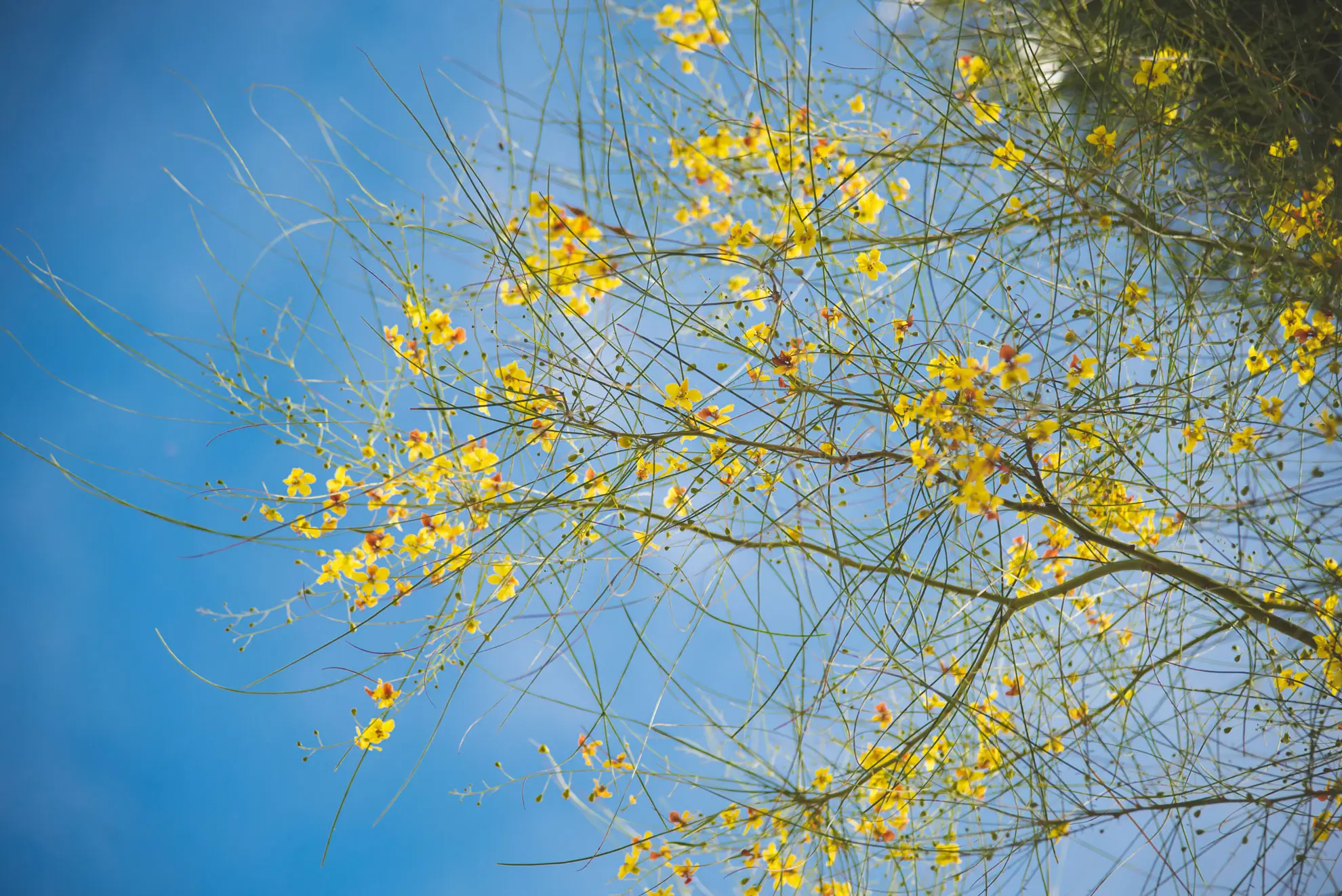
Foothills palo verde is the patient one. It grows slowly, maybe a foot a year, on rocky slopes and desert bajadas where it is drier and rockier than the wash bottoms blue palo verde prefers.
The bark is yellow-green rather than blue-green. The flowers appear in the same spring window as blue palo verde. The two species often grow near each other at the edges of washes, and can hybridize naturally, which is how the thornless ‘Desert Museum’ hybrid came to exist.
Before you run to plant a ‘Desert Museum’ thornless hybrid (which is totally fine! Especially if you have a yard with kids and/or pets), let’s briefly celebrate why those thorns exist.
Those thorns are saguaro protection
Foothills palo verde has branches tipped with sharp thorns. The thorns keep rodents and deer away from the seedlings sheltering inside. Research tracking saguaro survival shows saguaros are dramatically more likely to make it through their first decade under a nurse plant like foothills palo verde than out in the open. The saguaro’s desert success comes from nurse trees like foothills palo verde.
It is also the most drought-hardy of the native species, getting by on rainfall alone once it has been in the ground a couple of years. If you have a hot, rocky, sun-blasted slope that nothing grows on, foothills palo verde might be your tree. It will outlast almost anything you plant around it.
Worried about the thorns?
I get it. The thorns are useful in nature, but what if you have a yard with kids and pets? Then the thornless ‘Desert Museum’ palo verde might be what you need.
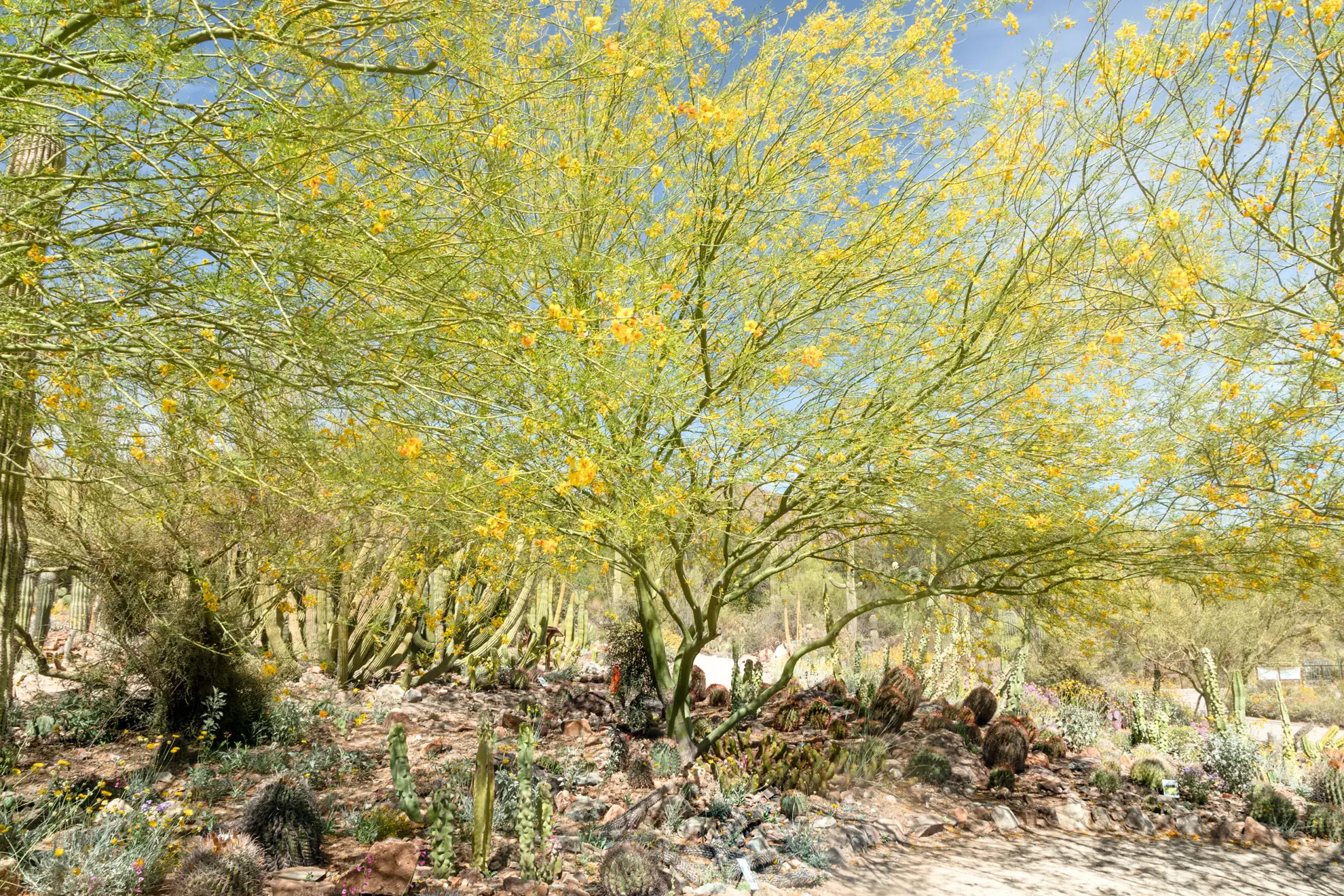
‘Desert Museum’ palo verde
Parkinsonia × ‘Desert Museum’
If you have shopped for palo verdes at an Arizona or California nursery in the last 20 years, you have almost certainly been offered ‘Desert Museum.’ It is a sterile triploid hybrid of all three native species, developed at the Arizona-Sonora Desert Museum in Tucson in the 1990s.
It’s three palo verdes in one
It has the best traits of each parent: the size and showiness of blue palo verde, the drought toughness of foothills palo verde, the extended bloom season of Texas palo verde. It rarely sets seed and almost never makes seedpods (i.e., no mess). It is also completely thornless, which makes it a much easier tree for pets, kids, and any thorn accidents.
But hybrids are complicated. Let’s be clear-eyed about the pros and cons, and you can make the decision for yourself.
‘Desert Museum’ might be great for your yard, but maybe less great for the natural world.
‘Desert Museum’ is a genuinely excellent tree for many landscape situations, and I am not here to talk you out of it. But it is worth knowing what it is.
It is a human-made hybrid of three different trees. Research by Doug Tallamy and others has documented that wild native species (often called “straight species”) generally support higher wildlife diversity than cultivars, since caterpillars track plant chemistry, and hybrid chemistry can differ from what native insects are adapted to. Based on this, here is some practical, honest guidance:
- If you want the easiest, most manageable palo verde for a tight urban space, ‘Desert Museum’ is excellent.
- If you have more room and are specifically trying to support native insects and birds, plant one of the straight native species.
If you have room for both, plant both!
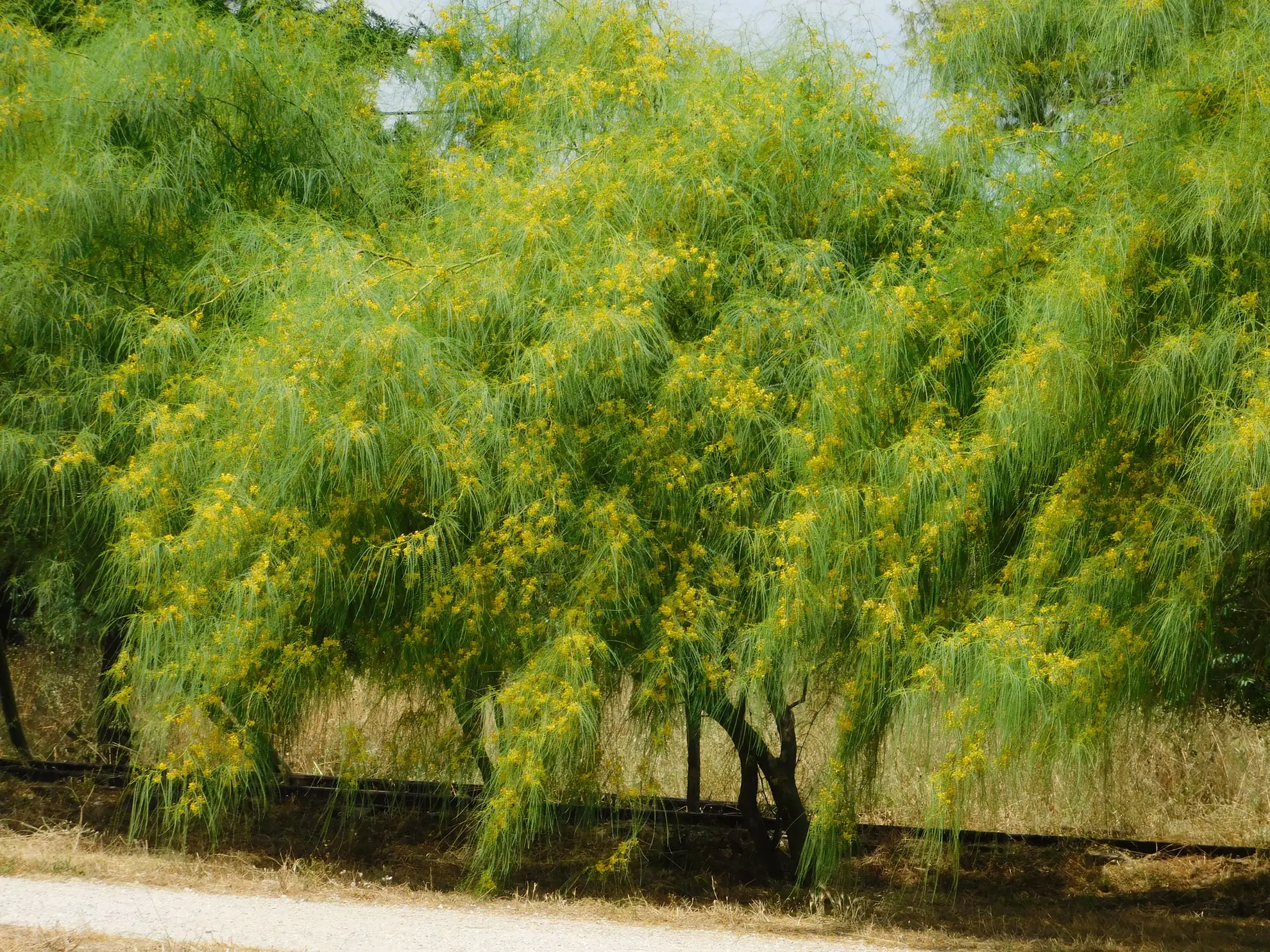
Texas palo verde / retama
Parkinsonia aculeata
Texas palo verde, also called retama or Jerusalem thorn, is the most widely distributed of the group. Its native range runs from southern Texas and New Mexico through Mexico and Central America into South America, and it has been so widely planted and naturalized around the warm parts of the world that its original range is genuinely difficult to pin down.
The USDA PLANTS Database lists it as native from California eastward, reaching South Carolina. In Texas, retama is a landscape staple: fast-growing, drought-hardy, and covered in drooping, bright yellow flower clusters from spring through fall.
It grows 15 to 30 feet tall, with a more weeping, tropical-looking canopy of long, drooping branchlets that give the tree an almost feathery quality in the wind. The flowers come in loose, hanging clusters, and they bloom in waves across a much longer season, often from April into November. The green bark is lighter and yellower than blue palo verde. It has paired spines at each node, which is where the name “Jerusalem thorn” comes from.
Don’t live in North America? Read this.
One honest note: Texas palo verde / retama spreads readily by seed and has become invasive in parts of Australia, South Africa, and other warm regions where it was introduced.
In its native North American Southwest range, it is not invasive, and in those regions it is an appropriate, drought-friendly landscape choice (and why we’re talking about it on The Plant Native, a website devoted to North American native plants.)
Outside North America, it should not be planted.
Where palo verdes shine in your yard
- Desert wash or low-garden anchor (blue palo verde). Plant blue palo verde in or near a dry wash or low garden area with occasional deep water and watch it reach 20 feet in less than a decade. The April bloom will stop traffic.
- Rocky slope or dry hillside (foothills palo verde). The slow, tough, deep-rooted choice for the spots that defeat other trees. Once established, it basically takes care of itself.
- Long-season color (retama). Texas palo verde’s spring-through-fall bloom window makes it the choice when you want extended flower color rather than one concentrated spring show.
- Specimen tree in an open front yard. Any of the three native species as a single specimen, given room, becomes the visual anchor of the property. The green bark reads as attractive twelve months a year.
- Nurse tree planting. Plant foothills palo verde or blue palo verde near a young saguaro to replicate the nurse tree relationship that makes young cacti thrive. You are doing what the desert does.
- Shade tree for a hot patio. Palo verde’s open, filtered canopy casts dappled rather than solid shade, which is gentler on plants underneath and still provides meaningful cooling for an outdoor seating area.
- Street tree or parkway planting. All three handle heat, reflected pavement, and infrequent water well. Blue palo verde and ‘Desert Museum’ are the most common choices for urban streetscapes in Phoenix and Tucson.
What pairs well with palo verdes?
Palo verdes belong in the company of other Sonoran Desert and Southwest natives. Think about what would actually grow together in their natural habitat: washes, rocky slopes, and desert bajadas.


Where can I buy a palo verde?
Skip the big box stores. To find the healthiest, most beautiful palo verde for your yard, head straight to a plant nursery that specializes in native plants.
To make this fun adverture easy, we’ve assembled four tried-and-true sources for finding native-focused nurseries near you:
FAQs
Which palo verde should I plant?
Blue palo verde for the most dramatic spring bloom and fastest growth in a wash or low garden position. Foothills palo verde for rocky slopes, maximum drought toughness, and the nurse tree function. Retama for an extended bloom season and in Texas and Gulf Coast gardens. ‘Desert Museum’ for a thornless, litter-free option in a tight urban landscape.
How fast do they grow?
It depends on the species:
- Blue palo verde is the fastest: 3 to 5 feet per year in good conditions, reaching 20 feet in under a decade.
- Foothills palo verde is slower: 1 to 2 feet per year, with mature height reached in 10 to 15 years.
- Retama is similar in speed to blue palo verde.
- ‘Desert Museum’ is among the fastest, often gaining 4 to 6 feet per year when young.
Do they need water once established?
Foothills palo verde can survive on rainfall alone in the Sonoran Desert once established. Blue palo verde and retama benefit from occasional deep summer watering in the driest years. None of them want to be on an automatic drip schedule after the first two years.
Plant nerd fact
What causes palo verde leaves to drop?
Palo verde drops its leaves in response to drought, not cold. When water is scarce, the tree sheds leaves to reduce water loss. Because the bark photosynthesize, the tree is not shutting down when it drops its leaves; it is just shifting to a lower-energy mode while keeping the lights on. After rain, new leaves appear within days.
Palo verdes are among the most rewarding trees you can plant in a Southwest garden, and they are also, once established, among the least demanding. They want sun, good drainage, and room to grow. They will give you yellow flowers in April that you will stop and look at. They will feed your bees and your doves. They will grow green and alive-looking through the whole year, even when everything else is brown and waiting for rain.
If you are in Arizona or Southern California, there is almost certainly a palo verde growing within a mile of your house right now, doing its thing with zero assistance from anyone. Your job, if you plant one, is simply to replicate the conditions it already knows. Visit our Best Native Plants for Southwestern Gardens next to find some other native pairings. Happy planting!
Sources
- Arizona-Sonora Desert Museum. “Parkinsonia florida (Blue Palo Verde).” Desert Museum Digital Library. Accessed April 9, 2026.
- Arizona-Sonora Desert Museum. “Parkinsonia microphylla (Foothills Palo Verde).” Desert Museum Digital Library. Accessed April 9, 2026.
- Breslin, Peter B et al. “Establishment patterns of saguaro cactus (Carnegiea gigantea) at the microsite scale help explain saguaro regeneration and distributions in heterogenous, regional habitats.” American Journal of Botany vol. 112,6 (2025): e70053. doi:10.1002/ajb2.70053.
- Drezner, T.D. “The keystone saguaro (Carnegiea gigantea, Cactaceae): a review of its ecology, associations, reproduction, limits, and demographics.” Plant Ecol 215, 581–595 (2014). https://doi.org/10.1007/s11258-014-0326-y
- Ellsworth, Alyssa. “Babysitters Wanted—Saguaro Cactuses Seek Desert Nurse Trees for Permanent Position.” Western National Parks. Accessed August 23, 2026. https://wnpa.org/plan-your-trip/trip-ideas/park-stories/babysitters-wanted-saguaro-cactuses-seek-desert-nurse-trees-for-permanent-position-3.
- Lady Bird Johnson Wildflower Center. “Parkinsonia florida (Blue Palo Verde).” University of Texas at Austin. https://www.wildflower.org/plants/result.php?id_plant=pafl6. Accessed April 9, 2026.
- Lady Bird Johnson Wildflower Center. “Parkinsonia microphylla (Foothills Palo Verde).” University of Texas at Austin. https://www.wildflower.org/plants/result.php?id_plant=pami5. Accessed April 9, 2026.
- Lady Bird Johnson Wildflower Center. “Parkinsonia aculeata (Retama).” University of Texas at Austin. https://www.wildflower.org/plants/result.php?id_plant=paac2. Accessed April 9, 2026.
- Rowe, Helen I., Mary Fastiggi, Debbie Langenfeld, Scott Milne, John Parente, Giavanna Raboin, Nikhil Sethi, Madelaine Stockman, and Melanie Tluczek. “The Benefits of a Nurse Plant, Shade Cloth, and Nurse Rock on Carnegiea Gigantea (Saguaro) Growth and Survival Shift along a Stress Gradient.” Journal of Arid Environments 232, (2026): 105492. Accessed August 23, 2026. https://doi.org/10.1016/j.jaridenv.2025.105492.
- USDA PLANTS Database. “Parkinsonia aculeata L.” Natural Resources Conservation Service. https://plants.usda.gov/home/plantProfile?symbol=PAAC2. Accessed April 9, 2026.
- USDA PLANTS Database. “Parkinsonia florida (Benth. ex A. Gray) S. Watson.” Natural Resources Conservation Service. https://plants.usda.gov/home/plantProfile?symbol=PAFL6. Accessed April 9, 2026.
- USDA PLANTS Database. “Parkinsonia microphylla Torr.” Natural Resources Conservation Service. https://plants.usda.gov/home/plantProfile?symbol=PAMI5. Accessed April 9, 2026.
- Xerces Society. “Native Plants for Pollinators in the Southwest – Sonoran Desert.” Xerces Society for Invertebrate Conservation. Accessed April 9, 2026.
Similar plants

Updated Find more: Yellow Deer Resistant Keystone Statement Tree Tree Spring Full Sun Dry Drought-Tolerant
The ads on this site help pay real native plant nerds to research and write these guides.
Garden notes
Notes from people who’ve grown it
Tips, wins, and the occasional disaster. If you’ve grown palo verdes, share the advice you’d give to a neighbor.
No notes yet. Yours could be the first.
Grown palo verdes? Tell the next person what you wish someone had told you.
Tap anywhere to close


