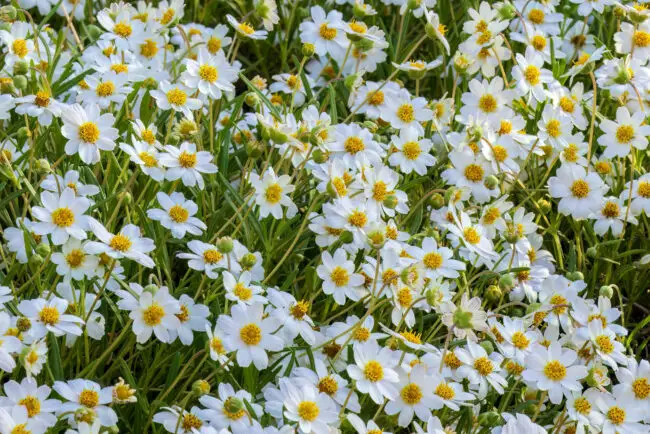
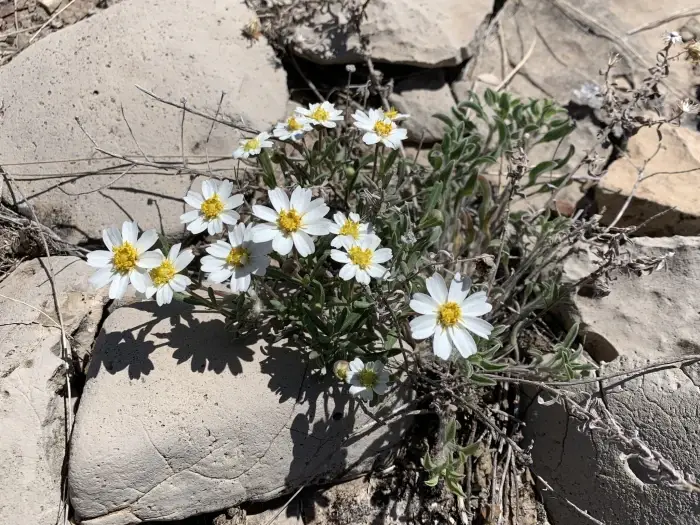
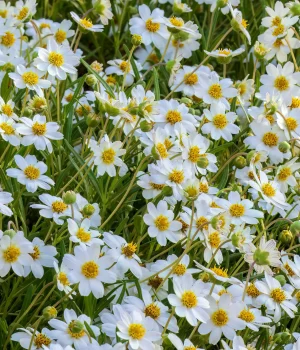
Blackfoot daisy is the plant you put in the spot where everything else has died. Rocky, shallow, baking in full sun, soil so thin you can see the limestone underneath? Blackfoot daisy will not only survive there, it will cover itself in cheerful white-and-yellow flowers for the better part of the year. The blooms smell like honey. The mound stays tidy without you touching it. And it keeps going from spring through fall, sometimes into November, on almost no water at all.
Is blackfoot daisy right for my yard?
Plant it if…
You have a dry, sunny spot with rocky or gravelly soil and nothing else has worked there.
You want months and months of flowers without deadheading, fertilizing, or fussing.
You love the idea of honey-scented flowers you can smell from the sidewalk.
You need a low, tidy mound (under 12 inches) for a border, rock garden, or hellstrip.
Deer are eating everything in your yard. They skip this one.
You garden in the Southwest and want something that actually belongs here.
Flowers for months with minimal water? YEP.
Skip it if…
Your soil stays wet or your yard has heavy clay with poor drainage. Blackfoot daisy rots in soggy ground.
You garden in the eastern U.S. or the Pacific Northwest. This is a Southwest native; check your USDA range map before planting.
You want a tall backdrop plant. Blackfoot daisy stays under a foot tall. You have rich, moist garden soil and like to water and fertilize regularly. All that generosity will shorten this plant’s life.
Blackfoot daisy is native to the dry, rocky landscapes of the southwestern United States and northern Mexico. You’ll find it growing wild on limestone slopes, desert mesas, and high plains from southern Colorado and western Kansas down through Oklahoma, Texas, New Mexico, and Arizona. The largest wild populations are in Texas and New Mexico, particularly in the Edwards Plateau and the Chihuahuan Desert.
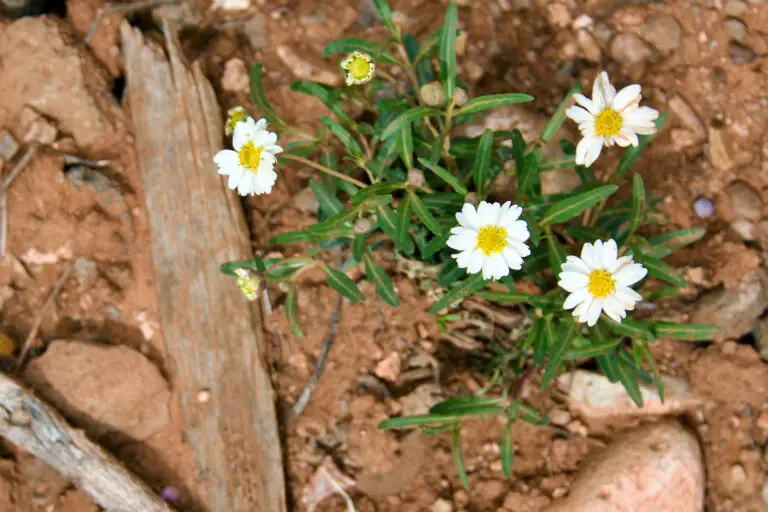
Check the USDA PLANTS Database range map to see if you’re in blackfoot daisy territory. A close relative, white zinnia (Zinnia acerosa), overlaps with blackfoot daisy in parts of its range and looks almost identical at first glance. The easiest way to tell them apart: blackfoot daisy has 8–13 white ray flowers per head; white zinnia has only 4–7.
You can have this, without any fussy sprinkler systems involved.
“
It’s the kind of plant that makes a neighbor stop and ask, “What is that?” And when you tell them it’s native and you never water it, you’ve just started a conversation that matters.
”
Why blackfoot daisy matters
Months of flowers
Blackfoot daisy is one of those plants that quietly holds a landscape together.
While showier plants come and go with the seasons, blackfoot daisy keeps blooming month after month, feeding pollinators from spring through fall. Bees, butterflies, and small native insects rely on it as a consistent nectar source, especially in hot, dry months when other flowers have checked out for the summer.
It feeds birds
The seeds feed birds, too. According to the Lady Bird Johnson Wildflower Center, birds seek out blackfoot daisy seeds, which means a patch of this plant is doing double duty: feeding pollinators above and birds below.
It’s a low-water champ
In a region where water is increasingly precious, blackfoot daisy is also a quiet argument for rethinking what a “good yard” looks like. It thrives on almost nothing. It looks intentional, not neglected. It’s the kind of plant that makes a neighbor stop and ask, “What is that?” And when you tell them it’s native and you never water it, you’ve just started a conversation that matters.
More good news:
Blackfoot daisy is deer-resistant
Deer do NOT normally eat Blackfoot daisy. If you’re worried about deer nibbling your garden, planting Blackfoot daisy is a good native gardening choice.
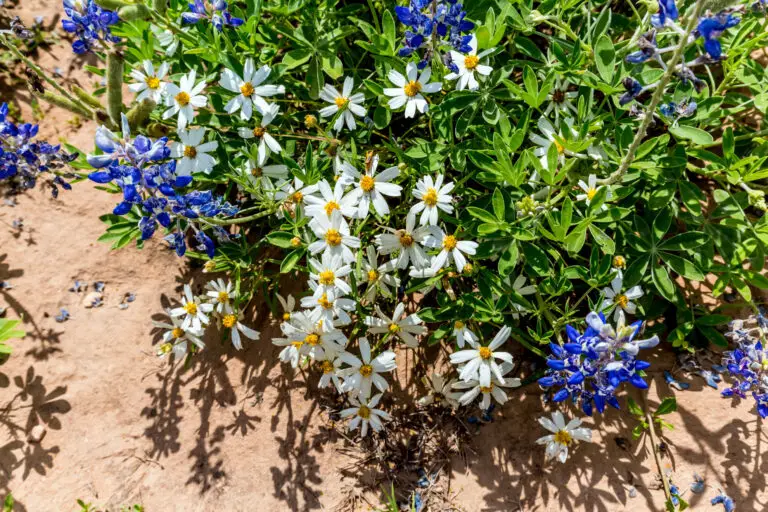
Full sun, all day. Blackfoot daisy wants the hottest, driest, most exposed spot you have. South-facing slopes, curbside strips, gaps between rocks, edges of driveways: these are its favorite places. The soil must drain fast.
Sandy, gravelly, rocky, or limestone-based ground is perfect. Alkaline soil (pH above 7) is ideal. If you have heavy clay, either skip this plant or build a raised bed with drainage.
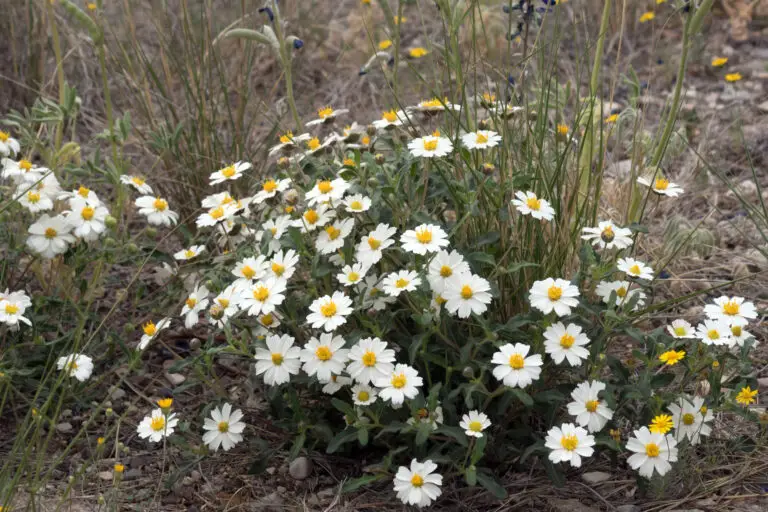
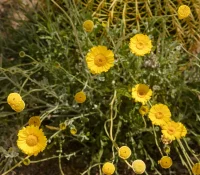
Proof that blackfoot daisy thrives in hot, full sun areas. Image by C K Kelly.
Spacing
Plant 12 to 18 inches apart. Each plant will mound to about 12 inches tall and up to 24 inches wide. Give them room to spread into their natural dome shape; crowding them leads to poor air circulation and powdery mildew.
Watering
Once established, almost none. Blackfoot daisy has a taproot that reaches deep for moisture. During the first growing season, water every week or two to help the roots get going. After that, step away. Overwatering is the fastest way to kill this plant. If your area gets occasional rain, that’s enough.
Garden Recipe™
Blackfoot Daisy
Melampodium leucanthum
Full sun
Sun
Easy
Effort
Short (under 3') tall 12-24 in wide
Size
Spring - Fall
Blooms
What it needs
Sunlight
Full sun, 6+ hoursSouth- or west-facing is ideal
Water
Likes it dryPick a spot that doesn't stay soggy after rain
Directions
Spacing
12-18 inAbout one forearm apart
Watering
Weekly for the first seasonAfter that, rain is usually enough
Notes
Comes back?
Yes, every yearGoes dormant in winter, that's normal. New growth each spring.
Deer resistant. Deer usually walk right past this one. If they've been snacking on your other plants, this one should be safe.
Fall is best in the Southwest, giving roots time to settle in before summer heat. Spring works too, but water a little more through the first summer to help the plant get established.
Fertilizer
None. Do not fertilize blackfoot daisy. Rich soil and extra nutrients will push fast, floppy growth and shorten the plant’s life. This is a plant that does its best work on a lean diet.
Pruning
In late winter, cut the plant back by about half to keep it compact and encourage fresh growth. You do not need to deadhead; blackfoot daisy keeps making new flowers without it. If the plant gets leggy or sparse in midsummer, a light trim can help it rebound.
Beginner Tip
Buy blackfoot daisy as transplants, not seeds. The taproot makes transplanting easier when the plant is small. Plant in fall for best results.
Potential challenges with blackfoot daisy
Short lifespan
Blackfoot daisy is a perennial, but it’s not a long-lived one. Expect three to five years from a healthy plant. The good news: it self-seeds freely, so new plants pop up around the original. If you let the seeds fall, you’ll always have blackfoot daisies. It’s less “one plant forever” and more “a self-sustaining colony.”
Overwatering and poor drainage
This is the number one way people kill blackfoot daisy. It needs dry, fast-draining soil. If you water on a regular schedule, or your soil holds moisture after rain, the roots will rot. The fix is simple: don’t water it. If you garden in a humid climate or have clay soil, this may not be your plant.
Powdery mildew
In hot, humid environments, blackfoot daisy can develop powdery mildew, a white, powdery coating on the leaves. NC State notes this as the plant’s main disease issue. Good air circulation helps: don’t crowd plants, and avoid overhead watering.
Not a transplant-friendly plant
Blackfoot daisy has a taproot, which means you can’t divide it or move it easily once it’s established. Plant it where you want it and leave it there. If you need more plants, let the seeds do the work, or start new ones from nursery transplants.
Rock gardens. This is blackfoot daisy’s natural habitat in miniature. Tuck it between boulders and let it spill over the edges. It looks like it’s been there forever.
Hellstrips and curbside strips. That narrow strip of baking soil between the sidewalk and the street? Blackfoot daisy will own it. No irrigation needed.
Gravel gardens and xeriscapes. The white flowers pop against a gravel or decomposed granite mulch. Clean, intentional, and zero maintenance.
Front yard borders. A low, continuous line of blackfoot daisy along a walkway or driveway reads as tidy and welcoming, especially when it’s covered in flowers for eight months straight.
Pollinator gardens. The long bloom season makes blackfoot daisy a reliable anchor plant. Pair it with desert marigold, autumn sage, and blackfoot daisy’s fellow Southwest natives for a garden that feeds pollinators from spring through frost.
Slope stabilization. The taproot anchors soil on dry, rocky inclines. Plant a grid and let the mounds knit together.
FAQs
Does blackfoot daisy spread?
It self-seeds, but it’s not aggressive. New seedlings pop up in rocky, gravelly areas near the parent plant. You can pull unwanted seedlings easily. The plant itself does not spread by runners or rhizomes.
Yes, and it’s a great container plant. Use a gritty, fast-draining cactus mix or blend of sand, gravel, and a little potting soil. Make sure the pot has a drainage hole. Water sparingly. A wide, shallow pot mimics the rocky conditions it loves.
How long does blackfoot daisy bloom?
In most of its range, March through November. That’s eight to nine months of flowers. Bloom may slow in the hottest weeks of July and August but doesn’t stop entirely.
Is blackfoot daisy the same as the annual melampodium sold at garden centers?
No. The tropical butter daisy (Melampodium divaricatum) is a yellow-flowered annual from Central America often sold as a bedding plant under the name “melampodium.” It’s a completely different plant. Blackfoot daisy is a white-flowered perennial native to the U.S. Southwest. Same genus, very different plants.
Why is it called blackfoot daisy?
The common name comes from the genus name, Melampodium, which is Greek for “black foot” (melas = black, podion = foot). It refers to the dark color at the base of the stems and roots. If you flip a flower head over, you’ll also find small, foot-shaped bracts that turn black when mature.
Plant Nerd Fact
A maybe cure for cancer in a tiny desert daisy.
In 2015, researchers at the University of Texas Health Science Center in San Antonio published a study in the Journal of Natural Products describing five chemical compounds they’d isolated from blackfoot daisy leaves and branches. All five were effective at killing human prostate and cervical cancer cells in lab tests.
One of those compounds, meleucanthin, was entirely new to science. A follow-up study in 2016 confirmed that several Texas native plants, blackfoot daisy among them, contain compounds that disrupt cancer cell division. The research is still early, and no one is prescribing blackfoot daisy as medicine, but the idea that this unassuming little desert daisy is hiding anticancer chemistry in its leaves is the kind of thing that makes you look at a plant differently.
What pairs well with blackfoot daisy?
Blackfoot daisy plays well with other Southwest natives that share its love of sun, lean soil, and sharp drainage. Here are some of the best pairings.
Blackfoot daisy is one of those rare plants that asks for almost nothing and gives back almost everything: months of honey-scented flowers, a tidy form that never needs fussing, food for pollinators and birds, and a quiet demonstration that the best-looking yards don’t have to be the most watered ones.
Cai, Shengxin, Jiangnan Peng, Andrew J. Robles, et al. “Melampodium leucanthum, a Source of Cytotoxic Sesquiterpenes with Antimitotic Activities.” Journal of Natural Products 78, no. 3 (2015): 388–395. https://doi.org/10.1021/np500768s. Accessed April 19, 2026.
North Carolina State Extension. “Melampodium leucanthum (Arnica, Blackfoot Daisy, Melampodium, Plains Blackfoot, Rock Daisy).” NC State University. https://plants.ces.ncsu.edu/plants/melampodium-leucanthum/. Accessed April 19, 2026.
Shaffer, Corena V., Shengxin Cai, Jiangnan Peng, et al. “Texas Native Plants Yield Compounds with Cytotoxic Activities against Prostate Cancer Cells.” Journal of Natural Products 79, no. 3 (2016): 531–540. https://doi.org/10.1021/acs.jnatprod.5b00908. Accessed April 19, 2026.
USDA PLANTS Database. “Melampodium leucanthum Torr. & A. Gray.” United States Department of Agriculture. https://plants.usda.gov/plant-profile/mele2. Accessed April 19, 2026.
Emily Lessard is the founder and editor of The Plant Native, the site that helps homeowners across North America get started with native plants. She holds a Sustainable Landscapes certificate through the Pennsylvania Landscape & Nursery Association, is finishing a Native Perennial Garden Design Certificate at Temple University, and is the author of Plant Native:A Practical Guide to Over 100 Native Plants of North America (Quarto, February 2027). She gardens outside Philadelphia in the 8.3 Southeastern Plains ecoregion.