

Highlights
Vines are the plot twist of the garden. One summer there’s a polite green tendril on the fence; the next, something has swallowed the mailbox. Here’s the catch: several of our best native vines have look-alikes from Asia that are a lot less polite, and from the sidewalk they can be hard to tell apart. This guide puts each native vine next to the look-alike it gets mixed up with, with the one or two clues that settle it, so you can decide whether to cheer it on or pull it out.
Most of these pairs can be told apart with a single clue: where the flowers sit, what the seed pods feel like, or which way the stem twists.
Vine vocabulary in one minute
A few words come up again and again when you’re identifying vines. You don’t need to memorize them, but they make the clues below a lot easier to use.
- Twining: the whole stem wraps around a support, like a ribbon around a maypole. Each twining species always coils the same direction, so direction can be a clue (looked at from above, some twist clockwise and some counterclockwise).
- Tendrils: thin, threadlike grabbers that reach out and curl around whatever they touch.
- Aerial rootlets: tiny roots along the stem that cling to walls, fences and tree bark.
- Simple or compound leaves: a simple leaf is one blade; a compound leaf is split into several small leaflets along one stem, like a feather.
- Opposite or alternate leaves: opposite leaves grow in pairs across from each other on the stem; alternate leaves take turns, one on each side.
The quick version
- Coral honeysuckle or Japanese honeysuckle? Red tubes with almost no scent, sitting in clusters at the stem tips, means native coral honeysuckle. White-to-yellow, very fragrant flowers in pairs along the stem means Japanese honeysuckle.
- American wisteria or Asian wisteria? Short, plump flower clusters after the leaves are out, then smooth pods, means American wisteria. Long, dangling clusters in early spring, then fuzzy pods, means Chinese or Japanese wisteria.
- American trumpet vine or Chinese trumpet vine? Narrow red-orange trumpets and leaflets that are fuzzy underneath means the native. Wide, flaring salmon trumpets and smooth leaflets means the import.
- American bittersweet or Oriental bittersweet? Berries only in clusters at the ends of the branches means native. Berries tucked all along the stem where the leaves meet it means Oriental bittersweet.
Honeysuckles
Honeysuckles (Lonicera) come as both vines and shrubs. The best native vine for gardens is coral honeysuckle, a hummingbird magnet. Its main look-alike is Japanese honeysuckle, the one you smell on June evenings, and two shrubby Asian honeysuckles round out the family’s most wanted list.
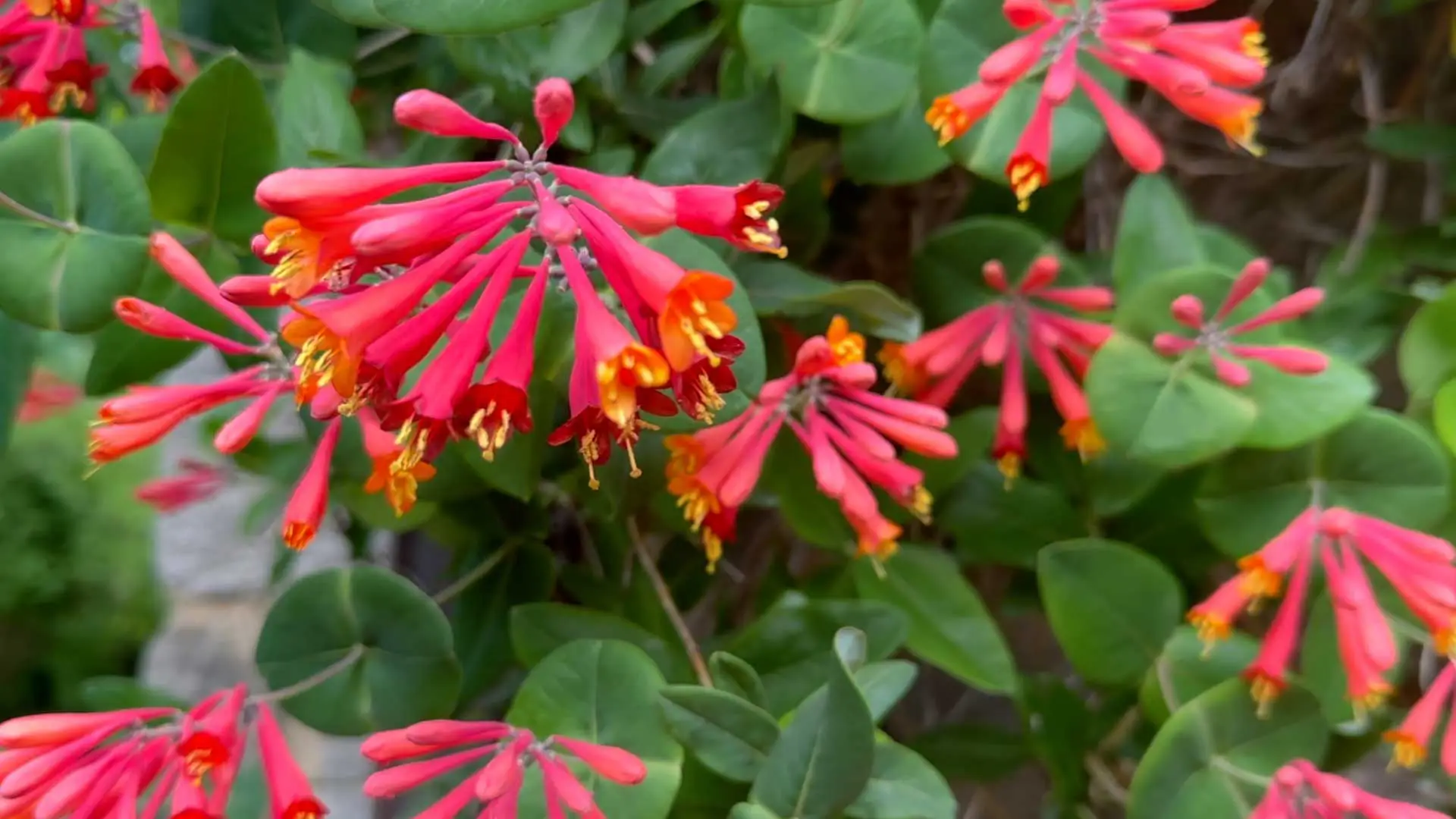
Coral honeysuckle (native)
- Red to coral tubes, yellow inside
- Almost no scent
- Flowers in clusters at the tips of the stems
- The top pair of leaves is fused into one round disk around the stem
- Red berries
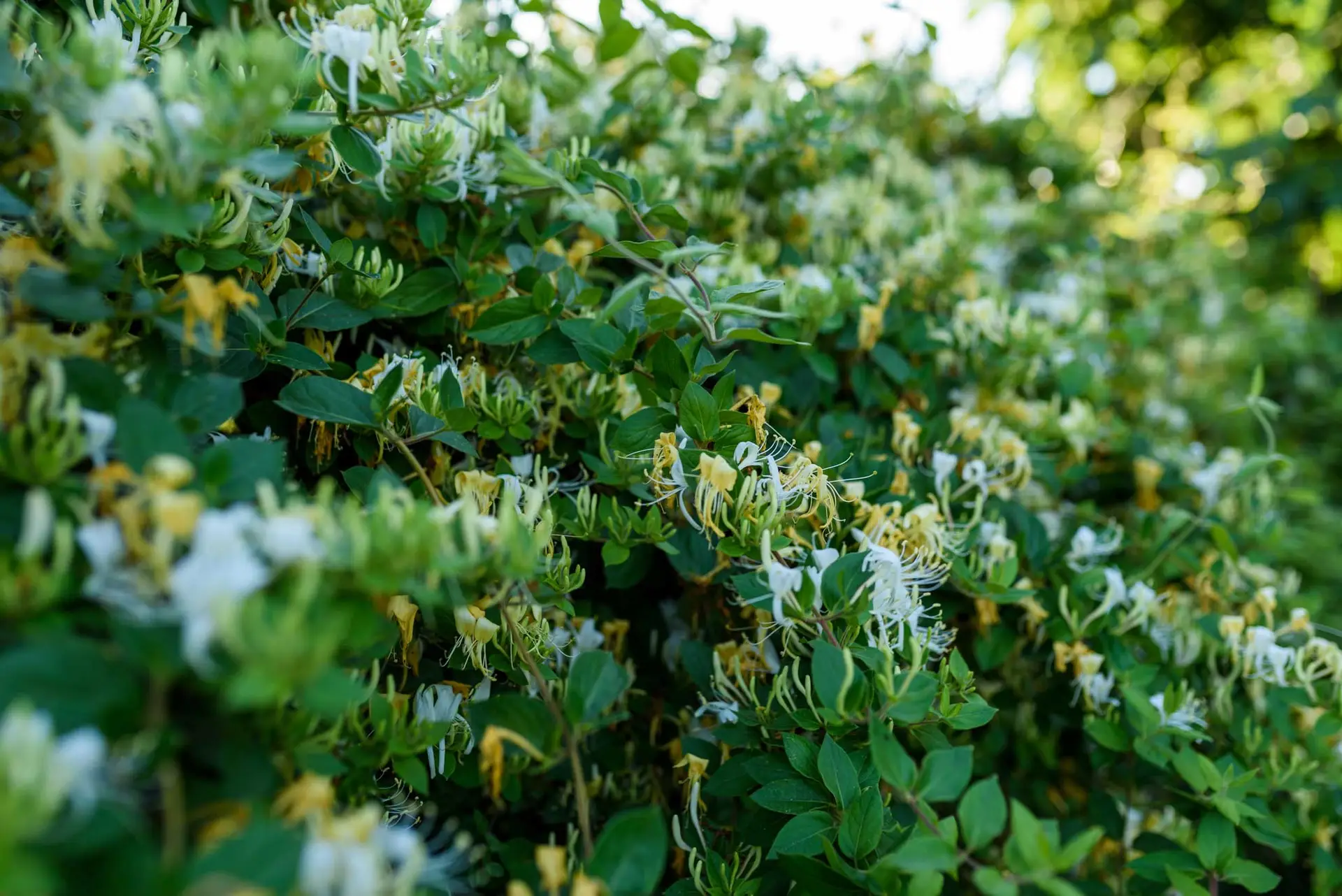
Japanese honeysuckle (invasive)
- White flowers that age to yellow
- Strong, sweet scent
- Flowers in pairs along the stem, where the leaves attach
- Leaves stay separate, never fused
- Black or purple berries
Coral honeysuckle (Lonicera sempervirens)
Status: Native
Where it’s native: Alabama, Arkansas, Connecticut, Delaware, Florida, Georgia, Illinois, Indiana, Kentucky, Louisiana, Maryland, Massachusetts, Michigan, Mississippi, Missouri, Nebraska, New Hampshire, New Jersey, New York, North Carolina, Ohio, Oklahoma, Pennsylvania, Rhode Island, South Carolina, Tennessee, Texas, Vermont, Virginia, Washington, D.C.
ID tips: Unlike Japanese honeysuckle, coral honeysuckle has almost no fragrance. Look just below a flower cluster: the last pair of leaves is joined into a single round leaf with the stem running through the middle, a detail no other vine in this guide has.
Japanese honeysuckle (Lonicera japonica)
Status: Invasive
Listed as invasive in: Alabama (listed), Connecticut (prohibited), Delaware (listed), Florida (regulated), Georgia (listed), Illinois (prohibited), Indiana (prohibited), Kentucky (listed), Maine (prohibited), Maryland (listed), Massachusetts (prohibited), Michigan (prohibited), Minnesota (prohibited), Missouri (listed), New Hampshire (prohibited), New Jersey (listed), New York (prohibited), North Carolina (listed), Ohio (prohibited), Ontario (listed), Pennsylvania (listed), Rhode Island (listed), South Carolina (listed), Tennessee (listed), Texas (listed), Vermont (listed), Virginia (restricted), West Virginia (listed), Wisconsin (prohibited).
ID tips: The flowers of Japanese honeysuckle are fairly distinctive, at least when compared to coral honeysuckle. They are white or yellow, fragrant, and bloom along the stem in pairs. The flowers are tube-like, opening up into two distinct “lips.” The thin, stringy stamens burst out of the center of the flower like a bouquet wrapped in decorative paper. Amur honeysuckle also has similar flowers, but those are less than an inch long. Japanese honeysuckle flowers are closer to two inches.
The berries are also a good indicator that you’re dealing with Japanese honeysuckle. Japanese honeysuckle has black or purple berries, while most other honeysuckles have red berries. Like the flowers, these berries sit in pairs along the stem.
The bush honeysuckles: Amur and Tartarian
While not technically vines, Amur honeysuckle (Lonicera maackii) and Tartarian honeysuckle (Lonicera tatarica) are two of the most common invasive honeysuckles, and their flowers look a lot like Japanese honeysuckle’s. Both are shrubs that fill woodland edges with a wall of green that leafs out early and holds its leaves late.
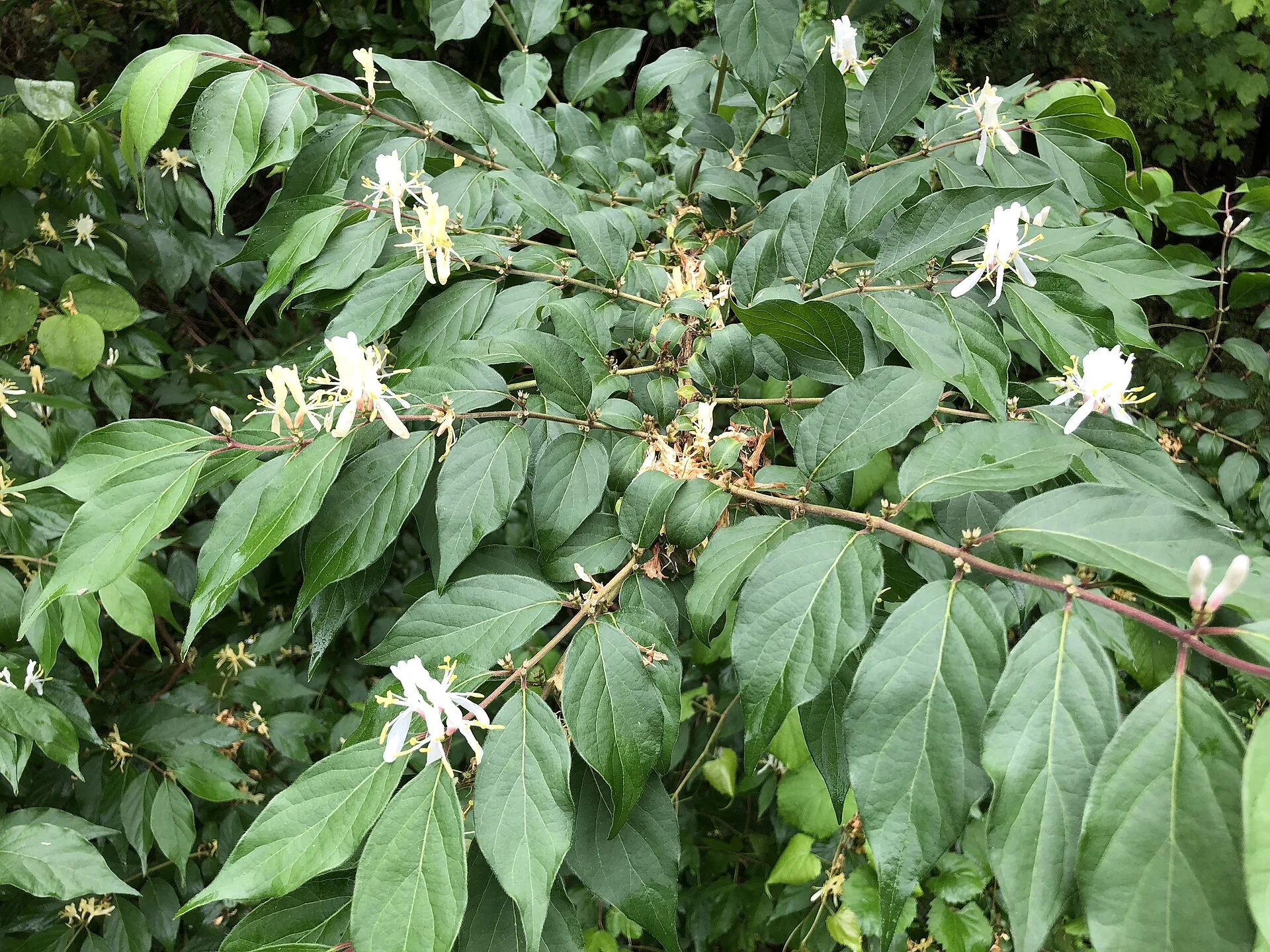
- Amur honeysuckle: a tall shrub, up to 15 feet or more, with leaves that taper to a long, sharp point. White flowers age to yellow, followed by red berries along the stems.
- Tartarian honeysuckle: a smaller shrub with smooth, blunt-tipped leaves and white to pink flowers, followed by red or orange berries.
- The twig test: snap a twig and look inside. Invasive bush honeysuckles are hollow (or filled with brown pith), while our native shrub honeysuckles are solid and white inside.
Amur honeysuckle is listed as invasive in: Alabama (listed), Connecticut (prohibited), Delaware (listed), Georgia (listed), Illinois (prohibited), Indiana (prohibited), Iowa (listed), Kentucky (listed), Maine (prohibited), Maryland (prohibited), Massachusetts (prohibited), Michigan (prohibited), Minnesota (restricted), Missouri (listed), New Hampshire (prohibited), New Jersey (listed), New York (prohibited), North Carolina (listed), Ohio (prohibited), Ontario (listed), Pennsylvania (listed), Rhode Island (listed), South Carolina (listed), Tennessee (listed), Texas (listed), Vermont (listed), Virginia (restricted), West Virginia (listed), Wisconsin (restricted).
Tartarian honeysuckle is listed as invasive in: Connecticut (prohibited), Delaware (listed), Illinois (prohibited), Indiana (prohibited), Kentucky (listed), Maine (prohibited), Massachusetts (prohibited), Michigan (prohibited), Minnesota (restricted), Missouri (listed), New Hampshire (prohibited), New Jersey (listed), New York (prohibited), North Carolina (listed), Ohio (prohibited), Ontario (listed), Pennsylvania (listed), Rhode Island (listed), Texas (listed), Vermont (listed), Virginia (listed), West Virginia (listed), Wisconsin (restricted).
Wisterias
Wisteria (Wisteria) is the vine most people picture dripping off a pergola, and most of those pergolas are holding Asian species. Our native American wisteria is the smaller, later-blooming cousin, and it has better manners: it won’t pull down the porch.

American wisteria (native)
- Blooms in late spring, after the leaves are out
- Short, plump clusters, about 4–6 inches long
- Smooth, hairless seed pods
- Grows at a moderate pace
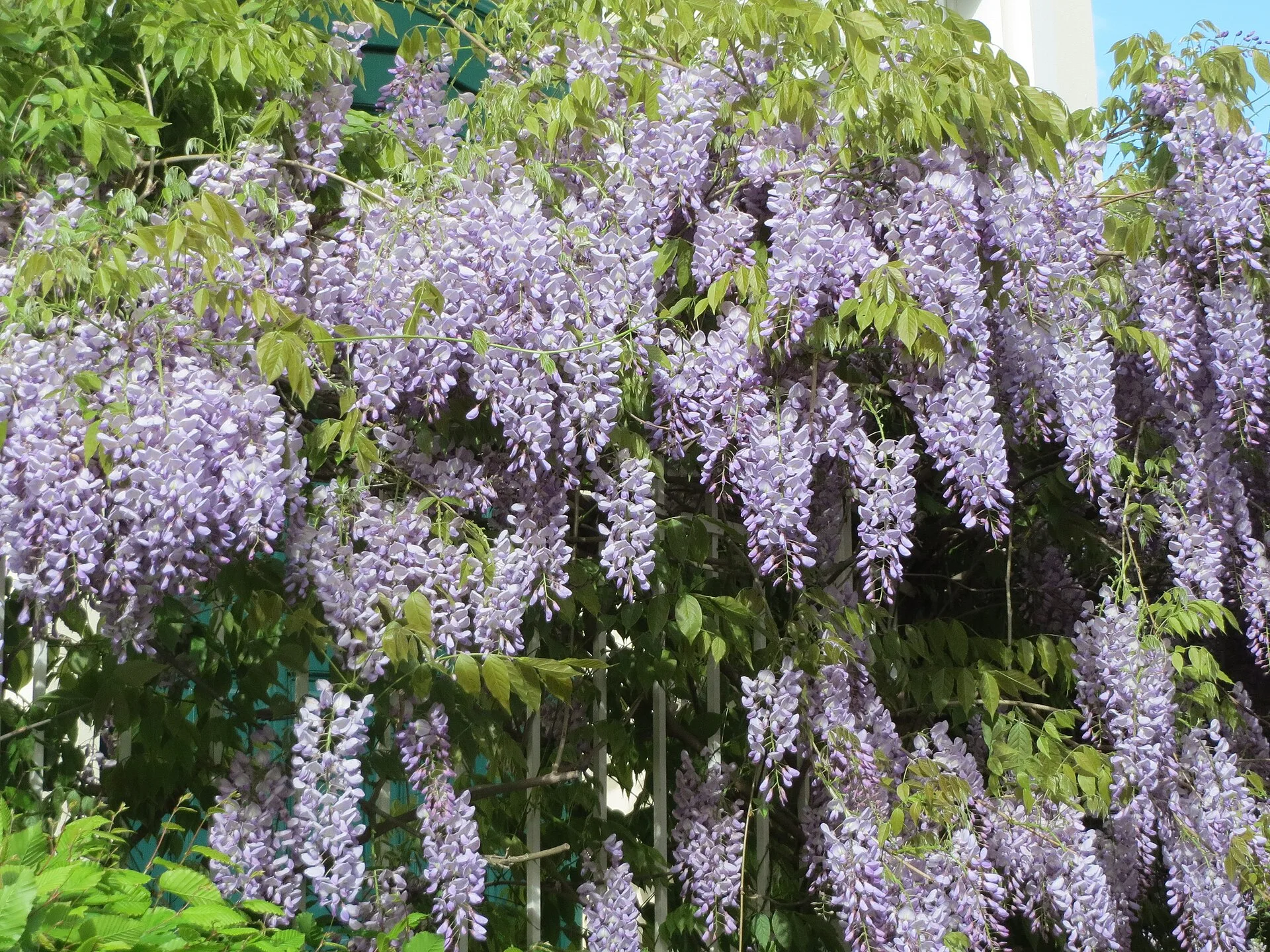
American wisteria (Wisteria frutescens)
Status: Native
Where it’s native: Alabama, Arkansas, Florida, Georgia, Illinois, Indiana, Kentucky, Louisiana, Maryland, Massachusetts, Michigan, Mississippi, Missouri, North Carolina, Ohio, Oklahoma, South Carolina, Tennessee, Texas, Virginia, Washington, D.C.
ID tips: Wait for the pods. American wisteria’s pods are smooth and hairless, while both Asian wisterias have fuzzy, velvety pods. The flower clusters are also a giveaway: American wisteria’s are short and full, and they open when the vine is already leafy.
The pod check: run a finger along a pod. Smooth means native; velvety means Asian.
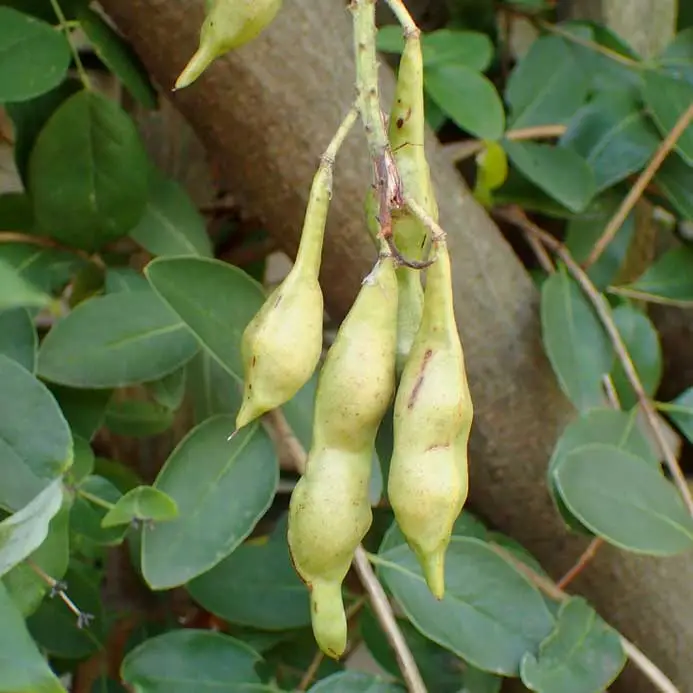
Smooth pods (native)
- Hairless, often slightly twisted when dry
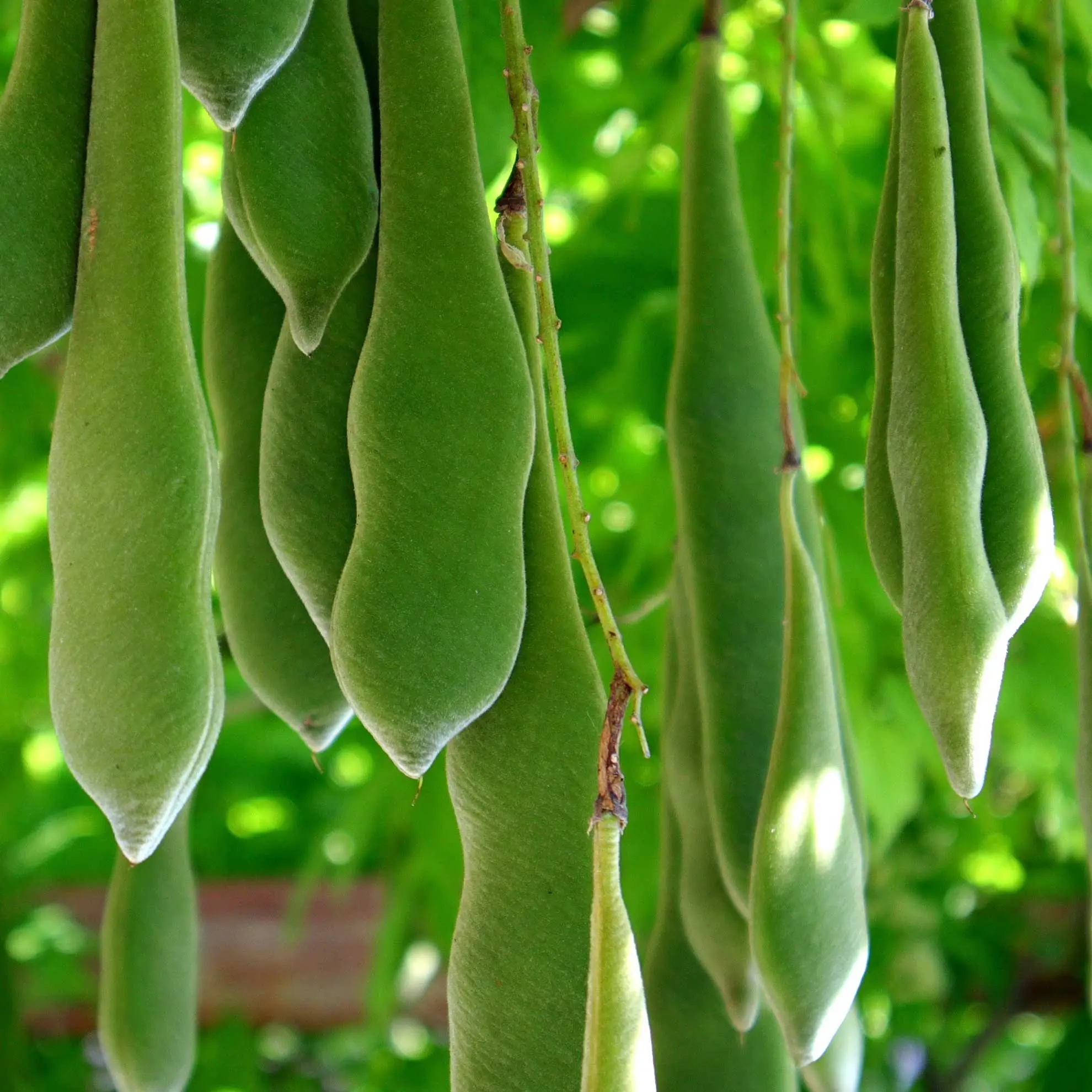
Fuzzy pods (invasive)
- Covered in soft, velvety hairs
Kentucky wisteria (Wisteria frutescens subsp. macrostachya)
Status: Native
Where it’s native: Alabama, Arkansas, Florida, Georgia, Kentucky, Louisiana, Mississippi, Oklahoma, South Carolina, Tennessee, Texas.
ID tips: Kentucky wisteria is a southern form of American wisteria (some references list it as its own species, Wisteria macrostachya). Its flower clusters are longer, closer to 8–12 inches, and it blooms a few weeks later, in early summer. It’s also the parent of ‘Blue Moon,’ a cold-hardy selection that flowers reliably even in northern gardens.
Japanese wisteria (Wisteria floribunda)
Status: Invasive
Listed as invasive in: Connecticut (prohibited), Georgia (listed), Kentucky (listed), Maine (listed), Maryland (prohibited), Missouri (listed), New Jersey (listed), North Carolina (listed), Pennsylvania (listed), Rhode Island (listed), South Carolina (listed), Tennessee (listed), Texas (listed), Virginia (listed), West Virginia (listed), Wisconsin (prohibited).
ID tips: The most distinctive characteristic of Japanese wisteria is the direction in which it twines. Both Chinese and American wisteria twine counterclockwise, but Japanese wisteria twines clockwise. It can also be distinguished from Chinese wisteria by how the flowers open. On Chinese wisteria, all flowers in each cluster open at about the same time. Japanese wisteria, however, blooms from the base of the flower cluster to the tip.
Chinese wisteria (Wisteria sinensis)
Status: Invasive
Listed as invasive in: Alabama (listed), Connecticut (prohibited), Delaware (listed), Florida (listed), Georgia (listed), Indiana (listed), Kentucky (listed), Maine (listed), Maryland (prohibited), Missouri (listed), New Jersey (listed), Pennsylvania (listed), Rhode Island (listed), South Carolina (listed), Tennessee (listed), Texas (listed), Virginia (listed), West Virginia (listed), Wisconsin (prohibited).
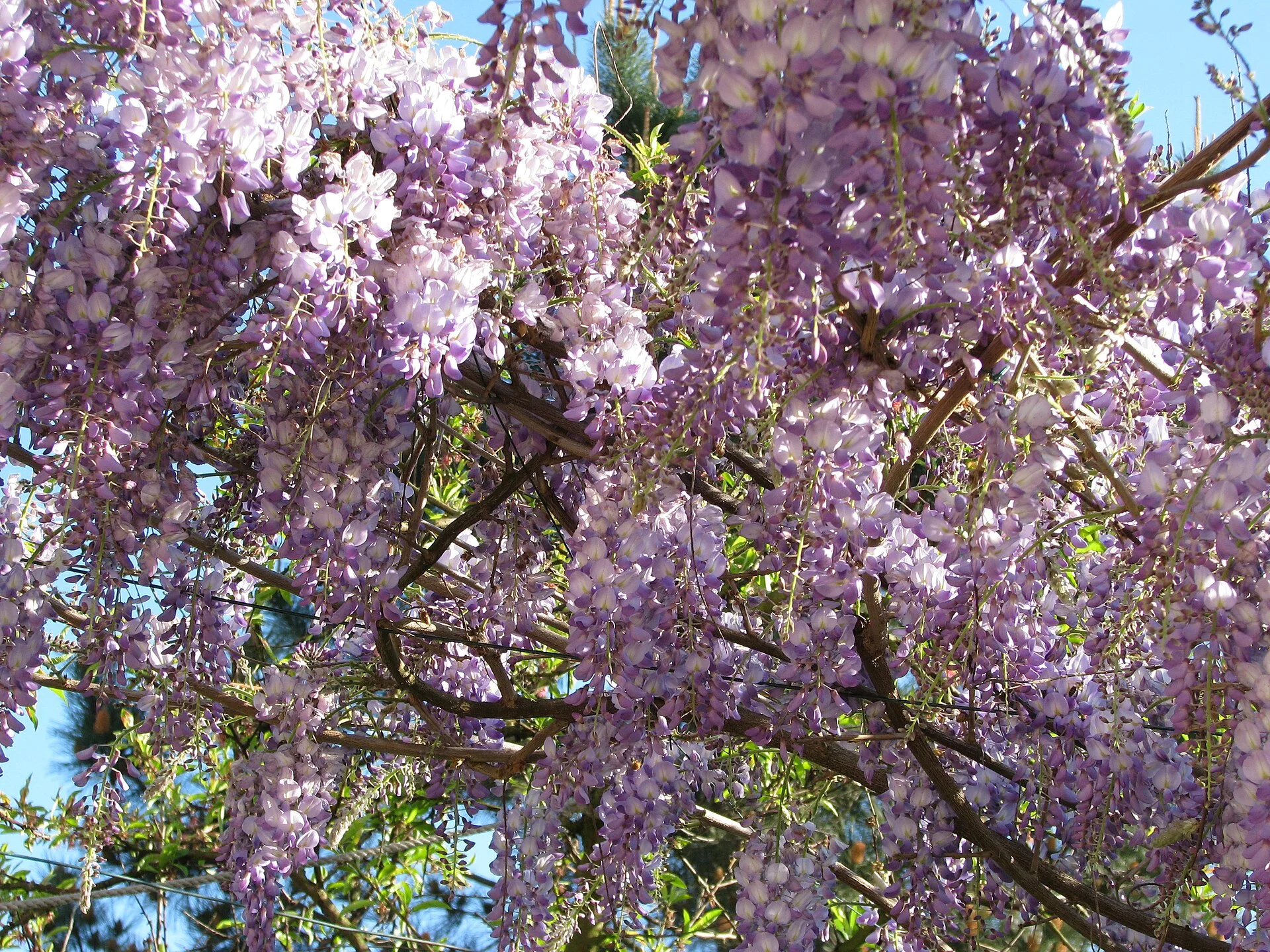
ID tips: Chinese wisteria is usually the first wisteria to bloom, often before its leaves appear, and its whole cluster opens at once for a short, dramatic show. Count the leaflets on one leaf: Chinese wisteria usually has 7 to 13, while Japanese wisteria has more, often 13 to 19. Both have fuzzy pods.
Trumpet vines and crossvine
These three climbers belong to the same family as catalpa trees, and all of them make trumpet-shaped flowers that hummingbirds adore. Two are native. The third is a garden import that, so far, has mostly stayed in the garden.

American trumpet vine (native)
- Narrow, red-orange trumpets in clusters at the stem tips
- Leaflets fuzzy underneath along the veins
- Climbs with aerial rootlets
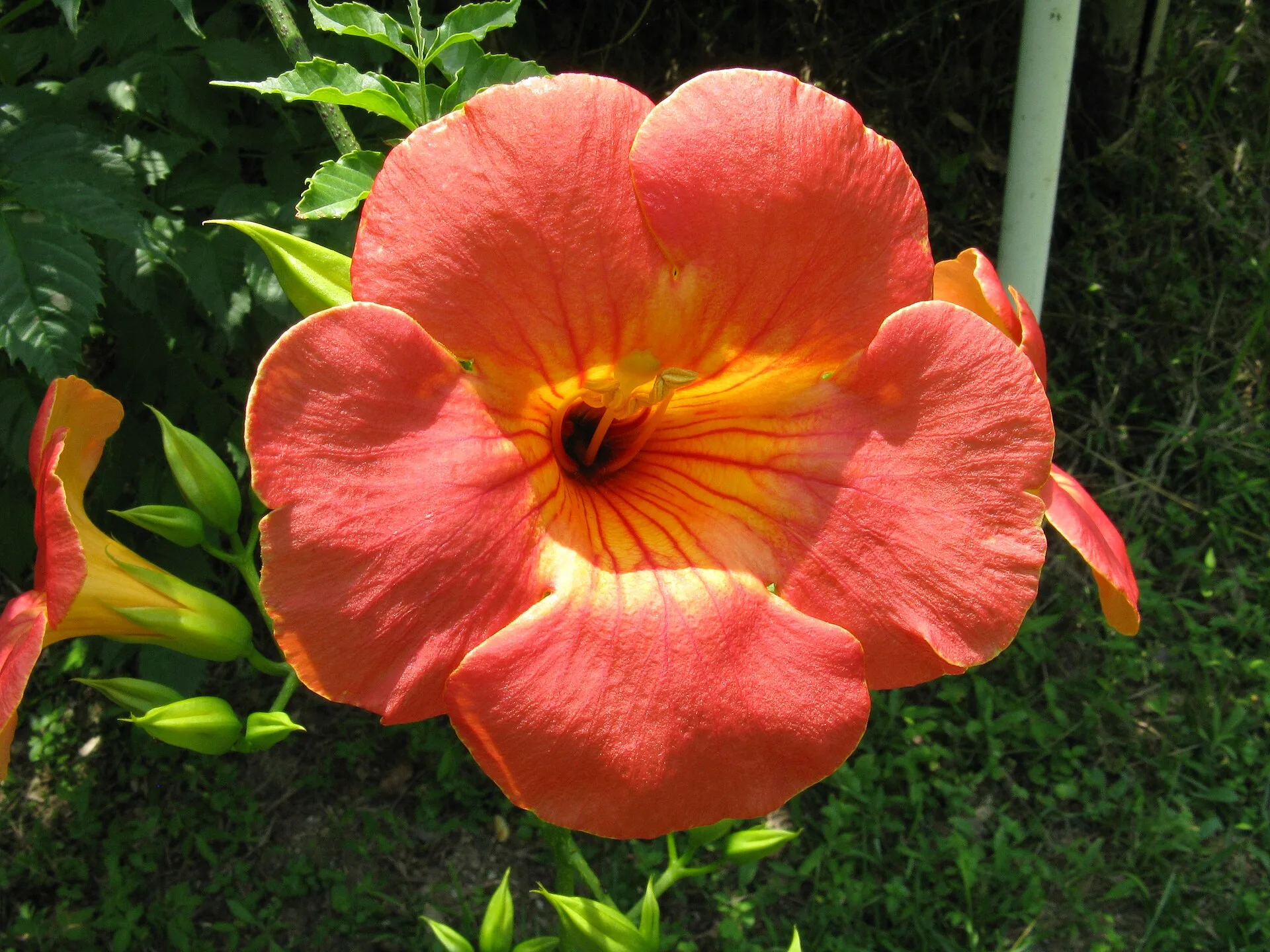
Chinese trumpet vine (introduced)
- Wide, flaring salmon-orange trumpets
- Leaflets smooth underneath
- Weaker rootlets, often needs tying in
American trumpet vine (Campsis radicans)
Status: Native, but can be a nuisance in small gardens
Where it’s native: Alabama, Arkansas, Delaware, Florida, Georgia, Illinois, Indiana, Kansas, Kentucky, Louisiana, Maine, Maryland, Massachusetts, Mississippi, Missouri, Nebraska, New Jersey, New York, North Carolina, North Dakota, Ohio, Oklahoma, Pennsylvania, South Carolina, South Dakota, Tennessee, Texas, Utah, Virginia, Washington, D.C., West Virginia, Wisconsin.
ID tips: When not in flower, trumpet vine can be a bit tough to distinguish from wisterias. Both have compound leaves with a similar number of leaflets. Look at how they attach, though: trumpet vine’s leaves grow in opposite pairs, and the vine climbs with little aerial rootlets instead of twining.
The seed pods of trumpet vine are fairly distinct when compared to the other plants on this list; this goes for both trumpet vines. Trumpet vine is in the same family as catalpa, so it has long seed pods that split open when mature. The wisterias also have seed pods, but these are legumes with bumps around each seed. Their seeds are round and pea-like, while the seeds of trumpet vine are flat and winged.
Chinese trumpet vine (Campsis grandiflora)
Status: Introduced, but not listed as invasive
ID tips: Chinese trumpet vine has bigger, more open flowers that flare wide at the mouth, often in a softer salmon-orange. Its leaflets are smooth underneath, while American trumpet vine’s leaflets are fuzzy along the veins on the underside. Nurseries also sell a hybrid of the two, ‘Madame Galen,’ which falls somewhere in between.
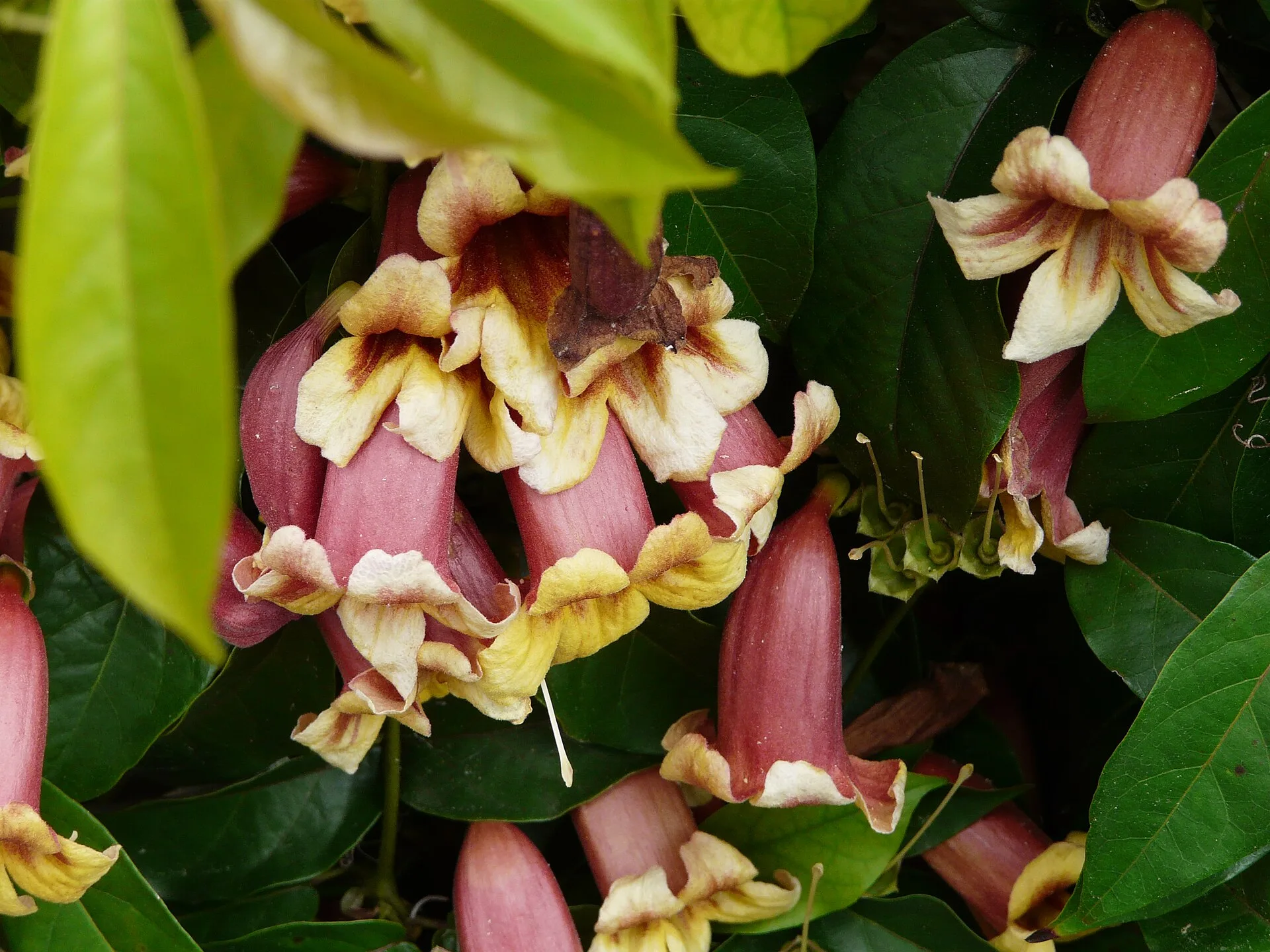
Crossvine (Bignonia capreolata)
Status: Native
Where it’s native: Alabama, Arkansas, Florida, Georgia, Illinois, Indiana, Kentucky, Louisiana, Maryland, Mississippi, Missouri, New Jersey, North Carolina, Ohio, Oklahoma, South Carolina, Tennessee, Texas, Virginia, West Virginia.
ID tips: Crossvine is the early riser of the group, blooming in spring with trumpets that are red-orange outside and yellow inside. Each leaf is just two leaflets with a branched tendril between them, and the leaves often hang on through winter, turning a purplish bronze. The name comes from the inside of the stem: cut an older stem crosswise and you’ll see a cross-shaped pattern.
Bittersweets
Bittersweet (Celastrus) gets noticed in fall, when its husks split open to show bright berries inside. The native and the invasive look almost identical in a wreath, so check the vine, not the cuttings.
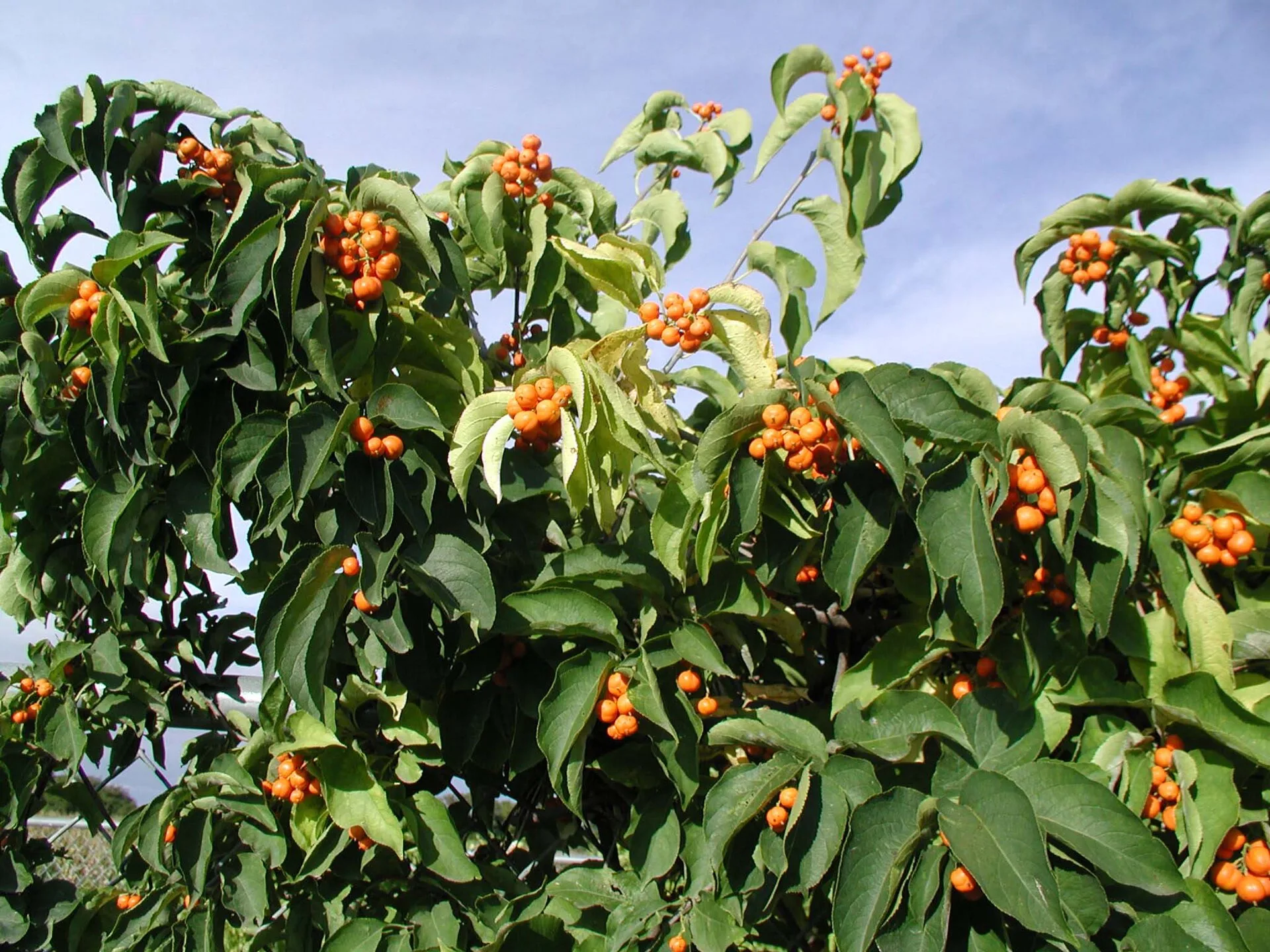
American bittersweet (native)
- Flowers and berries in clusters only at the ends of the branches
- Leaves about twice as long as they are wide, with a pointed tip
- Orange husks around red berries
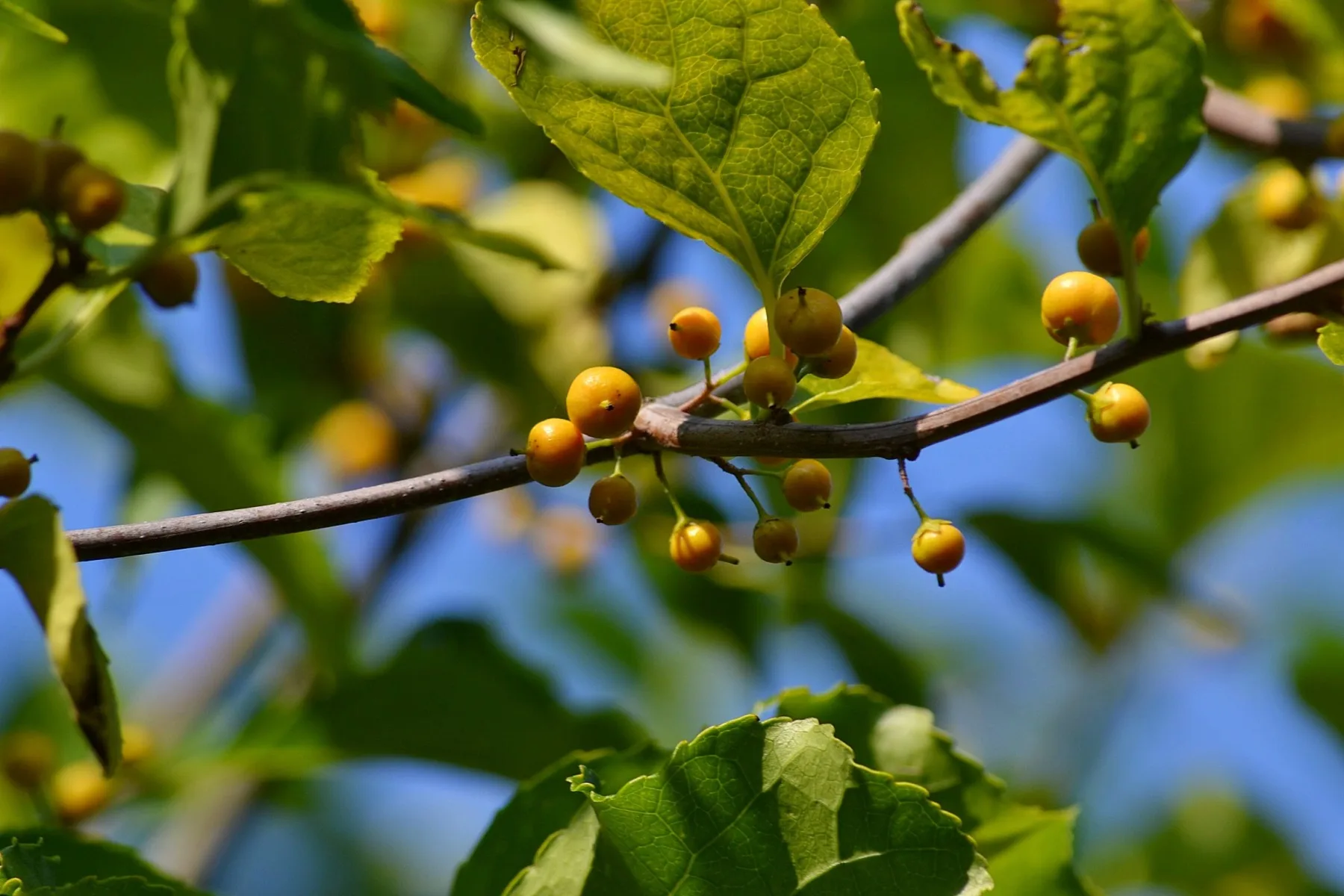
Oriental bittersweet (invasive)
- Flowers and berries in small clusters all along the stem, where the leaves attach
- Leaves nearly round
- Yellow husks around red-orange berries
American bittersweet (Celastrus scandens)
Status: Native
Where it’s native: Alabama, Arkansas, Connecticut, Georgia, Illinois, Indiana, Iowa, Kansas, Kentucky, Louisiana, Maine, Maryland, Massachusetts, Michigan, Minnesota, Mississippi, Missouri, Montana, Nebraska, New Hampshire, New Jersey, New York, North Carolina, North Dakota, Ohio, Oklahoma, Pennsylvania, Rhode Island, South Dakota, Tennessee, Texas, Vermont, Virginia, Washington, D.C., West Virginia, Wisconsin, Wyoming.
ID tips: Look at where the fruit sits. On American bittersweet, the berries hang in a bunch at the very end of each branch. On Oriental bittersweet, they’re tucked along the length of the stem, a few at every leaf.
Oriental bittersweet (Celastrus orbiculatus)
Status: Invasive
Listed as invasive in: Alabama (listed), Connecticut (prohibited), Delaware (listed), Georgia (listed), Illinois (prohibited), Indiana (prohibited), Iowa (listed), Kentucky (listed), Maine (prohibited), Massachusetts (prohibited), Michigan (prohibited), Minnesota (prohibited), Missouri (listed), New Hampshire (prohibited), New Jersey (listed), New York (prohibited), North Carolina (listed), Ohio (prohibited), Ontario (listed), Oregon (prohibited), Pennsylvania (listed), Rhode Island (listed), South Carolina (listed), Tennessee (listed), Vermont (listed), Virginia (restricted), West Virginia (listed), Wisconsin (restricted).
ID tips: Besides the berries along the stem, Oriental bittersweet’s leaves are rounder, and the vine is far more vigorous, wrapping young trees tightly enough to girdle them. If you bring home bittersweet for fall decorating, bag it and put it in the trash afterward rather than the compost pile, since birds and compost both spread the seeds.
Native vines to plant instead
Found an invasive vine on your fence? The good news is that the fence is ready for something better. Each of these natives climbs, blooms and feeds wildlife, without taking over the neighborhood.


Vines are some of the most generous plants you can grow: they turn a bare fence, a mailbox post or a porch rail into a hummingbird stop without taking up any ground. Once you know the clues, the look-alikes stop being a mystery. Sniff the flowers, check where the berries sit, run a finger along a pod, and you’ll know what you’re working with. Then hand the fence to a native and let it climb. Happy planting!
Sources
- Borland, Kim, Suzan Campbell, Rebecca Schillo, and Phyllis Higman. A Field Identification Guide to Invasive Plants in Michigan’s Natural Communities. Michigan State University Extension, December 2009. https://mnfi.anr.msu.edu/invasive-species/InvasivePlantsFieldGuide.pdf. Accessed July 30, 2026.
- Cutler, Karen Davis. “Flowering Vines 101.” bbg.org, April 1, 1999. https://www.bbg.org/article/flowering_vines_101. Accessed July 29, 2026.
- Huebner, Cynthia D., Cassandra Olsen, and Heather C. Smith. Invasive Plants Field and Reference Guide: An Ecological Perspective of Plant Invaders of Forests and Woodlands. USDA Forest Service, 2005. https://www.govinfo.gov/app/details/GOVPUB-A13-PURL-gpo86254. Accessed July 28, 2026.
- Invasive Plant Atlas of the United States. “Amur Honeysuckle (Lonicera maackii).” https://www.invasiveplantatlas.org/subject.cfm?sub=3040. Accessed July 29, 2026.
- Invasive Plant Atlas of the United States. “Chinese Wisteria (Wisteria sinensis).” https://www.invasiveplantatlas.org/subject.html?sub=3083. Accessed July 29, 2026.
- Invasive Plant Atlas of the United States. “Japanese Honeysuckle (Lonicera japonica).” https://www.invasiveplantatlas.org/subject.cfm?sub=3039. Accessed July 29, 2026.
- Invasive Plant Atlas of the United States. “Japanese Wisteria (Wisteria floribunda).” https://www.invasiveplantatlas.org/subject.cfm?sub=3082. Accessed July 29, 2026.
- Invasive Plant Atlas of the United States. “Round Leaf Bittersweet (Celastrus orbiculatus).” https://www.invasiveplantatlas.org/subject.cfm?sub=3012. Accessed July 29, 2026.
- Invasive Plant Atlas of the United States. “Tartarian Honeysuckle (Lonicera tatarica).” https://www.invasiveplantatlas.org/subject.cfm?sub=3043. Accessed July 29, 2026.
- Kew, Royal Botanic Gardens. World Checklist of Vascular Plants (WCVP), version 16. Accessed October 6, 2026.
- Lady Bird Johnson Wildflower Center. “Bignonia capreolata (Crossvine).” https://www.wildflower.org/plants/result.php?id_plant=BICA. Accessed July 28, 2026.
- Lady Bird Johnson Wildflower Center. “Campsis radicans (Trumpet Creeper).” https://www.wildflower.org/plants/result.php?id_plant=cara2. Accessed July 28, 2026.
- Lady Bird Johnson Wildflower Center. “Celastrus scandens (American Bittersweet).” https://www.wildflower.org/plants/result.php?id_plant=CESC. Accessed July 28, 2026.
- Lady Bird Johnson Wildflower Center. “Lonicera sempervirens (Coral Honeysuckle).” https://www.wildflower.org/plants/result.php?id_plant=lose. Accessed July 28, 2026.
- Lady Bird Johnson Wildflower Center. “Wisteria frutescens (American Wisteria).” https://www.wildflower.org/plants/result.php?id_plant=WIFR. Accessed July 28, 2026.
- Master Gardeners of Northern Virginia. “Twine.” mgnv.org. https://mgnv.org/plants/glossary/glossary-twine/. Accessed July 20, 2026.
- Missouri Botanical Garden. “Wisteria macrostachya ‘Blue Moon’.” https://plantfinder.mobot.org/PlantFinderDetails.aspx?taxonid=265854. Accessed July 28, 2026.
- Morton Arboretum. “Kentucky Wisteria.” https://mortonarb.org/plant-and-protect/trees-and-plants/kentucky-wisteria/. Accessed July 28, 2026.
- NatureServe Explorer. State status records for Bignonia capreolata, Campsis radicans, Celastrus scandens, Lonicera sempervirens and Wisteria frutescens. https://explorer.natureserve.org/. Accessed October 6, 2026.
- North Carolina State Extension. Plant Toolbox entries for Bignonia capreolata, Campsis grandiflora, Campsis radicans, Celastrus orbiculatus, Celastrus scandens, Lonicera japonica, Lonicera maackii, Lonicera sempervirens, Lonicera tatarica, Wisteria floribunda, Wisteria frutescens and Wisteria sinensis. https://plants.ces.ncsu.edu/. Accessed July 28, 2026.
- Palazzola, Elizabeth, John Bradtke, and Robyn J. Burnham. “Campsis radicans.” climbers.lsa.umich.edu. https://climbers.lsa.umich.edu/campsis-radicans/. Accessed July 28, 2026.
- Penny, Larry. “Nature Notes: Round and Round.” easthamptonstar.com, February 8, 2012. https://www.easthamptonstar.com/archive/nature-notes-round-and-round. Accessed July 29, 2026.
- Plants of the World Online. “Wisteria frutescens subsp. macrostachya.” powo.science.kew.org. https://powo.science.kew.org/taxon/urn:lsid:ipni.org:names:77199029-1. Accessed June 28, 2026.
- South Carolina Native Plant Society. “Invasive Plants: What’s in a Name?” scnps.org, November 11, 2024. https://scnps.org/invasive-plants-whats-in-a-name/. Accessed July 28, 2026.
- Toi Moana Bay of Plenty Regional Council. “Japanese Honeysuckle.” boprc.govt.nz. https://www.boprc.govt.nz/environment/pests/pest-plants/climber/japanese-honeysuckle/. Accessed July 29, 2026.
- University of Maryland Extension. “Chinese and Japanese Wisteria: Invasive Species Fact Sheet.” https://extension.umd.edu/resource/chinese-and-japanese-wisteria/. Accessed July 28, 2026.
- USDA PLANTS Database. Profiles for BICA, CARA2, CEOR7, CESC, LOJA, LOMA6, LOSE, LOTA, WIFL, WIFR and WISI. https://plants.usda.gov/. Accessed July 28, 2026.
- US Forest Service. “Invasive Plants.” fs.usda.gov, 2025. https://www.fs.usda.gov/wildflowers/invasives/index.shtml. Accessed July 28, 2026.
Updated
The ads on this site help pay real native plant nerds to research and write these guides.


