

Highlights
Sneezeweed has a terrible name and a great flower. Picture a badminton birdie: a round, domed center with fan-shaped petals swept back from it, in yellow, copper, rust and brick red. It opens in late summer and keeps going until frost, right when the bees are frantic and the rest of the border has quit.
And no, it won’t give you hay fever. The name comes from people grinding the dried flowers into snuff to make themselves sneeze on purpose.
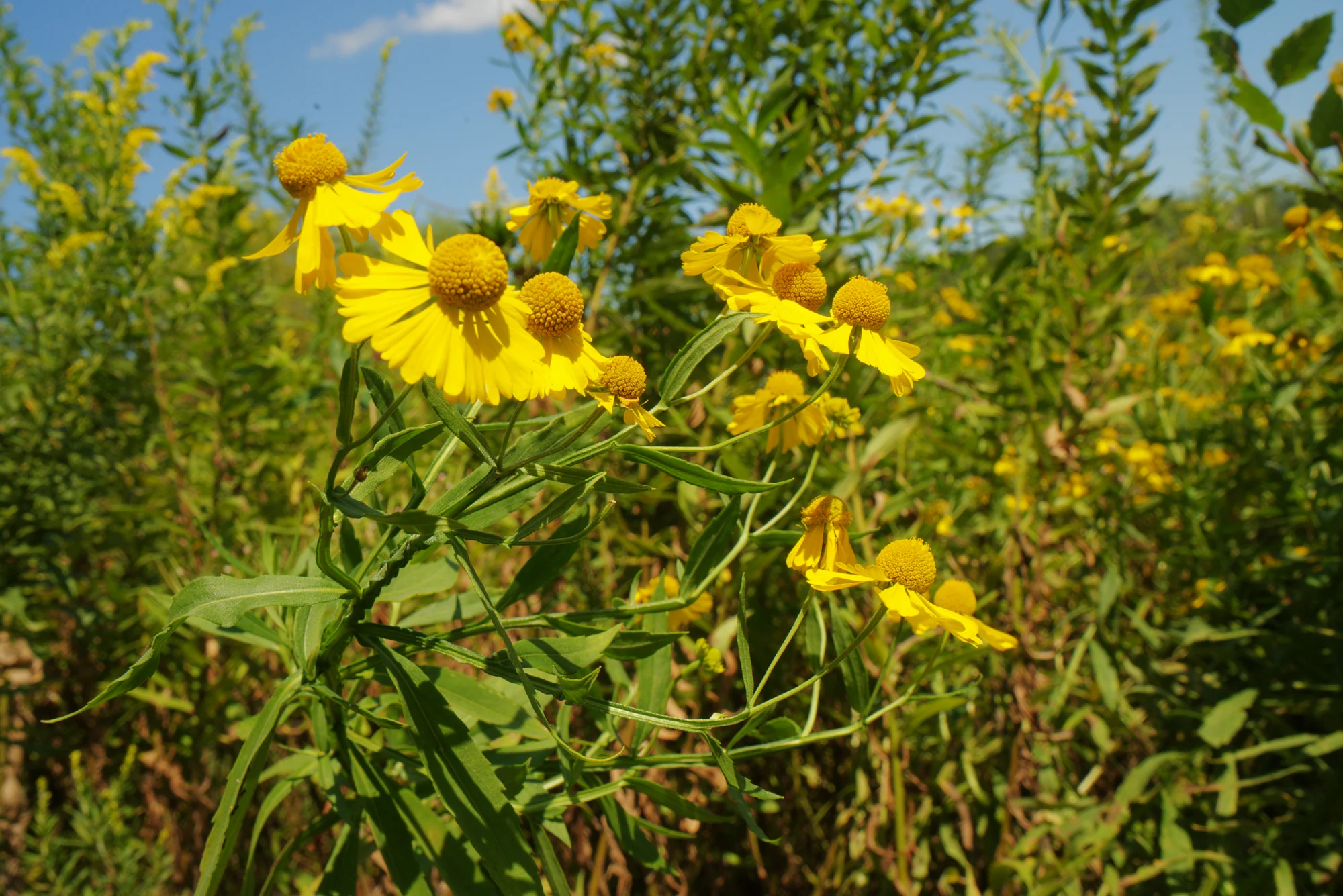
Is a native sneezeweed a good choice for my yard?
Yes, if…
- Your yard goes quiet in August. Most native perennials front-load the season. Common sneezeweed runs from late summer to frost.
- You have a sunny spot that stays damp. A rain garden, a ditch, the soggy end of the yard. That’s its native habitat, not a compromise.
- You want fall color that isn’t purple or gold. Sneezeweed brings copper, rust and brick.
- Deer are a problem. Rutgers rates common sneezeweed “seldom severely damaged,” and NC State tags it deer resistant.
Skip it if…
- Your soil is dry and you don’t water. This is the deal breaker. In dry ground sneezeweed limps along for a season or two and then quietly disappears.
- You want a plant that stands up on its own. The tall ones flop, and Mt. Cuba Center found most of theirs needed staking. A tomato cage in spring takes care of it.
- You keep sheep, goats or cattle. The genus is toxic to grazing animals, and one species turns milk bitter. More on that below.
- You’re outside its range. Common sneezeweed covers most of the country, but check your state on the map in each species card before you buy.
Why is it called sneezeweed?
Nobody gets hay fever from a sneezeweed. Its flowers are pollinated by insects, so the pollen is heavy and sticky and doesn’t ride the wind. The U.S. Forest Service puts it plainly: insects pollinate common sneezeweed, not wind.
The sneezing was the point. Dried flower heads were ground into snuff to clear a stuffed-up head, and that idea turns up in four far-apart corners of the continent. Menominee and Meskwaki records from the western Great Lakes describe a snuff of the dried flowers for colds and headaches, and Cherokee records describe powdered dry leaves used to bring on a sneeze, all from common sneezeweed. On the southern Plains, Comanche records describe pulverized flowers of smallhead sneezeweed inhaled to clear the nose. In coastal California, Costanoan records describe the same use of rosilla. Three species, one idea.
You’ll see it written that the snuff was meant to drive out evil spirits. We looked, and that motive doesn’t appear in the original records we could find, which talk about colds, congestion and headache. It seems to have entered through garden writing, so we’d rather not repeat it.
One real caution is about touch, not breath. The same bitter compounds can cause a skin rash in some people, so wear gloves if you’re cutting a lot of it back.
Why native sneezeweed matters
It blooms in the hungry month
By September most of what a bee can eat is finished. Bumble bee colonies are raising next year’s queens right then, and those queens have to fatten up before they go underground alone for the winter. Sneezeweed is open, flat, easy to land on and loaded with pollen through that whole stretch. Watch a stand at ten in the morning in late September and it will be busier than anything else in the yard.
Specialist bees use it, though not the ones you’ve read about
Common and purplehead sneezeweed both appear on Fowler and Droege’s host lists for pollen specialist bees, including Svastra petulca, Svastra aegis, Dianthidium curvatum and Megachile parallela, with several Melissodes in the central states. To be precise, none of these is a sneezeweed-only bee. They specialize on the aster family and count sneezeweed among their hosts. That’s still a real relationship, and still a reason to plant it.
The caterpillar number is small, and that’s fine
We check every host-plant claim against the Shropshire-Tallamy caterpillar records, and here they say something unflattering: sneezeweed hosts 11 species of native moths and butterflies. Goldenrods host 181 and asters 162. If you’re choosing a plant to feed baby birds, those two come first, and we’d rather tell you that than inflate a number.
Sneezeweed earns its place another way: pollen and nectar in the weeks when both are scarce, and seed heads goldfinches pick over into fall. Plant it next to the goldenrod, not instead of it.
Plant it next to the goldenrod, not instead of it.
Sneezeweed, black-eyed Susan or blanket flower?
Sneezeweed blooms in the same weeks, and often the same wet meadows, as a few look-alikes. Two quick checks sort most of them out, no hand lens needed.
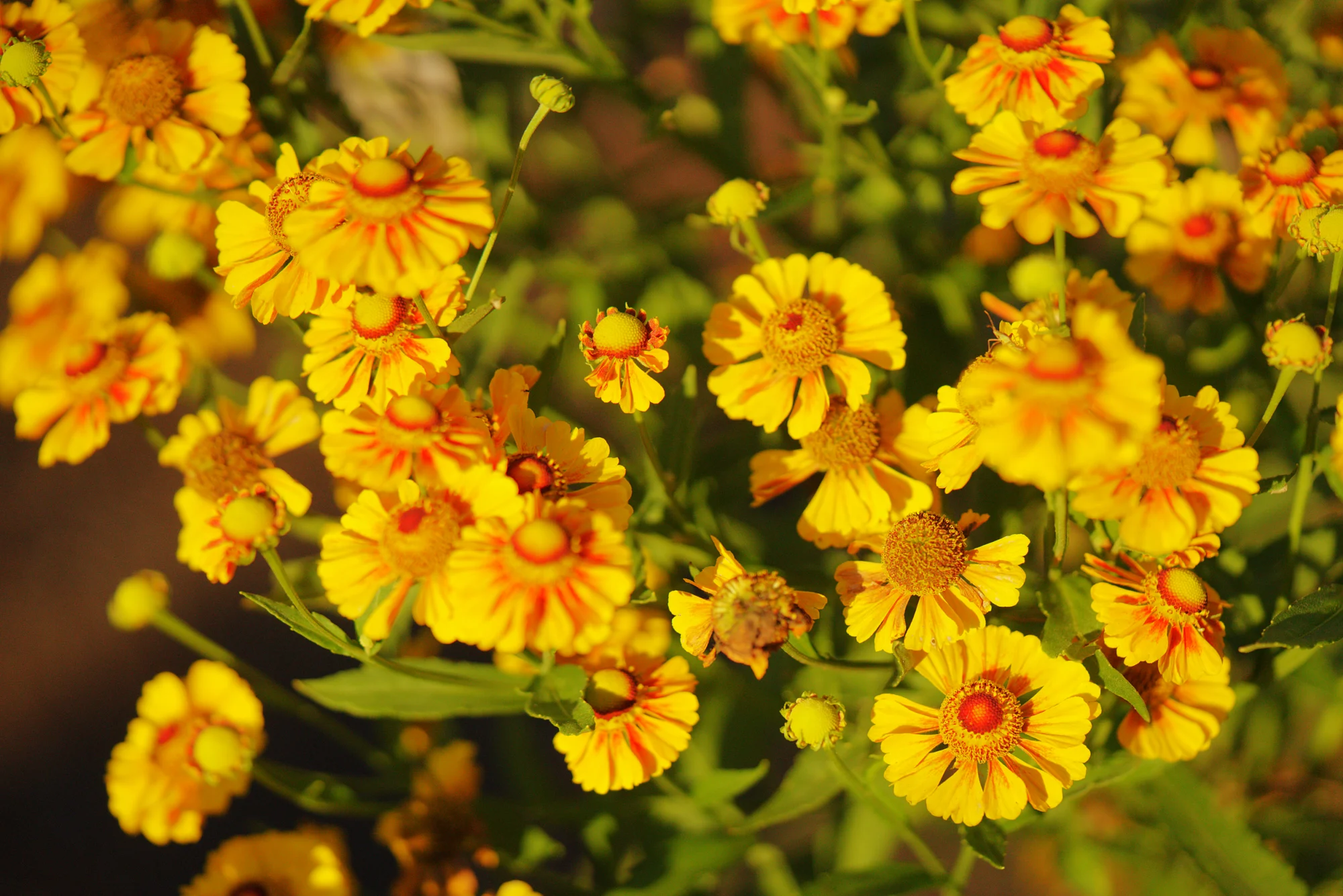
Run your thumb down the stem
On most sneezeweeds, the base of each leaf runs down the stem as a thin green flange, so the stem feels ridged and winged instead of round. Flora of North America calls these leaves decurrent. Black-eyed Susans, prairie coneflowers and blanket flowers don’t do this.
Split a flower head open
A sneezeweed center is smooth between the tiny florets. Black-eyed Susan, prairie coneflower and false sunflower pack theirs with stiff papery scales, so a cut head looks bristly inside. If it’s chaffy, it’s not a sneezeweed.
The one that fools people
Blanket flower (Gaillardia) has three-toothed petal tips too, and no papery scales, so those tests won’t separate them. Look at how it’s built instead: blanket flower holds one flower per stalk on a round stem, while sneezeweed branches into a spray of many heads on a winged one. False sunflower also has leaves in opposite pairs all the way up the stem, and sneezeweed doesn’t.
The exception to the winged-stem rule is bitterweed, Helenium amarum, which has round stems and thread-fine leaves. It’s also the one sneezeweed you’re not trying to grow (see below).
Meet the native sneezeweeds
There are about 32 species of sneezeweed, all from the Americas, and 18 grow wild in the U.S. These five are the ones worth knowing for a garden.
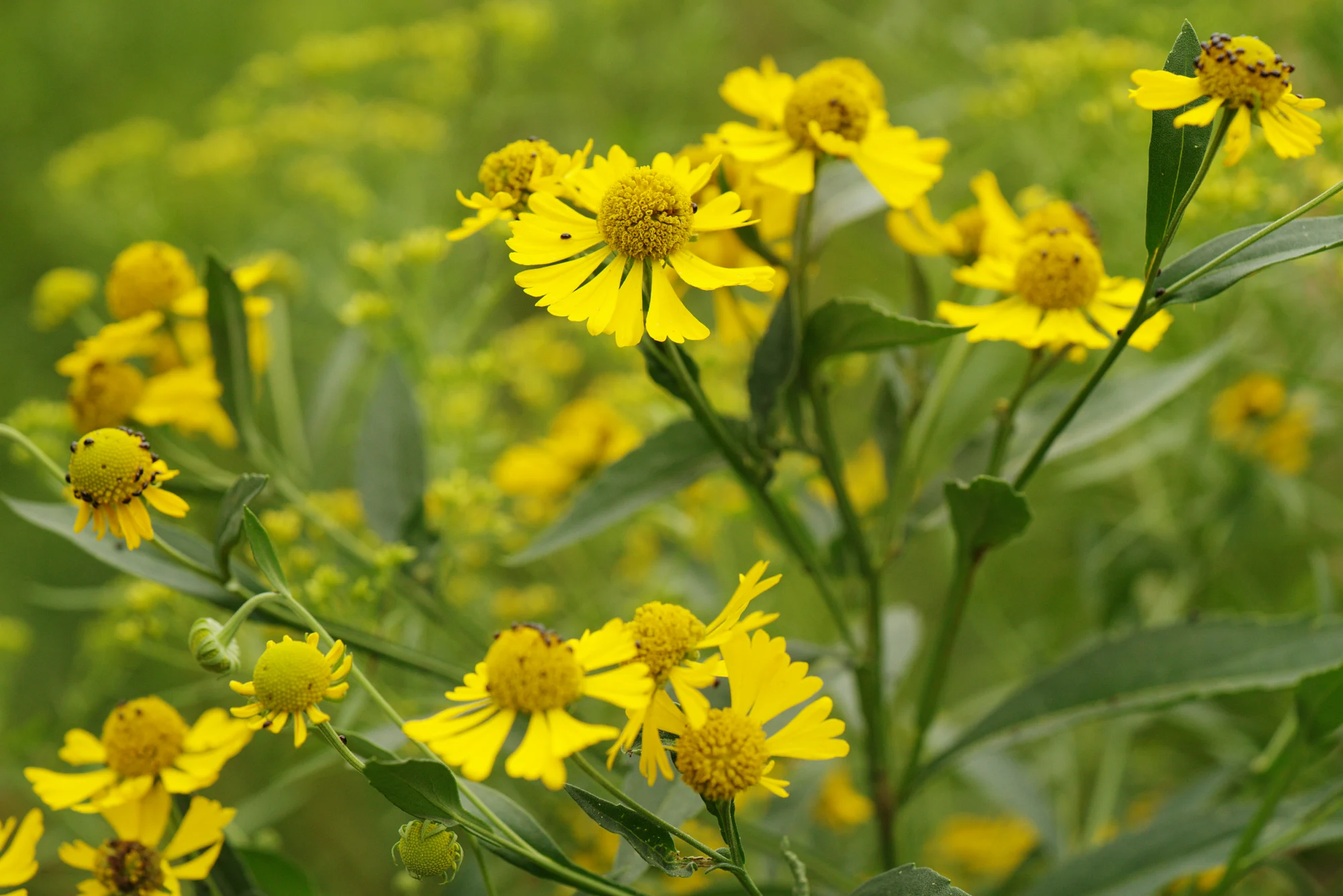
Common sneezeweed
Helenium autumnale
This is the one people mean, and the easiest to find. It grows across most of the continent in wet meadows and along streams and ponds. Stems carry dozens of heads at once, yellow rays around a greenish-yellow dome. In rich soil or part shade it leans, which is the main complaint about it. In Mt. Cuba Center’s trial, the straight species drew more bee and wasp visits than the top-rated cultivar.
- Height: 3 to 5 feet
- Flower color: yellow
- Bloom time: August to October
- Sun: full sun, takes a little afternoon shade
- Soil: moist to wet; handles standing water
- Zones 3 to 8
- Native regions: Northeast, Mid-Atlantic, South, Midwest, Southwest, California and Northwest
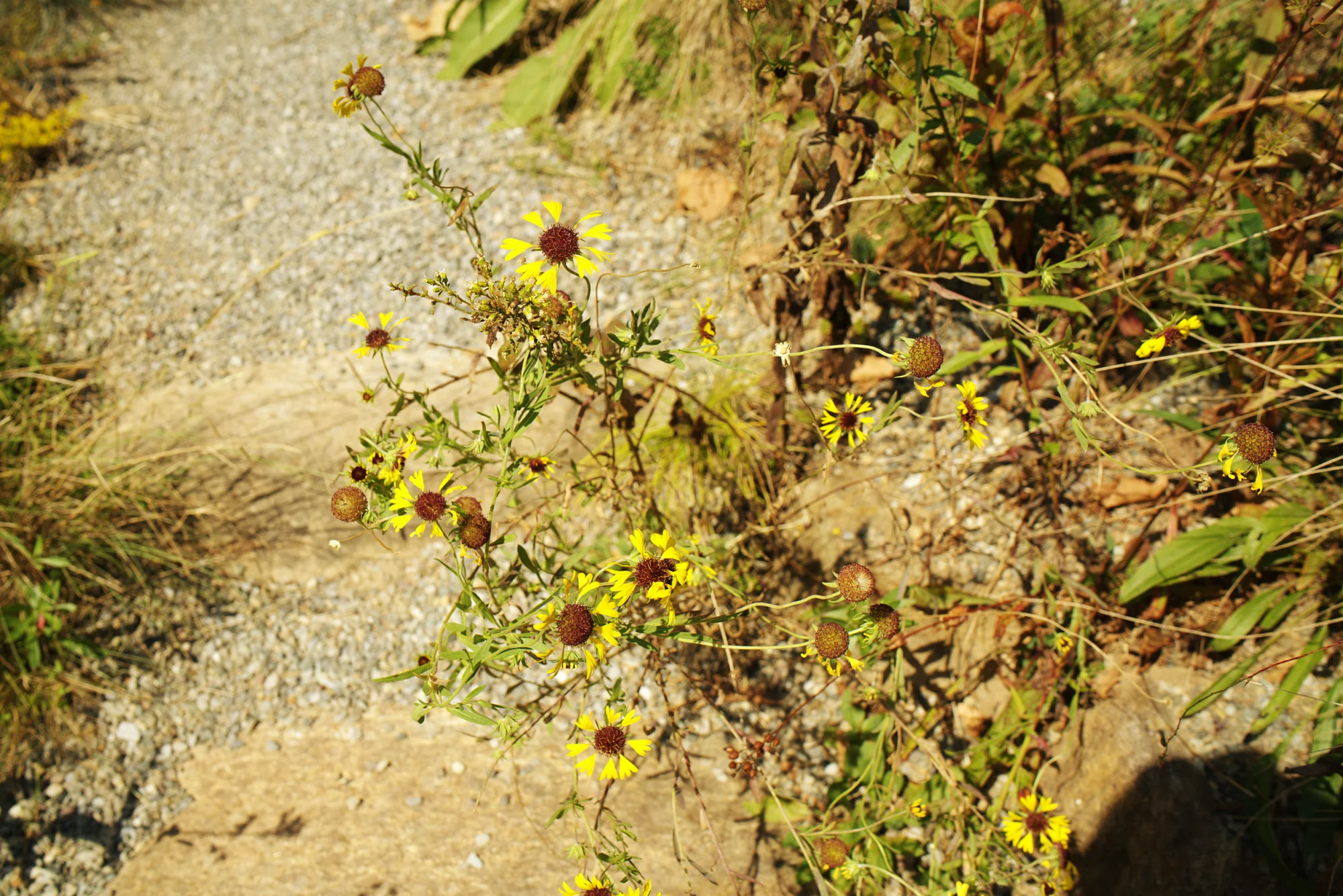
Purplehead sneezeweed
Helenium flexuosum
Smaller, looser and earlier. The center is a deep purple-brown, almost chocolate, against bright yellow rays. In the wild it blooms mostly May to July, though in Mt. Cuba’s Delaware trial it flowered from July into September. It handles salt and clay, and NC State warns it can turn weedy in old fields and roadsides. In a meadow that’s a feature. In a small tidy bed it’s a chore.
- Height: 1 to 3 feet
- Flower color: yellow rays, purple-brown center
- Bloom time: May to July in the wild, into September in the North
- Sun: full sun
- Soil: moist to wet; takes seasonal flooding
- Zones 5 to 9
- Native regions: Northeast, Mid-Atlantic, South, Midwest and Southwest
Bigelow’s sneezeweed
Helenium bigelovii
The western one. It grows wild only in California and Oregon, in wet mountain meadows, seeps and stream edges. Big heads on mostly unbranched stems over a green basal rosette. If you garden on the West Coast with a reliably damp spot, this is your sneezeweed. In the East, skip it: a Bigelow’s-type cultivar in Mt. Cuba’s Delaware trial lasted a single year.
- Height: 1 to 4 feet
- Flower color: yellow rays, brown center
- Bloom time: July and August
- Sun: full sun
- Soil: wet, and it needs summer water in California
- Native regions: California and Northwest
Spring sneezeweed
Helenium vernale
Spring sneezeweed flips the genus calendar and blooms in early spring. One flower per stem rides on a long, nearly bare stalk above a flat rosette, in the wet pine savannas and ditch edges of the coastal plain from North Carolina to Florida and west to Louisiana. You won’t find it at a garden center, but the Lady Bird Johnson Wildflower Center lists it as having special value to native bees, and in March that means something.
- Height: 1 to 2.5 feet
- Flower color: yellow
- Bloom time: March to May
- Sun: full sun
- Soil: wet, acidic, sandy
- Native regions: South
Rosilla
Helenium puberulum
The California one, and it looks like a sneezeweed that lost its petals. The rays are often missing, so what you get is a yellow-brown globe on a wiry stem, dozens at once, along creeks, seeps and pond edges from the coast up to about 4,000 feet. It self-sows freely, which in a California garden with a damp corner is usually what you wanted.
- Height: 1.5 to 5 feet
- Flower color: yellow-brown globes, rays small or absent
- Bloom time: June to August
- Sun: full sun
- Soil: moist to wet, along water
- Native regions: California and Northwest
And one to recognize, not plant
Bitterweed, Helenium amarum, is the roadside annual with thread-fine leaves that looks more like dog fennel than a daisy until it blooms. It’s the reason sneezeweed has a reputation among people who keep animals. A 1975 study showed its main bitter compound, tenulin, poisons grazing animals and taints milk, and Texas A&M notes cows that eat it give bitter, undrinkable milk. Its cousin smallhead sneezeweed (Helenium microcephalum) is worse: Texas A&M reports that eating as little as 0.25 percent of an animal’s body weight can kill. Neither belongs in a planting plan.
Which sneezeweed is right for my region?
East of the Rockies, plant common sneezeweed. On the West Coast, plant Bigelow’s sneezeweed or rosilla. Check the native range for your state before you order.
- Northeast, Mid-Atlantic and Midwest: common sneezeweed, in the wettest sunny spot you have. Purplehead sneezeweed is native here too, if you have room for it to roam.
- South: common sneezeweed inland, purplehead sneezeweed for wet ditches and floodplain edges, spring sneezeweed if you have a wet savanna and can find a source.
- Southwest and Mountain West: common sneezeweed, which reaches farther than most people expect.
- California and the Northwest: Bigelow’s sneezeweed for mountain-meadow conditions, rosilla at lower elevations and along water.
Where sneezeweed shines in your yard
- Rain gardens. It’s near the top of our rain garden list.
- Pond and stream edges, where it grows naturally and looks right immediately.
- The back of a sunny border. Four to five feet of late color behind everything that finished in July.
- Meadow plantings, for height and copper among the grasses in October.
- The corner where the downspout empties. This is the plant for it.
- A cutting garden. The copper and rust forms hold well in a vase.
How to grow sneezeweed
Give it water before anything else
Full sun, and soil that stays damp through July and August. Everything else is optional. If your only sunny spot is dry, plant something else and be happier.
When to plant
Spring or fall. Spring plants catch up faster if you can keep them watered through the first summer; fall plants ask less of you and spend the cool months making roots.
The June haircut
In late May or early June, cut every stem back by a third to a half. The British call this the Chelsea chop, and NC State recommends a cutback in early summer to encourage branching. You get shorter plants with more flowers, a week or two later.
It won’t keep them standing on its own, though. Mt. Cuba cut their trial plants back in May, and they still flopped in stormy weather. Their fix was staking, and a tomato cage set over the clump in spring was the easiest. Tall grasses like switchgrass work too.
Spacing
Eighteen inches to two feet apart, and don’t crowd it against a fence. Powdery mildew shows up in humid late summers where air doesn’t move. It’s cosmetic, and spacing prevents most of it.
Dividing
Every three or four years, in spring. Clumps go bare in the middle otherwise, and you end up with plants to give away.
Leave the stems up
Goldfinches work the seed heads well into fall. Cut everything back in late winter, right before new growth starts.
Beginner tip
Put two reminders in your phone. The first week of June: “cut the sneezeweed back by a third.” The first week of July: “tomato cages.” Those two five-minute jobs are most of what this plant asks.
What are good pairings for native sneezeweed?
Pick plants that want the same wet, sunny ground and bloom in the same weeks. Swamp milkweed, cardinal flower, great blue lobelia and Joe Pye weed share the wet spot. Asters, ironweed and goldenrod bloom alongside it. Switchgrass gives a leaning sneezeweed something to rest on, and false blue indigo and golden Alexanders give the same bed something to do in May.


Where can I buy native sneezeweed?
Common sneezeweed is easy to find, as plants and as seed. Seed is worth trying here: it sprouts readily after a cold, moist winter, and a packet costs less than one plant. Everything else takes a regional specialist. Look for purplehead sneezeweed at native plant society sales, and Bigelow’s sneezeweed and rosilla at California native nurseries. Start with our list of native plant nurseries or order online.
What about sneezeweed cultivars?
Most named sneezeweeds in the trade are German and Dutch hybrids of complicated, mostly undocumented parentage. Some are lovely. They’re also much less dependable than the tags suggest, and we know that unusually well, because Mt. Cuba Center grew 44 kinds of sneezeweed, five plants each, for three years in Delaware and published the results.
By the start of the third year, only a third of the 220 plants were still alive, lost to dry soil, mildew, aster yellows and winter. Most of the survivors flopped. It’s a genus where the label photo and the third-year reality are far apart.
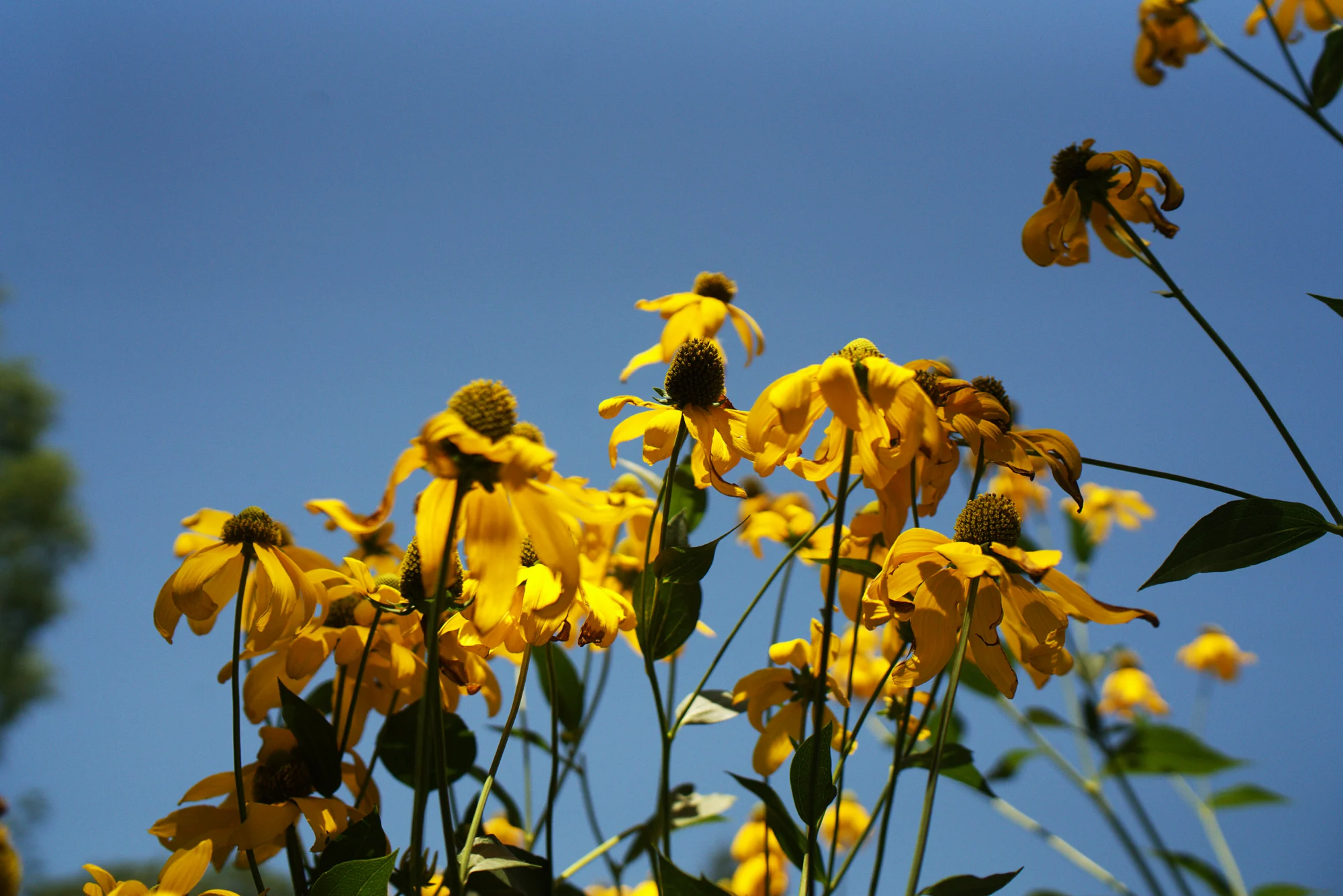
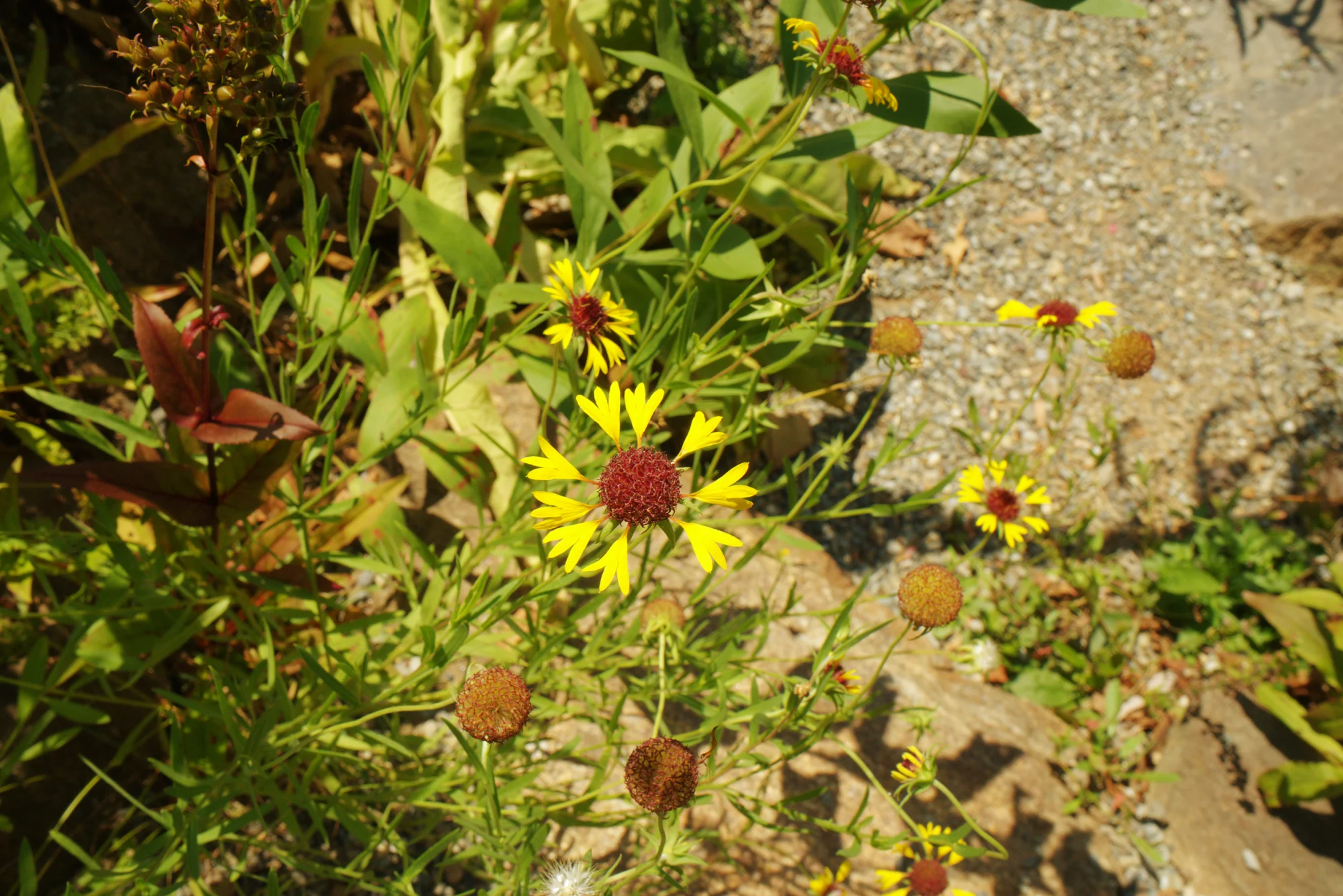
- Top of the trial: ‘Kanaria’ at 4.3 out of 5, ‘Zimbelstern’ and ‘Flammenspiel’ at 4.2, and ‘Can Can’, a selection of common sneezeweed, at 4.1. The straight species came in at 3.9, ahead of most of the field.
- ‘Mardi Gras’ rated 1.5, the lowest score of any plant that finished the trial. It’s widely sold and was recommended in an earlier version of this page. The trial doesn’t support it.
- ‘Sahin’s Early Flowerer’ rated 2.8. It looked great for two years, then lost heavily in the third.
- On pollinators, the straight species logged 162 bee and wasp visits to 151 for ‘Zimbelstern’. That’s one garden over two seasons, so read it as a nudge, not a verdict.
What we’d buy: the straight species first, ‘Can Can’ if you want a selection of it, and one of the top-rated hybrids if you love the copper colors. Ask whether a plant is the species or a hybrid; a tag that says only “Helenium” and a color name is almost always a hybrid, and that’s a choice you should get to make on purpose.
Native sneezeweed FAQs
Does sneezeweed cause allergies?
No. It’s pollinated by insects, so the pollen is heavy and sticky and never gets airborne the way ragweed’s does. The name comes from snuff. It can irritate skin, so wear gloves when you cut it back.
How do I stop sneezeweed from flopping?
Stake it. A tomato cage set over the clump in spring is the easiest fix Mt. Cuba found. Cutting it back by a third in early June helps it branch and bloom more, but in their trial it didn’t stop the flop on its own.
Is sneezeweed poisonous?
To farm animals, yes. The genus contains compounds that are toxic to sheep and cattle. In a garden the risk is low: NC State rates common sneezeweed medium severity, toxic only if eaten in quantity, and purplehead sneezeweed low. The Forest Service notes the compound helenalin is poisonous to dogs, so don’t let a dog graze it.
Will it grow in normal garden soil?
Yes, if that soil never dries out for long. Common sneezeweed does fine in an average bed that stays reasonably moist. What it won’t survive is a sunny bed that bakes in August with no water. In dry soil it fades over a season or two, which is why people decide it’s short-lived when it’s really just thirsty.
Does sneezeweed spread?
Slowly, at the crown. Common sneezeweed widens into a bigger clump rather than running. Purplehead sneezeweed reseeds freely and can get weedy in disturbed ground. Deadhead if you don’t want volunteers, and divide clumps every few years.
Do deer eat sneezeweed?
Seldom. Rutgers puts common sneezeweed in its “seldom severely damaged” group, and NC State tags both common and purplehead sneezeweed as deer and rabbit resistant. The bitterness that makes it a problem for farm animals is what keeps deer off it.
Which sneezeweed should I buy?
Common sneezeweed, the straight species. It has the widest range and the longest late-season bloom, it outdrew the top-rated cultivar for pollinators in Mt. Cuba’s trial, and it’s the easiest to find. Add cultivars later if you want specific colors.
Plant nerd fact
It’s named for Helen of Troy
Linnaeus named the genus in 1753, reusing helenion, an old Greek plant name that Flora of North America ties to Helen of Troy. So a flower that grows in Ohio ditches carries the name of the most famous face in Greek myth. (The story about it springing up where her tears fell is a later legend.)
The gap in most gardens isn’t spring. It’s the stretch from mid-August to the first hard frost, when the coneflowers have gone brown and the bees are still working every day and finding less. Put sneezeweed in the wettest sunny spot you have, cut it back in June, cage it in July, and leave the seed heads up for the goldfinches. Happy planting!
Sources
- Bierner, Mark W. “Helenium.” In Flora of North America North of Mexico, vol. 21. Species accounts for H. autumnale, H. flexuosum, H. bigelovii, H. puberulum and H. amarum. Accessed October 11, 2026.
- Cornell University. “Sesquiterpene Lactones.” Poisonous Plants Informational Database. Accessed October 11, 2026.
- Fowler, Jarrod. “Pollen Specialist Bees of the Central United States.” 2020. Accessed October 11, 2026.
- Fowler, Jarrod, and Sam Droege. “Pollen Specialist Bees of the Eastern United States.” 2020. Accessed October 11, 2026.
- Hoadley, Sam, and George Coombs. Helenium for the Mid-Atlantic Region. Hockessin, DE: Mt. Cuba Center, 2019. Summary at mtcubacenter.org/trials/helenium. Accessed October 11, 2026.
- Ivie, G. Wayne, D. A. Witzel, and D. D. Rushing. “Toxicity and Milk Bittering Properties of Tenulin, the Major Sesquiterpene Lactone Constituent of Helenium amarum (Bitter Sneezeweed).” Journal of Agricultural and Food Chemistry 23, no. 5 (1975): 845–849. pubmed.ncbi.nlm.nih.gov/1159180.
- Lady Bird Johnson Wildflower Center. “Helenium vernale.” Native Plant Database. Accessed October 11, 2026.
- Moerman, Daniel E. “Helenium.” Native American Ethnobotany Database (citing Smith 1923 and 1928, Densmore 1932, Hamel and Chiltoskey 1975, Carlson and Jones 1940, Bocek 1984). Accessed October 11, 2026.
- NC State Extension. “Helenium autumnale” and “Helenium flexuosum.” Extension Gardener Plant Toolbox. Accessed October 11, 2026.
- Royal Horticultural Society. “Chelsea Chop.” Accessed October 11, 2026.
- Rutgers New Jersey Agricultural Experiment Station. “Landscape Plants Rated by Deer Resistance.” Accessed October 11, 2026.
- Shropshire, Kimberley J., and Douglas W. Tallamy. “Lepidoptera of North America North of Mexico: An Annotated List Containing Geographic Ranges and Host Plant Records.” ZooKeys, 2025. Host counts from the UDELep data, May 2025.
- Texas A&M AgriLife. “Bitter Sneezeweed” and “Smallhead Sneezeweed.” Rangeplants of Texas. Accessed October 11, 2026.
- USDA Forest Service. “Common Sneezeweed (Helenium autumnale).” Plant of the Week. Accessed October 11, 2026.

Similar plants
Updated Find more: Beginner Guide Deer Resistant Flower
The ads on this site help pay real native plant nerds to research and write these guides.
Garden notes
Notes from people who’ve grown it
Tips, wins, and the occasional disaster. If you’ve grown sneezeweed, share the advice you’d give to a neighbor.
No notes yet. Yours could be the first.
Grown sneezeweed? Tell the next person what you wish someone had told you.
Tap anywhere to close


