Introduction
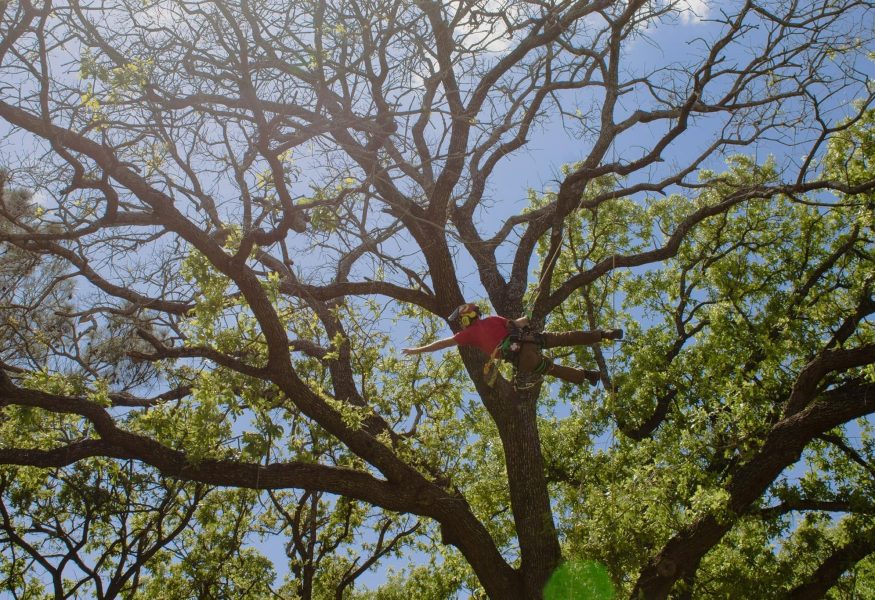
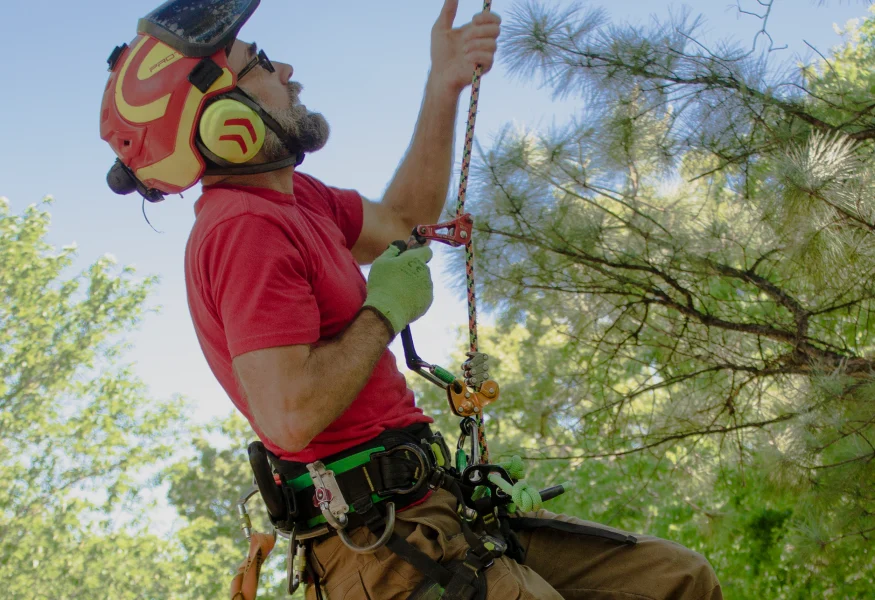
At The Plant Native, we spend most of our time talking about starting a garden, but not enough time talking about what’s growing above. That’s why we wanted to bring an arborist into our interview series. Jason Atwood is the ISA-Certified Arborist and owner of Atwood Tree Care, a family-owned tree service that’s spent the last eight-plus years keeping Fort Worth’s trees healthy. His path here wasn’t exactly a straight line—political science, pre-law, corporate banking, grocery store management—before a mowing client asked him to take down a tree. Twelve years later, he’s one of the go-to voices for tree health in North Texas.
In this interview, Jason talks about the tension of caring for native oaks in a landscape full of Bradford pears and crape myrtles, why our shifting climate is hitting native species hard, and what he wishes every homeowner understood about the trees in their yard.
Thanks so much for the time, Jason!
We are curious about your path to being an arborist. You went from a political science degree to becoming an ISA-Certified Arborist. What actually happened?
It was a long road. Jumping from a pre-law track to what I joke was more of a “pre-lumber” track took a while to click into place. Law didn’t fit. After six months interning at an Austin law firm, it was clear to me that what’s ethical and what’s legal don’t always overlap. Corporate banking wasn’t much better on that front, so I landed in management at Whole Foods, which I genuinely enjoyed. Until the hours caught up with me.
After our first child, my then-wife and I wanted to adopt, and one of the adoption criteria was a stay-at-home parent. Since she was finishing nursing school, it was my turn to step back from a full-time career. A couple of years in, I started a small mowing business to stay close to home and keep my own schedule.
One day a mowing client asked if I could cut down her tree, and that’s where it started. Looking back on that first tree job 12 years ago is right down embarrassing now. I was wearing my bright neon Brooks running shoes, a baseball cap backwards, and a pair of motocross goggles. At least I had a climbing harness left over from my mountain climbing days in college.
“
Sometimes I feel like a broken record when I talk to clients about their Bradford pears and why they shouldn't be there, and then just a few hours later I'm talking about why spring and summer aren't the best time to prune your oaks.
”
Wow, that was a fortuitous professional leap!
You’ve now run Atwood Tree Care for over years, a Texas region with native oaks and cedars alongside Bradford pears and crape myrtles. How does this mix shape your work?
It shapes nearly every conversation I have with clients. Sometimes I feel like a broken record when I talk to clients about their Bradford pears and why they shouldn’t be there, and then just a few hours later I’m talking about why spring and summer aren’t the best time to prune your oaks.
It shapes our operational calendar just as much. Winter is typically the slow season for most tree services, but it’s our busiest stretch at Atwood Tree Care, since that’s when all of our oak pruning gets scheduled.
You’re a member of several arborist societies. What does that level of credentialing actually mean for a homeowner?
It shows an individual’s willingness and drive to stay current with industry standards and the latest science when it comes to tree care. The ISA Certified Arborist credential is really just the entry point into arboriculture.
Since becoming certified, I’ve added a Texas Oak Wilt Qualification, a Prescription Pruning Qualification, and a Tree Risk Assessment Qualification. That last one led to a seat on the Small/New Landowner Committee of the Texas A&M AgriLife Extension of Johnson County.
You see stressed and declining trees every day. Are native trees actually holding up better than non-native ornamentals in North Texas?
What we are seeing is that the invasives are thriving while our natives are struggling. I’d narrow the reasons down to three:
Climate change. North Texas has seen more severe winters, longer droughts, and, less talked about, an estimated 5% increase in daily average wind speed since 2010. More wind moving across a leaf canopy speeds up evaporation, the same way wind gives us chapped lips.
Disturbed soil. When a homebuilder strips native soil to grade a lot, then backfills with an inconsistent mix and lays sod on top, native trees end up growing in conditions nothing like the native soil they evolved for. Meanwhile, many invasives find that odd mix welcoming.
Finally, a reconsideration of what “native” and “invasive” even mean going forward. I love native species, but I believe that without significant adaptation, trees like the post oak and live oak will take a real hit over the next 50 years.
When a homeowner asks what to plant, do you steer them toward natives?
The first step, always, is a soil sample. Don’t necessarily plant what you envision, but what your soil is asking for. Once the soil results are in, I can narrow down the species that will actually work for that spot. That often rules out a default favorite like the live oak on the smaller front yards common in newer developments.
What’s the most common tree problem you see in Fort Worth yards?
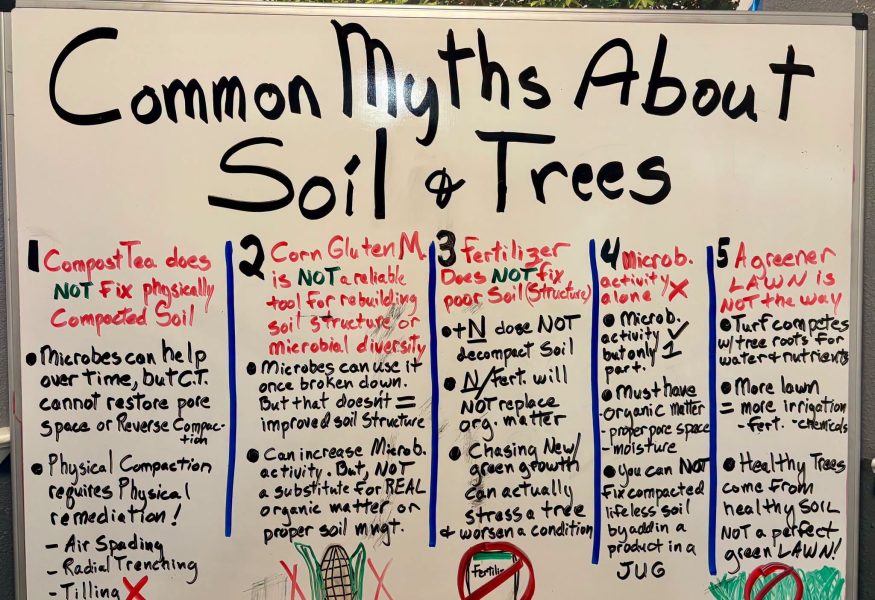
Soil, soil, soil. Or should I say compaction, compaction, compaction. There’s a real gap between forestry and urban forestry. In most yards, the natural forest floor has been completely stripped away in the name of a tidy lawn.
My analogy is this: take great soil, seal it in a glass jar for a year, and retest it. It’ll come back as junk dirt. Soil isn’t good soil on its own. It has to regenerate and have decomposing factors to keep it in the good soil category.
Most people treat the trees in their yard like furniture; they’re just kind of there. What do you wish they understood?
Tree health is directly connected to human health. Think about an overpruned tree throwing off more heat than necessary, or a lawn getting hit with chemical treatments six to eight times a year. Just think of how unhealthy it’s making us.
Beginner Tip
Jason Atwood’s Picks for Smaller Lots
Looking for a native tree that won’t outgrow a modern DFW front yard? Here are his go-to recommendations:
- Texas Redbud, an early spring bloomer that tops out around 30 feet
- Mexican Plum
- Lacey Oak
- Chinkapin Oak
- Bigtooth Maple
Oak Wilt is a serious threat to native Texas oaks. How often does it come up in your work, and what do you wish more homeowners understood before picking up a pruning saw in spring?
Surprisingly, I don’t see much Oak Wilt directly in the DFW metro. There are pockets from Crowley to Alvarado to Venus to Benbrook, and it shows up more at scale further southwest, in places like Granbury and Glen Rose.
The core message I repeat constantly is to not pick up that saw in spring. Outside of emergency situations, we only prune oaks in winter, when the sap beetle (the insect that spreads Oak Wilt) is far less active.
You specialize in tree health, not just removal. Tell us about a time you saved a tree everyone assumed was a lost cause.
This is one of my favorite kinds of calls. More than once, I’ve been brought in for a removal estimate after a previous tree service labeled a tree diseased and unsalvageable. Then I find the issue wasn’t a death sentence at all, and we save the tree. It’s also my case for vetting whoever shows up to an estimate. Make sure they actually hold the right credentials and qualifications before you take their word for it.
“
The same handful of species: live oaks, cedar elms, bald cypress, crape myrtles—get planted over and over. Oversaturating with too few species sets a city up for rapid canopy loss the next time a species-specific disease hits.
”
Fort Worth is growing fast. What happens to the urban tree canopy when a city expands at that pace?
I’m seeing a homogenization of the canopy. The same handful of species: live oaks, cedar elms, bald cypress, crape myrtles—get planted over and over. Oversaturating with too few species sets a city up for rapid canopy loss the next time a species-specific disease hits. That’s how Emerald Ash Borer and Dutch Elm Disease reshaped urban canopies in the Midwest and Northeast, even though ash and elm were themselves native there.
What’s the single most common, completely preventable mistake homeowners make with their trees?
Wrong tree, wrong place, and incorrect planting. I’d also flag a widely missed fact: Texas Arbor Day is the first Friday in November, not spring. Trees should go in the ground in fall or winter, not spring.
You mention instilling in your three daughters a love of trees. What does that actually look like day-to-day?
All my kiddos have been to estimates and consultations with me. One favorite memory is my then-6-year-old “helping” me cut up a tree on a small job with her play chainsaw. The client handed her ten dollars, and she thought she was the coolest kid in the world. Because I talk trees 24/7, I think they gain respect and love for trees and nature through osmosis.
Any resources you’d point a tree-curious homeowner toward?
I recommend joining the International Society of Arboriculture as a homeowner. Membership starts as low as $15 a year and comes with resources, discounts, and educational opportunities. I’m also a fan of the Texas Master Naturalist program. It’s a great group with a deep love of the outdoors and our native species.
What’s one thing you wish more people understood about trees, not as landscape features, but as living systems?
At the risk of sounding like an old hippie, trees are a direct reflection of the kind of stewards we are. If we can start treating our trees as the actual living systems they are versus treating them as yard décor, then the very way in which we care for them changes, and that is a benefit for all involved.
Thank you so much, Jason, for all the helpful tips! We’re excited to keep following—and learning—from you. Happy tree planting!