
Highlights
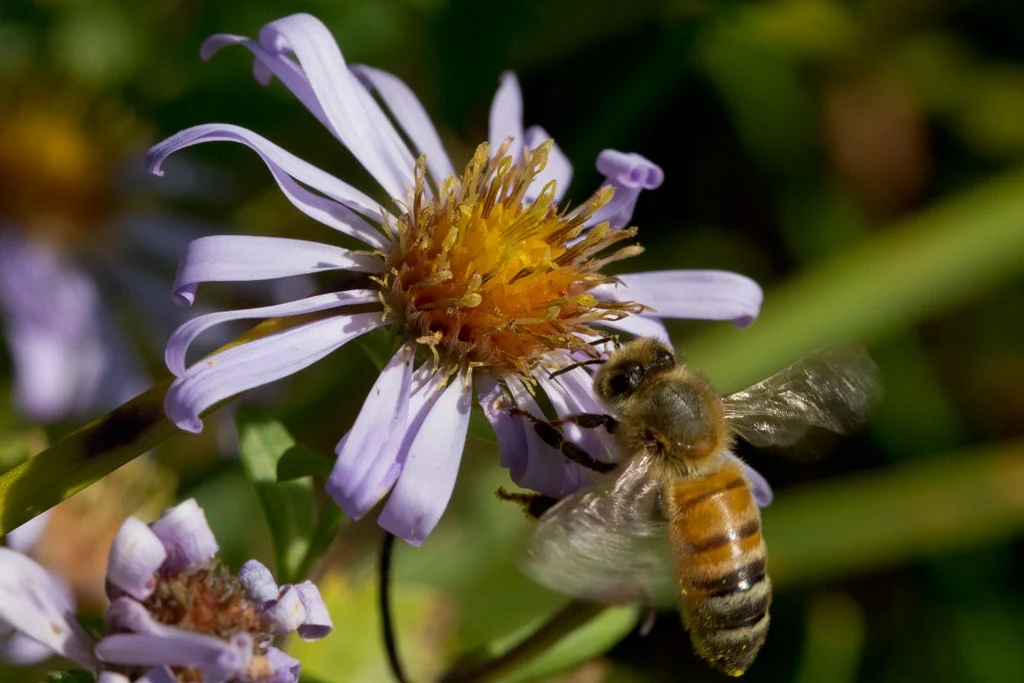
Douglas aster (Symphyotrichum subspicatum) is the Pacific Northwest’s late-summer aster: sprays of purple-blue daisies with yellow centers, on stems 1½ to 4 feet tall, from July into fall. It grows wild in marshes, wet meadows and along the coast from Alaska to California.
It’s also a bee plant with receipts. In a three-year Oregon State University study of 23 native plants, Douglas aster came out first for bees.
Is Douglas aster a good choice for my yard?
Yes, if…
- You garden in the Pacific Northwest. Its home is west of the Cascades, from Alaska and British Columbia down into northern California.
- You have a damp, sunny spot. It grows wild in marshes, thickets and meadows. A rain garden or a low spot that stays moist suits it.
- You want bees in September. It blooms when most of the garden is winding down.
- You have room for a patch. It spreads by underground stems into a colony.
Skip it if…
- You want a plant that stays in a clump. In rich, moist soil it travels. Give it a meadow or a wide bed.
- Your bed is shady. It blooms best in full sun.
- You garden in the dry interior West. Western aster is the better fit there.
Why Douglas aster matters
The Oregon State study is the reason to plant it. Over three years, OSU entomologist Gail Langellotto’s team counted bees on 23 Pacific Northwest natives. “The clear winner for native bees was Douglas aster,” she said. “It had the highest bee diversity and abundance.”
The clear winner for native bees was Douglas aster.
The most common visitors in her lab’s counts were long-horned bees (Melissodes), then yellow-faced bumblebees. The Xerces Society adds leafcutter bees and the woodland skipper, a small orange butterfly of late summer. Asters as a group are host to 34 specialist bee species in the West.
Asters also host 162 native moths and butterflies in the Shropshire-Tallamy caterpillar records.
Where Douglas aster shines in your yard
- A rain garden, on the moist slopes rather than the very bottom.
- A meadow or pollinator patch, where spreading is welcome.
- Along a ditch or swale that stays damp.
- A coastal garden, where it grows wild.
Beginner tip
Plant Douglas aster where you can see it from a window in September. Pull up a chair on a sunny afternoon and count the different bees on one plant. It’s more than you think.
How to grow Douglas aster
Sun and soil
Full sun, in moist to wet soil. The Xerces Society lists it for moist to wet sites.
Planting
Spring or fall, from plugs or pots. Xerces notes it establishes better from transplant than from seed. Set plants 18 inches to 2 feet apart and water through the first summer.
Keeping it in bounds
Each spring, pull or slice off the new shoots that come up where you don’t want them. A mowed edge or a path next to the bed keeps the patch honest.
Cleanup
Leave the stems and seed heads up over winter, then cut them to the ground in late winter before new growth starts.
Planting card
Symphyotrichum subspicatum
The trickSlice off the runners you don’t want each spring; a mowed edge keeps the patch in bounds.
Where is Douglas aster native?
Native to 6 US states
Sources: NatureServe, Royal Botanic Gardens, Kew (World Checklist of Vascular Plants) and the USDA PLANTS Database, compiled by The Plant Native. How we map native ranges
What are good pairings for Douglas aster?
Pair it with other sunny, damp-ground natives of the Northwest: Oregon sunshine and bigleaf lupine for earlier color, goldenrods alongside it, and native irises at the wetter edge.


Where can I buy Douglas aster?
Native nurseries in Oregon, Washington and British Columbia carry it, and it shows up at native plant society sales in spring and fall. Start with our list of native plant nurseries or order online.
FAQs
When does Douglas aster bloom?
July into fall. Flora of North America lists July to September, and in Oregon gardens it often keeps going into October.
How tall does Douglas aster get?
About 1½ to 4 feet, taller in rich, wet soil. Flora of North America gives 40 to 120 centimeters.
Does Douglas aster spread?
Yes. It’s long-rhizomatous, so it forms colonies. Expect a patch, not a single plant.
What’s the difference between Douglas aster and leafy aster?
Habitat, mostly. Douglas aster grows in lowland marshes and meadows; leafy aster (Symphyotrichum foliaceum) grows in mountain forests and subalpine meadows. Both spread underground.
Is it the same as Douglas’s aster?
Yes. Flora of North America spells it “Douglas’s aster.” The older Latin name was Aster subspicatus.
Plant nerd fact
A name that describes the flowers
The species name subspicatum is Latin for “somewhat spiked,” a nod to the way the flower heads line up along the upper stems. Botanists moved it from Aster to Symphyotrichum in 1995, along with most North American asters, so older books still call it Aster subspicatus.
If you want to feed bees in a Northwest garden in fall, there’s research behind this one. For the drier-country cousin, see western aster, and for the rest, our beginner’s guide to native asters. Happy planting!
Sources
- Brouillet, Luc, et al. “Symphyotrichum subspicatum” and “Symphyotrichum foliaceum.” Flora of North America North of Mexico, vol. 20, 2006. Accessed October 12, 2026.
- Costner, Lucas. “Plant of the Week: Douglas Aster (Revisited).” OSU Garden Ecology Lab, October 30, 2018. Accessed October 12, 2026.
- Fowler, Jarrod. “Pollen Specialist Bees of the Western United States.” 2020. Accessed October 12, 2026.
- Lady Bird Johnson Wildflower Center. “Symphyotrichum subspicatum.” Native Plant Database. Accessed October 12, 2026.
- NatureServe. “Symphyotrichum subspicatum.” NatureServe Explorer. Accessed October 12, 2026.
- Pokorny, Kym. “OSU Study of Native Plants and Pollinators Presented at the Largest Nursery Industry Show in the West.” Oregon State University Extension Service, September 2, 2022. Accessed October 12, 2026.
- Shropshire, Kimberley J., and Douglas W. Tallamy. “Lepidoptera of North America North of Mexico: An Annotated List Containing Geographic Ranges and Host Plant Records.” ZooKeys, 2025. Host counts from the UDELep data, May 2025.
- Washington State University Extension. “Pollinator Plants for Northwest Washington.” Accessed October 12, 2026.
- Xerces Society. “Pollinator Plants: Maritime Northwest Region.” 2018. Accessed October 12, 2026.

Similar plants
-
 Irises
-
 Lupines
-
 Columbines
-
 Bluebell Bellflower
-
 Swamp Milkweed
-
 Trillium
-
 Hummingbird Mint
-
 Joe Pye Weed
-
 Blazing Star
Updated Find more: Flower
The ads on this site help pay real native plant nerds to research and write these guides.
Garden notes
Notes from people who’ve grown it
Tips, wins, and the occasional disaster. If you’ve grown Douglas aster, share the advice you’d give to a neighbor.
No notes yet. Yours could be the first.
Grown Douglas aster? Tell the next person what you wish someone had told you.
Tap anywhere to close


