

Highlights
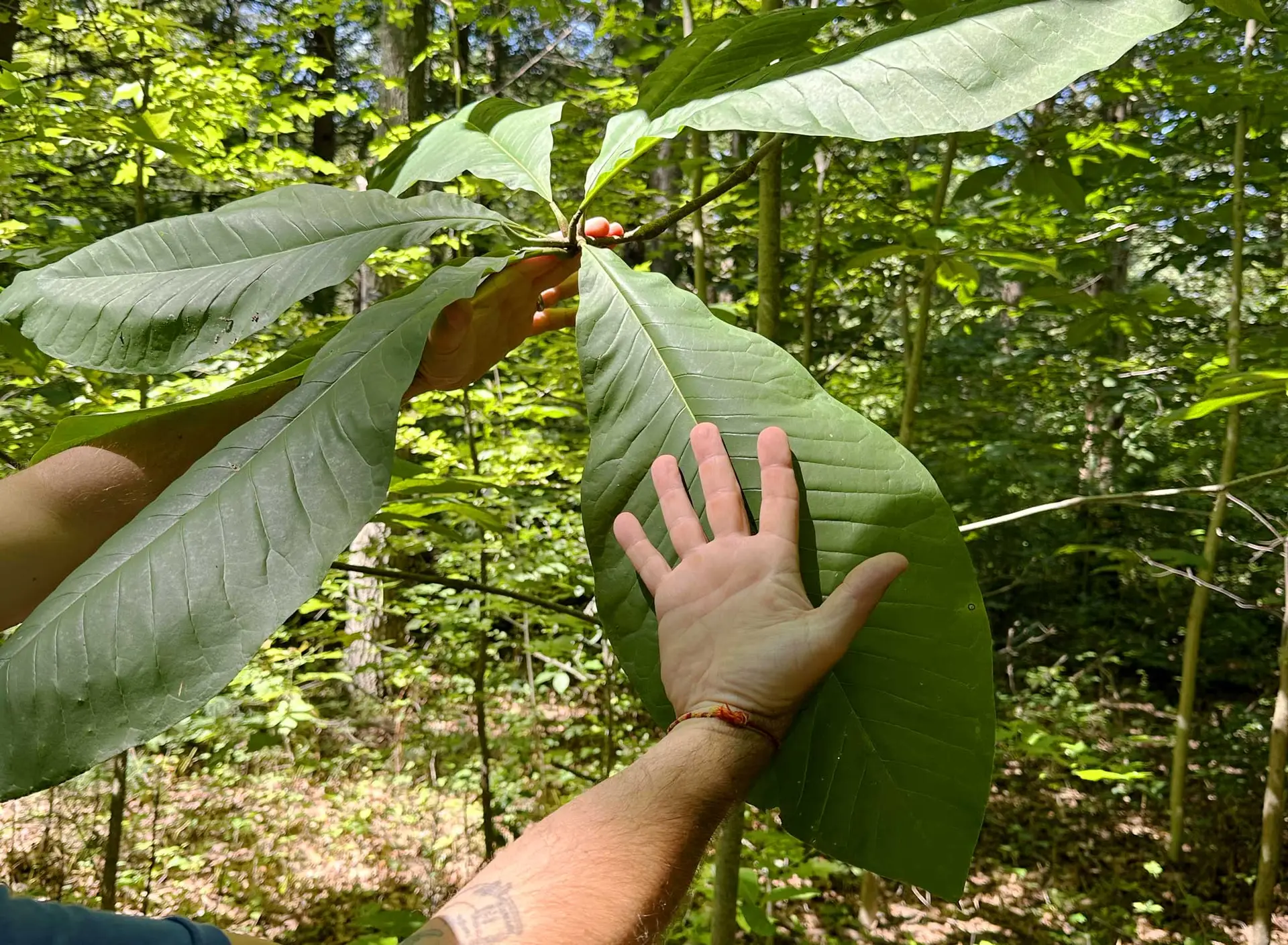
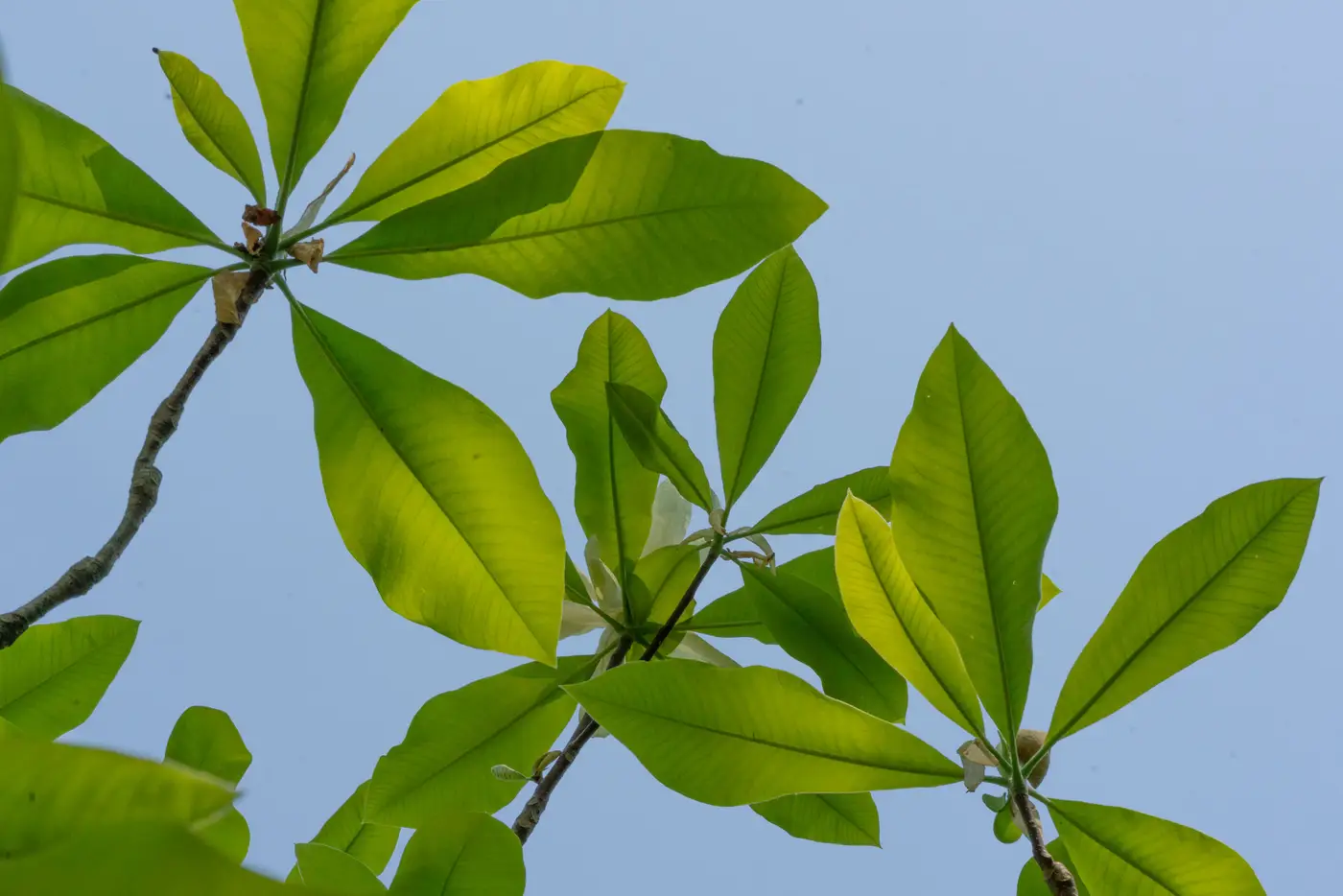
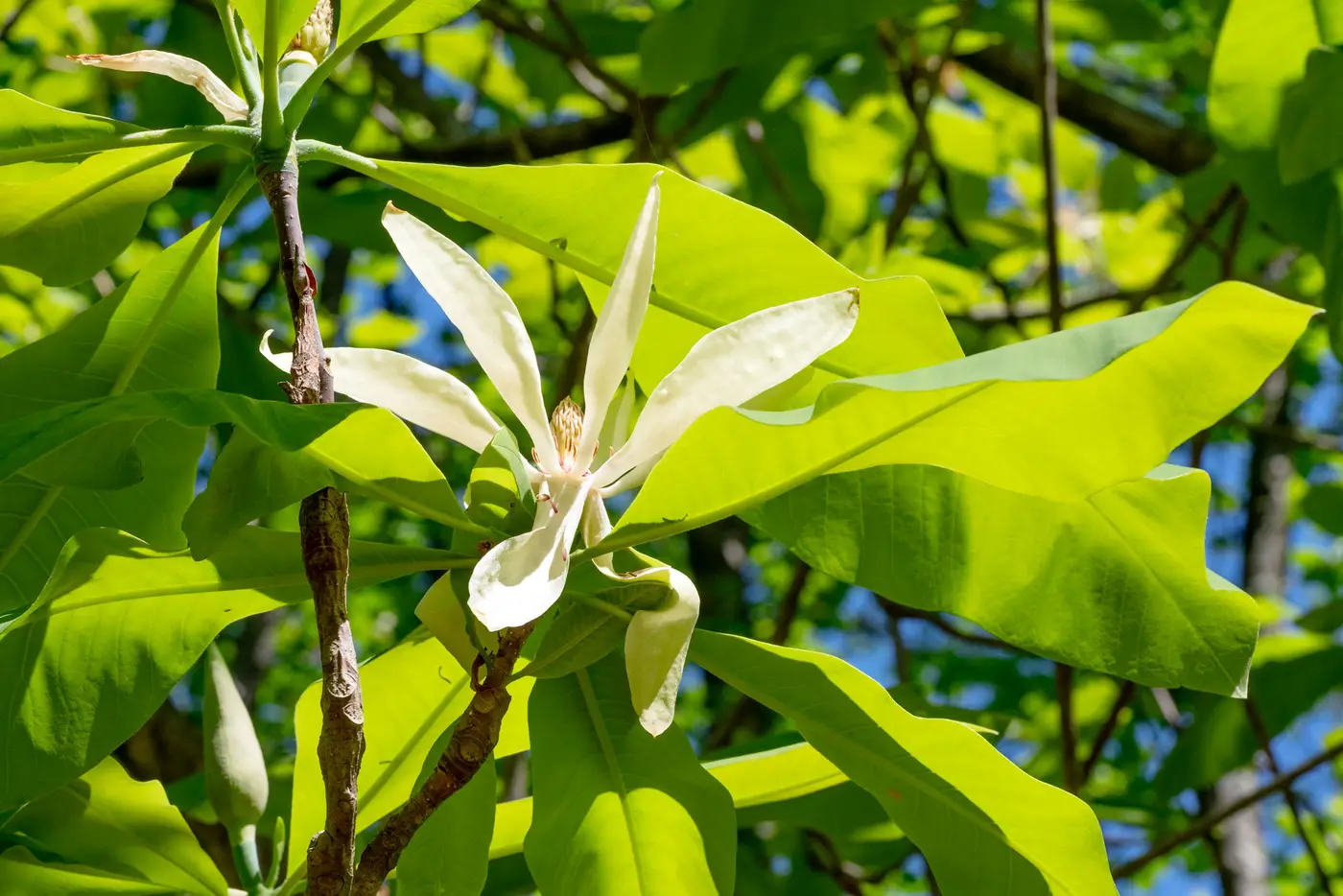
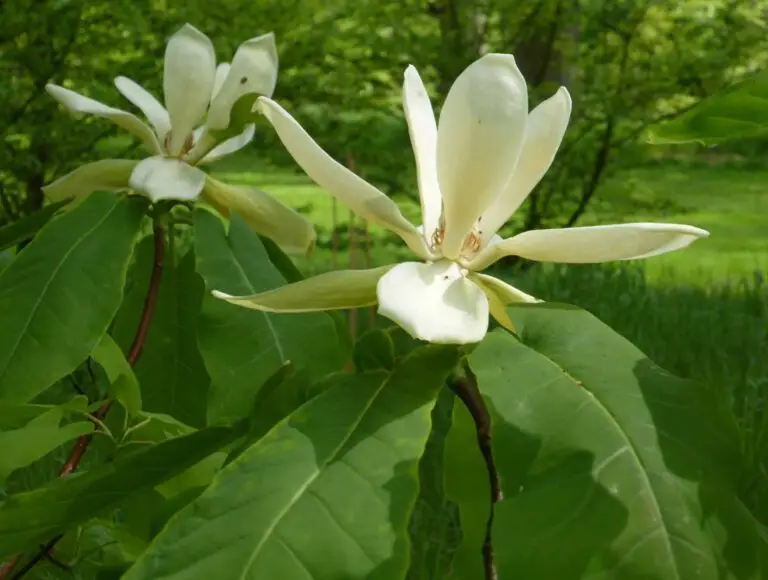
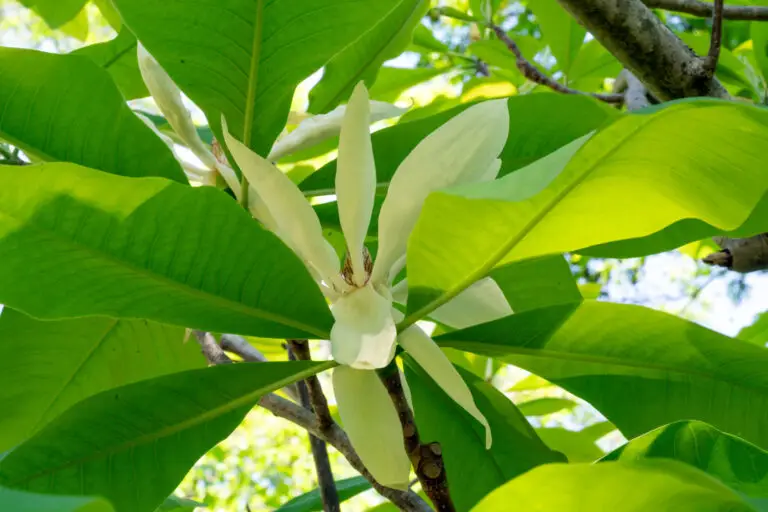
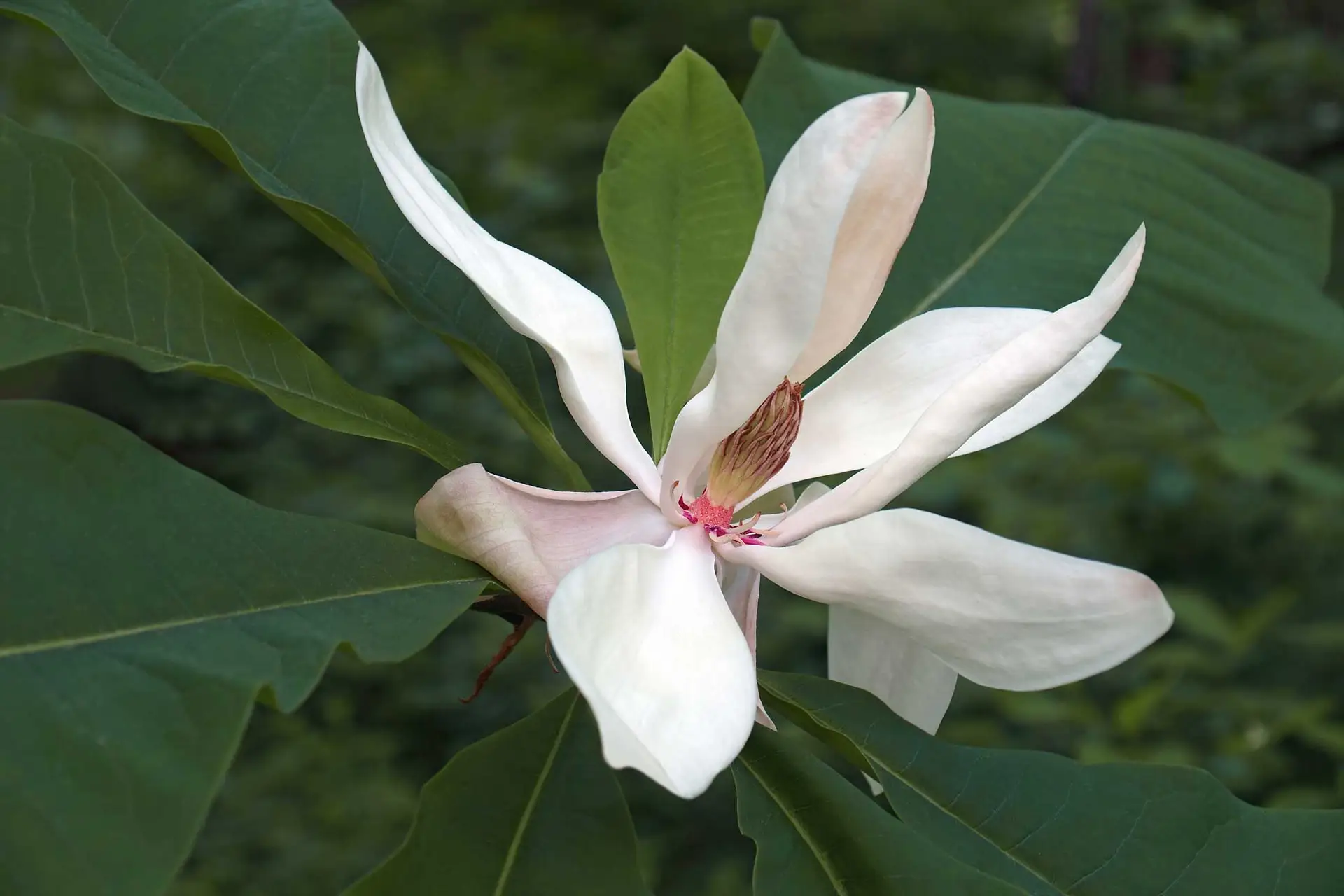
Umbrella magnolia is a rare, shade-loving magnolia found in the Appalachian Mountains. The leaves are large, arranged in whorls, and the pale green buds are reminiscent of a paintbrush. The flowers are creamy white, then turn into pinkish-red fruit that persists late into the fall. It is an ancient beauty with unique pollinator relationships and food for all the little critters in your yard.
Is umbrella magnolia right for my yard?
Plant it if…
- You have acidic soil. Umbrella magnolia can handle a slightly alkaline soil, but it is happiest with some acidity.
- You want a magnolia that can handle shade. Unlike most other magnolias, umbrella magnolia can handle heavy shade like a champion.
- You have a sheltered spot in your garden. For umbrella magnolia, pre-existing trees are a feature, not a bug.
- You have a spot with lots of leaf litter. When it decomposes, the leaf litter acts as compost to keep the soil rich.
- You want to attract moths. While the major host plant of the tuliptree silk moth is the tulip poplar, they will also lay eggs on umbrella magnolia.
- You like the big leaves of other magnolias, but don’t have a lot of space. Umbrella magnolia has a smaller, more shrubby habit than other native magnolias.
Skip it if…
- You have really dry or really wet soil. Umbrella magnolia is easily distressed by extremes, so drought and wet feet is a no-go.
- You want a large shade tree. While umbrella magnolia casts shade, its shrub-like habit makes it less than ideal to shade your garden.
- You want nice-smelling flowers. While most magnolias have a pleasant fragrance that helps them attract beetles, umbrella magnolia smells unpleasant.
Where is umbrella magnolia native?
Native to 18 US states and Washington, D.C.
Sources: NatureServe, Royal Botanic Gardens, Kew (World Checklist of Vascular Plants) and the USDA PLANTS Database, compiled by The Plant Native. How we map native ranges
Umbrella magnolia has a large native range, stretching from the Mid-Atlantic to the south and toward the west. It naturally occurs as individual trees, as opposed to in groves, along stream banks, slopes, and in ravines. It is most commonly found in the Appalachian Mountains and has also been naturalized in some parts of the Northeast. See the full range map at the USDA PLANTS Database.
Even if you don’t have room for a tulip poplar, planting umbrella magnolia can still provide a home for these silkmoths.
Why umbrella magnolia matters
Due to its scattered distribution, umbrella magnolia is considered a rare tree in North America. However, its range has expanded into the Northeast, so it has been able to adapt in the face of climate change.
Though it may not be a popular plant in the eyes of big plant nurseries, umbrella magnolia is a valuable resource for a variety of wildlife. With an umbrella magnolia in your yard, the local songbirds will come by and eat the fruit in the summer and fall. It also has a unique relationship with pollinators, as it is pollinated by beetles. This is an ancient pollinator relationship that predates bees, and it’s still happening in your backyard.
Umbrella magnolias are host plants
According to the HOSTS Database, umbrella magnolia is a host plant for the tuliptree silk moth (Callosamia angulifera). While the most important host of this moth is the tulip poplar (Liriodendron tulipifera), many butterflies and moths do not limit themselves to one plant. Often, they will use related species, even an entire genus, as host plants. Liriodendron is in the magnolia family, Magnoliaceae, and only one species is native to North America. Due to their shared family, the silkmoths likely recognize umbrella magnolia as a viable host.
Even if you don’t have room for a tulip poplar, planting umbrella magnolia can still provide a home for these silkmoths.
Where umbrella magnolia shines in your yard
- Naturalized areas: If you want a low-maintenance planting, a naturalized area is perfect. As long as there’s moist soil and some compost, umbrella magnolia will take to it like a fish to water.
- Near stream banks and pond edges: While it doesn’t like wet feet, umbrella magnolia is far from a stranger when it comes to bodies of water. During dry periods, the nearby water may help you keep it from wilting.
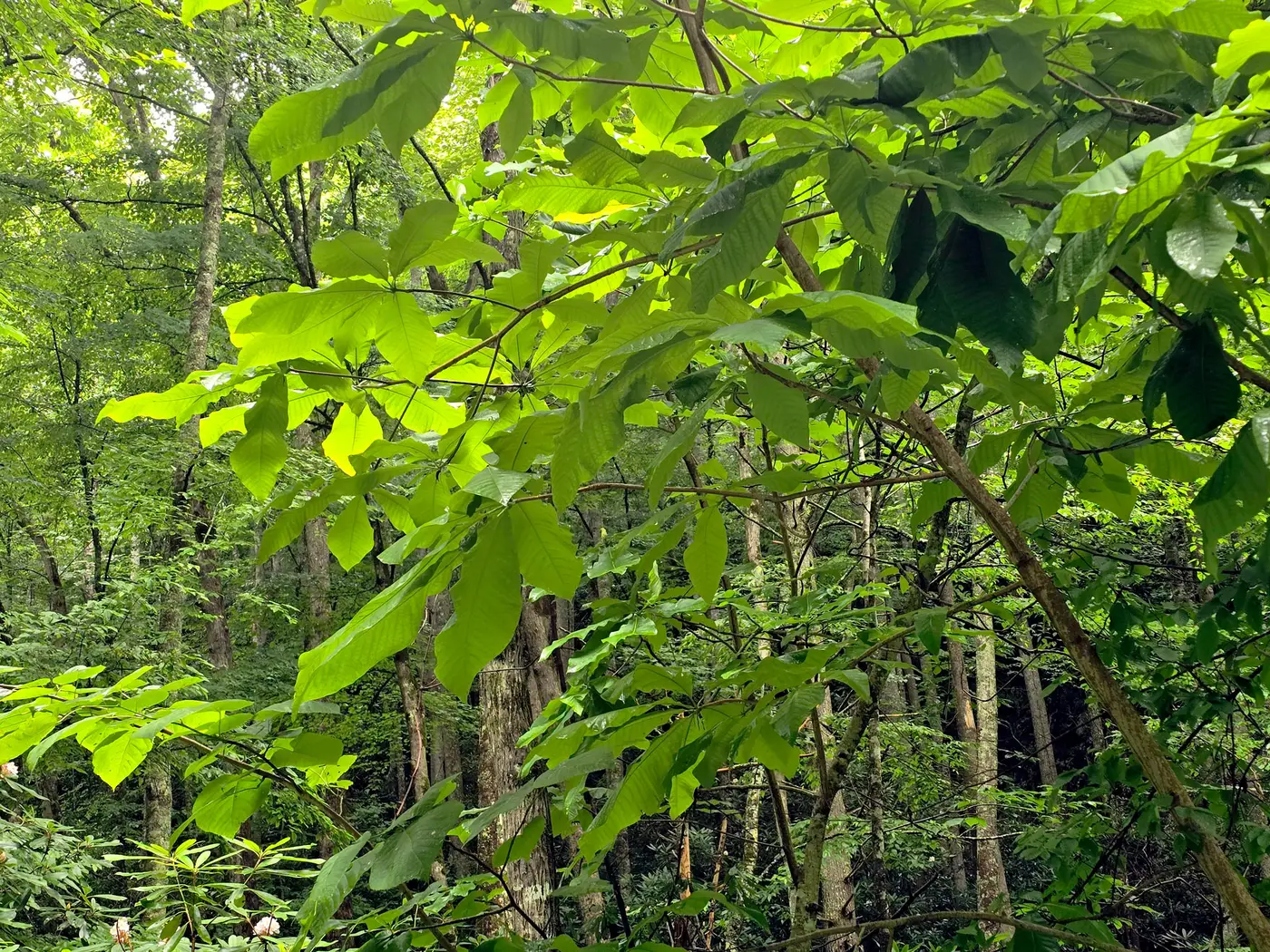
- Woodland gardens: Umbrella magnolia is naturally occurring as an understory tree, so it will feel right at home beneath a forest canopy.
- Shade garden: Umbrella magnolia remains graceful beneath heavy shade, so you can pair it with other shade-loving plants.
Umbrella magnolia cultivars
Due to its rarity, umbrella magnolia is not a plant with a lot of cultivars. There has been some hybrid usage, but this is mostly with non-native species. What few cultivars exist generally aren’t available at your average nursery. However, we have found a few unique cultivars to share with you:
- ‘Bloomfield’: A cultivar from Pennsylvania with larger leaves and flowers.
- ‘Variegata’: You probably won’t see this cultivar at the garden center, but it is a historic variety with golden leaves.
- ‘Woodlawn’: This cultivar has large flowers, as well as large fruit.
How to grow umbrella magnolia
Where to plant
A shady, protected spot with rich soil is best. While umbrella magnolia can tolerate a wide range of sun, planting it in full sun means you’ll have to pay more attention to water needs. The soil should be moist, but well-drained, and acidic soil is preferable.
Spacing
Give umbrella magnolia roughly 12–24 feet of space. It has a more shrub-like habit compared to other native magnolias, so it can be planted in smaller spaces.
Watering
Make sure to water thoroughly as the plant is establishing, especially in warmer climates. After that, umbrella magnolia should be fine as long as the soil is moist. You only need to water during dry spells; nature will do the rest.
Planting card
Magnolia tripetala
When to plant
Umbrella magnolia is best planted when dormant, so early spring or late fall is best. The best time also depends on the climate. In colder climates, early spring is your safest best because magnolias are sensitive to frost damage. However, in warmer climates, late fall is better.
Beginner tip
Protect this plant from strong winds. Since umbrella magnolia likes shade, the other trees in your yard should be enough to shelter it. Otherwise, the leaves are more likely to become damaged.
What pairs well with umbrella magnolia?
Umbrella magnolia grows naturally in the forests of North America, loving shade and acidic soil. Its best companions are other woodland understory plants that handle shade and acidity, or tall trees that can act as a windbreak to protect it.


Where can I buy umbrella magnolia?
Most big-box garden centers don’t carry true natives, but umbrella magnolia is easier to find than you might think. Your best bets are a native plant nursery near you, a native plant society sale, or a trusted online grower that ships to your region.
Potential challenges with umbrella magnolia
The stinkiest magnolia
Not only do the flowers smell bad, but the wood is also said to have an unpleasant odor when damaged. And, of course, the wood is very soft and easy to damage.
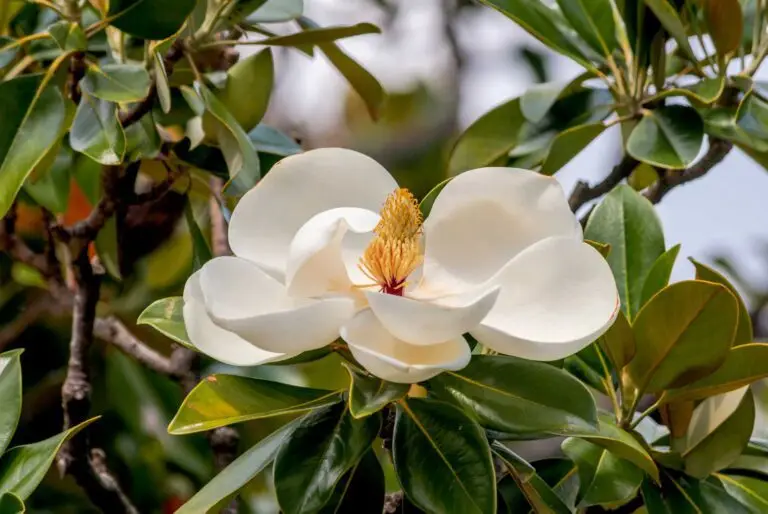
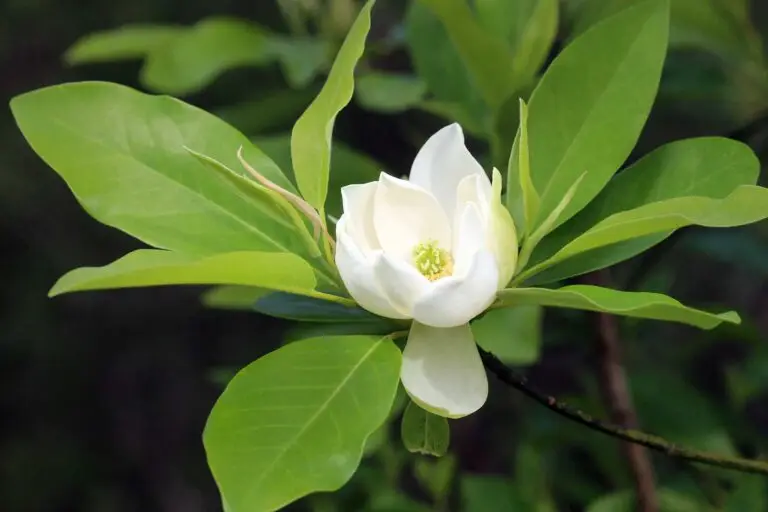
In order to limit the unpleasantness of the smell, plant it somewhere further from your house. If you can plant it in an area that doesn’t get mowed, preventing damage from machinery, that will also help. However, if you’re sensitive to bad smells, this magnolia may not be for you. For more pleasantly fragrant species, we recommend southern magnolia (Magnolia grandiflora) or sweetbay magnolia (Magnolia virginiana).
Suckering habit
As a multi-stemmed shrub or tree, umbrella magnolia produces suckers at its base. It may not sucker as aggressively as other plants, but the suckers can make the tree look messy. However, if the suckering habit bothers you, you can simply prune the suckers off. It won’t spread fast, so you can take some pruners and snip the young stems as you see them.
Strong winds
The large leaves of umbrella magnolia are one of its more impressive characteristics, but it is also a concern when it comes to choosing a site for planting. When planted out in the open, strong winds can cause the leaves of this plant to tear. Instead, plant it somewhere that your house, or other trees, can shelter it from the wind.
FAQs
What is unique about umbrella magnolia?
Upon looking at an umbrella magnolia for the first time, its most striking feature would be the large leaves. However, this is not the only unique characteristic of umbrella magnolia. It is generally smaller than most other native magnolias, and it is also the number one shade-lover.
What is the difference between umbrella magnolia and bigleaf magnolia?
There are a few differences between umbrella magnolia (Magnolia tripetala) and bigleaf magnolia (Magnolia macrophylla). Firstly, their native ranges. Umbrella magnolia has a larger native range than the bigleaf magnolia, including more of the Midwest and southern states.
Additionally, they have some key identifying features. Umbrella magnolia is a multi-stemmed shrub or small tree with smaller, whorled leaves that look like the spokes of an umbrella. Bigleaf magnolia has a single trunk, much larger leaves, and often grows much larger. The leaf bases also provide a clue. The umbrella magnolia has a leaf base that tapers back to the petiole, or leaf stem, forming a ‘V’ shape. The bigleaf magnolia has a much more rounded leaf base, creating a ‘U’ or sometimes heart shape.
Is umbrella magnolia a tree or a shrub?
It can be both! Compared to other magnolias, umbrella magnolia has a much shrubbier growth habit. It will start off as a large shrub, then grow into a small tree with enough time.
What are the benefits of the umbrella magnolia tree?
Umbrella magnolias provide services for pollinators, birds, mammals, and others. Beetles are the primary pollinators of magnolias, but some kinds of bees also visit umbrella magnolia flowers. When it sets fruit, the seeds are eaten by birds and small mammals. Umbrella magnolia also acts as a host plant for the tuliptree silk moth (Callosamia angulifera).
Is umbrella magnolia evergreen?
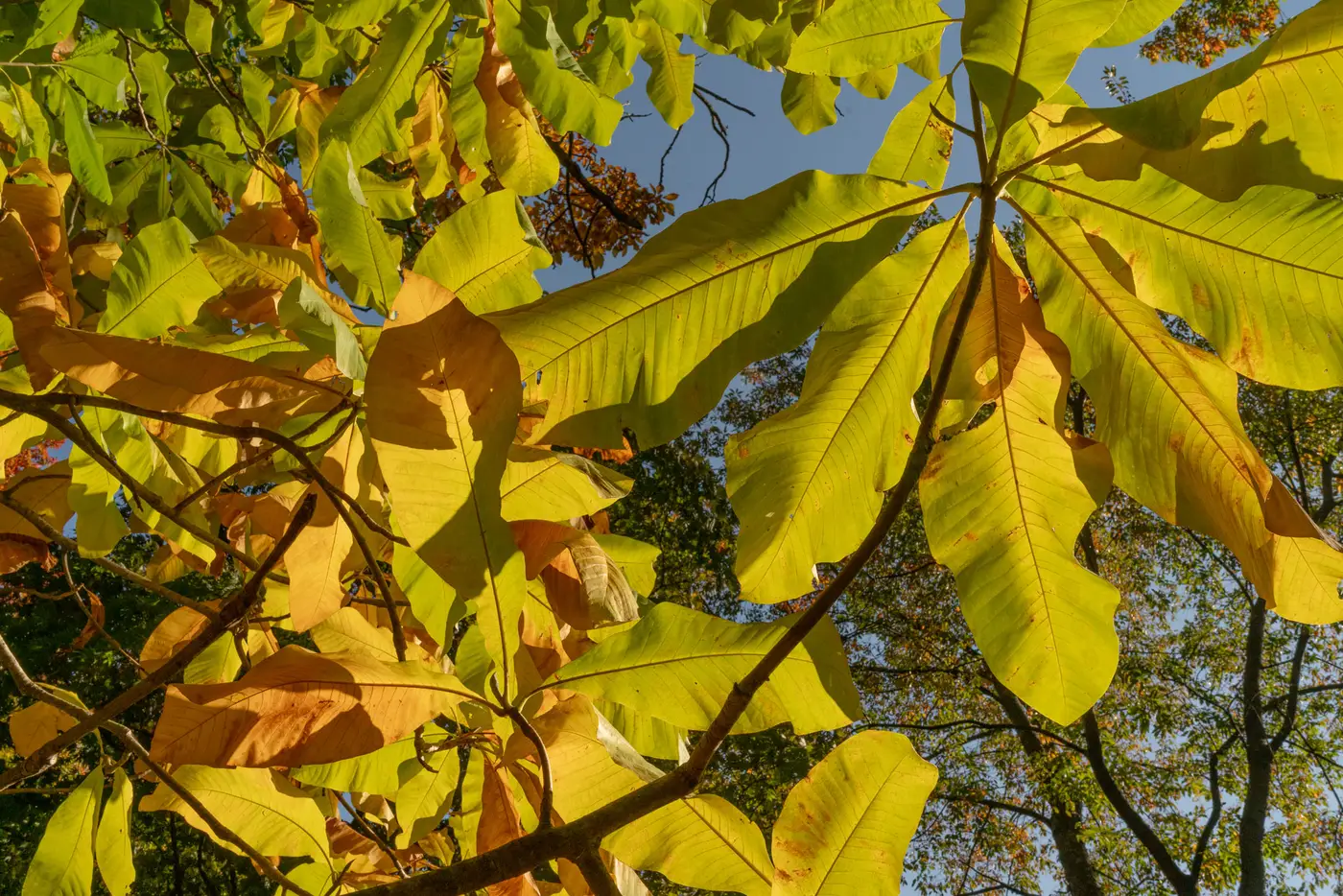
No, umbrella magnolia is not evergreen. It loses its leaves in the winter, making it a deciduous magnolia. However, there are two native semi-evergreen magnolias: southern magnolia and sweetbay magnolia.
Plant nerd fact
What makes umbrella magnolia so stinky?
Aside from their beauty, magnolias are well known for their fragrance. Many magnolias emit a powerful fragrance, such as the southern magnolia (Magnolia grandiflora). The scent of this species is so strong, indigenous tribes refused to sleep beneath it when it was in bloom, for they said it could kill any who slept there. When describing their scent, many say that magnolias have a sweet, pleasant fragrance.
The same cannot be said for the umbrella magnolia. It is described as having an unpleasant or even foul odor. But why? It comes down to chemistry. While umbrella magnolia hasn’t been as extensively studied as other magnolias, a few studies have been conducted to assess the compounds in its essential oils. In these studies, umbrella magnolia was shown to have a unique composition compared to other native magnolia species. While southern magnolia (M. grandiflora), sweetbay magnolia (M. virginiana), and bigleaf magnolia (M. macrophylla) had an abundance of methyl esters, umbrella magnolia was composed almost exclusively of benzene structures. While both are aromatic compounds, it is likely the methyl esters that give magnolias their scent.
In short, the umbrella magnolia smells different because it evolved differently. They have an odor that no other species can match, and it makes them unique.
Umbrella magnolia is a shy species of magnolia, preferring the comfort of a shady forest understory. However, while overlooked by most people, it is a resilient plant that provides for the local wildlife. From birds to butterflies, umbrella magnolia’s seeds, fruit, and flowers make for a valuable food source. It fits perfectly into a shade or woodland garden, adding a quiet beauty to your yard.
If you want to learn about other magnolias, check out our Beginner’s Guide to Native Magnolias. Looking to attract songbirds? Head over to The Best Native Plants for Birds. Happy planting!
Sources
- Azuma, Hiroshi, Masao Toyota, Yoshinori Asakawa, Ryohei Yamaoka, Jose G. Garcia‐Franco, Gregg Dieringer, LEeonard B. Thien, and Shoichi Kawano. “Chemical Divergence in Floral Scents of Magnolia and Allied Genera (Magnoliaceae).” Plant Species Biology 12, no. 2–3 (December 1997): 69–83. https://doi.org/10.1111/j.1442-1984.1997.tb00159.x. Accessed June 9, 2026.
- Bellemare, Jesse, and Claudia Deeg. “Horticultural Escape and Naturalization of Magnolia tripetala in Western Massachusetts: Biogeographical Context and Possible Relationship to Recent Climate Change.” Rhodora 117, no. 971 (2015): 371–83. http://www.jstor.org.libproxy.temple.edu/stable/24777331. Accessed June 8, 2026.
- Gaden S. Robinson, Phillip R. Ackery, Ian Kitching, George W Beccaloni, Luis M. Hernández (2023). HOSTS (from HOSTS – a Database of the World’s Lepidopteran Hostplants) [Data set resource]. Natural History Museum. Accessed June 10, 2026. https://data.nhm.ac.uk/dataset/hosts/resource/877f387a-36a3-486c-a0c1-b8d5fb69f85a.
- Hood, Mary A. “Cumberland River: Magnolias and Other Rare Plants of the Appalachians.” In RiverTime: Ecotravel on the World’s Rivers. State University of New York Press, 2008. http://www.jstor.org.libproxy.temple.edu/stable/jj.18252363.10.
- Kershner, Bruce, Craig Tufts, Daniel Mathews, Gil Nelson, and Richard Spellenberg. Field Guide to Trees of North America. New York: Sterling Pub. Co, 2008.
- Lady Bird Johnson Wildflower Center. “Magnolia tripetala (Umbrella Tree).” wildflower.org. Accessed June 8, 2026. https://www.wildflower.org/plants/result.php?id_plant=MATR.
- Lobdell, Matthew S. “Register of Magnolia Cultivars.” HortScience 56, no. 12 (2021): 1614–1675. https://doi.org/10.21273/HORTSCI16054-21. Accessed June 8, 2026.
- Magnolia Society International. “Getting Started with Magnolias.” magnoliasociety.org. Accessed June 8, 2026. https://www.magnoliasociety.org/Magnoliaresources.
- Native Plant Trust. “Magnolia tripetala.” plantfinder.nativeplanttrust.org. Accessed June 10, 2026. https://plantfinder.nativeplanttrust.org/plant/Magnolia-tripelata.
- North Carolina State Extension. “Magnolia macrophylla.” plants.ces.ncsu.edu. Accessed June 8, 2026. https://plants.ces.ncsu.edu/plants/magnolia-macrophylla/.
- North Carolina State Extension. “Magnolia tripetala.” plants.ces.ncsu.edu. Accessed June 8, 2026. https://plants.ces.ncsu.edu/plants/magnolia-tripetala/.
- Oozeerally, Barbara, James Milton Gardiner, and Stephen A. Spongberg. Magnolias in Art & Cultivation. Richmond, Surrey, UK: Kew Publishing, Royal Botanic Gardens, Kew, in association with the Royal Horticultural Society, 2014.
- Sutton, Julian. “Magnolia tripetala.” treesandshrubsonline.org. 2022. treesandshrubsonline.org/articles/magnolia/magnolia-tripetala/. Accessed June 8, 2026.
- Thien, L. B., W. H. Heimermann, and R. T. Holman. “Floral Odors and Quantitative Taxonomy of Magnolia and Liriodendron.” Taxon 24, no. 5/6 (1975): 557–68. https://doi-org.libproxy.temple.edu/10.2307/1220717. Accessed June 9, 2026.
- USDA PLANTS Database. “Magnolia tripetala (L.) L. Umbrella-Tree.” plants.usda.gov. https://plants.sc.egov.usda.gov/plant-profile/MATR. Accessed June 8, 2026.
Explore more native magnolia profiles
-
-
-

-
-
-
-
-


Updated Find more: White Acidic Flower Tree Spring Summer Full Sun Part Sun Full Shade Moist
The ads on this site help pay real native plant nerds to research and write these guides.
Garden notes
Notes from people who’ve grown it
Tips, wins, and the occasional disaster. If you’ve grown umbrella magnolia, share the advice you’d give to a neighbor.
No notes yet. Yours could be the first.
Grown umbrella magnolia? Tell the next person what you wish someone had told you.
Tap anywhere to close


