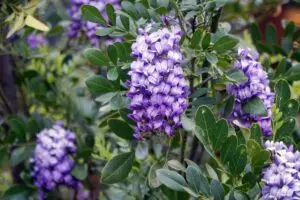
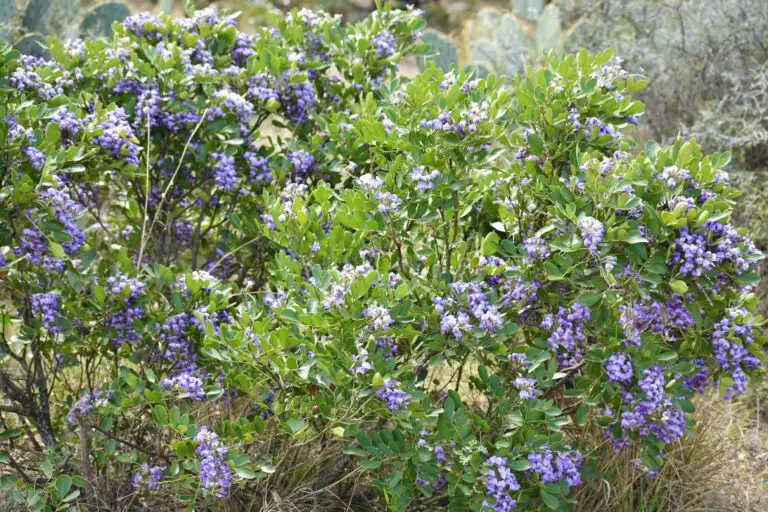
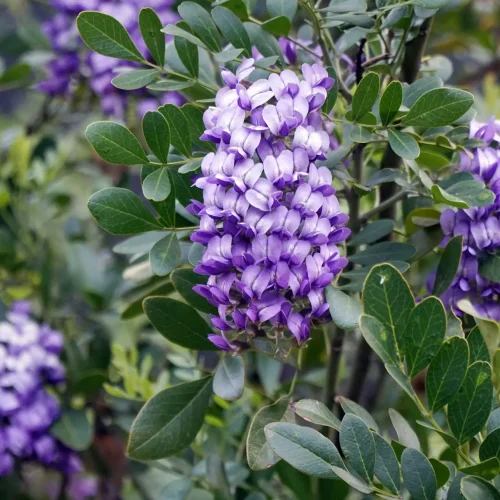
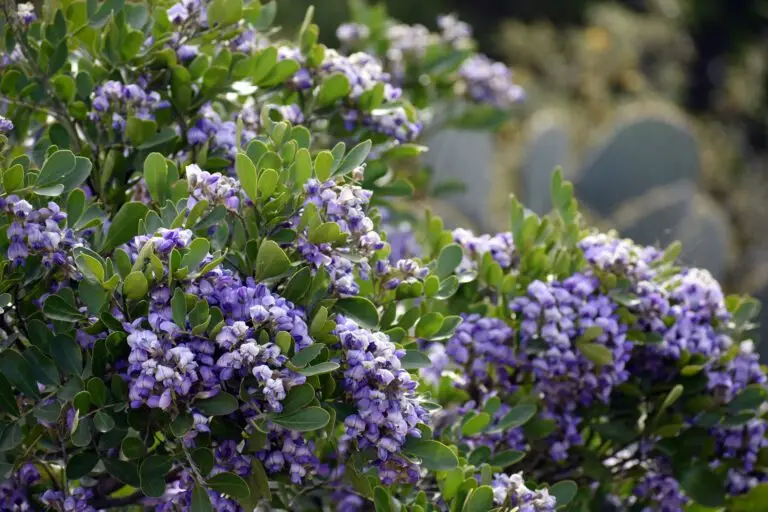
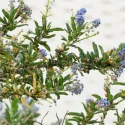
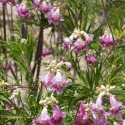
Texas mountain laurel sends out gorgeous fistfuls of purple flowers in the spring that attract pollinators (and people.) The smell of Texas mountain laurel flowers has been compared to grape Kool-Aid in several gardening books. They are easy to grow and, over time, can turn into small 20-foot trees.
Texas mountain laurel has been called “one of the ten best ornamental shrubs in the nation.” They are a stunning addition to any yard or park in the Southwestern United States. Find planting tips below.
Texas Mountain Laurel
Latin name:
Dermatophyllum secundiflorum
Tall Shrub (11-15'), Small Tree (15-30')
Full Sun, Part Sun
Spring flowers
If only we could share the amazing smell on a website...
In This Guide
Is Texas mountain laurel a good choice for my yard?
Yes, if…
You live in central Texas or the Southwest, with hot summers, alkaline soil, and not a lot of rain. This plant was built for that.
You want an evergreen that actually does something interesting. Many evergreens just sit there. This one fills your yard with grape-scented purple flowers every spring.
You want drought-friendly beauty. Texas mountain laurel stays green year-round and handles drought like a pro once established.
You’re willing to be patient. It grows slowly, especially in the first few years. But it speeds up once it gets going, and the wait is worth it.
Skip it if…
You have acidic soil. Texas mountain laurel needs alkaline, limestone-rich soil. It will not be happy in acidic conditions.
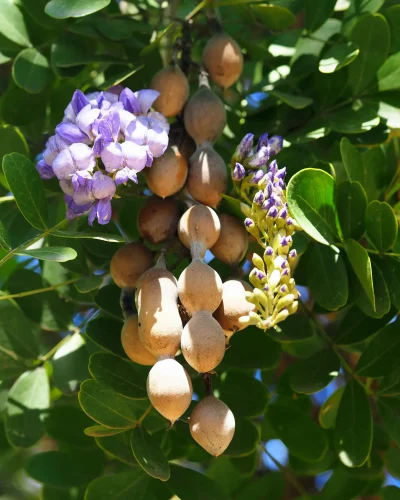
You have small children or pets who put things in their mouths. The bright red seeds are extremely toxic. The hard pods offer some protection, but this is a real concern.
You need fast results. This shrub grows 6 to 12 inches a year in the early years. If you need instant screening, look elsewhere.
Texas mountain laurel vs. *mountain laurel*
Many species of mountain laurel native to America roughly fall into either the “Texas mountain laurel” or “mountain laurel” group. (If you’re worried about which is which or looking for a specific plant, writing down the Latin name of the type you want will be a huge help. See below for their Latin names!)
Both Texas mountain laurel and mountain laurel:
Look fantastic in highly visible spaces, like against houses or front gardens
Are evergreen: their leaves are there, year-round
Like a wide range of light, from full sun to part sun
Perennials: they will come back year after year. Once you plant them and they are happily established, you can enjoy them in your yard for years to come.
Low maintenance: no fertilizer or special needs are required for these plants to thrive
Here they are at a glance:
Texas Mountain Laurel
Dermatophyllum secundiflorum
Texas mountain laurel is native to Central Texas through to New Mexico. This species has flowers that smell glorious. Read on to find out how to plant Texas mountain laurel.
Mountain Laurel
Kalmia latifolia
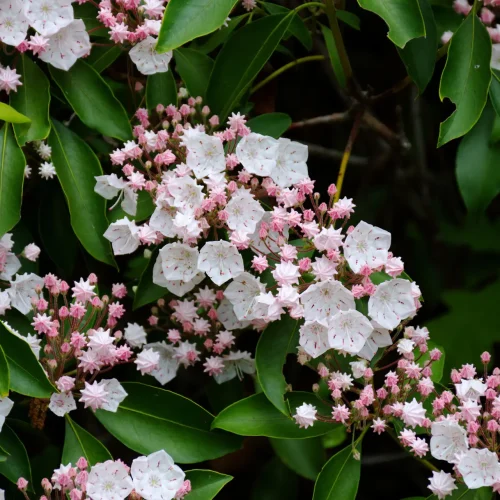
These species of mountain laurel are native to the Eastern US. Shrubs in this species group have tiny flowers shaped like algebraic equations. You’ll know you’ve got the right plant if the Latin name starts with Kalmia. Learn more in our mountain laurel profile.
George O. Miller, in his book Landscaping with Native Plants of Texas, calls Texas mountain laurel “one of the ten best ornamental shrubs in the nation” and describes how “showers of vibrant purple flowers cover the plant and perfume the air with the scent of grape Kool-Aid.” That’s not a gentle floral scent. It’s grape candy. Walk past a blooming Texas mountain laurel and you’ll stop, look around, and wonder who spilled something. The flowers are the show, and they happen in February through April, when most of the landscape is still brown and dormant.
This is a pollinator’s dream
The flowers attract honeybees, native leaf-cutting bees, and hoverflies, all of which crawl inside the pea-shaped blooms to reach the nectar. Texas mountain laurel is also a host plant for Henry’s elfin, a small, brown butterfly whose caterpillars feed on the flower buds and young leaves. Henry’s elfin uses different host plants in different parts of its range, but in Texas, this is one of its go-to plants. If you see tiny green or reddish caterpillars on the buds in spring, leave them alone. They’re doing exactly what they’re supposed to.
And then there’s the cultural history, which goes back at least 6,500 years. The bright red seeds, called mescal beans, have been found in archaeological sites across the Lower Pecos region of Texas. At least twelve Indigenous nations, including the Apache, Comanche, Pawnee, and Wichita, used the seeds for adornment, ceremony, and as rattles in dances while still in the pod. This is a plant with deep roots, in every sense.
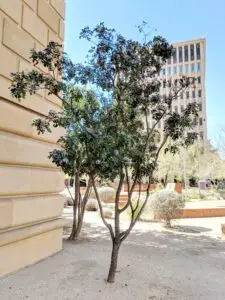
Texas mountain laurels can go from bush to small tree
You can prune a Texas mountain laurel over time to be more in the shape of a tree than a bush. It will still make its purple Kool-Aid flowers and remain evergreen, even as it gets tall. Texas mountain laurels grow up to two feet a year.
Beginner Tip
Texas mountain laurel is evergreen, so it never goes bare. That makes it an excellent choice for spots where you want year-round screening or green backdrop, like along a fence line or against a house wall.
How to grow Texas mountain laurel
Soil
Alkaline, rocky, well-drained. This plant evolved on limestone hillsides and it wants soil that reflects that.
If you garden in the Texas Hill Country, your native soil is probably perfect. If your soil is heavy clay, make sure it drains well; Texas mountain laurel will not survive in waterlogged ground. It doesn’t need rich soil. In fact, it prefers lean, rocky, chalky conditions.
Garden Recipe™
Texas Mountain Laurel
Dermatophyllum secundiflorum
Sun to part sun
Sun
Pretty easy
Effort
Tall Shrub (11-15'), Small Tree (15-30') tall 8-12 ft wide
Size
Spring
Blooms
What it needs
Sunlight
Full to partial sun, 4+ hoursThe more sun the better, but it can handle some shade
Directions
Spacing
8-10 ftThink of it like a parking space between plants
Watering
Weekly for the first seasonAfter that, rain is usually enough
Notes
Comes back?
Yes, every yearGoes dormant in winter, that's normal. New growth each spring.
Deer resistant. Deer usually walk right past this one. If they've been snacking on your other plants, this one should be safe.
Full sun is ideal and gives you the most flowers. It also handles part sun, since it naturally grows as an understory plant beneath taller trees. In part sun, expect slower growth and fewer flowers, but the plant will still look good and stay healthy.
Water
Texas mountain laurel handles drought with ease after it’s established, which normally takes the first year. Water regularly during the first year or two while the roots get a foothold, then back off. Overwatering is a bigger risk than underwatering with this plant. If you’re in a spot that gets regular rainfall, make sure the drainage is excellent.
A note on Texas mountain laurel seeds
Sadly, Texas Mountain Laurel seeds are poisonous. The seeds themselves reside inside a hard seed coat (it’s almost like a big peapod.) This hard seed coat helps give some protection from easily accessing the poisonous seeds found inside.
This native plant is best planted away from children and pets.
Where Texas mountain laurel shines in your yard
Against a house wall or fence: The dark green evergreen leaves and spring purple flowers look stunning against stone, stucco, or wood. And you’ll smell the flowers every time you walk by.
Privacy hedges: Plant a row and let them fill in. They stay green year-round, grow dense, and don’t need much water once established. You can prune them into a hedge or let them go natural.
Hot, dry spots where other plants struggle: That strip along the driveway that bakes in the afternoon sun? The rocky slope you can’t keep anything alive on? Texas mountain laurel was literally made for those conditions.
Xeriscape gardens: This is a cornerstone plant for low-water gardens. Pair it with other drought-loving natives for a landscape that barely needs a hose.
Small tree form: Prune the lower branches over time and you get an elegant small tree with a rounded canopy, textured bark, and those grape-scented spring flowers.
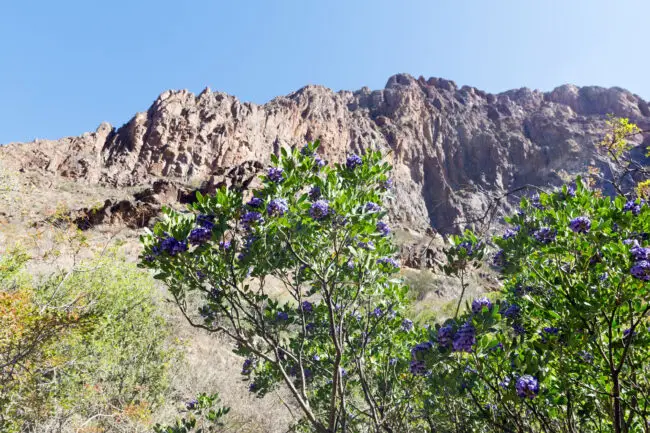
Texas mountain laurel's native habitat is along the rocky slops of the Southwest
FAQs
How fast does Texas mountain laurel grow?
Slowly. Expect 6 to 12 inches a year in the early years. Growth speeds up once the plant reaches about 5 to 6 feet tall. A mature Texas mountain laurel can eventually reach 15 to 20 feet, but that takes many years.
Can I grow Texas mountain laurel in a container?
Yes, and it actually does well in large pots, especially when you can control the soil (alkaline, well-drained). It’s a great option for patios and pool areas where you want the spring fragrance up close.
Will it grow OK in acidic soil?
Not well. Texas mountain laurel evolved on limestone and strongly prefers alkaline soil. If your soil is acidic, this isn’t the right plant for your yard. Try other evergreens like native pines, instead.
Plant Nerd Fact
This plant recently got a new name.
You’d think a plant’s Latin name is settled forever, carved in stone by some botanist in a powdered wig, hunched over a candle. Not so.
For over 200 years, Texas mountain laurel was known by the Latin name Sophora secundiflora. Then in the early 2000s, scientists took a closer look at the chemistry inside its leaves, found an alkaloid fingerprint that didn’t match anything else in the Sophora genus, and created a brand-new genus for it: Dermatophyllum. Two centuries of textbooks, rewritten in just the last few decades because of a chemistry test.
You may still encounter this plant in nurseries or gardens called by its old name, but now you know: it’s the same plant. Latin names sound permanent, but plants get reclassified all the time.
What to grow with Texas mountain laurel
Texas mountain laurel wants alkaline soil, full sun, and minimal water. Pair it with other natives that share those preferences:
Texas mountain laurel is one of those plants that does a lot with very little. It stays green all year, blooms purple every spring, fills your yard with the smell of grape candy, barely needs water, and handles the worst heat and drought Texas can throw at it. It’s slow, but it’s worth the wait.
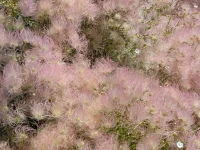
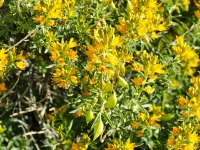
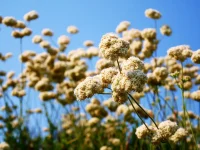
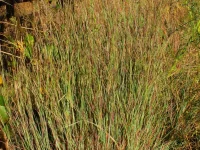
Plant it alongside American beautyberry, agarito, blackfoot daisy, and red yucca for a drought-smart native garden that looks great in every season. Check out our profiles on coneflowers, milkweeds, and rattlesnake master for more native plants that pair well with Texas mountain laurel. Happy planting!
Written by Emily Lessard. Emily is the founder and editor of The Plant Native. She is a Sustainable Landscapes-certified gardener through the Pennsylvania Landscape & Nursery Association, is finishing a Native Plant Landscaping certificate at Temple University, and is the author of The World of Native Plants (Quarto, February 2027).
Lee, Stephen T., Daniel Cook, Russell J. Molyneux, T. Zane Davis, and Dale R. Gardner. “Alkaloid Profiles of Dermatophyllum arizonicum, Dermatophyllum gypsophilum, Dermatophyllum secundiflorum, Styphnolobium affine, and Styphnolobium japonicum Previously Classified as Sophora Species.” Biochemical Systematics and Ecology 49 (2013): 87–93. https://www.sciencedirect.com/science/article/pii/S030519781300063X. Accessed March 7, 2026.