This is a tree with a backstory worthy of a Hollywood movie. Osage orange originally grew in just a tiny pocket of North America, in what is present-day Texas, Oklahoma, and Arkansas. Then humans helped it travel.
The Osage Nation valued it for bow-making: a single Osage orange bow could be traded for a horse and a blanket. In the 1800s, farmers used it for fences, planting thousands for “horse-high, bull-strong, pig-tight” living fences (even Martha Stewart agrees). According to the University of Arkansas, by 1948, Kansas alone had 96,596 miles of living Osage orange hedgerows.
Why is a rare tree so loved? It grows fast, is drought-tolerant, and produces the hardest wood in North America. The tree itself is nearly bulletproof: fast-growing, drought-tough, and worth planting if you know what you’re getting into.
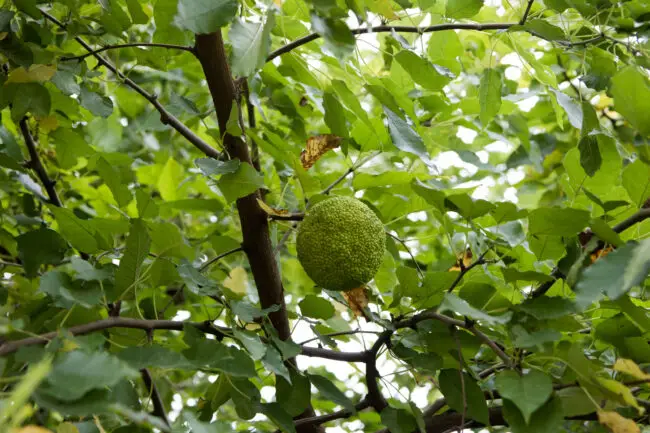
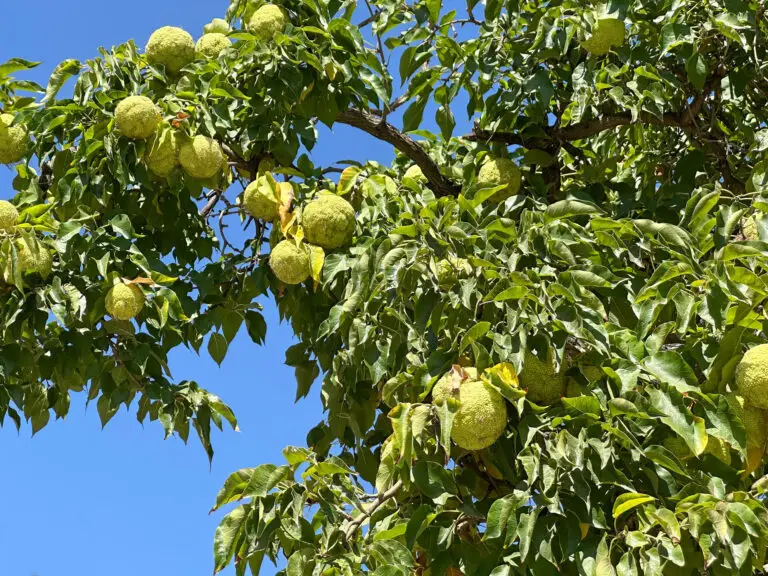
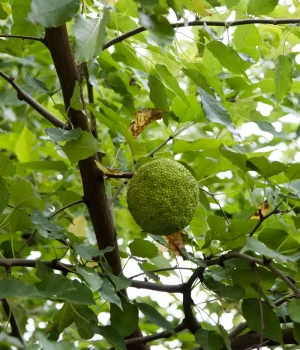
A verdant wall of Osage orange leaves and fruits
Is Osage orange right for my yard?
Plant it if…
You want a tough-as-nails tree that laughs at difficult sites. Osage orange handles drought, poor soil, compaction, salt spray, and temperature swings with zero complaints.
You love fascinating backstories. This tree has been shaped by mammoths, the Osage Nation, 19th-century farmers, and barbed wire manufacturing. Few trees have more human history.
You need a windbreak. Its dense, thorny growth and fast speed make it excellent for shelter belts, especially on rural properties.
You want to support specialist wildlife. Hagen’s sphinx moth is a specialist that eats ONLY Osage orange. If you want to support this moth, you need this tree.
If you plant the straight species, respect the thorns. If thorns are a safety concern near walkways, driveways, or play areas, this isn’t the tree for you.
Stick to a cultivar if you want a a thornless, fruit-less option. ‘White Shield’ is a thornless male that makes no fruit. You get all the toughness, but none of the thorns or fruit mess.
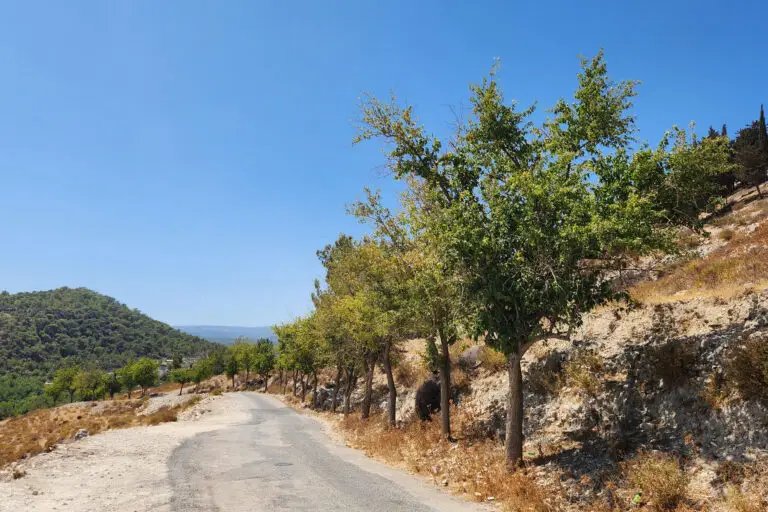
A row of Osage orange trees provides a welcoming archway along a Midwestern road
Skip it if…
Thorns are a safety issue. The thorns are serious and can puncture tires. Female trees drop large, heavy fruit that creates cleanup problems.
You need a tidy tree near walkways or patios. Hedge apples are messy, and thorny twigs can break and litter the ground.
You’re worried about aggressive roots or suckering. Osage orange can spread via root suckers, especially if cut.
You don’t want a potentially aggressive plant. In some regions, Osage orange can be invasive via suckering and should be managed carefully.
Where is Osage orange native?
Osage orange’s native range was originally tiny: just a small pocket where present-day Texas, Oklahoma, and Arkansas meet. This is one of the smallest native ranges of any North American tree.
It wasn’t always so rare. Millions of years ago, the genus Maclura had multiple species spread across North America, Asia, and Africa. Osage orange started to disappear 11,000 years ago, when Pleistocene megafauna icons like woolly mammoths, mastodons, giant ground sloths went extinct. These enormous animals were its seed dispersers (yep, because they would eat the fruit and poop out the seeds). When these enormous animals disappeared, this tree’s range contracted to a pocket in the Red River Valley and stayed there for millennia.
Then humans took it for a ride.
The Osage Nation spread it across the South and West for bow wood. In the 1800s, farmers planted it everywhere as a living fence. Today it’s found across much of the United States, from the Great Plains to the East Coast.
Where is Osage orange native?
Native to 34 US states, Washington, D.C., and 1 Canadian province (Ontario)
Before barbed wire, Osage orange hedgerows held the Great Plains together. Farmers planted it by the thousands of miles because it was reliable and tough.
”
Why Osage orange matters
A moth specialist’s only home
Osage orange is the sole host plant for Hagen’s sphinx moth (Ceratomia hageni). This moth exists nowhere else on Earth. Its caterpillars feed exclusively on Osage orange leaves. If the tree disappears, the moth disappears. If you plant an osage orange in your yard, you’re not just growing a tree: you’re sustaining a specialist species that depends entirely on it.
Wildlife shelter
The dense, vicious thorny branches make Osage orange an ideal shelter for birds nesting in safety. Few predators can penetrate those thorns. Squirrels harvest the seeds. Beetles and other insects live in the bark and wood.
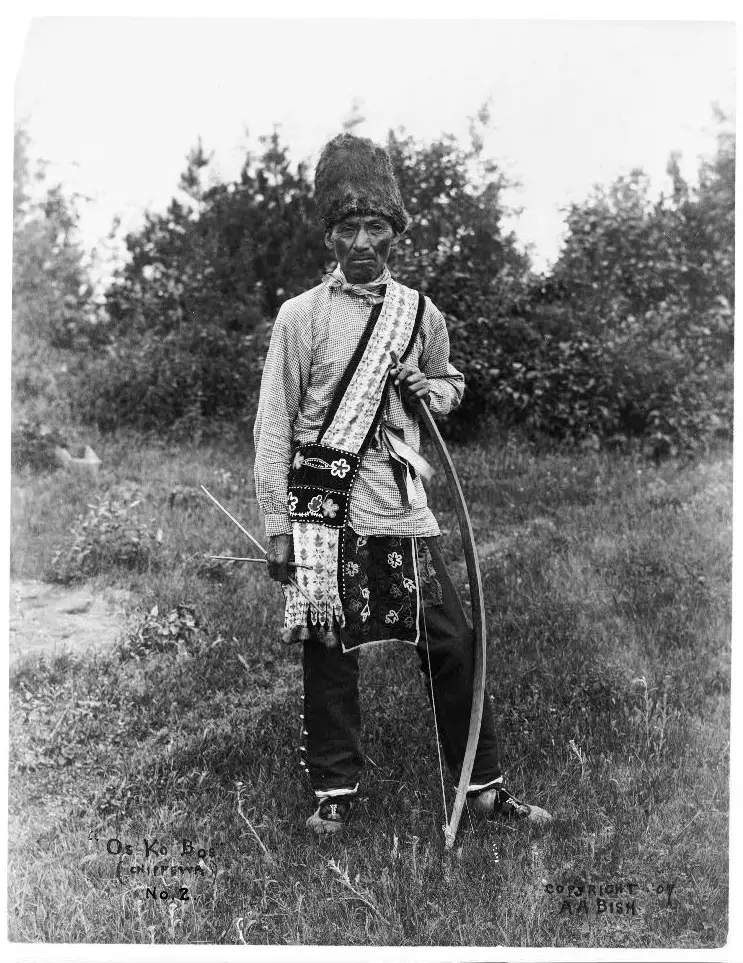
Os Ko Bos, an Osage Indian, holding bow and arrows, 1907. Image from the Library of Congress.
A tree with deep indigenous roots
The Osage knew, long before colonists arrived, how important this tree is. They planted it and used it for their bows. Osage orange bows were valued and often traded at a premium among indigenous nations and colonists. Meriwether Lewis (of the Lewis and Clark expedition) sent Osage orange cuttings back to Thomas Jefferson in 1804, writing, “the savages esteem the wood of this tree for the purpose of making their bows, that they travel many hundred miles in quest of it.” (I thought of removing the word “savages” here…but it’s important not to hide the racist history.)
Full sun is essential. Osage orange handles almost any soil: clay, sand, rocky, acid, alkaline. It’s at home in wet bottomlands and bone-dry uplands. It shrugs off compacted urban soil, salt spray, and pollution.
Spacing
For a specimen tree, plan for 30–40 feet of spread. For a hedge, space trees 5 feet apart and plan to prune ruthlessly.
Watering
Water deeply once a week through the first growing season. Once established, Osage orange is remarkably drought-tough and asks for almost nothing.
Garden Recipe™
Osage Orange
Maclura pomifera
Full sun
Sun
Easy
Effort
Medium Tree (30-60') tall 30-40 ft wide
Size
Spring - Summer
Blooms
What it needs
Sunlight
Full sun, 6+ hoursSouth- or west-facing is ideal
Water
AdaptableHandles both dry and wet conditions
Directions
Spacing
30-40 ftThink of each one as its own tree
Watering
Weekly for the first seasonAfter that, rain is usually enough
Notes
Comes back?
Yes, every yearGoes dormant in winter, that's normal. New growth each spring.
Butterfly host plant. Certain butterflies depend on this plant to reproduce. It's one of the specific species their caterpillars need to survive.
A 2–3 inch layer of mulch around the base helps during establishment. Keep mulch a few inches away from the trunk.
Beginner Tip
Worried about thorns and fruit, but want this tree? Choose 'White Shield,' a thornless male cultivar that makes no fruit. You get all the toughness and wildlife value of Osage orange without the thorns or mess.
Potential challenges with Osage orange
Thorns
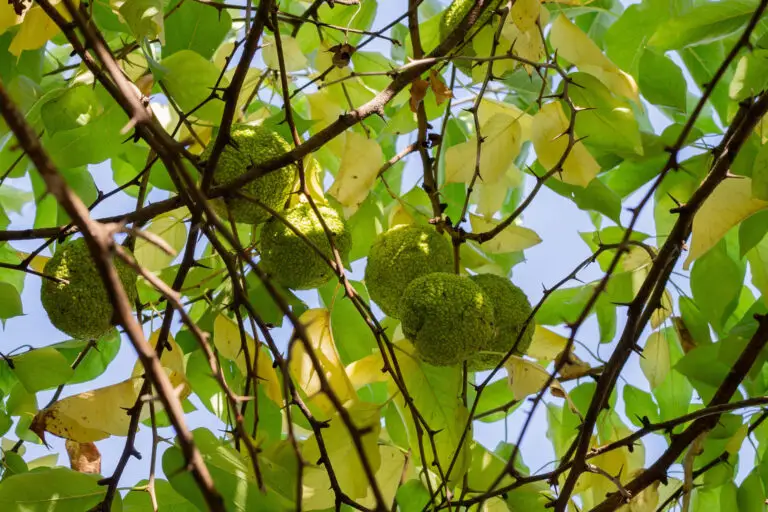
Vicious, long thorns on new growth can tear skin and cause serious injury. Wear heavy leather gloves when pruning. Long sleeves are a must. Consider safety glasses. Never plant near walkways, driveways, or play areas unless you choose a thornless cultivar.
Hedge apple mess
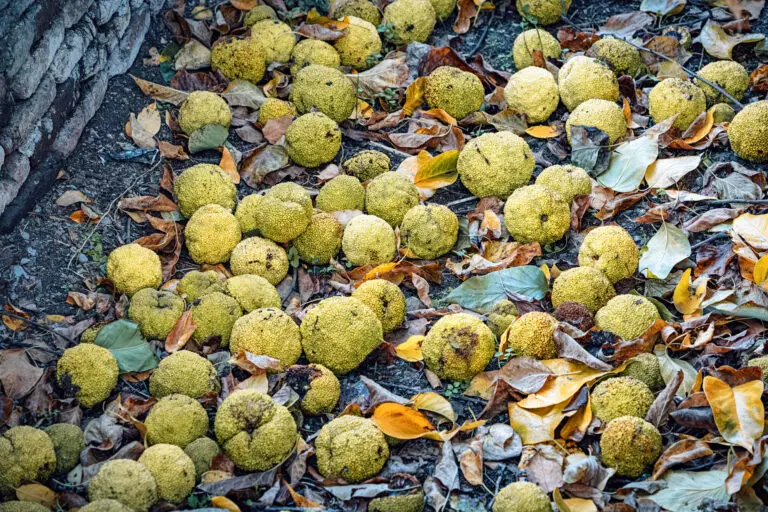
Large, warty, heavy fruit drops in fall. It’s toxic to livestock and sits on the ground creating a tripping hazard. Female trees are the culprit for the fruit. Male trees make no fruit.
Aggressive roots
Osage orange can spread via root suckers, especially if the tree is cut or damaged.
Not into mess? This might not be your tree.
Suckering
If the tree is damaged or cut down, it will resprout vigorously from the roots. This can be used to advantage in hedgerow management or can be a serious problem if left unchecked.
Sap on pruning wounds
Freshly cut wood can weep sap. Not dangerous, but messy and can stain surfaces.
Where Osage orange shines in your yard
Windbreaks: Fast growth and dense, thorny structure make it ideal for shelter belts, especially on rural properties and farms.
Wildlife hedgerows: The thorny shelter and seed-bearing branches create excellent nesting and food habitat. Pair with prairie grasses and other natives for a full hedgerow system.
Difficult sites: If you have a spot with terrible soil, extreme drought, compaction, or urban stress, Osage orange thrives where almost everything else fails.
Living fences: With proper pruning, Osage orange becomes a true ‘horse-high, bull-strong, pig-tight’ fence that needs little maintenance once established.
Specimen trees on rural properties: Its massive size, thorny architecture, and unusual fruit make it a striking presence on larger rural lots.
Supporting specialist moths: If you want Hagen’s sphinx moth in your yard, you need Osage orange. No alternative.
FAQs
Is the wood really that hard?
Yes. Osage orange is the hardest native hardwood in North America. Fence posts made from Osage orange in the 1800s still stand today, over 150 years later, with minimal rot. The wood is so dense it sinks in water. It was prized for bow-making (bois d’arc in French means ‘wood of the bow’), and an Osage orange bow was valuable enough to trade for a horse and a blanket in the early 19th century.
What is 'bois d'arc'?
Bois d’arc is French for ‘wood of the bow.’ The Osage Nation used Osage orange wood to make bows that were so effective and durable they became famous across the continent. A single bow was valuable enough to trade for a horse and a blanket: extraordinary value for a hunting tool. When French fur traders encountered the tree, they called it by this name, and it stuck.
Is Osage orange invasive?
In some regions, yes. Osage orange spreads aggressively via root suckers, especially if the tree is cut or damaged. In some states, it’s listed as a potentially invasive species. Check with your local extension office before planting. In any case, choose thornless cultivars like ‘White Shield’ for landscaping to avoid encouraging spread through suckering.
Can I eat the fruit?
The Osage “apple” itself is not poisonous to humans, but it’s inedible; tough, woody, and unpalatable. However, the seeds inside are edible (though you have to break through a very hard shell to get them). Livestock should not eat the fruit or seedlings, as it can cause digestive issues.
Plant Nerd Fact
Who eats these enormous, tennis-ball fruits?
We wondered this, too! The fruit is gigantic and energy-expensive for the tree to produce. It’s a mystery until you consider when it evolved.
Osage orange’s oversized fruit is designed to be eaten and dispersed by enormous Ice Age megafauna like woolly mammoths, mastodons, and giant ground sloths. These animals could swallow the fruit whole and yes—poop out the seeds as they walked, planting new plants. When these creatures went extinct about 11,000 years ago, Osage orange was left with its evolutionary tennis-ball fruits, but no customers.
Today, squirrels eat the seeds, but they’re not big enough to swallow the whole fruit. The fruit is essentially a relic of a lost world.
And no, humans can’t eat the fruit. It’s tough, woody, and inedible.
Where can I find Osage orange for my garden?
We are not going to lie; finding this one might be tough. But here are four reliable ways to find Osage orange for your yard:
Osage Orange
Where can I find seeds and plants?
Finding native plants can be challenging (we partly blame King Louis XVI.) To make it easier, we’ve assembled four sourcing ideas.
Osage orange pairs well with tough, adaptable natives that share its ability to handle difficult sites. These companions look great alongside it and support the broader wildlife picture:
Osage orange is a tree with unmatched toughness and an extraordinary history. It thrives where most trees fail, grows fast, and requires almost nothing once established. Its thorns are serious and its fruit is messy, but those challenges have clean solutions: choose ‘White Shield’ and enjoy all the benefits without the drawbacks. On rural properties or in windbreak plantings, Osage orange is bulletproof. And if you plant one, you’re not just growing a tree: you’re sustaining Hagen’s sphinx moth, which cannot survive anywhere else on Earth.
Carey, Jennifer H. “Maclura pomifera, Osage-Orange.” Fire Effects Information System. U.S. Department of Agriculture, Forest Service, Rocky Mountain Research Station, Fire Sciences Laboratory, 1994. https://research.fs.usda.gov/feis/species-reviews/macpom. Accessed August 28, 2026.
Wunderlin, Richard P. “Moraceae.” In Flora of North America North of Mexico, vol. 3, edited by the Flora of North America Editorial Committee. New York: Oxford University Press, 1997. http://www.efloras.org/florataxon.aspx?flora_id=1&taxon_id=233500764. Accessed August 28, 2026.
Emily Lessard is the founder and editor of The Plant Native, the site that helps homeowners across North America get started with native plants. She holds a Sustainable Landscapes certificate through the Pennsylvania Landscape & Nursery Association, is finishing a Native Perennial Garden Design Certificate at Temple University, and is the author of Grow Native (Quarto, February 2027). She gardens mostly in her pajamas outside Philadelphia in the Southeastern Plains ecoregion.