
Highlights
Wax currant (Ribes cereum) is a tidy, rounded shrub from the dry, rocky West. The leaves secrete a wax-like substance, hence the name. In spring, small tubular flowers, light pink to white, hang in short, drooping clusters, and by midsummer they’ve turned into shiny red berries.
In the wild it grows on dry slopes, ridges and rock outcrops from about 4,950 to 13,200 feet. A sunny, gravelly yard that bakes in July and freezes in January is home turf.
Is wax currant a good choice for my yard?
Yes, if…
- Your soil is dry, rocky or sandy. That’s its preferred soil, and alkaline ground is fine.
- Your winters are cold. Red Butte Garden rates it for zones 3 through 8.
- You don’t want to water. Its water needs are low once it’s settled.
- You need a shrub that stays in scale. It’s usually 3 to 6 feet tall and as wide.
Skip it if…
- You’re outside its range. It’s a western plant. In the East, American black currant is the native currant to look for.
- You grow white pines. The Lady Bird Johnson Wildflower Center’s verdict is blunt: “Not recommended; carries disease which kills white pine.”
- You want big, showy flowers. Each one is 3/8 inch long at most.
- Your yard is shady. It grows best without forest canopy.
Why wax currant matters
It’s fruit in places that don’t have much. The berries ripen by August, and the Forest Service notes that chickadees and other birds eat the fruit. Birds favor the berries, and the flowers are especially valuable to native bees.
Currants and gooseberries (Ribes) host 193 native moths and butterflies in the Shropshire-Tallamy caterpillar records. Their flowers also carry nectar that makes them attractive to both hummingbirds and butterflies. On a bare, dry hillside, a shrub that feeds caterpillars, bees and birds is doing a lot of the heavy lifting.
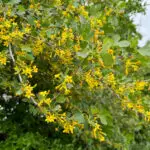
Wax currant is one of three native currants we cover. Golden currant has yellow flowers and handles wetter ground, and red-flowering currant is the big pink-flowered one of the Pacific coast.
Where wax currant shines in your yard
- A dry slope or rocky bank where other shrubs give up.
- The shrub layer of a xeric garden, with penstemons and rubber rabbitbrush.
- A low, informal hedge that feeds birds in summer.
- A mountain garden, where cold winters and thin soil are a given.
- In front of evergreens like Rocky Mountain juniper, where its pink flowers show up.
Beginner tip
Buy a container plant rather than starting from seed. The seeds need months of cold stratification, and a nursery plant skips the wait.
How to grow wax currant
Sun and soil
Full sun to part shade, in dry, rocky or sandy soils. Fast drainage is what counts, and soil high in lime is fine.
Water
Water it through its first growing season while the roots spread. After that, it can live on what falls from the sky in most of its range.
Spacing
Most plants reach 3 to 6 feet, though Red Butte Garden lists it at 6 feet high and 8 feet wide. Set plants 4 to 6 feet apart. It’s nonrhizomatous, so it won’t run, and it’s without bristles or thorns, unlike the gooseberries in the same genus.
Growing from seed
It’s slow going. The University of Washington propagation sheet says the seeds need about 4 to 5 months of cold, moist stratification, because embryo dormancy is the primary dormancy mechanism. If you’re not set on starting from seed, buy a plant.
Planting card
Ribes cereum
The trickPlant it in gravelly, fast-draining soil and stop watering after the first season.
Where is wax currant native?
Native to 15 US states
Sources: NatureServe, Royal Botanic Gardens, Kew (World Checklist of Vascular Plants) and the USDA PLANTS Database, compiled by The Plant Native. How we map native ranges
What happens to wax currant in a fire?
Some older write-ups say wax currant bounces back from wildfire. The Forest Service’s fire research says otherwise: fire usually kills wax currant, and sprouting from the root crown is weak.
Its comeback is underground. Fallen seeds stay viable in soil and duff for many years, and a low-severity fire may trigger them to germinate. The parent shrub rarely makes it; the seeds in the ground are the comeback plan. So don’t plant it as a fire-safe shrub. Colorado State’s firewise guidance is that all plants need space and maintenance close to the house, and wax currant is no exception.
The parent shrub rarely makes it; the seeds in the ground are the comeback plan.
What are good pairings for wax currant?
Pair it with plants that like the same sun and dry ground: Apache plume, native buckwheats, rubber rabbitbrush and penstemons. For the ground layer, try prairie smoke, and add golden currant if you have a moister spot.


Where can I buy wax currant?
You’re most likely to find it at native nurseries in the interior West, sometimes alongside golden currant. Look for a container plant, since seed is slow. Check your state’s rules on currants first if you live near white pine country. Start with our list of native plant nurseries or order online.
FAQs
Can you eat wax currant berries?
Yes, but don’t expect much. Oregon State calls the fruit unpalatable to good flavor, depending on the plant. The Santa Fe Botanical Garden warns that eating too many berries could result in nausea. The Forest Service notes people have used them for jam, jelly and pie.
Will wax currant grow back after a fire?
Mostly from seed, not from the roots. Fire usually kills the shrub. New plants come up afterward from soil-stored seed.
Does wax currant attract hummingbirds?
Probably, though we couldn’t find a study on this species. Currant flowers as a group carry nectar that draws hummingbirds and butterflies. If hummingbirds are the main goal, golden currant is the safer bet.
Is wax currant safe to plant near white pines?
No. It’s an alternate host for white pine blister rust, and OSU Extension’s handbook says do not plant white pine near currants or gooseberries. Keep them well apart.
What’s the difference between wax currant and golden currant?
Flower color is the quick tell. Golden currant has spicy-scented racemes of yellow flowers and handles everything from standing water to drought. Wax currant has light pink to white flowers and wants it dry.
Does wax currant spread?
No. It’s a clumping, densely branched shrub that doesn’t send out runners. New plants come from seed.
Plant nerd fact
The whisky currant
One of wax currant’s three varieties, var. pedicellare, goes by whisky currant. The name isn’t idle. The Santa Fe Botanical Garden notes that fermented fruit can make people unsteady, and lists an old synonym, Ribes inebrians.
Wax currant is a small shrub for hard places. Give it sun, sharp drainage and distance from white pines, and it will feed the chickadees every summer without asking for water. Happy planting!
Sources
- Colorado State University Extension. “Firewise Plant Materials.” May 2025. Accessed October 12, 2026.
- Hebert, Jack. “Plant Data Sheet: Ribes cereum.” University of Washington Botanic Gardens, 2006. Accessed October 12, 2026.
- Kuyper, Jennifer. “April: Wax Currant, Ribes cereum.” Plant of the Month, Santa Fe Botanical Garden, April 1, 2022. Accessed October 12, 2026.
- Lady Bird Johnson Wildflower Center. “Ribes cereum” and “Ribes aureum.” Native Plant Database. Accessed October 12, 2026.
- Marshall, K. Anna. “Ribes cereum.” Fire Effects Information System. USDA Forest Service, Rocky Mountain Research Station, 1995. Accessed October 12, 2026.
- NatureServe. “Ribes cereum.” NatureServe Explorer. Accessed October 12, 2026.
- Oregon State University. “Ribes cereum.” Landscape Plants. Accessed October 12, 2026.
- OSU Extension Service. “White Pine Blister Rust.” Pacific Northwest Pest Management Handbooks, revised March 2026. Accessed October 12, 2026.
- Red Butte Garden. “Wax Currant.” University of Utah. Accessed October 12, 2026.
- Rutgers New Jersey Agricultural Experiment Station. “Landscape Plants Rated by Deer Resistance.” Accessed October 12, 2026.
- Schalau, Jeff. “Gooseberries and Currants.” University of Arizona Cooperative Extension, Yavapai County, October 2, 2019. Accessed October 12, 2026.
- Shropshire, Kimberley J., and Douglas W. Tallamy. “Lepidoptera of North America North of Mexico: An Annotated List Containing Geographic Ranges and Host Plant Records.” ZooKeys, 2025. Host counts from the UDELep data, May 2025.
- University of Arizona Cooperative Extension, Yavapai County. “Ribes cereum: Wax Currant.” Yavapai County Native and Naturalized Plants. Accessed October 12, 2026.
- USDA Forest Service. “Ribes americanum.” Fire Effects Information System. Accessed October 12, 2026.

Similar plants
-
 Viburnums
-
 Manzanitas
-
 Red-Flowering Currant
-
 Rubber Rabbitbrush
-
 Roses
-
 Red Twig Dogwood
-
 Golden Currant
-
 American Plum
-
 Texas Mountain Laurel
Updated Find more: Deer Resistant Flowering Shrub Shrub
The ads on this site help pay real native plant nerds to research and write these guides.
Garden notes
Notes from people who’ve grown it
Tips, wins, and the occasional disaster. If you’ve grown wax currant, share the advice you’d give to a neighbor.
No notes yet. Yours could be the first.
Grown wax currant? Tell the next person what you wish someone had told you.
Tap anywhere to close


