





Highlights
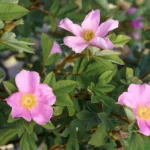
Red-flowering currant (Ribes sanguineum) opens its flowers just as its leaves unfold, in the first real weeks of spring. Drooping clusters of little tubular flowers, pale-pink to dark-red, cover the bare-looking branches, and they carry a spicy fragrance. Hummingbirds are the regulars.
It’s a big, loose western shrub, often 5 to 12 feet tall and wide. Once settled it gets by on dry summers. By midsummer the flowers have become blue-black berries with a white bloom, and the birds clean them up.
Is red-flowering currant a good choice for my yard?
Yes, if…
- You live where it grows wild, from the California Coast Ranges north to British Columbia and east into Idaho.
- You want hummingbirds in early spring. NC State calls it favored by hummingbirds for its early nectar.
- You have sun and room. Full sun gives you the most flowers, and the shrub needs space to arch.
- Your summers are dry. Once it’s established it handles drought.
Skip it if…
- You’re outside its range, especially in the humid East. NC State says it would not do well in the southeastern United States, and it’s hardy only in zones 6 to 8.
- There’s a white pine nearby. Currants carry white pine blister rust (more on that below), and all Ribes are prohibited in North Carolina.
- You have a small yard. This is a large shrub, and it will crowd anything planted too close.
- You want a shrub that looks lush all summer. In dry years the leaves naturally begin to fall by mid to late summer.
Why red-flowering currant matters
It’s nectar at a time of year when there isn’t much. The Lady Bird Johnson Wildflower Center lists it as a nectar source for hummingbirds, butterflies and bees, and the Forest Service notes the flowers come out in early spring as the leaves emerge. In the Northwest, it’s the shrub that says spring is here.
The leaves feed moth and butterfly larvae, too. Currants and gooseberries (Ribes) host 193 native moths and butterflies in the Shropshire-Tallamy caterpillar records. NC State names one of them for this species: Hyalophora euryalus, the ceanothus silkmoth, one of the big western silk moths.
Then come the berries. Grouse, quail, robins, finches, towhees and woodpeckers all eat the fruit, and Native Americans ate the berries fresh or dried. If you want the golden-flowered and drier-country cousins, see golden currant and wax currant.
Where red-flowering currant shines in your yard
- Outside a window where you can watch hummingbirds work the flowers.
- A loose screen along a fence or property line.
- The back of a border, where its early bloom starts the season.
- A woodland edge with western sword fern, salal and Oregon grape below.
- A hummingbird garden that runs from spring to fall, paired with late-blooming California fuchsia.
Beginner tip
Stop watering when the leaves start dropping in late summer. It’s the shrub’s normal summer rest, and extra water then does more harm than good.
How to grow red-flowering currant
Sun and soil
Plant it in full sun for the best bloom. It grows in shade, but NC State says it won’t flower as well there. The soil just needs to drain: it wants moist to drier, well-drained soils, and soggy ground is the thing to avoid.
Water
NRCS says to provide supplemental water during the first and perhaps second season. After that, back off. Don’t keep watering in late summer when the leaves start to drop; that’s the shrub resting, not dying.
Spacing
NC State lists it at 5 to 12 feet tall and wide, with an upright-arching to rounded habit. Set plants 6 to 8 feet apart, farther from a path. NC State calls its growth rapid while NRCS says moderate, so give it the full space from day one.
Pests and problems
NC State calls it somewhat resistant to most insects and diseases, though currant borer and oak root fungus can hit it. Powdery mildew on currants starts with spores released around bloom; good air circulation is the best prevention.
Which cultivar?
The Forest Service counts more than a dozen cultivars and hybrids. ‘King Edward VII’ is compact, about 6 ft high and wider than tall. ‘Pulborough Scarlet’ is red with white centers, ‘Pokey’s Pink’ is light pink, and ‘White Icicle’ is white and blooms early.
Planting card
Ribes sanguineum
The trickStop watering when the leaves start to drop in late summer; it’s resting, not dying.
Where is red-flowering currant native?
Native to 4 US states
Sources: NatureServe, Royal Botanic Gardens, Kew (World Checklist of Vascular Plants) and the USDA PLANTS Database, compiled by The Plant Native. How we map native ranges
Red-flowering currant and white pines
Every currant comes with one real caveat. Red-flowering currant is an alternate host of white pine blister rust (Cronartium ribicola), a disease of five-needle pines, and NRCS notes it has been considered a weed in several timber states because of it.
OSU Extension’s plant disease handbook says susceptible currants cannot be planted safely nearer than 1,000 ft from white pine, and preferably half a mile. If there’s a white pine within 1,000 feet, pick a different shrub. Some states regulate currants outright, so check your state’s rules before you buy.
In the Northwest, it’s the shrub that says spring is here.
What are good pairings for red-flowering currant?
Give it neighbors that bloom before and after. Saskatoon serviceberry flowers in spring too, and California lilacs, mock orange and oceanspray carry the shrub layer into summer. Underneath, add western sword fern and native columbines.


Where can I buy red-flowering currant?
Look for it at native nurseries in the Northwest and California, where it’s often sold as named cultivars. When you can find the straight species grown from local seed, choose it, though a cultivar still beats a lawn. Check your state’s rules on Ribes first. Start with our list of native plant nurseries or order online.
FAQs
When does red-flowering currant bloom?
Early spring. The Lady Bird Johnson Wildflower Center lists March and April, and NRCS gives March to June for its Corvallis, Oregon, plantings.
Is red-flowering currant good for hummingbirds?
Yes. NC State, NRCS, the Forest Service and the Lady Bird Johnson Wildflower Center all list it as hummingbird nectar. Plant it where you can see it from the house.
Can you eat red-flowering currant berries?
You can, but they’re not great. Oregon State calls them edible but insipid, and NC State says they’re better left for the birds. People do cook the tart berries into jams, pies, juice and syrup.
Why is my red-flowering currant dropping leaves in summer?
That’s normal. The leaves naturally begin to fall in mid to late summer, especially in dry years. Don’t try to water them back.
Can I grow red-flowering currant in the East?
Usually not. It dislikes humidity and is rated for zones 6 to 8, and North Carolina bans all Ribes. If you love currants and live east of the Rockies, look at golden currant instead.
Is this the currant you eat?
No. Kitchen currants are black currant and red currant, different species bred for fruit. They also host blister rust, and OSU Extension notes black currant is more susceptible than red.
Plant nerd fact
“In the very front rank”
The plant explorer David Douglas introduced red-flowering currant to British gardens for the Horticultural Society in 1826. In Trees and Shrubs Hardy in the British Isles, W. J. Bean called it “the finest of ribes and in the very front rank of all spring-flowering shrubs.”
There are even two wild varieties. In var. sanguineum the flower clusters stand up or spread stiffly, and in var. glutinosum they hang down with 15 to 40 flowers each.
Red-flowering currant gives you a big, easy shrub that blooms when almost nothing else does, and it feeds hummingbirds while it’s at it. Keep it away from white pines, let it rest in late summer, and give it room. Happy planting!
Sources
- Bean, W. J. “Ribes sanguineum Pursh.” Trees and Shrubs Hardy in the British Isles, via Trees and Shrubs Online, International Dendrology Society. Accessed October 12, 2026.
- Flora of North America Editorial Committee. “Ribes sanguineum.” Flora of North America. Accessed October 12, 2026.
- Gonzalves, Pete, and Dale Darris. “Red-Flowering Currant, Ribes sanguineum Pursh.” Plant Fact Sheet. USDA NRCS Plant Materials Center, Corvallis, Oregon, 2008. Accessed October 12, 2026.
- Holmes, Russ. “Red-flowering Currant (Ribes sanguineum).” Plant of the Week. USDA Forest Service, Celebrating Wildflowers. Accessed October 12, 2026.
- Lady Bird Johnson Wildflower Center. “Ribes sanguineum (Redflower Currant).” Native Plant Database. Accessed October 12, 2026.
- NatureServe. “Ribes sanguineum.” NatureServe Explorer. Accessed October 12, 2026.
- NC State Extension. “Ribes sanguineum.” Extension Gardener Plant Toolbox. Accessed October 12, 2026.
- Oregon State University. “Ribes sanguineum.” Landscape Plants. Accessed October 12, 2026.
- OSU Extension Service. “Gooseberry and Currant (Ribes spp.): Blister Rust” and “Gooseberry and Currant (Ribes spp.): Powdery Mildew.” Pacific Northwest Plant Disease Management Handbook, revised March 2026. Accessed October 12, 2026.
- Rutgers New Jersey Agricultural Experiment Station. “Landscape Plants Rated by Deer Resistance.” Accessed October 12, 2026.
- Shropshire, Kimberley J., and Douglas W. Tallamy. “Lepidoptera of North America North of Mexico: An Annotated List Containing Geographic Ranges and Host Plant Records.” ZooKeys, 2025. Host counts from the UDELep data, May 2025.
Similar plants
Updated Find more: Deer Resistant Flowering Shrub Hummingbird Favorite Shrub
The ads on this site help pay real native plant nerds to research and write these guides.
Garden notes
Notes from people who’ve grown it
Tips, wins, and the occasional disaster. If you’ve grown red-flowering currant, share the advice you’d give to a neighbor.
No notes yet. Yours could be the first.
Grown red-flowering currant? Tell the next person what you wish someone had told you.
Tap anywhere to close


