




Highlights
Rocky Mountain juniper (Juniperus scopulorum) is the evergreen of western foothills and canyon rims: a narrow, pointed tree covered in tiny scale-like leaves that run from dark green to bluish-green. Female trees carry dark blue “berries” dusted with a pale bloom. They hang on through winter, which is when the birds come looking.
It grows from British Columbia to Arizona and east to North Dakota and west Texas, on thin, rocky, alkaline ground with very little rain. Give it sun and a dry spot and it will probably outlive everyone who planted it. One wild tree in Utah has been growing for nearly 1,500 years.
Is Rocky Mountain juniper a good choice for my yard?
Yes, if…
- You garden in the interior West or the northern Plains. NC State rates it for zones 3a to 7b.
- Your soil is dry, rocky or alkaline. In the wild it prefers calcareous and somewhat alkaline soils.
- You want birds in winter. The cones ripen in fall and stay on the tree into spring.
- You need an evergreen windbreak that barely needs a hose. Utah State says it wants very little water once established.
Skip it if…
- Your summers are humid. It does not adapt to high humidity or high night temperatures. In the East, plant eastern red cedar instead.
- You grow apples, crabapples, hawthorns or serviceberries nearby. Junipers and those trees pass cedar-apple and related rusts back and forth.
- It would stand close to your house in wildfire country. Colorado State asks you to keep junipers at least 30 feet from any structure.
- Your soil stays wet. NC State lists root rot in poorly drained soil among its few problems.
Why Rocky Mountain juniper matters
The cones are winter food. Bohemian waxwings eat them in large numbers, and cedar waxwings, robins, wild turkeys and several kinds of jays join in. The cones ripen in the second fall after pollination and can stay on the tree until March or April.
One small gray bird leans on it harder than the rest. In winter, the Townsend’s solitaire eats largely or even exclusively juniper berries, claims a patch of trees as its own and sings all through fall and winter to keep other solitaires away.
Robins and chipping sparrows nest in it, and bighorn sheep and deer eat the cones.
It’s a host plant
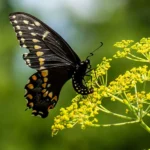
Junipers host 111 native moths and butterflies in the Shropshire-Tallamy caterpillar records. On Rocky Mountain juniper, that includes the olive butterfly.
Where Rocky Mountain juniper shines in your yard
- A windbreak on the open side of a rural or Plains property.
- A dry, rocky slope where the soil is thin and the sun is strong.
- A winter bird garden, with female trees for cones and dense branches for cover.
- A narrow screen along a property line, using an upright form like ‘Skyrocket’.
- A low-water yard with native grasses and shrubs that live on rain alone.
Beginner tip
Want birds? Skip the male blue cultivars and plant two or three seed-grown trees, so the odds are good that one is female.
How to grow Rocky Mountain juniper
Sun and soil
Full sun. Young trees handle a little shade, but older ones need open sky. It does especially well in dry, sandy soil, and rocky or alkaline ground is no problem. Rich, damp garden beds are the wrong place.
Water
In the wild it gets by on only about 10 inches of rain and snow a year. Water a new tree deeply through its first summer while the roots spread, then mostly leave it to the weather. More trees die from too much water than too little.
Size and growth
NC State puts it at 30 to 40 feet tall and 3 to 15 feet wide, narrow when young and rounder with age. It’s slow: southwestern trees grew about 4 inches a year until around age 40, then slowed down.
Male or female?
Most trees are either male or female, and only females bear the blue cones, which need pollen from a male nearby. That matters when you shop. ‘Wichita Blue’, a popular compact blue form, is a male, so it will never feed a bird.
Cultivars and pests
Named forms are picked for color and shape: ‘Moonglow’ is silver-blue, and ‘Skyrocket’ is narrowly pyramidal. NC State reports no serious diseases or insect pests, though bagworms and spider mites show up now and then.
Planting card
Juniperus scopulorum
The trickSkip the male blue cultivars and plant a few seed-grown trees, so the odds are good one bears berries.
Where is Rocky Mountain juniper native?
Native to 15 US states
Sources: NatureServe, Royal Botanic Gardens, Kew (World Checklist of Vascular Plants) and the USDA PLANTS Database, compiled by The Plant Native. How we map native ranges
It grows from near sea level to about 9,000 feet. Where it meets eastern red cedar, the two cross; along the Missouri River the whole population is reported to be a hybrid swarm. It shares that dry western country with shrubs like golden currant and wax currant.
What are good pairings for Rocky Mountain juniper?
Pair it with natives that like sun, wind and dry ground: rubber rabbitbrush, Rocky Mountain bee plant, purple prairie clover and golden currant. Underneath, buffalo grass and little bluestem stay low and need as little water as the tree. Leave the serviceberries and crabapples for another part of the yard.


Where can I buy Rocky Mountain juniper?
Native nurseries across the West sell it as seedlings and as named cultivars. Seedlings give you a mix of male and female trees; cultivars are uniform, and some are male. Start with our list of native plant nurseries or order online.
Junipers, apples and rust
Cedar-apple rust is a fungus that needs two hosts, a juniper and an apple-family tree, and it can’t finish its life without both. On the juniper it makes galls that push out yellow-orange gelatinous horns in a wet spring. They look alarming, but Colorado State calls the galls innocuous to the juniper.
The apple side takes the damage. Spores blow to apples and crabapples, and related rusts reach hawthorn, pear and serviceberry, where repeated infections mean early leaf drop and smaller fruit. Keep the two apart; a few hundred yards is generally enough.
Give it sun and a dry spot and it will probably outlive everyone who planted it.
FAQs
Are juniper berries really berries?
No, they’re cones. The blue “berry” is a seed cone whose scales have grown soft and fused together. The Lady Bird Johnson Wildflower Center notes the name is technically incorrect but used everywhere anyway.
Can I eat Rocky Mountain juniper berries or make gin with them?
We don’t recommend it. Gin is made from common juniper, a different species, and the Forest Service warns that common juniper extract can be fatal in even fairly small amounts. We found no reliable source on eating this species, so leave the cones for the birds.
Is Rocky Mountain juniper deer resistant?
In most gardens, yes. Rutgers rates its cultivars “seldom severely damaged,” and ‘Moonglow’ “rarely damaged.” In the wild, mule deer browse it moderately in winter, spring and fall, so a hungry year can still bring nibbling.
What’s the difference between Rocky Mountain juniper and eastern red cedar?
Mostly geography. Eastern red cedar grows from Nova Scotia west to Ontario and south to Texas and Florida; Rocky Mountain juniper is the western tree. The two look alike and cross where their ranges meet, in the northern Great Plains and the Texas panhandle.
Is Rocky Mountain juniper a fire risk?
Yes, more than most trees. Its high volatile oil content makes it burn readily, and it doesn’t sprout back after fire. Colorado State lists junipers among common flammable trees. In fire country, plant it well away from the house.
Plant nerd fact
The tree that lost 1,500 years
The Jardine Juniper grows from the edge of a limestone cliff in Logan Canyon, Utah. For decades it was billed as more than 3,000 years old. Then someone cored it and counted the rings, and the Natural History Museum of Utah now puts it at nearly 1,500 years old. Visit Utah agrees it’s probably closer to 1,500. Plenty of reference books still repeat the bigger number.
Rocky Mountain juniper asks for sun, sharp drainage and patience, and gives back an evergreen that feeds winter birds for a few hundred years. For more plants that live on rain alone, see our guide to native penstemons. Happy planting!
Sources
- Colorado State University Extension. “1450 Juniper-hawthorn Rust.” PlantTalk Colorado. Accessed October 12, 2026.
- Cornell University Woody Plants Database. “Moonglow” and “Skyrocket.” Accessed October 12, 2026.
- Cornell Lab of Ornithology. “Townsend’s Solitaire.” All About Birds. Accessed October 12, 2026.
- Fort Lewis College. “Juniperus scopulorum.” FLC Arboretum. Accessed October 12, 2026.
- Lady Bird Johnson Wildflower Center. “Juniperus scopulorum.” Native Plant Database. Accessed October 12, 2026.
- Langelo, Linda, S. Carter, N. Goeckner, C. Julian, I. Shonle, and C. Dennis. “Firewise Plant Materials.” Colorado State University Extension, 2025. Accessed October 12, 2026.
- Moorman, Gary W. “Cedar Apple and Related Rusts on Ornamentals.” Penn State Extension, 2023. Accessed October 12, 2026.
- Natural History Museum of Utah. “Explorer Corps Marker: Cache County.” Accessed October 12, 2026.
- NatureServe. “Juniperus scopulorum.” NatureServe Explorer. Accessed October 12, 2026.
- NC State Extension. “Juniperus scopulorum.” Extension Gardener Plant Toolbox. Accessed October 12, 2026.
- Noble, Daniel L. “Rocky Mountain Juniper.” In Silvics of North America, vol. 1, Agriculture Handbook 654. USDA Forest Service. Accessed October 12, 2026.
- Rutgers New Jersey Agricultural Experiment Station. “Landscape Plants Rated by Deer Resistance.” Accessed October 12, 2026.
- Scher, Janette S. “Juniperus scopulorum.” Fire Effects Information System. USDA Forest Service, 2002. Accessed October 12, 2026.
- Shropshire, Kimberley J., and Douglas W. Tallamy. “Lepidoptera of North America North of Mexico: An Annotated List Containing Geographic Ranges and Host Plant Records.” ZooKeys, 2025. Host counts from the UDELep data, May 2025.
- USDA Forest Service. “Juniperus communis” and “Juniperus virginiana.” Fire Effects Information System. Accessed October 12, 2026.
- Utah State University Extension. “Juniper, Rocky Mountain.” TreeBrowser. Accessed October 12, 2026.
- Visit Utah. “Jardine Juniper Trail.” Accessed October 12, 2026.

Similar plants
Updated Find more: Deer Resistant Evergreen Evergreen Tree Tree
The ads on this site help pay real native plant nerds to research and write these guides.
Garden notes
Notes from people who’ve grown it
Tips, wins, and the occasional disaster. If you’ve grown Rocky Mountain juniper, share the advice you’d give to a neighbor.
No notes yet. Yours could be the first.
Grown Rocky Mountain juniper? Tell the next person what you wish someone had told you.
Tap anywhere to close


