
Highlights
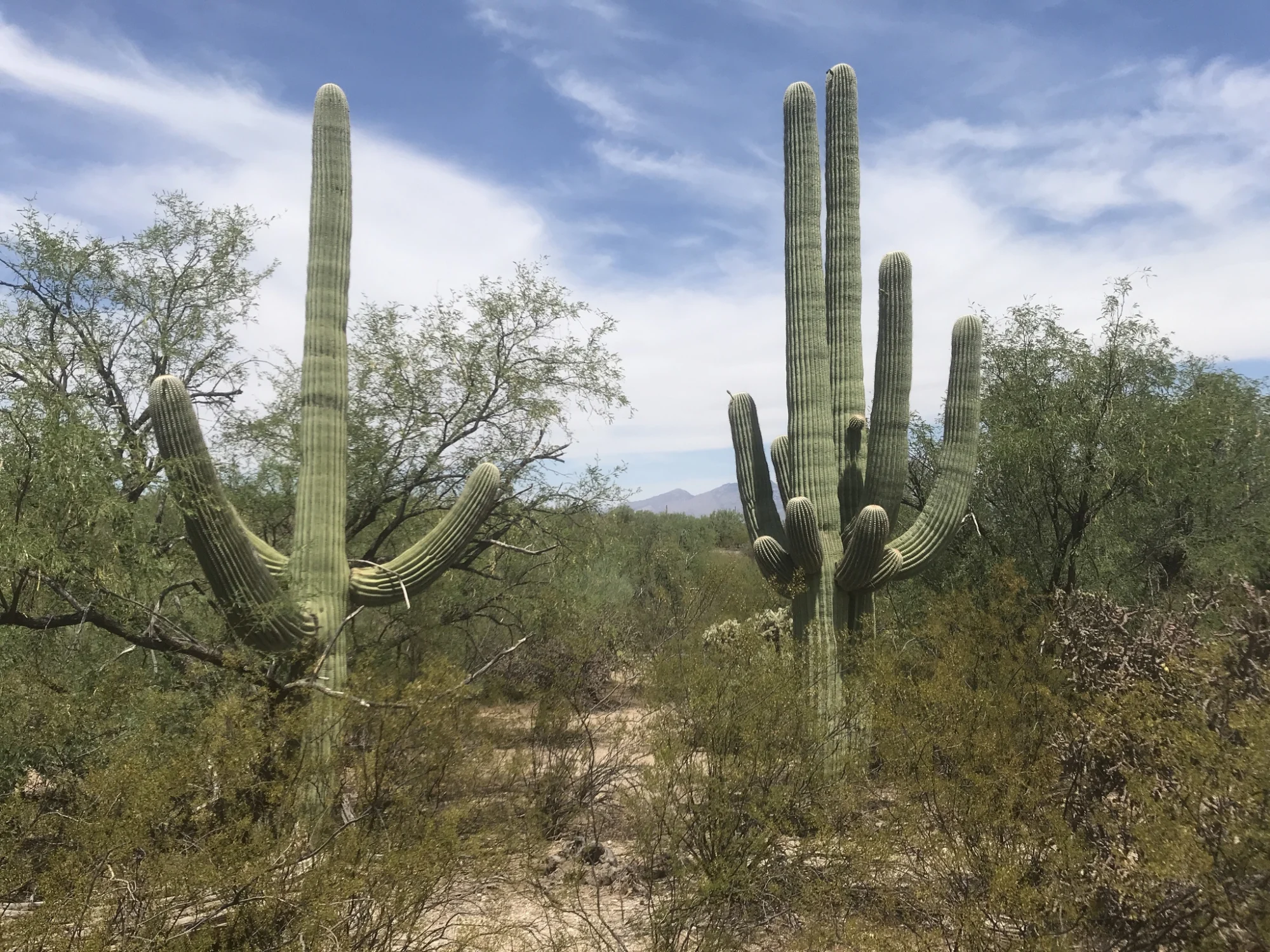
Picture the cactus from every desert postcard you’ve ever seen: tall green columns, sometimes with arms raised like they’re waving (hello!). In May and June they wear a crown of big white flowers that open after dark and close by the next afternoon. The saguaro is also a keystone plant, with more than 100 other plants and animals leaning on it for food or shelter. Bats drink the nectar at night, birds and mammals eat the fruit during the driest weeks of June, and woodpeckers carve nest holes that owls will move into later. It takes its time, growing only an inch or so over about 10 years, so if you are planning on adding one to your space, be ready for the long game.
Is saguaro right for my yard?
Yes, if…
- You live in the Sonoran Desert, or somewhere that acts like it: hot, dry, and mostly frost-free in winter (zones 9 to 11).
- You have a sunny spot with sandy, gravelly, or rocky soil, the kind where water drains like a sieve.
- You like planting for the long haul. Your grandkids will be the ones watching this one grow.
- You have room for arms, and for a plant that can weigh over a ton. Give it elbow room.
- You want a showpiece that needs no introduction. Everybody knows this cactus on sight.
Skip it if…
- Your winters bring hard freezes. Saguaro does not do snow days: a cold snap below 17 to 22°F lasting 15 to 20 hours can be deadly, and the damage can take a year to show.
- Your yard has heavy clay, soggy low spots, or lawn sprinklers. Saguaro hates wet feet, and extra water can split the skin and rot the roots.
- You were thinking of digging one up from the desert. Put the shovel down. It’s illegal, and these plants can’t be replaced.
- The spot you want is a property line, driveway edge, or pool side. Saguaros get heavy and wide, and a fallen one is dangerous, so keep it away from where people walk, park, or swim.
Where is saguaro native?
Native to 2 US states
Sources: NatureServe, Royal Botanic Gardens, Kew (World Checklist of Vascular Plants) and the USDA PLANTS Database, compiled by The Plant Native. How we map native ranges
Saguaros are native to Arizona and southeastern California, along the Colorado River. You can find them in northern Mexico also (Sonora and Baja California Norte).
Your grandkids will be the ones watching this one grow.
Why saguaro matters
You know this plant before you know its name. It is a symbol of the desert Southwest, the largest cactus in the United States, and Saguaro National Park is named after it.
For the Tohono O’odham, the Indigenous people of the Sonoran Desert in southern Arizona whose name means “desert people,” the saguaro is much more than a symbol. In their stories the saguaro was once human, and saguaros are viewed as respected members of the tribe. Every summer, families gather ripe fruit from their saguaro groves using a long pole made from saguaro ribs, sometimes 30 feet long. The harvest was traditionally women’s work, and it marks the start of the O’odham New Year. The fruit gets cooked into syrup and made into a wine for a ceremony meant to bring the summer rains.
It is also the desert’s main landlord. Saguaro is a keystone species, which means it is central to keeping its desert neighbors supported. At night, lesser long-nosed bats drink the nectar. By morning, white-winged doves and honey bees take over. The fruit ripens in June and early July, during the hottest parts of the summer, offering a hydrating snack for the many birds, mammals and insects in the neighborhood.
Then come the apartments. Gila woodpeckers and gilded flickers dig nest holes in the trunk, and after they leave, elf owls, house finches, ash-throated flycatchers, and purple martins move in. Red-tailed hawks nest in the crook between trunk and arm.
Baby saguaros start life under a nurse tree: foothills palo verde or velvet mesquite trees, which shield them from cold and heat. As the saguaro grows, the nurse plant often dies away, and the saguaro keeps growing into the stately form we all know and love.
Saguaro through the seasons
In the Sonoran Desert, the year has five seasons, not four. Summer comes in two acts: a scorching, bone-dry foresummer, and then the stormy monsoon.
Spring (late February to April)
Warm days, cool nights. The first saguaro flowers open in late April.
Foresummer (May and June)
The hottest, driest stretch, and saguaro’s big moment. Flowers open at night, a few at a time, for weeks. In June the fruit ripens and splits open to show red pulp, right when little else offers moisture. If it hasn’t rained, an established saguaro needs water only about once a month.
Monsoon (July to early September)
Hot days and afternoon thunderstorms. The last fruit finishes in early July. Heavy rain can turn soil to mud, and healthy saguaros sometimes fall, so keep water from pooling at the base and skip extra watering.
Fall (late September to November)
Still warm, with cooler evenings. This is planting season. October is a good target, and fall into winter works too, so seasonal rains can help roots settle in before summer heat.
Winter
Cool days and occasional frost. Watch the forecast, because a freeze below 17 to 22°F for 15 to 20 hours can be deadly, and damage may not show for a year or more. Reddish patches on the south or west side are cold stress, not sunburn.
Where saguaro shines in your yard
- The focal point. Give it open space and nothing competing with it, and one saguaro can add the elegance of a garden statue. A small mound or berm adds height and keeps water from pooling at the base.
- A dramatic rockscape. Boulders, rock, and gravel are familiar ground, since in the wild it grows on gravelly slopes and rocky ridges. Tuck it into a rock pile and it looks like it grew there on its own.
- A xeriscape garden. Let it be the tall exclamation point in a bed of low, dry-loving plants that run on rain or very little irrigation. Palo verde and mesquite can add a second layer overhead.
- A wildlife stop. Bats drink its nectar at night, doves and honey bees visit by day, woodpeckers dig nest holes in the trunk, and hawks use it as a lookout. It works as a bird feeder, a nest box, and a perch in one plant.
- A group in different heights. Cluster a tall one, a medium one, and a baby. The layers read like a desert hillside.
- Anywhere your yard needs structure. A flat gravel yard or a blank corner by a wall gets a bold vertical line. It can handle any heat bouncing off the pavement and walls, but be sure to leave room for the arms.
How to grow saguaro
Where to plant
Pick a sunny, well-drained spot with sand, gravel, or rock. Skip clay and low spots. Also be sure to plant it at the same depth it came in. Planting too deep is a common mistake and can lead to rot. If transplanting, remember that it also needs to face the same side to the sun that it faced before; turning it can sunburn the skin. Wrap a new plant in 30% shade cloth through its first summer.
When to plant
Fall is the best time. October is a good target, and fall into winter works too, because seasonal rains help roots settle in before summer heat. Spring is the next best window: plant in warm, dry weather, into dry soil, and not right before a rain. Skip late spring and early summer, when the heat is extreme and the rain is low. Fresh transplants can also rot in winter wet, so pick a dry stretch.
Spacing
Leave room for arms and keep it away from buildings and utilities. Planting in rows and clusters both work, but saguaros grow at different speeds, so expect the heights to drift apart. Keep them off driveway edges and property lines.
Watering
Hold off for two to four weeks after planting so damaged roots can heal. Then water about every three weeks in warm months, roughly one gallon for each foot of cactus, for at least four years. After that, a slow soak once a month in the hottest month is plenty. Don’t mix compost into the planting hole, saguaros need soil that drains well.
Planting card
Carnegiea gigantea
The trickPlant it at the same depth, facing the same way it grew before.
What to plant with saguaro
Saguaro is the exclamation point. Give it a supporting cast with some color.
- Yellow. Brittlebush makes a rounded, silvery-green mound topped with bright yellow flowers in late winter and early spring. Palo verde adds a cloud of yellow overhead in spring.
- Pink. Parry’s penstemon sends up pink-red flower spikes from March to May. Pink fairy duster adds pin-cushion flowers on a ferny shrub.
- Orange. Globemallow covers itself in apricot to bright orange flowers in spring.
- Red. Ocotillo and chuparosa bring tubular red flowers. Chuparosa’s name means hummingbird in Spanish.
- Purple. Ironwood has purple flowers in spring, and it shades young saguaros as they grow.
Saguaro blooms in May and June, so pick a few that flower into summer, like ocotillo, chuparosa, and globemallow, so something else is in bloom when it is. Most of these run on low to very low water, so they fit a saguaro’s needs. Keep saguaro away from lawns, fruit trees, and vegetable gardens, which need more water than it does.


Where can I buy saguaro?
Buy your saguaro from a native plant nursery. You can find them either grown from seed or legally rescued from a building site. If you adopt a rescue, ask to see its state tag, and look for Carnegiea gigantea on the label.
Potential challenges
Nibbling
Deer aren’t an issue when it comes to saguaro. But jackrabbits, packrats, and javelina gnaw at the base and can do some serious damage, especially to a young plant. Wrap your baby saguaros in chicken wire or hardware cloth.
Too much water
This is the real killer. It’s tempting to look at a fat, happy saguaro and think “that plant looks amazing!” But a saguaro that stays swollen when it hasn’t rained may be getting too much water, which can split the skin and rot the roots. If you see oozing brown or black fluid, act fast: scoop out the soft tissue with a clean tool until you hit firm, whitish-green flesh, and spray the area with 70% rubbing alcohol for a week or two.
Hard freezes
Saguaro loves heat and gets cranky when the nights turn cold. Treat a young one like a tender seedling and cover it when the temperature drops below 25°F. Bigger plants can handle short dips to about 20°F, but a long freeze is a different story. A hard freeze of 15 to 20 hours at 17 to 22°F can be deadly, and the damage can take a year to show, so a plant that looks fine in January can still be in trouble the next winter. Check the forecast on cold nights.
Sunburn
Yes, a desert cactus can get sunburned. Dark brown patches are the sign. It happens when a saguaro is laid on its side during a move, gets turned to face a different direction, or loses the shade tree that was looking after it. Think of it as the skin getting caught off guard by a side of the sun it has never met.
Falling over
A saguaro is a tall, heavy plant standing in dirt, and heavy rain can turn that dirt to mud. Even healthy ones can topple, and the multi-armed heavyweights go first, like a top-heavy bookshelf on a soft rug. Keep water from pooling around the base, and don’t plant one near a pool, driveway, or lot line, where a fall would do real damage.
Fire
Saguaros aren’t fire-adapted, so think of one as a guest who should not be seated next to the grill. Keep grills, fire pits, and anything else with a flame well away from it.
Pruning and spread
Put the pruners away. A saguaro is finished as it is, and the advice is simple: don’t prune. As for spread, you can relax. A saguaro drops millions of seeds, but only a few ever sprout, so you won’t wake up to a saguaro forest.
A note on cultivars and relatives
The saguaro is one of a kind. It is the only plant in the Carnegiea genus: in other words it is what is called monotypic. However, if you really want to stand out from the crowd, a crested saguaro grows a fan-shaped crown instead of a point. Only roughly one in 200,000 saguaros does it, usually starting around age 60 to 80. Nobody is sure why; frost is one suspect.
FAQs
Can you plant a saguaro cactus?
Yes, you can plant a saguaro, as long as it came to you legally. Nursery-grown and rescued plants come with a state tag, like a birth certificate for a cactus. Digging one up from the desert is illegal, so leave the shovel at home.
Do saguaro cacti grow flowers?
Yes, and they’re worth the wait. The big white blooms are about three inches long. They open at night, close by the next afternoon, and keep coming a few at a time for weeks. Each one is a short show, so catch it early.
Can I put a cactus in regular potting soil?
Not the heavy stuff. Use a mix that drains fast. Most soils work if water runs through them like a sieve, and this is one place where compost is not your friend. A pot is only a short-term home, because growth slows even more once the roots fill it.
How often do saguaro cactuses bloom?
Once a year, from late April into early June. Getting to that first bloom takes a while, though. A young saguaro doesn’t start flowering for decades.
Are saguaro cacti hard to grow?
They’re fussy at first, then easy once settled in. The first few years are like caring for a newborn. Plant it at the right depth, shade it the first summer, and water on a schedule in the hottest months. After that, rain usually covers it.
How long does it take a saguaro cactus to grow 10 feet?
Around 80 years in the wild. Slow is an understatement. A saguaro reaches about 6.5 feet at 70 years and 15 to 16 feet at 95 to 100. Wetter spots grow faster.
Will deer eat saguaro?
Deer aren’t typically considered a problem for saguaros. The real troublemakers are jackrabbits, packrats, and other rodents, so still consider caging young plants.
Plant nerd fact
A cactus named by letter
The saguaro’s scientific name started with a letter. On November 2, 1902, botanist Nathaniel Lord Britton wrote to Andrew Carnegie to ask if he could name the saguaro’s genus after him, calling it “peculiarly fitting.” Three days later, Carnegie’s secretary wrote back that he was “greatly honored by the proposal.” Carnegie’s money also paid for the Desert Botanical Laboratory near Tucson in 1903, where today its studies include 5,800 saguaros.
Plant a saguaro and you’re playing a very long game. Get the spot right, water it on schedule for the first few years, then get out of its way. It will be standing there in a century, still photobombing everyone’s vacation pictures. Happy planting!
Sources
- Arizona Department of Agriculture. “Native Plants.” Accessed October 22, 2026.
- Arizona Department of Transportation. “Native Plant Salvage.” Accessed October 22, 2026.
- Arizona-Sonora Desert Museum. “Can You Sense the Season?” Accessed October 22, 2026.
- Arizona-Sonora Desert Museum. “Saguaro (Carnegiea gigantea).” Accessed October 22, 2026.
- Arizona-Sonora Desert Museum. “Swing into Spring with These 11 Beautiful Blooms.” Accessed October 22, 2026.
- Carnegie Museum of Natural History. “Carnegie’s Cactus.” Accessed October 22, 2026.
- Chicago Botanic Garden. “Carnegiea gigantea (Saguaro).” Accessed October 22, 2026.
- Desert Botanical Garden. “32 New Saguaros Added on Desert Botanical Garden Trails.” Accessed October 22, 2026.
- Desert Botanical Garden. “Five Interesting Facts about Saguaros.” Accessed October 22, 2026.
- Desert Botanical Garden. “Saguaro Care.” Accessed October 22, 2026.
- Desert Botanical Garden. “Top 10 Spring Blooms to Look for at the Garden.” Accessed October 22, 2026.
- Forest Service. “Carnegiea gigantea (Saguaro), Plant of the Week.” Accessed October 22, 2026.
- Forest Service. “Carnegiea.” Accessed October 24, 2026.
- Kew Plants of the World Online. “Carnegiea gigantea.” Accessed October 22, 2026.
- Lady Bird Johnson Wildflower Center. “Carnegiea gigantea.” Accessed October 22, 2026.
- National Park Service. “O’odham.” Accessed October 31, 2026.
- National Park Service. “Saguaro Cactus.” Accessed October 22, 2026.
- National Park Service. “Saguaro Fruit: A Traditional Harvest.” Accessed October 31, 2026.
- National Park Service. “Saguaro National Park.” Accessed October 22, 2026.
- National Park Service. “Weather.” Accessed October 22, 2026.
- New York Botanical Garden. “The Naming of Carnegiea.” Accessed October 22, 2026.
- Oregon State University. “Carnegiea.” Accessed October 24, 2026.
- Pima County Public Library. “Crested or Cristate Saguaros.” Accessed October 22, 2026.
- Tohono O’odham Nation. “Tohono O’odham Nation.” Accessed October 31, 2026.
- Tucson Cactus and Succulent Society. “Cactus Rescue.” Accessed October 22, 2026.
- Tucson Spotlight. “Saguaro Fruit Harvest Sustains Tohono O’odham Traditions.” Accessed October 31, 2026.
- University of Arizona Cooperative Extension. “AZ1932.” Accessed October 22, 2026.
- University of Arizona Cooperative Extension. “AZ1933.” Accessed October 22, 2026.
- University of Arizona Cooperative Extension. “AZ1962.” Accessed October 22, 2026.
- University of Arizona Cooperative Extension. “NatureScape Plant List.” Accessed October 22, 2026.
- University of Arizona Native American Advancement, Initiatives, and Research. “Tohono O’odham Nation of Arizona.” Accessed October 31, 2026.
- University of Arizona. “Desert Laboratory on Tumamoc Hill.” Accessed October 22, 2026.
- University of Arizona. “Nine Flowers to Find in the Sonoran Desert this Spring.” Accessed October 22, 2026.
- USDA. “Saguaro Plant Guide.” Accessed October 22, 2026.
- USGS. “Iconic Giant Saguaro Cactus of the Sonoran Desert.” Accessed October 22, 2026.
Similar plants
-
 Serviceberry
-
 Crabapples
-
 Coreopsis (Tickseed)
-
 Buckwheat
-
 Firewheel
-
California Buckwheat
-
 Dogwoods
-
 Palo Verdes
-
 Goldenrods
Updated Find more: Keystone
The ads on this site help pay real native plant nerds to research and write these guides.
Garden notes
Notes from people who’ve grown it
Tips, wins, and the occasional disaster. If you’ve grown saguaro, share the advice you’d give to a neighbor.
No notes yet. Yours could be the first.
Grown saguaro? Tell the next person what you wish someone had told you.
Tap anywhere to close


