
Highlights
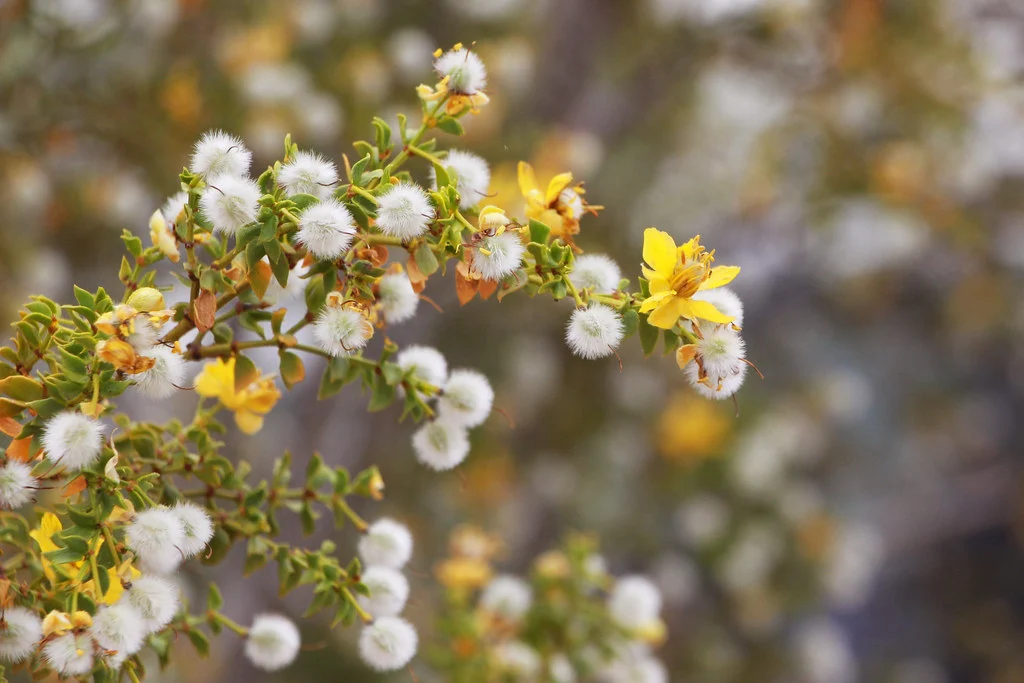
Some plants earn their spot with flowers, but creosote bush (Larrea tridentata) brings you the smell of desert rain. It’s a tough shrub with tiny yellow flowers that turn into fuzzy white seed balls, and the dark green leaves stay through winter. It’s one of the desert elders, sheltering desert tortoises and other wildlife for up to a century. In the Mojave Desert, one cloned patch of creosote has been slowly widening for an estimated 11,700 years (read more about creosote clones below!). Plant it along the edges of your yard, and enjoy one of the most magical parts of living in the desert every time it rains.
Is creosote bush a good choice for my yard?
Yes, if…
- You have a far edge or back corner of the yard with sunny, gravelly soil that drains fast.
- You love the smell of rain. It carries, so don’t feel like the plant needs to be right under your window.
- You like a loose, natural look, with slender, branching stems.
- You want bees and birds in the yard. Bees visit the flowers, and birds eat the seeds.
Skip it if…
- Your soil stays soggy or heavy after rain. It wants loose, fast-draining ground.
- You garden somewhere humid or with cold, wet winters. It’s a desert plant rated for cold down to about 10°F.
- You want a big shrub fast. In the wild, a plant only a foot tall can already be about 10 years old.
- You live outside the Southwest. It’s native to six states, so look for a shrub from your own region first.
Where is creosote bush native?
Native to 6 US states
Sources: NatureServe, Royal Botanic Gardens, Kew (World Checklist of Vascular Plants) and the USDA PLANTS Database, compiled by The Plant Native. How we map native ranges
Soon you’ll be the person standing in the yard after a downpour, breathing in, while the neighbors wonder what you’re doing.
Why creosote bush matters
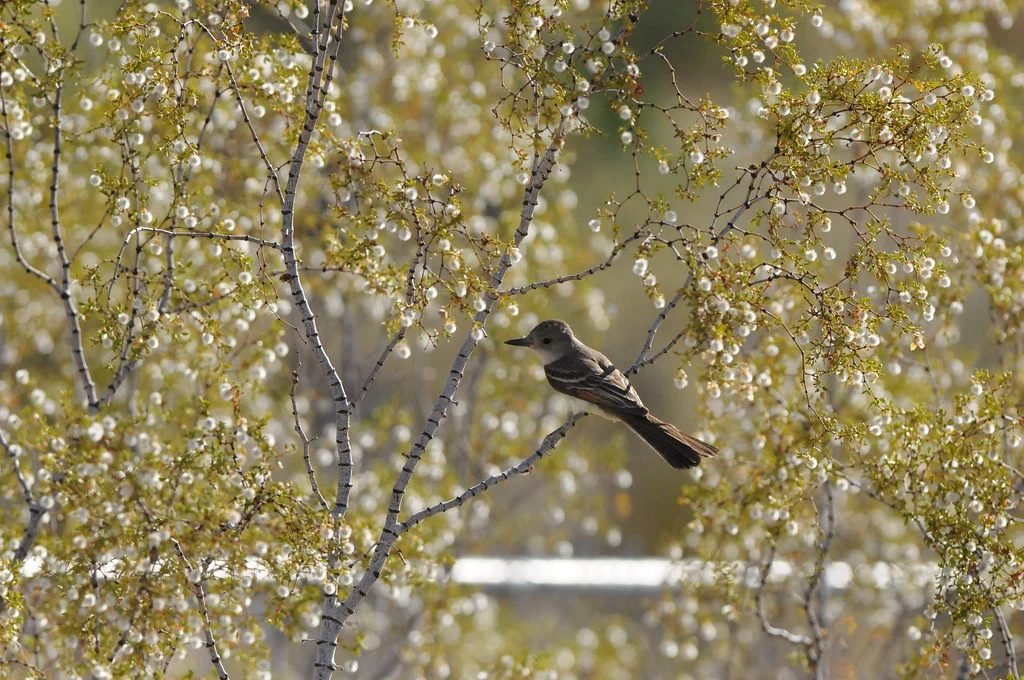
Desert wildlife depends on creosote bush. Bees visit the flowers, birds eat the seeds, and some grasshoppers, praying mantises, and crickets are found only on this plant. In California, around 150 kinds of native bees have been recorded visiting its flowers.
Desert tortoises also dig their shelters beneath it, where its roots hold the soil in place. In one study near San Bernardino, California, 71% of the tortoise burrows were tied to creosote bush. Kangaroo rats den under it, and desert woodrats eat its leaves.
Young creosote bushes often start out next to a white bursage, which shelters the seedling. Once a creosote bush is settled in, it may trap soil and help water soak in for the plants around it.
Creosote bush through the seasons
Spring
Spring is the main bloom. Small yellow flowers with five petals cover the shrub, followed by fuzzy white seed capsules.
Summer
Summer rain brings a second round of flowers and the mesmerizing smell. In dry stretches the leaves fold in half to dodge the sun, and in a long drought the plant can drop its leaves and rest until rain comes back.
Fall
Flowers can keep showing up into fall when there’s enough moisture. Fall is also one of the two best times to plant a new one.
Winter
It stays green all winter and handles cold down to about 10°F.
Where creosote bush shines in your yard
- The far edge of the yard. The smell carries, so it doesn’t have to be close.
- A few steps from the patio. You get the smell after a storm without brushing against the plant.
- A slope. It works well on a slope, and its roots help hold the soil in place.
- A gravel garden with cactus. It sits comfortably beside barrel cactus, agave, and prickly pear.
- The high edge of a rain garden. It does best on the upper, drier edge.
How to grow creosote bush
Where to plant
Put it toward the edge of the yard, not along the front walk. The smell fills the air after a rain, so it doesn’t need to be close to reach you. The resin can also bother skin in some people, which is one more reason to keep it out of brushing range. A spot a few steps from the patio works fine. Whatever spot you pick, give it the sunniest, best-drained ground you’ve got, the kind where a houseplant wouldn’t last a weekend. Loosen the soil where you dig, then plant right into it.
When to plant
Spring or fall, whichever you get to first.
Spacing
Full-size plants end up 6 to 12 feet wide, somewhere between one and two parked cars. Leave room for that.
Beginner tip
Skip the seed adventure and start with a nursery plant. Seeds sprout slowly, cuttings rarely root, and seedlings sulk if they dry out.
Watering
Think of the first year or two as training wheels. Water it once in a while, then taper off and stop. After that, rain does the job. In California, a drink once a month in summer is all it needs.
Planting card
Larrea tridentata
The trickWater it now and then for the first year or two, then stop and let the rain take over.
What are good pairings for creosote bush?
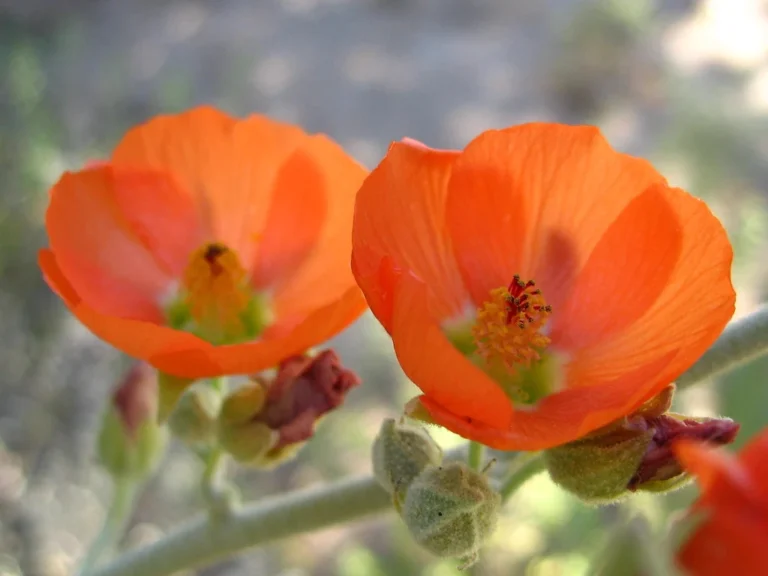
Pair it with other sun lovers that like fast-draining ground. Desert globemallow adds apricot-orange flowers near its base, and palo verde and desert willow add height behind it. Mesquite grows in the same desert plant communities. For more variety, try white bursage, brittlebush, ocotillo, jojoba, or a barrel cactus, which all grow alongside it in the wild.


Where can I buy creosote bush?
Ask a native plant nursery in the Southwest for creosote bush, and check the tag for Larrea tridentata, since it also goes by greasewood, hediondilla, and gobernadora. Buy a small nursery-grown plant, because seeds sprout slowly and cuttings rarely root.
Potential challenges
Deer, rabbits, and other nibblers
Deer pass it by. Rabbits mostly leave it alone too, javelina nibble it sometimes, and desert woodrats and jackrabbits eat it in some places.
It takes its time
Growth is slow, and sprouting from seed is slower. Think of it as the long game. A single plant can live around 100 years, and a spreading patch can go on far longer.
Neighbors
Plants right at its base can struggle. In lab tests, creosote roots slowed the roots of a nearby shrub, and the soil under some bushes repels water. Other plants grow under it just fine, and annuals may do better there once it’s settled. Leave some space around it at first and see how your neighbors do.
Galls
Small leafy galls from a tiny fly are common, and no serious pests or diseases are known.
A note on cultivars and relatives
Creosote bush is really three forms, one each in the Chihuahuan, Sonoran, and Mojave Deserts. They look alike but differ in their genes, and its closest cousins live in the dry regions of Argentina. If you can, buy a plant grown from seed collected in your own desert.
FAQs
What does creosote bush smell like?
It smells like a desert storm, earthy and strong, with a fresh edge. Creosote bush (Larrea tridentata) has resin-coated leaves that give off a strong scent, and the smell gets stronger when the leaves are wet. A summer storm sets it off.
Is creosote bush toxic?
Don’t eat it or brew it. Swallowing it can cause liver damage in people, and farm animals that eat a lot can be poisoned. One university database lists it as non-toxic to cats and dogs, but it’s smart to keep pets from chewing on it.
What is creosote bush used for?
People in the desert Southwest have used it as medicine and as glue for a very long time. The Cahuilla, Apache, and other peoples brewed the leaves into tea for colds and kidney pain and put them on bruises and wounds, and the resin mended pottery and fixed arrow points. That’s history, not a recipe, since swallowing it can harm your liver.
Will deer eat creosote bush?
Deer rarely touch it. It’s rated highly deer resistant, and most grazing and browsing animals find it unpalatable. Desert woodrats and some jackrabbits do eat it.
How much water does creosote bush need?
Very little once it’s settled in. Water it now and then for the first year or two, then taper off and stop. In California gardens, a drink once a month in summer is the most it needs.
Plant nerd fact
A patch that started in the Ice Age
Creosote bush spreads outward in a ring. As a plant ages, the old stems in the middle die and new ones sprout around the edge, so the patch slowly widens, and all of it grows from one seed. One patch in California’s Mojave Desert, nicknamed King Clone, is estimated at up to about 11,700 years old, which puts its start around the end of the Ice Age. Patches like it spread about a yard every 500 years, and some scientists call King Clone one of the oldest living things on Earth.
Creosote bush gives you the smell of desert rain, a home for bees, birds, and tortoises, and a plant that can outlast you. It looks like it belongs in a dry, sunny yard because it does. Put one by the gravel edge of your driveway and let the next storm do the selling. Soon you’ll be the person standing in the yard after a downpour, breathing in, while the neighbors wonder what you’re doing. Happy planting!
Sources
- Calscape. “Creosote Bush.” California Native Plant Society. Accessed November 8, 2026.
- Lady Bird Johnson Wildflower Center. “Larrea tridentata.” Native Plant Database. Accessed November 8, 2026.
- National Park Service. “Creosote Bush.” Joshua Tree National Park. Accessed November 8, 2026.
- NatureServe. “Larrea tridentata.” NatureServe Explorer. Accessed November 8, 2026.
- NC State Extension. “Larrea tridentata.” North Carolina Extension Gardener Plant Toolbox. Accessed November 8, 2026.
- Royal Botanic Gardens, Kew. “Larrea tridentata.” Plants of the World Online. Accessed November 8, 2026.
- University of Arizona Campus Arboretum. “Creosote Bush.” Accessed November 8, 2026.
- University of Arizona Cooperative Extension. “Creosote Bush.” Accessed November 8, 2026.
- University of Arizona Cooperative Extension. Deer Plant Resistance Ratings. AZ2098b. Accessed November 8, 2026.
- University of Arizona Cooperative Extension. Javelina Plant Resistance Ratings. AZ2098a. Accessed November 8, 2026.
- University of Arizona Cooperative Extension. Rabbit Plant Resistance Ratings. AZ2098c. Accessed November 8, 2026.
- USDA Forest Service. “Larrea tridentata.” Fire Effects Information System. Accessed November 8, 2026.
- Vasek, Frank C. “Creosote Bush: Long-Lived Clones in the Mojave Desert.” American Journal of Botany 67, no. 2 (1980): 246–255. Accessed November 8, 2026.
Similar plants
-
 Apache Plume
-
 Fairydusters
-
 California Buckwheat
-
 Texas Sage
-
 Mesquites
-
Buckwheat
-
 Desert Willow
-
 Triangleleaf Bursage
-
 Toyon
Updated Find more: Yellow Deer Resistant Evergreen Shrub Spring Summer Fall Full Sun Dry Drought-Tolerant
The ads on this site help pay real native plant nerds to research and write these guides.
Garden notes
Notes from people who’ve grown it
Tips, wins, and the occasional disaster. If you’ve grown creosote bush, share the advice you’d give to a neighbor.
No notes yet. Yours could be the first.
Grown creosote bush? Tell the next person what you wish someone had told you.
Tap anywhere to close


