
Highlights
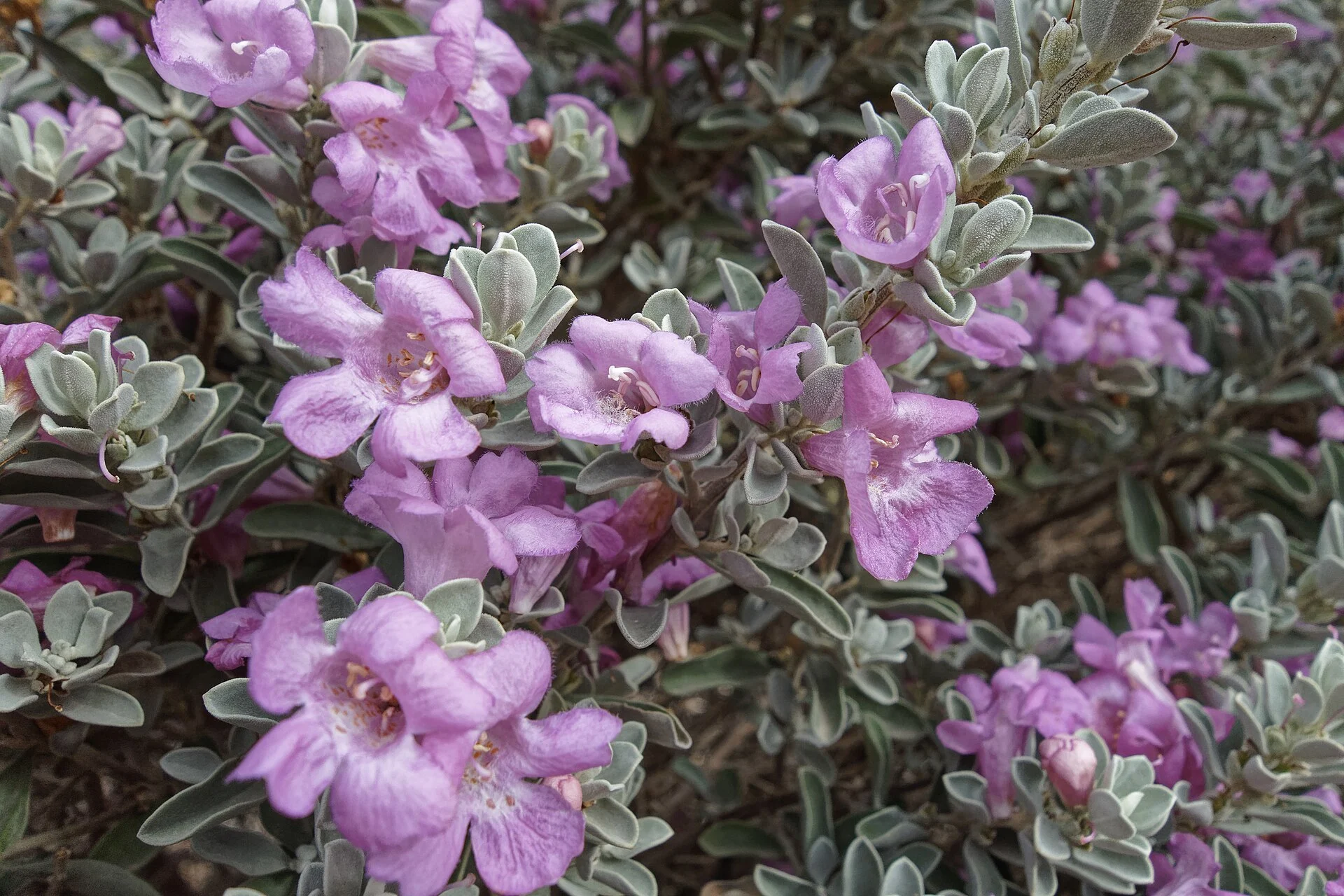
When the air turns humid and a storm is close, your Texas sage is the first to know. This silver shrub (Leucophyllum frutescens) blooms in pink and purple bells, which is why Texans also call it the barometer bush. Bees pile into the flowers, songbirds nest in its branches, and both a native butterfly and a native moth raise their caterpillars on its leaves. Texas liked it enough to name it the official state native shrub in 2005. Between bloom bursts it’s a soft, silvery cloud that looks good in every season. Even better, it’s at its finest when the hedge trimmers never leave the garage.
Is Texas sage a good choice for my yard?
Yes, if…
- You want a big evergreen shrub with silver leaves that looks good all year and never needs trimming.
- You have rocky ground, limestone, or a layer of caliche your shovel bounces off.
- You need a loose, blooming screen along a side fence or property line.
- You have a sunny spot by a wall, fence, or patio where the heat reflects back all afternoon, cooking anything planted nearby.
- Deer come through your yard and you want a shrub they usually skip.
- You’re happy to forget the fertilizer bag exists.
Skip it if…
- Your summers are muggy and the nights stay warm.
- Water puddles in your yard and takes a long time to drain.
- Your winters often drop well below 10°F.
- You want a crisp, boxy hedge you can trim flat. Texas sage is sheared that way all the time, but it looks and blooms its best when it’s left alone.
- You live far from the dry Southwest. It grows wild only in Texas, so check the range below before you buy.
Where is Texas sage native?
Native to 1 US state
Sources: NatureServe, Royal Botanic Gardens, Kew (World Checklist of Vascular Plants) and the USDA PLANTS Database, compiled by The Plant Native. How we map native ranges
In the US, Texas sage grows wild only in Texas. There it lives on the Edwards Plateau, the Rio Grande Plain, and the southern Trans-Pecos, on rocky hills, slopes, ravines, and flat brushland, and its range continues south into Mexico. Gardeners grow it well beyond Texas though, from Phoenix and Las Vegas to California’s Central Valley. Many shrubs sold as Texas sage or Texas ranger are related species from Mexico, so check the tag for Leucophyllum frutescens (see “A note on cultivars and relatives”).
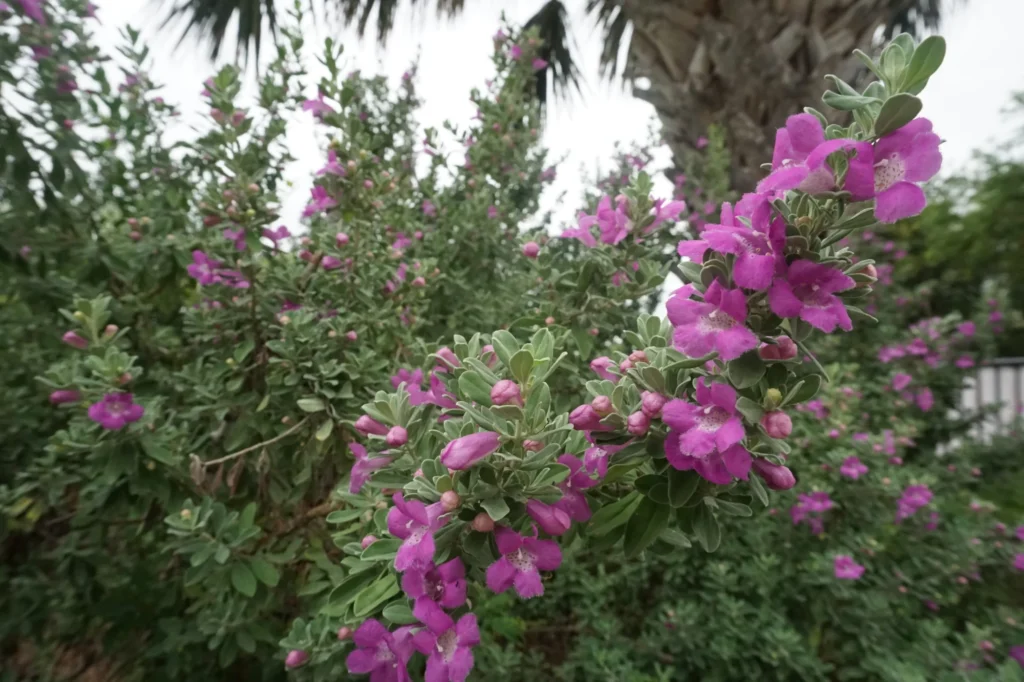
A few chewed leaves are a sign your shrub is doing its job.
Why Texas sage matters
When Texas sage blooms, it goes all in, and the bees notice. Honey bees and native bees work the bell-shaped flowers, hummingbirds and butterflies drop by too, and because the flowers come in waves from spring into fall, the snack bar keeps reopening long after many spring bloomers have closed.
It also raises the next generation. Texas sage is a host plant for the theona checkerspot butterfly and the calleta silkmoth, which means their caterpillars grow up eating its leaves. A few chewed leaves are a sign your shrub is doing its job.
Then there are the birds. Texas sage gives songbirds cover and places to nest, mockingbirds included, and a full, unclipped shrub has the most room for them to tuck in.
Texas sage through the seasons
Spring
The silver leaves catch the light, and some plants open an early round of flowers. If your shrub ever needs a snip, early spring is the time, and most years it won’t need one.
Summer
This is the main show. After a summer shower in Texas or a monsoon storm in the desert Southwest, the whole shrub can turn pink or purple. The flowers come in batches, each lasting several days, and then it goes back to a silver puff until the next round of rain.
Fall
The flowers keep coming in waves into fall. It’s also the best time to plant, because the roots get the cool months to settle in before their first summer.
Winter
Most plants keep their silver leaves all winter, so your yard still has something soft and shimmery when everything else has gone brown. In colder spots, and with some named types, it drops some or all of its leaves until spring.
Where Texas sage shines in your yard
- Along a side property line. Plant a few in a loose row and you get a screen that blooms instead of a fence that just stands there.
- Against a west-facing wall. Afternoon heat bouncing off stucco or brick doesn’t bother it.
- A rocky slope. In the wild it grows on hillsides and in ravines, so a slope full of rock feels like home.
- Outside the window where you check the weather. Give yourself a front-row seat for the bloom that shows up with the rain.
- The edge of the yard where deer wander through. Deer usually leave it alone.
- A pollinator bed with a silver backdrop. The pale leaves make purple and yellow flowers nearby really stand out.
- Along the house, if you pick a compact type. A smaller named type fits a foundation bed without ever needing to be cut back.
How to grow Texas sage
Where to plant
Give it full sun and soil that lets water rush through: rock, limestone, caliche, sand, or clay that drains. Alkaline soil is fine. What it can’t take is wet roots. In soggy ground it’s prone to cotton root rot, a soil fungus, so if you get a lot of rain, make sure it gets plenty of drainage. Muggy air and warm summer nights are hard on it too, which is why it’s happiest where the air dries out between storms.
When to plant
Plant in fall or winter while the shrub is resting. The roots get months of cool weather to settle in before they face their first summer.
Spacing
Texas sage grows 4 to 6 feet wide, so set plants about 5 to 6 feet apart. It’ll look gappy for a year or two. Let it fill in on its own rather than crowding plants together and trimming them to fit later.
Beginner tip
Leave room for its full size right from the start. That one decision is what lets you skip pruning for good.
Watering
Water deeply and regularly through the first year. After that, in its native range, rainfall is enough. In dry-summer places like California’s Central Valley, a deep soak once or twice a month is plenty. Skip fertilizer completely. Too much water and food is what gets this shrub in trouble, not too little.
Planting card
Leucophyllum frutescens
The trickPlant it where it has room to reach full size, and you’ll never need to prune it.
What are good pairings for Texas sage?
Pick neighbors that like sun, fast-draining soil, and long dry spells, and that can stand next to a big silver shrub. Low bloomers in front and an open, airy tree nearby work well.
- Blackfoot daisy: A low mound of white daisies for the front edge.
- Desert marigold: Bright yellow that looks even brighter against silver leaves.
- Firewheel: Red and yellow blooms to fill gaps while the shrubs grow in.
- Autumn sage: A smaller shrub with red, pink, or white flowers that hummingbirds love.
- Texas yellow star: Spring color before the sage hits its stride.
- Little bluestem: A grass that waves around the shrub’s base and turns copper in fall.
- Desert willow: A small, airy tree that won’t throw much shade on the shrub below.
- Texas mountain laurel: An evergreen with grape-scented spring flowers, so something is blooming when the sage is resting.


Where can I buy Texas sage?
Texas sage shares its nickname with a crowd of cousins and a couple of true sages. A tag that just says “Texas sage” or “silverleaf” could be any of them. At a native plant nursery, ask for Leucophyllum frutescens by name, and check the tag for a named type if you want white flowers or a smaller shrub.
Tips: what can go wrong, starting with deer. Pests, pruning and spread go here, not in How to grow.
Potential challenges
Deer, rabbits, and javelina
Deer resistance is rated high. In Arizona’s ratings for Texas sage types, deer and javelina almost never damage it and rabbits only sometimes nibble, so a young plant may need a little protection for its first season if rabbits are around.
Gumdrops, cubes, and other bad haircuts
You’ve probably seen Texas sage clipped into cubes and gumdrops in front of shopping centers and along medians. It’s the most common way people grow it, and the worst thing you can do to it. Those flat, tidy surfaces come from shearing, which cuts away the flower buds along with the leaf tips. A sheared shrub misses out on much of the bloom, which is the purple show you planted it for.
The damage keeps going after the flowers. Every round of shearing pushes out a thick crust of new growth on the outside, and that crust shades the center until the inner leaves drop. Part the branches on an old gumdrop and you’ll find a hollow shell: a thin layer of leaves wrapped around bare, twiggy sticks, like a lampshade with nothing inside. From the street, the shrub starts to look thin and see-through. Each haircut also uses up the energy the plant needs to grow new leaves, and cutting back into bare wood can send it into decline or kill it. And the shape only holds if you keep cutting, so you’ve signed up for a chore that never ends.
Left alone, Texas sage grows into a soft, loose cloud that’s full of leaves inside and out, flowers in waves, and has dense branches for birds to hide in. When it’s planted where it has room to reach full size, it doesn’t need pruning at all. If a branch is truly in the way, give it a light trim in early spring.
If you’ve inherited an old, overgrown gumdrop, you can start over. In spring, before new growth starts, cut all the stems back to 12 to 18 inches above the ground. By midsummer it will push out a crowd of new shoots; remove about half of them, cut the rest back to different heights, and then leave it alone. If that feels too drastic, take out a third to a quarter of the oldest branches each year for three or four years instead.
Wet soil and root rot
Soggy soil invites cotton root rot. A mound, a raised bed, or a slope keeps the roots out of standing water, and so does going easy with the hose.
Muggy summers
High humidity together with warm nights can kill Texas sage. In humid climates it struggles even when everything else is right, so it does best where the air dries out between storms.
A note on cultivars and relatives
If you’ve noticed that no two “Texas sage” shrubs look quite alike, you’re not imagining it. Leucophyllum is a family of about 17 species. Nurseries sell a crowd of them, plus named types and hybrids, under the same few nicknames, and they vary a lot:
- Size: From compact shrubs about 3 feet tall to old Texas sages pushing 10 feet.
- Leaves: Silver or gray on some, olive green or bright green on others.
- Flowers: White, pink, lavender, magenta, purple, or deep violet.
- Winter look: Most keep their leaves all year, but a few, like ‘Green Cloud’, drop them in winter.
Only three species grow wild in the US, and those are the ones to look for if you want a shrub that’s native here:
- Texas sage (L. frutescens): The star of this profile, native to Texas.
- Violet silverleaf (L. candidum): A smaller, rounded cousin, about 3 to 5 feet tall, with silver leaves and deep violet flowers. It grows wild in Texas.
- Big Bend silverleaf (L. minus): Up to about 5 feet tall, native to Texas and New Mexico. It blooms after rain or humid spells too.
The cousins you’ll see most at Southwest nurseries come from the Mexican side of the Chihuahuan Desert. Chihuahuan sage (L. laevigatum) is an open, rounded shrub about 4 feet tall with olive green leaves and fragrant lavender flowers. Langman’s sage (L. langmaniae), also sold as Rio Bravo sage and sometimes as Texas sage, is dense and bright green; ‘Lynn’s Legacy’ is a common named type. L. pruinosum and L. zygophyllum show up too. They’re handsome, low-water shrubs, and the first two also flower after summer rain, but none of them grows wild in the US. If you want a native, read the tag and look for frutescens, candidum, or minus.
Within Texas sage itself, ‘Compacta’ stays around 4 feet. ‘Silverado’ grows dense and rounded and stays full to the ground. ‘White Cloud’ has white flowers and gray leaves, and ‘Green Cloud’ has magenta flowers and greener leaves. The ‘Cloud’ series comes in a range of sizes, and some are hybrids, so ask before you buy if you want the straight species.
The easiest way to choose: shop by the space you have, not the shape you plan to cut it into. Measure the spot, pick a type whose full size fits, and the shears can stay in the shed.
FAQs
Are Texas sage and Texas ranger the same plant?
Yes, Texas sage and Texas ranger are two names for the same plant, Leucophyllum frutescens. The catch is that “Texas sage” is also the name of Salvia texana, a small, blue-flowered true sage that looks nothing like this big silver shrub. Texas sage isn’t a true sage like the salvias, and it never wore a badge either.
How big do Texas sage plants get?
Texas sage usually grows 3 to 8 feet tall and about as wide, depending on the type you buy. Compact types stay around 4 feet, and an old shrub of the straight species can reach up to 10 feet. Choose the size that fits your spot, so you never have to cut it back to fit.
Can Texas sage be kept small?
Yes, but pick a small type rather than shearing a big one. Compact Texas sages stay around 4 feet, and violet silverleaf, another US native, stays about 3 feet. Shearing a full-size shrub to fit a small spot leaves you with a hollow shell and far fewer flowers.
Will Texas sage come back every year?
Yes, Texas sage is a perennial shrub that stays put and grows year after year. In mild winters it keeps its silver leaves, and in colder spots some plants drop their leaves until spring. Cold winters (below 10°F) can damage it.
What are the common problems with Texas sage?
The most common problems with Texas sage are too much water, too much humidity, and too many haircuts. Soggy soil invites root rot, and muggy summers with warm nights are hard on it. Regular shearing hollows out the center and cuts off the flower buds, so the best care is mostly leaving it alone.
Is Texas sage toxic to dogs?
Whether Texas sage is toxic to dogs hasn’t been confirmed. Most dogs walk right past a woody shrub, but if yours chews a lot of any plant, call your vet or an animal poison control line.
Will deer or rabbits eat Texas sage?
Deer usually leave Texas sage alone. It’s rated highly deer resistant. It’s also generally safe from javelina. Rabbits are the ones to watch: they sometimes nibble young plants, so a wire cage helps for the first season.
Plant nerd fact
Its strangest guest never eats
Texas sage’s strangest guest is a moth that never eats. The calleta silkmoth is a big, dressed-up moth, up to about 4 inches across, with black wings striped in white and a red collar like it’s headed to a party. But the adult moths don’t feed at all, so all the eating happens in the caterpillar stage, and Texas sage is one of its caterpillar food plants. Young caterpillars eat together in a group, then go their separate ways as they grow. Each one hangs its cocoon from a twig by a short loop of silk, usually close to the ground and often in shade. In the Rio Grande Valley, Big Bend country, and parts of southern Arizona and New Mexico, a few chewed leaves on your shrub could mean one of these is on the way.
Texas sage is a shrub with opinions about the weather, and it shares them in purple. Most of the year it looks calm and silver, and then the sky starts thinking about rain and the whole thing lights up. It’s also proof that the best-looking shrub on the block can be the one nobody trimmed. Put the shears away, let it grow into whatever shape it picks, and enjoy owning a plant that knows a storm is coming before you do. For more plants that like the same hot, dry spots, browse our Southwest garden guide. Happy planting!
Sources
- Arizona Municipal Water Users Association. “Chihuahuan Sage.” Accessed November 11, 2026.
- Arizona Municipal Water Users Association. “Langman’s Sage.” Accessed November 11, 2026.
- Arizona Municipal Water Users Association. “Texas Sage.” Accessed November 11, 2026.
- Arizona Municipal Water Users Association. “Violet Silverleaf.” Accessed November 11, 2026.
- Butterflies and Moths of North America. “Calleta Silkmoth, Eupackardia calleta.” Accessed November 14, 2026.
- Butterflies and Moths of North America. “Theona Checkerspot, Chlosyne theona.” Accessed November 16, 2026.
- Garvey, Kathy Keatley. “Cenizo!” Bug Squad (blog), UC Agriculture and Natural Resources, October 8, 2008. Accessed November 11, 2026.
- Lady Bird Johnson Wildflower Center. “Leucophyllum candidum.” Native Plant Database. Accessed November 11, 2026.
- Lady Bird Johnson Wildflower Center. “Leucophyllum frutescens.” Native Plant Database. Accessed November 11, 2026.
- Lady Bird Johnson Wildflower Center. “Leucophyllum minus.” Native Plant Database. Accessed November 11, 2026.
- Lady Bird Johnson Wildflower Center. “Salvia dorrii var. incana.” Native Plant Database. Accessed November 11, 2026.
- Lady Bird Johnson Wildflower Center. “Salvia texana.” Native Plant Database. Accessed November 11, 2026.
- Native Plant Society of Texas. “Leucophyllum frutescens.” Accessed November 11, 2026.
- NatureServe. “Leucophyllum frutescens.” NatureServe Explorer. Accessed November 11, 2026.
- NC State Extension. “Leucophyllum frutescens.” North Carolina Extension Gardener Plant Toolbox. Accessed November 11, 2026.
- NC State Extension. “Leucophyllum langmaniae.” North Carolina Extension Gardener Plant Toolbox. Accessed November 11, 2026.
- Royal Botanic Gardens, Kew. “Leucophyllum frutescens (Berland.) I.M.Johnst.” Plants of the World Online. Accessed November 11, 2026.
- Royal Botanic Gardens, Kew. “Leucophyllum minus A.Gray.” Plants of the World Online. Accessed November 11, 2026.
- Schuch, Ursula K. Pruning Shrubs in the Low and Mid-Elevation Deserts in Arizona. AZ1499. Tucson: University of Arizona Cooperative Extension, 2016. Accessed November 11, 2026.
- Southern Nevada Water Authority. “Texas Sage (Cenizo).” Accessed November 11, 2026.
- Southern Nevada Water Authority. “White Cloud Texas Ranger.” Accessed November 11, 2026.
- Texas A&M AgriLife Extension, Bexar County. “‘Silverado’ Texas Sage.” Accessed November 11, 2026.
- Texas Legislature. H.C.R. No. 71, 79th Legislature, Regular Session, 2005. Accessed November 11, 2026.
- Texas Tech University. “Texas Sage, Silver Leaf Sage.” Landscape Plant Information Sheets. Accessed November 11, 2026.
- UC Davis Arboretum and Public Garden. “Leucophyllum frutescens.” Accessed November 11, 2026.
- University of Arizona Cooperative Extension. Deer Plant Resistance Ratings. AZ2098b. Accessed November 11, 2026.
- University of Arizona Cooperative Extension. Javelina Plant Resistance Ratings. AZ2098a. Accessed November 11, 2026.
- University of Arizona Cooperative Extension. Rabbit Plant Resistance Ratings. AZ2098c. Accessed November 11, 2026.
- USDA NRCS. “Leucophyllum frutescens.” PLANTS Database. Accessed November 11, 2026.
Similar plants
-
 Texas Mountain Laurel
-
 Triangleleaf Bursage
-
 Creosote Bush
-
 Buckwheat
-
 Fairydusters
-
 Apache Plume
-
California Buckwheat
-
 American Plum
-
 Desert Willow
Updated Find more: Pink Purple White Deer Resistant Evergreen Shrub Flowering Shrub Spring Summer Fall Full Sun Part Sun Dry Drought-Tolerant
The ads on this site help pay real native plant nerds to research and write these guides.
Garden notes
Notes from people who’ve grown it
Tips, wins, and the occasional disaster. If you’ve grown Texas sage, share the advice you’d give to a neighbor.
No notes yet. Yours could be the first.
Grown Texas sage? Tell the next person what you wish someone had told you.
Tap anywhere to close


