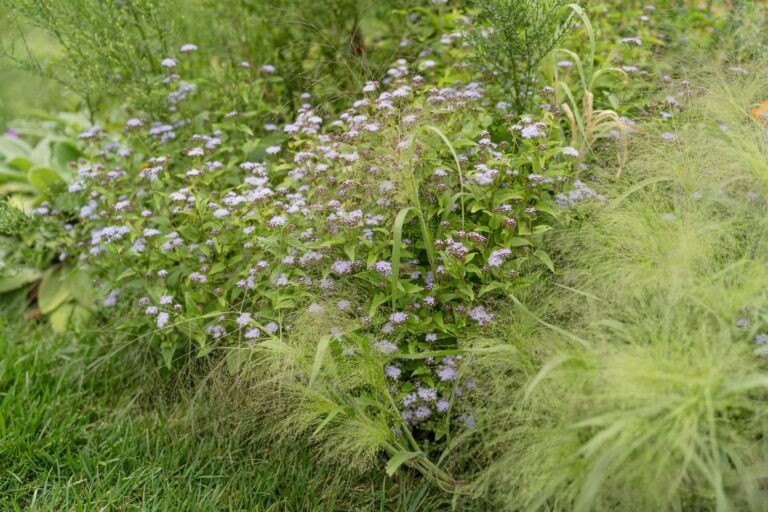
Highlights
Salal (Gaultheria shallon, say gawl-THEER-ee-uh) is the glossy evergreen that carpets the forest floor along the Pacific coast, from Alaska to California. In a sunny clearing it stays ankle-high. In shade and good soil it can reach 4 to 10 feet. Late spring hangs rows of small white or pinkish urns off the branch tips, and by late summer those have turned into reddish-blue to dark purple berries that birds, bears and people all eat.
You’ve probably held it without knowing. Florists sell the leaves as lemon leaf, and they’re shipped across the world. At home, it’s one of the best ways to cover the dim, rooty ground under big conifers, as long as you live where it does.
Is salal a good choice for my yard?
Yes, if…
- You garden in the cool, damp Pacific Northwest or along the northern California coast. Mild winters, gray summers and acidic soil are what salal is built for.
- You have shade under big trees. NC State lists it for partial to full shade, and the half-lit ground under Douglas fir is its home turf.
- You garden by the ocean. It handles salt spray and commonly forms dense stands in coastal shrub country.
- You’re pulling out English ivy. Salal gives you the same evergreen cover, plus berries the birds will eat.
Skip it if…
- You want a plant that stays put. Once it settles in, it spreads aggressively by underground stems. Give it room or a hard edge.
- Your soil is alkaline or soggy clay. It wants acid soil below pH 6.0 and good drainage.
- Your spot gets hot afternoon sun. Away from the cool coast, direct summer sun causes scorch.
- You’re outside its range. Salal is native to just four states on the Pacific coast. In the East, try its little cousin wintergreen instead.
Why salal matters
The berries feed a long list of animals. The Forest Service says salal fruit is readily eaten by many birds and mammals, and Portland State’s garden ecology project names ruffed, spruce, and blue grouse and band-tailed pigeons among the birds. Bears eat them too.
It’s a host plant for the brown elfin, a small brown butterfly of early spring. Across the genus, Gaultheria host 14 native moths and butterflies in the Shropshire-Tallamy caterpillar records.
In many areas it’s also an important winter food for black-tailed and mule deer, and elk browse it as well. Native peoples of the coast ate the berries fresh, dried, or mashed into cakes.
Where salal shines in your yard
- Under conifers, in the shade where grass gives up.
- In place of English ivy on a shady bank.
- A coastal garden with wind and salt in the air.
- An informal hedge that grows into a loose, shoulder-high screen in shade.
- A cutting patch for winter arrangements.
Beginner tip
Cut salal for the vase any time except spring. Commercial harvesters skip spring, when the new growth is tender, and so should you.
How to grow salal
When to plant
Fall, just before the rains, so the wet season does the watering while the roots settle. Early spring works too.
Light decides the size
Salal looks like a different plant in sun and shade. Oregon State puts it at less than 2 ft tall in full sun and poor soil, and 4 to 10 feet in shade and good soil.
Soil and water
Acidic soil that stays moist but drains. It grows best in moist sandy or peaty soils, and on dry, shallow ground it stays small and mat-like. Water a new plant every week or so through its first summer. After that, plants in shade under conifers mostly look after themselves; in sun, keep the roots from drying out.
Give it room
Be patient at first, because initial seedling growth is slow. Then it starts running. Plant it where a path, lawn edge or driveway will stop it, or where you want a solid patch.
Cutting and cleanup
If a patch gets leggy, cut the stems near the base and it sprouts back. Leaf spots show up in wet years; Oregon State’s plant disease handbook suggests removing spotted leaves and avoiding overhead irrigation.
Planting card
Gaultheria shallon
The trickCut stems for the vase any time but spring, when the new growth is still tender.
Where is salal native?
Native to 4 US states
Sources: NatureServe, Royal Botanic Gardens, Kew (World Checklist of Vascular Plants) and the USDA PLANTS Database, compiled by The Plant Native. How we map native ranges
In the wild, salal grows with western sword fern, Oregon grape and vine maple under the big conifers. Its closest relative in the East is wintergreen, a groundcover only 4 to 8 inches tall whose leaves smell and taste like the candy.
The green in your bouquet
Pull apart a florist’s bouquet and some of the glossy greens may well be salal. Pacific Northwest salal has been sold commercially since the early 1900s. Harvesters cut it in the woods of Oregon, Washington, and British Columbia and sell it to buying “sheds,” which ship it to city markets, and some goes on to European markets.
It’s big business. One study of harvesters on Washington’s Olympic Peninsula, based on interviews from 2001 to 2003, describes a “multi-million dollar floral greens industry” worked largely by migrant and immigrant harvesters. Cut salal keeps for a long time in the cooler. It’s normally stored at or slightly below freezing, and wholesalers can refrigerate plants for weeks to wait for a better price.
Pull apart a florist’s bouquet and some of the glossy greens may well be salal.
What are good pairings for salal?
Build a little piece of Northwest forest: western sword fern and bunchberry at its feet, trilliums and bleeding heart for spring, and goatsbeard and native rhododendrons behind. Inside-out flower and western wild ginger like the same shade.


Where can I buy salal?
Look for it at native nurseries and native plant society sales in the Pacific Northwest and northern California. It can be difficult to grow in a nursery, so buy from a grower that knows it, and never dig plants from the woods. Start with our list of native plant nurseries or order online.
FAQs
Are salal berries edible?
Yes, though they’re mild. NC State calls them rather bland raw, and the Forest Service rates them “bland but pleasant” for jellies and preserves. They ripen from August through October.
Will salal take over my yard?
It can. The Lady Bird Johnson Wildflower Center warns it can become somewhat invasive in a garden, and Portland Nursery says it can become aggressive in the garden. Plant it where you want a lot of it.
How do I tell salal from Oregon grape?
Look at the leaves. Salal has single, oval leaves. Oregon grape has compound leaves made of 5-13 spiny, holly-like leaflets, and its flowers are bright yellow instead of white-pink. Both have dark berries, so the fruit won’t help.
Can I grow salal outside the Pacific Northwest?
Rarely well. NC State says it may not be a good choice for the east because the growing conditions are so different. In the East, wintergreen is the native relative to try.
Is salal deer resistant?
No. Deer and elk browse it at least moderately in many areas, especially in winter. It sprouts back from the base and roots, so a nibbled patch usually recovers.
Plant nerd fact
Salal, not shallon
The botanical name says shallon, but the plant’s common name won. “Salal” came into English through Chinook Jargon, the trade language of the Northwest coast, and an 1825 note in the Dictionary of Canadianisms records that people there called it salal, not shallon. The plant collector David Douglas wrote about it in his journal on April 8, 1826, and brought seed to Britain in 1828.
Salal is a quiet plant with a big job: it covers hard shade, feeds birds and deer, and stays green all winter. Give it acidic soil and room to roam and it will fill in the ground under your trees for good. For more evergreen cover in the same shade, see our guide to native ferns. Happy planting!
Sources
- Alexander, Susan J. “Who, What, and Why: The Products, Their Use, and Issues About Management of Non-timber Forest Products in the United States.” NTFP Conference Proceedings. USDA Forest Service. Accessed October 12, 2026.
- Alexander, Susan J., and Marla Emery. “Non-Timber Forest Products in the United States: Harvest and Issues.” Food and Agriculture Organization of the United Nations. Accessed October 12, 2026.
- Ballard, Heidi L., and Lynn Huntsinger. “Salal Harvester Local Ecological Knowledge, Harvest Practices and Understory Management on the Olympic Peninsula, Washington.” Human Ecology 34, no. 4 (2006): 529–547. Accessed October 12, 2026.
- Dictionary of Canadianisms on Historical Principles. “Salal.” University of British Columbia. Accessed October 12, 2026.
- University of Oregon. Salal page, nontimber forest products series, compiled from a paper by C. W. George. Accessed October 12, 2026.
- Lady Bird Johnson Wildflower Center. “Gaultheria shallon.” Native Plant Database. Accessed October 12, 2026.
- NatureServe. “Gaultheria shallon.” NatureServe Explorer. Accessed October 12, 2026.
- NC State Extension. “Gaultheria shallon,” “Gaultheria procumbens” and “Mahonia aquifolium.” Extension Gardener Plant Toolbox. Accessed October 12, 2026.
- Oregon State University. “Gaultheria shallon.” Landscape Plants. Accessed October 12, 2026.
- Oregon State University Extension. “Salal (Gaultheria shallon)-Leaf Spots.” Pacific Northwest Plant Disease Management Handbook. Accessed October 12, 2026.
- Portland Nursery. “Gaultheria Shallon: The Versatile Garden Shrub.” Plant Library. Accessed October 12, 2026.
- Portland State University. “Gaultheria Shallon: Salal.” Urban Garden Ecology. Accessed October 12, 2026.
- Reid, M. S. “Recommendations for Maintaining Postharvest Quality: Lemonleaf, Salal.” 2009. FRIDOC, International Institute of Refrigeration. Accessed October 12, 2026.
- Shropshire, Kimberley J., and Douglas W. Tallamy. “Lepidoptera of North America North of Mexico: An Annotated List Containing Geographic Ranges and Host Plant Records.” ZooKeys, 2025. Host counts from the UDELep data, May 2025.
- Talarico, Jovanna. “Investigating Salal.” SER-UW Native Plant Nursery, University of Washington, 2023. Accessed October 12, 2026.
- Tirmenstein, D. “Gaultheria shallon.” Fire Effects Information System. USDA Forest Service, 1990. Accessed October 12, 2026.

Similar plants
-
 Rhododendron
-
 California Lilacs
-
 Mountain Laurels
-
 Rosebay Rhododendron
-
 Manzanitas
-
 Buckwheat
-
 Holly
-
 Roses
-
 Highbush Blueberry
Updated Find more: Acidic Edible Evergreen Evergreen Shrub Shrub
The ads on this site help pay real native plant nerds to research and write these guides.
Garden notes
Notes from people who’ve grown it
Tips, wins, and the occasional disaster. If you’ve grown salal, share the advice you’d give to a neighbor.
No notes yet. Yours could be the first.
Grown salal? Tell the next person what you wish someone had told you.
Tap anywhere to close


