




Highlights
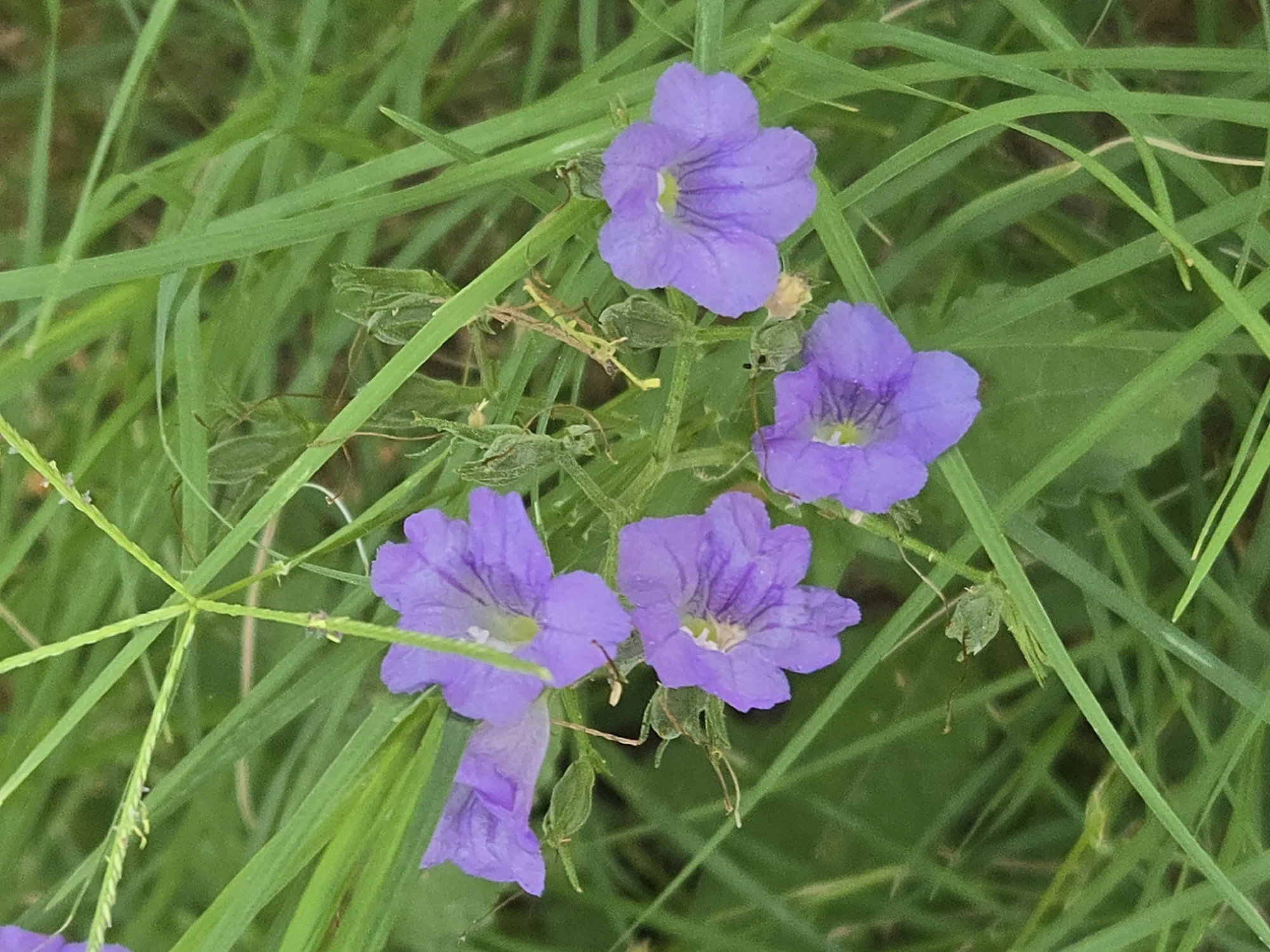
Violet wild petunia works the morning shift. Its purple trumpets open around sunrise and have dropped by early afternoon. A new set replaces them the next day for much of spring, summer, and fall. If you drink your coffee outside, you get the best seat. It looks a lot like the petunias in hanging baskets, but it’s a native perennial (Ruellia nudiflora) from a different plant family altogether. Common buckeye caterpillars and several other butterflies use its leaves as baby food. If you’ve been eyeing the purple Mexican petunia sold everywhere in spring, this is the native you plant instead.
Is violet wild petunia a good choice for my yard?
Yes, if…
- You have a patch of dappled shade under a tree where the grass keeps thinning out, and you’d like purple there instead of bare dirt.
- You want butterflies to raise their families in your yard, not just pass through.
- You need a low, loose cover along a garden path, one that doesn’t mind a mower now and then.
- You’ve been looking for a native swap for Mexican petunia.
- You’re an early riser. The flowers look their freshest right after sunrise.
- Your soil is sandy, or it’s the heavier loam or clay of an old prairie or field.
Skip it if…
- You want every plant to stay where you put it. Its seed pods pop open and fling seeds all around.
- Deer stroll through your yard every night and you’re not in the mood to share.
- You mostly see your garden after work. By evening, the day’s flowers are on the ground.
- Your winters are long and bitter. Its wild home is the mild-winter South, so in a cold-winter yard, treat it as an experiment.
Where is violet wild petunia native?
Native to 3 US states
Sources: NatureServe, Royal Botanic Gardens, Kew (World Checklist of Vascular Plants) and the USDA PLANTS Database, compiled by The Plant Native. How we map native ranges
In the US, violet wild petunia grows wild in Texas, Louisiana, and Arizona, and its range continues south through Mexico into Central America. Texas is its stronghold. It’s very common in the central and southeastern parts of the state, along woodland edges, in thickets, and in prairie openings.
Think of it as hiring a crew that recruits its own workers.
Why violet wild petunia matters
Plenty of flowers feed butterflies. Fewer feed their babies. Violet wild petunia is a host plant: common buckeye, Cuban crescent, fatima, malachite, and white peacock butterflies lay eggs on it, and their caterpillars eat the leaves. If you see chewed leaves in summer, that’s the plant doing its job. The flowers also serve nectar to adult butterflies, so one patch covers both the nursery and the snack bar.
It feeds more than insects. Bobwhite quail eat the seeds, and white-tailed deer browse the leaves.
There’s one more reason to plant it. The purple ruellia sold in big trays every spring is usually Mexican petunia, a non-native that’s on the Texas invasives list and rated invasive across Florida. Violet wild petunia gives you the same purple trumpets from a plant that belongs here.
[TK Dawna or Emily: one first-hand line about violet wild petunia, if you’ve grown or spotted it]
Violet wild petunia through the seasons
Spring
New leaves push up from the woody base, gray-green with wavy edges. The first purple trumpets arrive in April. In the warmest corners of its range, they can show up as early as February.
Summer
This is peak season, and early summer brings the most flowers. Each bloom lasts one morning, so the plant is always swapping out its decorations. It keeps flowering through dry spells, when much of the garden starts to look tired.
Fall
Flowers keep coming into October, and the seed pods start popping. When they’re ripe, they split open hard enough to throw seeds away from the parent plant, like popcorn jumping out of the pan.
Winter
It drops its leaves and goes dormant after a strong freeze. The tough root knot just below the soil waits it out. In mild winters it may stay green.
Where violet wild petunia shines in your yard
- Under a small tree. The dappled shade at the edge of a tree’s canopy is home turf for a plant that grows naturally along woodland edges.
- Along a garden path. It stays low and loose, and a line of purple trumpets makes the morning walk to the mailbox more interesting.
- The ragged edge of the lawn. It often grows right in with lawn grasses and can be mowed. Let it soften the line where lawn turns into garden.
- A butterfly garden. Plant it where you can watch for caterpillars, since this is a plant they eat, not just visit.
- A short-grass meadow. Tuck it into buffalo grass and let the purple dot the green.
- A rain garden. It handles soil that stays moist as well as soil that dries out.
How to grow violet wild petunia
Where to plant
This is one of the few native perennials that grows in full sun, part shade, or full shade. Sandy or clay soil, dry or moist, it handles them all. It does have one quirk in the shade. Besides the big purple flowers, it makes tiny closed flowers that never open, and in shade the plant starts making those earlier and quits on the showy ones sooner. If you want the purple, give it at least a few hours of sun. A spot with morning light and afternoon shade under a tree is a good balance.
When to plant
Spring is the easiest time, when native nurseries have pots in bloom. Buying it in flower lets you check what you’re getting before it goes in the ground.
Spacing
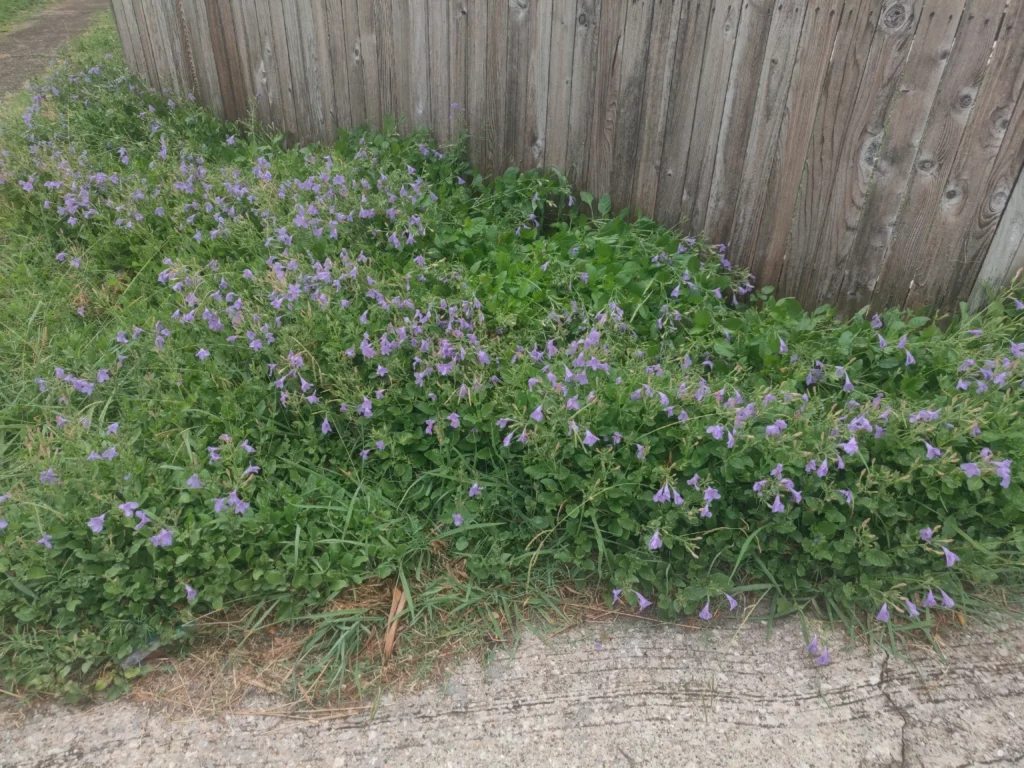
Each plant spreads about 6 inches to 2 feet. Set them about a foot apart and let the seedlings fill the gaps. Think of it as hiring a crew that recruits its own workers.
Beginner tip
Check the tag for Ruellia nudiflora. Several plants go by “wild petunia,” and the invasive Mexican petunia looks a lot like it in a pot.
Watering
It needs low to medium water. Water new plants while they settle in, then back off. Once it’s rooted, it keeps blooming through dry spells. Skip the fertilizer. Like most natives, it’s adapted to local soil and needs less feeding and fuss than garden-center plants.
Planting card
Ruellia nudiflora
The trickBuy it in bloom and check the leaves: short, oval and gray-green means you’ve got the native.
What are good pairings for violet wild petunia?
Build a butterfly patch around it in the sun, or let it fill the shady edge under a tree with other plants that don’t mind a little shade.
- Butterfly weed adds bright orange and a host plant for monarchs, so the patch raises two kinds of caterpillars.
- Black-eyed Susan brings gold daisies that look sharp next to purple.
- Purple coneflower gives the butterflies a second place to stop for nectar.
- Firewheel adds red and yellow pinwheels for the sunny side of the bed.
- Winecup is a low magenta sprawler for the front edge.
- Blue mistflower adds fuzzy blue puffs late in the season, at the shadier end.
- Asters pick up the purple in fall, when the petunia slows down.
- Little bluestem gives the flowers a grassy backdrop that turns copper in fall.


Where can I buy violet wild petunia?
Ask a native plant nursery for violet wild petunia, and buy it when it’s in bloom so you can see the flowers. Check the tag for Ruellia nudiflora, since the invasive Mexican petunia is often sold under the same “ruellia” label.
Potential challenges
Deer
Deer think violet wild petunia is quite tasty. White-tailed deer browse its leaves where they share ground with it, so in deer country, expect some nibbled tops.
It plants itself
This is how wild petunia keeps a patch going: ripe pods pop open and toss seed around the bed. Seedlings will show up near the parent plant and sometimes in the path. Mowing keeps it in check at a lawn edge. Pull extras while they’re small, as they grow they develop a knot of root just below the soil that makes them hard to get rid of later.
A bit leggy after a big bloom
Cutting it back after a flush of flowers keeps it compact and blooming through summer. It’s optional. Left alone, it looks looser and sets more seed.
A note on cultivars and relatives
“Wild petunia” is a family nickname, and several native cousins share it. Texas alone has four native ones. Drummond’s wild petunia (Ruellia drummondiana) has larger flowers and a bigger plant than violet wild petunia, and it likes the rocky, dry soil of Central Texas. Fringeleaf wild petunia (R. humilis) is the traveler of the group, native from Texas to Minnesota and east to Virginia, and usually under a foot tall. Carolina wild petunia (R. caroliniensis) covers much of the East.
FAQs
Do wild petunias come back every year?
Yes, violet wild petunia is a perennial that returns each spring. It drops its leaves and goes dormant after a strong freeze, then regrows from a tough woody base just under the soil. In mild winters it may not bother going dormant.
Do wild petunias like sun or shade?
Violet wild petunia grows in full sun, part shade, or shade. It makes more of its big purple flowers with some sun. In shade it leans on tiny closed flowers you’ll never notice.
Does ruellia spread easily?
Yes, violet wild petunia spreads easily by seed. Its pods burst open when ripe and scatter seed around the plant, so expect volunteers nearby. Mowing or pulling up young seedlings keeps it where you want it.
What is the difference between a Mexican petunia and a wild petunia?
Violet wild petunia (Ruellia nudiflora) is a native perennial, while Mexican petunia (R. simplex) is a non-native that has become invasive in Florida, Texas, and other states. The flowers look almost the same, so check the leaves. Wild petunia has short, oval, gray-green leaves with crinkly edges. Mexican petunia has long, skinny, dark green leaves like a willow’s, often with a purple tint and purple stems. Mexican petunia also spreads by roots as well as seed, which makes it hard to get rid of once it settles in.
Will deer eat violet wild petunia?
Yes, deer eat violet wild petunia. White-tailed deer browse its leaves, and it’s rated as having minimal deer resistance. Plant it where you can protect it, or count on sharing a few stems.
Plant nerd fact
A backup flower that never opens
Violet wild petunia has a backup plan hidden in plain sight. Besides the showy purple trumpets, it makes a second kind of flower that never opens and pollinates itself. The open flowers cost the plant more to build but can swap pollen with other plants. The closed ones are cheap and dependable. When researchers shaded the plants, the closed flowers started setting fruit earlier and the showy ones wrapped up sooner. It’s a little like a restaurant that switches to the cheaper takeout menu when business slows down. The flowers you do see are short-timers too: they open around sunrise and drop by early afternoon.
Violet wild petunia is for anyone who has bought a flat of petunias in May and watched it fry by July. This is the homegrown version of that cheerful purple, and it shows up for work every morning without being asked. Give it a few seasons and it will start choosing its own spots, which is how a garden starts to look like it grew there instead of being installed. Keep a few small pots handy, because sooner or later a neighbor will ask for a start. If you run out, send them to our page on where to buy native plants. And if this plant has you checking the leaves for caterpillars, our guide to the best native host plants for butterflies is a good next read. Happy planting!
Sources
- Caesar Kleberg Wildlife Research Institute. “Wild Petunia (Ruellia nudiflora).” Texas A&M University–Kingsville. Accessed November 11, 2026.
- Florida Natural Areas Inventory. “Mexican Petunia, Ruellia simplex.” Invasive species. Accessed November 11, 2026.
- Garden Style San Antonio. “Wild Petunia.” San Antonio Water System. Accessed November 11, 2026.
- Lady Bird Johnson Wildflower Center. “Invasiveness of Wild Petunia in Austin.” Ask the Expert, June 15, 2008. Accessed November 11, 2026.
- Lady Bird Johnson Wildflower Center. “Ruellia caroliniensis.” Native Plant Database. Accessed November 11, 2026.
- Lady Bird Johnson Wildflower Center. “Ruellia humilis.” Native Plant Database. Accessed November 11, 2026.
- Lady Bird Johnson Wildflower Center. “Ruellia nudiflora.” Native Plant Database. Accessed November 11, 2026.
- Lady Bird Johnson Wildflower Center. “Where Can I Purchase Ruellia nudiflora Seeds or Plants?.” Ask the Expert, January 10, 2011. Accessed November 11, 2026.
- Munguía-Rosas, Miguel A., Victor Parra-Tabla, Jeff Ollerton, and J. Carlos Cervera. “Environmental Control of Reproductive Phenology and the Effect of Pollen Supplementation on Resource Allocation in the Cleistogamous Weed, Ruellia nudiflora (Acanthaceae).” Annals of Botany 109, no. 2 (2012): 343–350. Accessed November 11, 2026.
- Native Plant Society of Texas. “Ruellia nudiflora.” Accessed November 11, 2026.
- NatureServe. “Ruellia nudiflora.” NatureServe Explorer. Accessed November 11, 2026.
- NC State Extension. “Ruellia simplex.” North Carolina Extension Gardener Plant Toolbox. Accessed November 11, 2026.
- Royal Botanic Gardens, Kew. “Ruellia ciliatiflora Hook.” Plants of the World Online. Accessed November 11, 2026.
- University of Florida IFAS. “Ruellia simplex.” Plant Directory. Accessed November 11, 2026.
- University of Texas at Austin, Plant Resources Center. “Violet Ruellia.” Accessed November 11, 2026.
- USDA NRCS. “Ruellia nudiflora.” PLANTS Database. Accessed November 11, 2026.
Similar plants
-
 Boneset
-
 Spiderwort
-
 Texas Bluebonnet
-
 Sneezeweed
-
 Pink Evening Primrose
-
 Wild Bergamot
-
 Blue Vervain
-
 Cardinal Flower
-
 Joe Pye Weed
Updated Find more: Purple Flower Spring Summer Fall Full Sun Part Sun Full Shade Rain Garden Moist Dry
The ads on this site help pay real native plant nerds to research and write these guides.
Garden notes
Notes from people who’ve grown it
Tips, wins, and the occasional disaster. If you’ve grown violet wild petunia, share the advice you’d give to a neighbor.
No notes yet. Yours could be the first.
Grown violet wild petunia? Tell the next person what you wish someone had told you.
Tap anywhere to close


