





Highlights
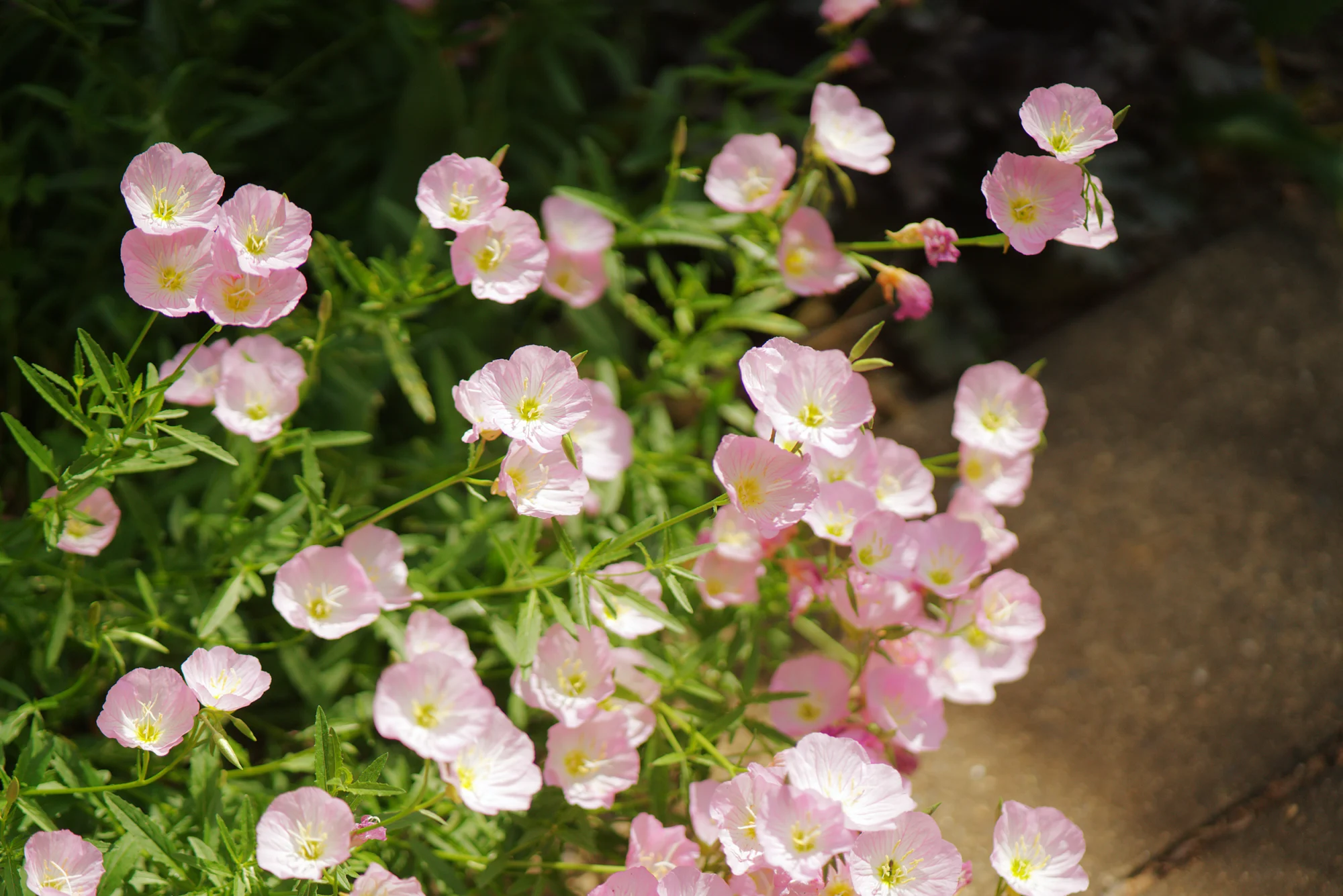
Pink evening primrose (Oenothera speciosa) makes a sheet of pale pink cups in late spring, each one veined in rose with a yellow throat. A patch in full bloom looks like someone scattered teacups across the ground. It blooms through heat, poor soil and drought, the places where most flowers quit.
It also travels. It spreads by underground runners and by seed, and the Forest Service warns it can become extremely weedy in a garden. Give it a hot bank, a curb strip or a spot ringed by pavement, and that habit turns into a feature.
Is pink evening primrose a good choice for my yard?
Yes, if…
- You have a hot, dry, sunny spot. It grows in loams, clays, sand, caliche and gravel, and handles drought.
- You want a fast groundcover. One plant can make a patch about 6 feet across.
- You want to feed native bees. NC State lists two specialist bees that visit evening primroses, and Kansas notes that hawk moths, hummingbirds and bees pollinate the flowers.
- The space is contained. A strip between a sidewalk and a street, a bed walled by a driveway, a slope you’d like covered.
Skip it if…
- You want it in a mixed border. Chicago Botanic Garden found it may be too aggressive for perennial borders, and NC State says it can take over a perennial garden.
- Your soil is rich and stays wet. It spreads faster in fertile soil, and the RHS warns of root rot in rich, wet, heavy ground.
- Your spot is shady. In part shade it grows but will not flower.
- You’re outside zones 5 to 8. That’s the range NC State gives for the species; the cultivar ‘Siskiyou’ is rated 4a to 9b.
Why pink evening primrose matters
The flowers are open for business when food is short in dry country. The Lady Bird Johnson Wildflower Center notes its value to native bees, and it keeps flowering into early summer, when the spring bloom elsewhere is done.
A moth dressed as a flower
Evening primroses host the primrose moth, a small pink-and-cream moth that spends the day tucked inside the flowers. Its caterpillars bore into the buds and then the young seed capsules. A study of the moth found that both larvae and adults mimic the plant: the caterpillars look like seed capsules, and the adults look like petals.
Where pink evening primrose shines in your yard
- A hell strip between sidewalk and street.
- A hot, dry bank you’d rather not mow.
- Gravel gardens and rock walls, where the soil is lean.
- A meadow planting, mixed with grasses that can hold their own.
- Big containers, where the runners can’t go anywhere.
Beginner tip
Plant it in a spot surrounded by pavement first. Watch how it behaves in your soil for a season before you invite it anywhere near a border.
How to grow pink evening primrose
When to plant
Plant container plants in spring or fall. You can also sow seed in fall; a cold, moist winter improves germination.
Sun and soil
Full sun, and well-drained soil. Poor, rocky soil is a feature here: it slows the spread and keeps the clumps tighter. Skip fertilizer and compost.
Water
Water the first few weeks, then mostly leave it alone. In a long dry spell the plants often go dormant in summer and resprout with fall rains, so a bare patch in August isn’t a dead patch.
Keeping it in bounds
The runners go deep, more than a foot below the surface, so pulling the tops doesn’t stop them. Plant it where pavement, a deep edging strip or a lawn you mow holds the line. If it pushes too far, the Lady Bird Johnson Wildflower Center’s advice is to divide and separate the clumps.
Planting card
Oenothera speciosa
The trickPlant it where pavement holds the line, and let it run.
Where is pink evening primrose native?
Native to 20 US states
Sources: NatureServe, Royal Botanic Gardens, Kew (World Checklist of Vascular Plants) and the USDA PLANTS Database, compiled by The Plant Native. How we map native ranges
Its home ground is the southern Great Plains, from Nebraska and Kansas to Texas and northeastern Mexico. Gardeners have carried it far beyond that, and it now grows wild along roadsides in many states.
Does it open in the evening or the morning?
Both, depending on where you are. Each flower lasts a single day. In most of Texas, the pink form usually opens in the morning, while the white form that’s more common in the northern part of the state opens late in the day. Kansas and North Carolina sources describe evening bloomers. Botanists who’ve looked at the Texas pattern add that there are plenty of exceptions.
A patch in full bloom looks like someone scattered teacups across the ground.
What are good pairings for pink evening primrose?
Pair it with other tough, sun-loving natives that can hold their ground: winecup, Texas bluebonnet, firewheel, blackfoot daisy and little bluestem.


Where can I buy pink evening primrose?
It’s easy to find at native nurseries, seed companies and many garden centers, often as ‘Siskiyou’. Seed is cheap if you have a big area to cover. Start with our list of native plant nurseries or order online.
FAQs
Is pink evening primrose invasive?
It’s native, but it spreads hard. It moves by deep runners and seed, and the Forest Service says it can become extremely weedy in a garden. Outside its home range on the southern Plains, it has escaped onto roadsides in many states.
Does pink evening primrose need full sun?
Yes, to bloom. It will grow in part shade, but NC State says it will not flower there.
Why did my evening primrose disappear in summer?
It’s probably dormant, not dead. In dry summers the plants go dormant and come back with fall rain. Mark the spot so you don’t plant over it.
Is pink evening primrose deer resistant?
Usually. The Lady Bird Johnson Wildflower Center rates it highly deer resistant, but Missouri lists deer among the animals that eat the leaves. Expect the odd nibble.
Which cultivar spreads the least?
‘Woodside White’ stayed tightest in Chicago Botanic Garden’s trial, at about 24 inches across. ‘Siskiyou’ rated best for flowers but spread to 36 inches, and all of them were fast-spreading.
Is pink evening primrose poisonous?
No source we found lists it as poisonous. The USGS notes that no evening primroses have been reported poisonous. As with any garden plant, keep pets and kids from eating it.
What’s the difference between pink evening primrose and Missouri evening primrose?
Color and size. Missouri evening primrose has big yellow flowers on a plant up to 12 inches tall that sprawls rather than runs. Pink evening primrose is pink or white and spreads underground.
Plant nerd fact
Six feet from one plant
The Forest Service says a single pink evening primrose can make a clump about 6 feet in diameter. A pound of its seed holds about 1,700,000 seeds. It’s easy to see how it made it out of Texas.
Pink evening primrose is a plant for the hard places. Put it where its spreading is welcome, give it sun and poor soil, and it will cover the ground in pink every spring. For more groundcovers that handle heat, see winecup. Happy planting!
Sources
- Handel, Steven N. “Population Structure of the Primrose Moth, Schinia florida.” Journal of the Lepidopterists’ Society 30, no. 4 (1976): 301.
- Hardwick, David F. “The Life History of Schinia florida (Noctuidae).” Journal of the Lepidopterists’ Society 24, no. 4 (1970): 282–287.
- Hawke, Richard G. “Sundrops and Primroses.” Plant Evaluation Notes 26. Chicago Botanic Garden, 2005.
- Kansas Wildflowers and Grasses. “Oenothera speciosa.” Accessed October 12, 2026.
- Lady Bird Johnson Wildflower Center. “Oenothera speciosa.” Native Plant Database. Accessed October 12, 2026.
- Missouri Department of Conservation. “Showy Evening Primrose” and “Missouri Evening Primrose.” Field Guide. Accessed October 12, 2026.
- NatureServe. “Oenothera speciosa.” NatureServe Explorer. Accessed October 12, 2026.
- NC State Extension. “Oenothera speciosa” and “‘Siskiyou’.” Extension Gardener Plant Toolbox. Accessed October 12, 2026.
- Royal Horticultural Society. “Oenothera speciosa.” Accessed October 12, 2026.
- Shropshire, Kimberley J., and Douglas W. Tallamy. “Lepidoptera of North America North of Mexico: An Annotated List Containing Geographic Ranges and Host Plant Records.” ZooKeys, 2025. Host counts from the UDELep data, May 2025.
- Smith-Rodgers, Sheryl. “Flora Fact.” Texas Parks & Wildlife, April 2010. Accessed October 12, 2026.
- University of Texas at Austin. “Oenothera speciosa.” Wildflowers of Texas. Accessed October 12, 2026.
- USDA Forest Service. “Showy Evening Primrose.” Plant of the Week. Accessed October 12, 2026.
- USGS Wetland and Aquatic Research Center. “Oenothera speciosa.” Louisiana Plant ID. Accessed October 12, 2026.

Similar plants
-
 Butterfly Weed
-
 Firewheel
-
 Milkweeds
-
 Amsonias
-
 Cardinal Flower
-
 Blue Vervain
-
 Coreopsis (Tickseed)
-
 Golden Alexander
-
 Black-Eyed Susans
Updated Find more: Pink Flower Spring Summer Full Sun Moist Dry Drought-Tolerant
The ads on this site help pay real native plant nerds to research and write these guides.
Garden notes
Notes from people who’ve grown it
Tips, wins, and the occasional disaster. If you’ve grown pink evening primrose, share the advice you’d give to a neighbor.
No notes yet. Yours could be the first.
Grown pink evening primrose? Tell the next person what you wish someone had told you.
Tap anywhere to close


