
Highlights
A spruce is the tree a kid draws: a dark spire, branches sweeping down to the ground, cones hanging like ornaments. Spruces (Picea, say it PIE-see-uh) are cold-country trees, and seven are native to North America, from northern bogs to Rocky Mountain streams.
They also star in one of the most common evergreen mistakes in American yards. Colorado blue spruce is native to the Rockies, where it can live for centuries. In humid eastern and Midwestern yards it’s prone to fungal diseases that thin it from the bottom up.
Is a native spruce a good choice for my yard?
Yes, if…
- Your winters are cold. White and red spruce are hardy to zone 2, and Engelmann spruce is hardy to zone 2 as well.
- You need a windbreak in full sun. The University of Minnesota recommends Black Hills spruce for windy, exposed sites.
- You want to feed winter birds. Chickadees, grosbeaks, crossbills, juncos, and sparrows all eat white spruce seed.
- You have a wet, acidic spot up north. Black spruce usually grows on wet organic soils.
- You want a small evergreen. Dwarf forms of native spruces, like black spruce ‘Nana,’ stay about 2 ft tall and 3 ft wide.
Skip it if…
- Your summers are hot and humid. NC State warns that white spruce can’t take hot, humid summers, and red spruce dislikes summer heat.
- You’re outside their range. In the Mid-Atlantic and southern lowlands, the only native spruce is red spruce, and it grows wild only high in the mountains, as low as 3,200 feet in West Virginia. Look at our native hollies or native cedars instead.
- You want a blue spruce in the East or Midwest. The University of Minnesota says Colorado blue spruce is “no longer recommended for Minnesota landscapes.”
- Your yard is shady. Most spruces want sun. For a big evergreen in shade, see our native hemlocks.
Why native spruces matter
Spruces host 262 native moths and butterflies in the Shropshire-Tallamy caterpillar records, well ahead of the 169 on hemlocks. Every one of those caterpillars is potential food for a nesting bird.
Seeds and needles for winter birds
Spruce seed carries a lot of birds through winter. Red spruce seeds make up 25 to 50 percent of the diet of white-winged crossbills. Spruce grouse eat the needles themselves, mostly the needles of conifers, white and black spruce among them.
Why blue spruce struggles in the East
Colorado blue spruce is a true native, primarily native to the central and southern Rocky Mountains. Move it to a humid eastern or Midwestern yard and it runs into the problems below.
Needle cast
Rhizosphaera needle cast hits trees aged between about 8 and 15 years old, starting on the lower branches. First-year needles turn yellow in midsummer, then brown or purplish-brown, and drop. Look for rows of tiny black dots on the needle undersides. Branches will decline and die after 3 to 4 years of successive defoliation.
Cytospora canker
Cytospora canker rarely affects trees less than 15 to 20 years old, and you’ll spot it by the white resin, or pitch, on dying branches. There’s no spray for it: Morton says “Chemical control is not useful.” Trees that are stressed or growing outside their natural range are more prone.
Diaporthe decline in Michigan
A Michigan research report traced spruce decline there to a fungus in the genus Diaporthe. In greenhouse tests, Colorado blue spruce was highly susceptible, Norway and white spruce moderately so, and Black Hills spruce resistant. The sample was small, eight trees at six locations, so treat it as a strong hint. Minnesota has already dropped blue spruce from its landscape recommendations.
The tree that can live for centuries along a Colorado stream is the same one losing its lower branches in humid eastern yards. It’s the clearest case we know for planting what’s native to your region.
The tree that can live for centuries along a Colorado stream is the same one losing its lower branches in humid eastern yards.
Spruce, fir or pine?
Pull a needle and roll it between your fingers. Spruce needles are 4-angled in cross section, rigid and sharp-pointed, so they roll and they prick. Balsam fir needles are flat, with two white bands underneath. Pines carry their needles in bundles; our native pines guide covers those.
Spruce cones hang down. Fir cones appear upright on branches in the fall, like candles on a cake.
Norway spruce is native to Europe. Among the natives, Engelmann and blue spruce are the hardest pair to tell apart. Look at young cones: Engelmann’s are violet or deep purple, while blue spruce cones are usually pale green or red.
Meet the native spruces
Seven species. Check your state before you buy.
White spruce
Picea glauca
The northern workhorse, dense and pyramidal when young. Crush a needle and you’ll learn why one of its old names is skunk spruce. Two forms fill nurseries. Black Hills spruce (var. densata) reaches 20 to 40 feet high and 10 to 20 feet wide, with a very narrow, dense form. Dwarf Alberta spruce (‘Conica’) stays 6 to 8 feet and rarely makes cones. NC State notes white spruce does poorly with salt spray.
- Height: 40 to 60 feet
- Cones: 1 to 2.5 inches, hanging, green ripening to pale brown
- Sun: full sun to part shade
- Soil: well drained; happy in many soils, including acidic
- Zones 2 to 6
- Native regions: Northeast, Mid-Atlantic, Midwest and Northwest
Black spruce
Picea mariana
The bog spruce, a narrow spire with thin, drooping branches. It usually grows on wet organic soils, though Oregon State says it can also do well with good drainage. Its cones can hang on for up to 30 years. The spruce grouse depends mainly on black spruce stands for food and cover.
- Height: 30 to 40 feet, narrow
- Cones: can stay on the tree up to 30 years
- Sun: sun or light shade
- Soil: wet to well drained; acidic, moist, organic
- Zones: hardy to zone 3
- Native regions: Northeast, Mid-Atlantic and Midwest
Red spruce
Picea rubens
The mountain spruce of the Northeast and the high southern Appalachians, where it grows as low as 4,500 feet. It’s also a comeback story. A study of 658 trees on 52 plots in five northeastern states found more than 75% of red spruce trees growing faster since 2001, and the authors tied that to less acid deposition and warmer temperatures. It can live about 400 years.
- Height: 60 to 70 feet
- Cones: 1.25 to 2 inches, light reddish brown
- Sun: full sun to part shade
- Soil: acidic (pH below 6) and moist
- Zones 2 to 5
- Native regions: Northeast, Mid-Atlantic and South
Colorado blue spruce
Picea pungens
The Rocky Mountain native, found along streams at roughly 6,000 to 10,000 feet and seldom found in large numbers. It can withstand drought better than any other spruce and can live several centuries in the wild. For a smaller one, ‘Fat Albert’ tops out around 15 feet and ‘Globe’ stays 3 to 5 feet tall.
- Height: 30 to 60 feet
- Cones: 2 to 4 inches, green with a violet bloom, ripening light brown
- Sun: full sun
- Soil: rich and moist, clay or loam, well drained
- Zones 2 to 7
- Native regions: Southwest and Northwest
Engelmann spruce
Picea engelmannii
The high-country spruce of the Rockies and Cascades, growing at 9,000 to 11,000 feet in Colorado, Utah and Wyoming and lower in the Cascades. It has a dense, narrow conical crown and stiff, sharp needles. A central Colorado tree has a crossdated age of 911 years. For gardens, ‘Bush’s Lace’ is a weeping form, about 6 by 4 feet after 10 years.
- Height: 80 to 100 feet
- Cones: 1 to 2.5 inches, violet to deep purple when young
- Sun: full sun; handles shade
- Soil: moist, well drained
- Zones: hardy to zone 2
- Native regions: Southwest, California and Northwest
Sitka spruce
Picea sitchensis
The coastal giant and the largest of the world’s spruces, with a record tree of 216 feet near Seaside, Oregon. It needs a maritime climate with abundant moisture throughout the year and is seldom found far from tidewater. On Alaska’s Admiralty Island, bald eagles use Sitka spruce for greater than 90 percent of their nest trees. NC State lists a dwarf, ‘Papoose.’
- Height: 40 to 200+ feet
- Cones: seeds feed small birds
- Sun: full sun to part shade
- Soil: acid to neutral, moist or occasionally wet
- Zones 7 to 8
- Native regions: California and Northwest
Brewer spruce
Picea breweriana
The weeping spruce, endemic to the Klamath-Siskiyou Mts. of southwestern Oregon and northern California, at about 4,000 to 8,000 feet. Its rope-like branchlets hang in a fringe, though young trees don’t weep until they’re about 10 to 20 years old. NatureServe calls it very limited in distribution. The Lady Bird Johnson Wildflower Center is blunt: it’s “not as easy as other spruces.”
- Height: 50 to 75 feet in the wild
- Branches: rope-like branchlets that hang like a curtain
- Sun: part shade
- Soil: moist and well drained, like other spruces
- Zones: hardy to zone 6
- Native regions: California and Northwest
Which spruce is right for my region?
Up north, white, black or red spruce. On the Plains and in the Midwest, Black Hills spruce. In the Rockies, blue or Engelmann spruce. On the Pacific coast, Sitka spruce. In the hot, humid lowlands, no native spruce fits.
- Northeast: red spruce in the mountains, white spruce for windbreaks, black spruce for wet ground.
- Mid-Atlantic and South: red spruce at high elevations only. In the lowlands, choose another evergreen.
- Midwest: Black Hills spruce or white spruce; black spruce in northern bogs.
- Southwest: blue spruce and Engelmann spruce in the mountains.
- California: Sitka spruce on the far north coast, Brewer spruce in the Klamath-Siskiyou, Engelmann spruce in the northern mountains.
- Northwest: Sitka spruce near the coast, Engelmann spruce in the mountains, blue spruce in the Rocky Mountain states.
Where native spruces shine in your yard
- A windbreak on the cold side of the house, in full sun.
- Winter cover near a bird feeder, where the branches go all the way down.
- A soggy northern corner, with black spruce.
- A small bed or container, with a dwarf like black spruce ‘Nana.’
- A specimen tree in the West, where blue and Engelmann spruce are at home.
Beginner tip
In the Midwest and want that blue Christmas-tree look? Ask your nursery for Black Hills spruce by name. It’s a native variety of white spruce, it handles windy, exposed sites, and it held up to the decline fungus in Michigan’s greenhouse tests.
How to grow native spruces
Sun and soil
Most spruces want full sun and moist, well-drained soil. Black spruce handles the wettest ground.
Watch for spider mites
Spruce spider mite is “sometimes referred to as a cool season pest,” so look in spring and fall, not midsummer. Penn State times treatment for early to mid-May, and again in early September. Dwarf Alberta spruce is a favorite host.
Don’t panic about some needle drop
Blue spruce needles drop three to four years after emerging, so some browning on the oldest, innermost needles is normal. Yellowing that starts on the lowest branches and moves up year after year is the pattern to worry about.
What are good pairings for native spruces?
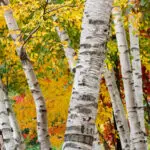
In the North, pair spruce with paper birch, with bunchberry and kinnikinnick at its feet. In the Rockies and the Northwest, Saskatoon serviceberry, common snowberry and wax currant add flowers and berries around it.


Where can I buy native spruces?
White spruce, Black Hills spruce and blue spruce are easy to find. If you live outside the Rockies, ask for Black Hills spruce by name. Red and black spruce are more likely at native nurseries, and Brewer spruce takes a specialist. Start with our list of native plant nurseries or order online.
Native spruce FAQs
Why is my blue spruce dying from the bottom up?
Most likely needle cast, canker or both. Needle cast shows up on trees about 8 to 15 years old and kills lower branches after a few years of repeated needle loss. Canker follows on older trees, and trees under stress or growing outside their natural range are more prone.
Is Colorado blue spruce native?
Yes, to the Rocky Mountains. It grows wild from Wyoming and Idaho south to Arizona and New Mexico. Planted in the humid East it’s outside its natural range, which is why so many struggle.
What’s the best native spruce for the Midwest?
Black Hills spruce. It’s a narrow, dense variety of white spruce, 20 to 40 feet tall, and it was rated resistant in Michigan’s spruce decline tests. Plain white spruce is a good second choice.
Is Norway spruce native?
No. Norway spruce is native to Europe. It’s also susceptible to Cytospora canker and needle cast, so it doesn’t dodge the blue spruce problem.
Is dwarf Alberta spruce native?
It’s a cultivar of a native. ‘Conica’ is a selected form of white spruce that stays 6 to 8 feet high. Watch it for spider mites: Penn State calls it “a particularly preferred host.”
Are spruce trees deer resistant?
Mostly, yes. Rutgers rates white spruce and Colorado blue spruce “seldom severely damaged” and dwarf Alberta spruce “rarely damaged.” Deer may still nibble young trees in a hard winter.
Plant nerd fact
The Wright brothers flew on red spruce
The straight parts of the Wright brothers’ airplane, such as the spars and struts, were red spruce, chosen because it is “very light, but extremely strong for its weight.” The curved ribs were white ash.
Pick the spruce that grew up where you live and it will hold its branches to the ground for decades. For shade, see our native hemlocks; for heat, our native pines and native cedars; and for the big picture, our native evergreen conifers overview. Happy planting!
Sources
- Clement, David. “What’s Wrong with My Colorado Blue Spruce Tree?” University of Maryland Extension, updated August 26, 2026. Accessed October 12, 2026.
- Cornell Lab of Ornithology. “Spruce Grouse Life History.” All About Birds. Accessed October 12, 2026.
- Flora of North America Editorial Committee. “Picea.” Flora of North America North of Mexico. Accessed October 12, 2026.
- Gymnosperm Database. “Picea engelmannii,” “Picea pungens” and “Picea breweriana.” Accessed October 12, 2026.
- Jarosz, Fulbright, Cregg, and O’Donnell. “Spruce Decline in Michigan: Disease Incidence, Causal Organism and Epidemiology.” MDARD Horticulture Fund final report. Michigan Nursery and Landscape Association. Accessed October 12, 2026.
- Kosiba, Alexandra M., Paul G. Schaberg, Shelly A. Rayback, and Gary J. Hawley. “The Surprising Recovery of Red Spruce Growth Shows Links to Decreased Acid Deposition and Elevated Temperature.” Science of the Total Environment 637–638 (2018): 1480–1491. doi.org/10.1016/j.scitotenv.2018.05.010.
- Lady Bird Johnson Wildflower Center. “Picea breweriana.” Native Plant Database. Accessed October 12, 2026.
- Missouri Botanical Garden. “Picea glauca.” Plant Finder. Accessed October 12, 2026.
- Morton Arboretum. “Spruce Diseases,” “Blue Spruce” and “White Spruce.” Accessed October 12, 2026.
- NatureServe. “Picea breweriana.” NatureServe Explorer. Accessed October 12, 2026.
- NC State Extension. “Picea glauca,” “Picea rubens,” “Picea pungens,” “Picea sitchensis,” “Picea abies” and “Abies balsamea.” Extension Gardener Plant Toolbox. Accessed October 12, 2026.
- Oregon State University. “Picea mariana” and “Picea engelmannii.” Landscape Plants. Accessed October 12, 2026.
- Penn State Extension. “Spruce Spider Mite.” Accessed October 12, 2026.
- Rutgers New Jersey Agricultural Experiment Station. “Landscape Plants Rated by Deer Resistance.” Accessed October 12, 2026.
- Shropshire, Kimberley J., and Douglas W. Tallamy. “Lepidoptera of North America North of Mexico: An Annotated List Containing Geographic Ranges and Host Plant Records.” ZooKeys, 2025. Host counts from the UDELep data, May 2025.
- University of Minnesota Extension. “Choosing Evergreens for Your Landscape.” Accessed October 12, 2026.
- USDA Forest Service. “Picea glauca,” “Picea mariana,” “Picea rubens,” “Picea pungens,” “Picea engelmannii,” “Picea sitchensis” and “Picea breweriana.” Silvics of North America, vol. 1, Conifers. Accessed October 12, 2026.
- USDA Forest Service. “Picea sitchensis.” Fire Effects Information System. Accessed October 12, 2026.
- USDA NRCS Plant Materials Program. “Red Spruce, Picea rubens.” Plant fact sheet. Accessed October 12, 2026.
- Wright Brothers Aeroplane Company. “Aircraft Materials.” Accessed October 12, 2026.

Similar plants
Updated Find more: Beginner Guide Deer Resistant Evergreen Evergreen Tree Statement Tree Tall Tree Tree
The ads on this site help pay real native plant nerds to research and write these guides.
Garden notes
Notes from people who’ve grown it
Tips, wins, and the occasional disaster. If you’ve grown spruces, share the advice you’d give to a neighbor.
No notes yet. Yours could be the first.
Grown spruces? Tell the next person what you wish someone had told you.
Tap anywhere to close


