
Highlights
Step under an old hemlock in July and it feels like walking into a cellar. Hemlocks (Tsuga, say it TSOO-guh) cast deep, dark shade, and along mountain streams it shows up in the fish: brook trout are about three times as common in hemlock-shaded streams as in hardwood ones, and brown trout about twice as common.
Our native hemlocks come in two pairs, two in the East and two in the West. The eastern pair is in serious trouble from an invasive insect, so planting one back East comes with homework. This guide covers both.
Is a native hemlock a good choice for my yard?
Yes, if…
- You have shade and want a big evergreen in it. Eastern hemlock grows in deep shade and can survive on as little as 5 percent of full sunlight.
- You have a cool, moist spot. A north slope, a ravine or a streambank is hemlock country. They want moist soil with good drainage.
- You want a soft evergreen hedge. Eastern hemlock can be sheared as a hedge, and its drooping tips keep it from looking stiff.
- You live in the Pacific Northwest. Western and mountain hemlock are native there, and the western species are reported to hold up against the adelgid that troubles the East.
Skip it if…
- You won’t inspect or treat it, and you live in the East. Hemlock woolly adelgid is now in about 20 states, and an infested mature hemlock may die in as little as 2 to 4 years.
- Your spot is hot, dry and sunny. Eastern hemlock does badly in drought, and NC State lists sun scorch among its problems.
- Deer winter in your yard. Hemlock is “highly preferred” winter browse for white-tailed deer. Small trees need protection.
- You’re outside their range. No hemlock is native to the Southwest or the Plains, and western hemlocks planted in a New York trial struggled with the climate.
Why native hemlocks matter
Hemlocks give winter and severe-weather cover when bare hardwoods give none, and hemlock forests are home to as many as 90 bird species. Hemlocks host 169 native moths and butterflies in the Shropshire-Tallamy caterpillar records, which is a lot of bird food from just four native trees.
Birds overhead
Blackburnian and black-throated green warblers are “especially abundant” in old eastern hemlock cove forests. Red crossbills eat the seeds, and ruffed grouse eat the buds.
Cold water for trout
As hemlocks died along eight southern Appalachian streams from 2003 to 2011, the annual temperature range widened: hotter summer highs, colder winter lows.
Hemlock, fir, spruce or yew?
Hemlock needles are flat, about 1/2 to 3/4 inch long, with two pale stripes underneath. But balsam fir has two white bands underneath too. Check the cones: eastern hemlock’s are only 0.5 to 0.75 inch, and they dangle from the twig tips. Fir cones stand upright on the branches and run 2.5 to 4 inches.
Spruce needles are four-angled and rigid, so they roll between your fingers; hemlock needles lie flat. (Our native spruces guide covers the sunnier choice.) Canada yew has flattened-looking needles too, but it never makes a woody cone, and it rarely grows over 5 feet tall.
Meet the native hemlocks
Four species, two coasts.
Eastern hemlock
Tsuga canadensis
The shade tree of eastern ravines, with soft, drooping branches. It can live a very long time: 800 years or more, by the Forest Service’s count. For small yards, look at the dwarf and weeping forms: ‘Pendula’ grows about 2 feet tall and 5 feet wide.
- Height: 40 to 70 feet in gardens, taller in the wild
- Cones: about 1/2 to 3/4 inch, hanging from the twig tips
- Sun: part shade to deep shade
- Soil: moist, acidic, well drained; no drought
- Zones 3 to 7
- Native regions: Northeast, Mid-Atlantic, South and Midwest
Carolina hemlock
Tsuga caroliniana
A southern Appalachian specialist of rocky slopes, ridges and gorge walls, where a taproot reaches deep water in dry spells. Its needles radiate from the twig, giving it a bottlebrush look, and its cone scales stick out at nearly right angles when dry. NatureServe ranks it globally vulnerable (G3), with the adelgid as the main threat.
- Height: 30 to 70 feet
- Cones: 1 to 1.5 inches, about twice the size of eastern hemlock’s
- Sun: part to full shade; forest edges in the wild
- Soil: moist and well drained; water it in dry spells
- Zones 6 to 7
- Native regions: South
Western hemlock
Tsuga heterophylla
The giant. In old Northwest forests, heights of 165 to 200 feet are not uncommon. Its seedlings often start on rotting logs and stumps, which is why you see old trees lined up on stilt roots where a log has rotted away. Shallow roots make it “subject to severe windthrow,” so plant it well away from the house. NC State lists a weeping form, ‘Thorsen’s Weeping.’
- Height: 60 to 240 feet
- Cones: 0.6 to 1 inch
- Sun: full sun to shade; grows faster in sun
- Soil: moist to wet, with good drainage
- Zones 5 to 8
- Native regions: California and Northwest
Mountain hemlock
Tsuga mertensiana
The high-country hemlock, with generally the longest cones in the genus, oblong, purple or brownish purple. It grows from sea level in Alaska up to about 4,200 to 7,500 feet in the Cascades and 7,900 to 10,000 feet in the Sierra Nevada. It wants cool summers and lingering snow. ‘Elizabeth’ is a spreading dwarf for gardens.
- Height: 30 to 100 feet, only 10 to 15 feet wide
- Cones: up to about 3 inches
- Sun: full sun, with cool summers
- Soil: moist, with good drainage
- Zones 5 to 8
- Native regions: California and Northwest
Which hemlock is right for my region?
In the East, eastern hemlock, with a treatment plan. In the Northwest, western or mountain hemlock.
- Northeast, Mid-Atlantic and Midwest: eastern hemlock.
- South: eastern hemlock in cool coves; Carolina hemlock on rocky southern Appalachian ridges.
- Northwest: western hemlock where you have room, mountain hemlock up high or as a dwarf.
- California: mountain hemlock in the high Sierra, western hemlock where it grows wild.
- Southwest and the Plains: no native hemlock; try our native pines.
Where native hemlocks shine in your yard
- The shady side of the house, where a big evergreen has nowhere else to go.
- A ravine or streambank, where hemlock shade keeps the water cool.
- Winter cover for birds when every other tree is bare.
- A weeping specimen, like a low ‘Pendula’ spilling over a rock.
Beginner tip
Not sure you’re ready? Start with a weeping ‘Pendula.’ At under 10 feet, it can be treated with a pump sprayer of horticultural oil, the safest option, with no systemic chemicals at all.
How to grow native hemlocks
Pick the cool side
Eastern and Carolina hemlock want part to deep shade, out of hot afternoon sun and drying wind. Mountain hemlock wants sun, but only where summers stay cool.
Keep the roots moist
Hemlock roots run shallow, especially where the water table is high. Mulch the root zone with leaves and water deeply through dry spells.
Prune lightly
Shear a hedge lightly and keep cuts in the green growth. Eastern hemlock “does not sprout” from a stump, so don’t count on a hard cut growing back.
Check the twigs every spring
Turn over a few low branches and look where the needles attach for the white wool that gives the adelgid its name. Needles with yellow banding point to elongate hemlock scale. Early treatment is cheaper.
What are good pairings for native hemlocks?
For the same cool, acidic shade in the East, rosebay rhododendron and mountain laurel fill the shrub layer, with Christmas fern and foamflower below. In the Northwest, western sword fern and salal are classic hemlock-forest neighbors.


Where can I buy native hemlocks?
Eastern hemlock is the easy one to find, including dwarf and weeping forms. Carolina hemlock takes a specialist, and the western pair is easiest to find in the Northwest. Check the Latin name on the tag. Start with our list of native plant nurseries or order online.
Hemlock woolly adelgid and elongate hemlock scale
Hemlock woolly adelgid is an invasive insect native to Japan and possibly China. It was first found in the eastern U.S. in 1951 in Virginia, and it has since spread to about 20 states.
How fast it works
In the southern Appalachians, mature trees may die in as little as 2 to 4 years; elsewhere it can take up to 10. In southeastern New York the adelgid arrived in 1998, but widespread death of hemlocks did not occur until after 2010. NatureServe notes that eastern hemlock has declined most severely in the southern Appalachians. Carolina hemlock is no safer, with “essentially the same” innate susceptibility.
The second pest: elongate hemlock scale
Elongate hemlock scale (Fiorinia externa) came from Japan and was first observed in Queens, New York, in 1908. It feeds mainly on eastern and Carolina hemlock, and on fir and spruce too. The soil-injected systemic insecticides used for the adelgid don’t work on it, so a treated tree can still decline.
Treating one yard tree
- Trees under 10 feet: horticultural oil or insecticidal soap, sprayed in spring just after the eggs hatch and again in early fall. Penn State calls oils and soaps “the safest insecticides for controlling HWA,” though trees will likely need repeat sprays.
- Bigger trees, long-lasting: imidacloprid, where protection “typically lasts four to six years.” A 2019 review reports protection up to 7 years.
- Bigger trees, fast: dinotefuran, which acts faster but only protects for one to two years. New York’s DEC notes that pairing the two gives “fast protection for up to 7 years.”
- Near water: don’t apply to soil near surface water or in very rocky ground. Use a basal trunk spray or trunk injection there.
- Cost: North Carolina’s hemlock program puts it at less than $5 for a fairly healthy tree, and $25 to $50 or more for one in worse shape.
Always read the product label and check your state’s pesticide rules before you buy.
What about the bees?
Both chemicals are neonicotinoids, which can turn up in a treated plant’s pollen and nectar and be detected inside plants years after application. Hemlock itself is pollinated by wind (not insects), and New York’s DEC calls the risk to other species negligible when the label is followed. We’d still keep flowering plants and streams out of the treatment zone.
Reasons for hope
Laricobius nigrinus, a Pacific Northwest beetle that eats adelgids, has been released on eastern hemlock since 2003. In New York’s 2025 survey it turned up at 41 of 54 sites. The same report confirmed the first New York establishment of a silver fly, Leucotaraxis argenticollis, another adelgid eater. The Forest Service is careful to add that the beetles “have thus far proved insufficient to alone halt hemlock damage.”
The U.S. National Arboretum has also released two resistant hybrids, ‘Traveler’ and ‘Crossroad,’ hardy in USDA Zones 6 and 7. With an Asian parent, they aren’t native hemlocks.
So should I plant one?
In the East, plant one if you’ll inspect it and treat it when you find the wool. North Carolina’s hemlock program calls planting “an excellent method of conserving them,” as long as it’s the native species. Penn State suggests that where hemlocks are declining, you “consider establishing other conifer species, preferably native.” A hemlock in a yard is far easier to save than one on a mountainside, because you can reach it.
A hemlock in a yard is far easier to save than one on a mountainside, because you can reach it.
Native hemlock FAQs
Can I still plant an eastern hemlock?
Yes, if you’ll check it every year and treat it when needed. In the adelgid’s range, untreated trees can die in 2 to 10 years. Treating a healthy yard tree can cost less than $5.
Is Carolina hemlock resistant to the adelgid?
No. Its innate susceptibility is “essentially the same” as eastern hemlock’s. Its edge is a deep taproot.
Will western hemlock grow in the East?
Not reliably. In a Zone 6b trial in Katonah, New York, mountain hemlock rated consistently lower than every other species. Western hemlock browned in spring but recovered by fall.
Are hemlocks deer resistant?
Sometimes. Rutgers rates eastern and Carolina hemlock “occasionally severely damaged,” and deer browse hemlock heavily in winter. Wrap or fence young trees until the lower branches are out of reach.
What can I plant instead of a hemlock in the East?
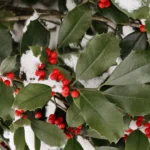
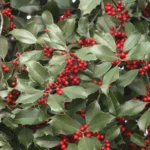
American holly for a tall evergreen in part shade. It reaches 40 to 60 feet and handles full sun to partial shade. Meet it in our American holly profile. For a low evergreen in deep shade, Canada yew stays under about 5 feet, though deer will browse this plant. In sunnier spots, try a native pine or spruce.
Plant nerd fact
A crossbill sized for hemlock cones
Red crossbills come in at least 11 different types, with bills sized to the cones they eat. Small-billed type 3 favors western hemlock, which has very small cones, while the biggest-billed type works over large pine cones.
A hemlock asks for a little attention every spring and gives back the coolest shade on your property. For sunny yards, see our guides to native spruces and native pines or our native evergreen conifers overview. Happy planting!
Sources
- Cornell Lab of Ornithology. “Red Crossbill Life History.” All About Birds. Accessed October 12, 2026.
- Emerald Ash Borer Information Network. “Hemlock Woolly Adelgid.” Accessed October 12, 2026.
- Gymnosperm Database. “Picea engelmannii.” Accessed October 12, 2026.
- Hemlock Restoration Initiative. “Carolina Hemlock,” “FAQ” and “The Importance of Hemlocks.” savehemlocksnc.org. Accessed October 12, 2026.
- Jackson, David R. “An Integrated Approach to Hemlock Woolly Adelgid Mitigation.” Penn State Extension, updated November 24, 2021. Accessed October 12, 2026.
- Lovett, Gary M. “7 Facts About Hemlock Woolly Adelgid.” Cary Institute, June 16, 2022. Accessed October 12, 2026.
- McCarty, Elizabeth P., and Karla M. Addesso. “Hemlock Woolly Adelgid (Hemiptera: Adelgidae) Management in Forest, Landscape, and Nursery Production.” Journal of Insect Science 19, no. 2 (2019): iez031. doi.org/10.1093/jisesa/iez031.
- Morton Arboretum. “Eastern Hemlock.” Accessed October 12, 2026.
- NatureServe. “Tsuga canadensis” and “Tsuga caroliniana.” NatureServe Explorer. Accessed October 12, 2026.
- NC State Extension. “Tsuga canadensis,” “Tsuga caroliniana,” “Tsuga heterophylla,” “Tsuga mertensiana,” “Abies balsamea,” “Taxus canadensis” and “Ilex opaca.” Extension Gardener Plant Toolbox. Accessed October 12, 2026.
- New York State Department of Environmental Conservation. “Hemlock Woolly Adelgid Management FAQ.” Accessed October 12, 2026.
- Penn State Extension. “Elongate Hemlock Scale.” Accessed October 12, 2026.
- Rutgers New Jersey Agricultural Experiment Station. “Landscape Plants Rated by Deer Resistance.” Accessed October 12, 2026.
- Shropshire, Kimberley J., and Douglas W. Tallamy. “Lepidoptera of North America North of Mexico: An Annotated List Containing Geographic Ranges and Host Plant Records.” ZooKeys, 2025. Host counts from the UDELep data, May 2025.
- USDA Agricultural Research Service. “U.S. National Arboretum Offers Solution to Hemlock Woolly Adelgid Pest.” February 23, 2023. Accessed October 12, 2026.
- USDA Forest Service. Fire Effects Information System species reviews: “Tsuga canadensis” and “Tsuga mertensiana.” Accessed October 12, 2026.
- USDA Forest Service. “Predatory Flies Offer New Hope for Hemlock Forests.” November 3, 2023. Accessed October 12, 2026.
- USDA Forest Service. “Tsuga canadensis,” “Tsuga heterophylla” and “Tsuga mertensiana.” Silvics of North America, vol. 1, Conifers. Accessed October 12, 2026.
- Virginia Tech Dendrology. “Carolina Hemlock.” Fact sheet. Accessed October 12, 2026.
- Webster, Jackson R., Kate Morkeski, Cathlyn A. Wojculewski, B. R. Niederlehner, E. F. Benfield, and Katherine J. Elliott. “Effects of Hemlock Mortality on Streams in the Southern Appalachian Mountains.” The American Midland Naturalist 168, no. 1 (2012): 112–131. srs.fs.usda.gov. Accessed October 12, 2026.
- Weston, Paul A., and Richard W. Harper. “Potential of Tsuga spp. from Western North America and Asia as Replacements for Eastern Hemlock (Tsuga canadensis).” Arboriculture & Urban Forestry 35, no. 1 (2009): 5–9. auf.isa-arbor.com. Accessed October 12, 2026.
- Whitmore, Mark, Tonya Bittner, Nicholas Dietschler, Elizabeth D’Auria, and Matthew Del Buono. “New York State Hemlock Initiative 2025 Annual Report.” Cornell University. Accessed October 12, 2026.
- Xerces Society for Invertebrate Conservation. “Systemic Insecticides.” Accessed October 12, 2026.

Similar plants
Updated Find more: Acidic Beginner Guide Evergreen Evergreen Tree Tall Tree Tree
The ads on this site help pay real native plant nerds to research and write these guides.
Garden notes
Notes from people who’ve grown it
Tips, wins, and the occasional disaster. If you’ve grown hemlocks, share the advice you’d give to a neighbor.
No notes yet. Yours could be the first.
Grown hemlocks? Tell the next person what you wish someone had told you.
Tap anywhere to close


