
Highlights
You know a pine with your eyes closed: the clean smell, the hush of wind in the needles, the orange carpet underneath. What people miss is how much lives in one. Pines host 409 native moths and butterflies in the Shropshire-Tallamy caterpillar records, and their seeds feed everything from red squirrels to black bears.
About 100 pine species grow worldwide, and 37 are native to the United States and Canada. They run from a 10-foot pinyon with edible nuts to a longleaf that spends its first years pretending to be grass. Here are 12 you can find and plant.
Is a native pine a good choice for my yard?
Yes, if…
- You want an evergreen screen soon. NC State rates six of these pines as rapid growers.
- Your soil is sandy, rocky or plain poor. Pitch, jack and Virginia pine all grow on ground where a maple would sulk.
- You want one tree that feeds a lot of wildlife. Caterpillars in summer, seeds in fall and winter, and year-round cover for birds.
- You’d like to mow less. Let the needles fall and you have a bed that mulches itself.
Skip it if…
- Your lot is small and you want a full-size species. Most of these finish somewhere between 50 and 125 feet. Pinyon, shore pine and dwarf cultivars are the exceptions.
- You want a perfect cone forever. Pines get open and lanky with age. That’s the charm, but it surprises people.
- You’re next to a salted road. Eastern white pine in particular is hurt by salt.
- The tree is outside its range. A longleaf in Ohio or a pinyon in Georgia is a mistake. Each pine below lists its native regions.
Why native pines matter
Pines host 409 native moths and butterflies in the Shropshire-Tallamy caterpillar records. One of the showiest is the imperial moth, which NC State lists on most native pines.
Some birds need one particular pine
The Kirtland’s warbler nests in young jack pine stands generally between five and 15 feet tall. The Forest Service manages about 3,400 acres a year in Michigan’s Huron-Manistee National Forests just to keep that kind of young forest coming. Down South, the endangered red-cockaded woodpecker lives in old-growth shortleaf pine with decayed heartwood, and mature longleaf stands give it the most desirable habitat.
Seeds for the whole neighborhood
Ponderosa seeds are consumed by a great many birds and small mammals, longleaf seeds go to squirrels, quail, doves, turkeys and brown-headed nuthatches, and pinyon’s big, wingless seeds rely on four kinds of jays and nutcrackers to carry them off.
Pine, spruce or something else?
Pull gently on a few needles. If they come off in a bundle of two, three or five, it’s a pine: pine needles grow in bundles sheathed at the base. On white pines like eastern white and limber, that little sheath falls off early, so look for the bundle itself. Spruce needles grow one at a time and are four-angled in cross section. See our guides to spruces, hemlocks and cedars for the rest.
The pine at the garden center is probably European
Big-box pines are often Austrian pine, native to central and southern Europe, Scots pine from Europe and northern Asia, or mugo pine from the mountains of Central Europe. Scots pine is now widely naturalized in the United States. NC State’s Austrian pine page suggests eastern white pine instead.
Lodgepole or shore pine?
Both. They’re one species, Pinus contorta, with a coastal form called shore pine and inland forms in the Rockies and the Sierra Nevada called lodgepole pine.
Meet the native pines
Twelve pines, roughly northeast to southwest. Check each one’s native regions before you fall for it.
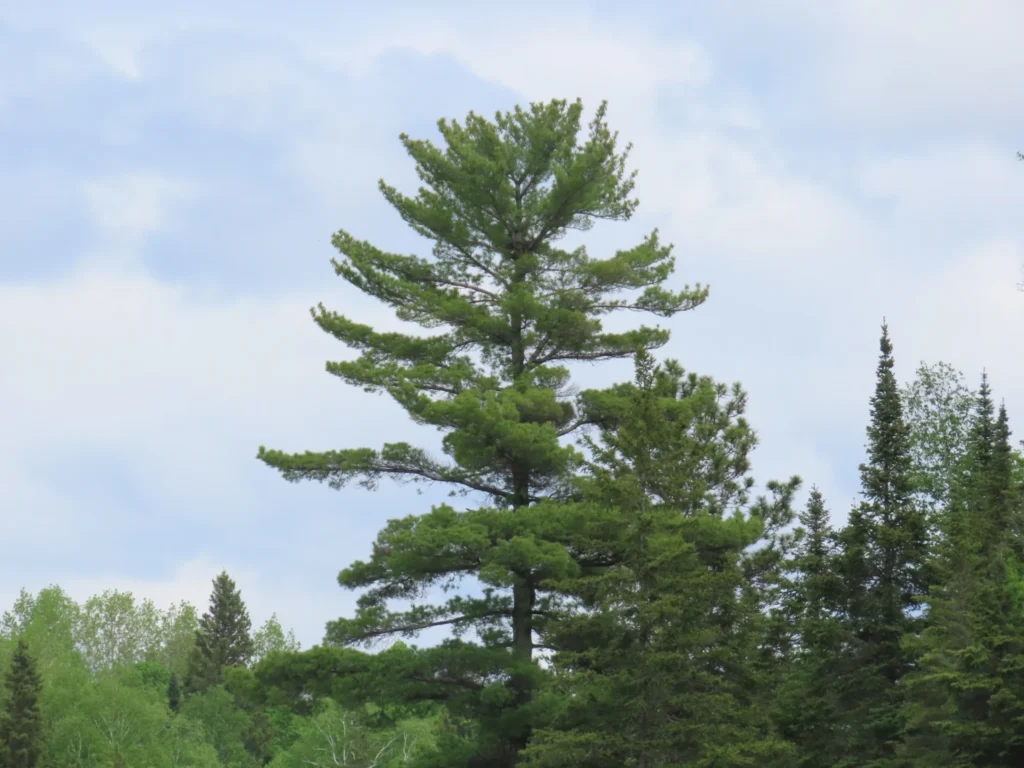
Eastern white pine
Pinus strobus
The soft and absolultely enormous one, with five blue-green needles to a bundle and long curved cones sticky with resin. It grows on nearly all the soils within its range, though it doesn’t like alkaline ground or salt. Give it 20 to 40 feet to spread; its maximum age may exceed 450 years.
- Height: 50 to 80 feet
- Cones: 4 to 8 inches, curved and resinous
- Sun: full sun to part shade
- Soil: moist, well drained; not alkaline
- Zones 3 to 8
- Native regions: Northeast, Mid-Atlantic, South and Midwest
Red pine
Pinus resinosa
The Great Lakes pine with orange-red bark that breaks into scaly plates up to 2 inches thick. Natural stands are confined largely to sandy soils, and it simply doesn’t grow where the surface soil is alkaline. Expect patience: in Minnesota it averages about a foot a year for its first 50 years.
- Height: 70 to 80 feet at maturity
- Bark: orange-red, in thick scaly plates
- Sun: full sun
- Soil: well-drained sand or sandy loam; not alkaline
- Native regions: Northeast, Mid-Atlantic and Midwest
Jack pine
Pinus banksiana
The scrappy northern one, at home on dry, acidic sandy soils. Its curved cones often stay sealed with resin until a fire melts it open. It grows fast and doesn’t pretend to live forever: stands begin to break up after 60 to 80 years.
- Height: 35 to 50 feet
- Cones: pointed, yellowish brown; some stay closed for years
- Sun: full sun only
- Soil: dry, acidic sand
- Zones 2 to 7
- Native regions: Northeast and Midwest
Pitch pine
Pinus rigida
The crooked pine of sandy barrens. It can grow tufts of needles straight out of its trunk, and after a fire it sprouts from its roots and stumps. NC State calls it salt-hardy, too.
- Height: 40 to 60 feet
- Cones: 1 to 3 inches, in whorls of 3 to 5
- Sun: full sun to part shade
- Soil: dry, thin, sandy or gravelly
- Zones 4 to 7
- Native regions: Northeast, Mid-Atlantic and South
Virginia pine
Pinus virginiana
The old-field pine. It’s a pioneer species that moves in after fire and onto eroded, worn-out fields. Its empty cones can hang on for as many as 15 years. NC State calls it resistant to damage by deer.
- Height: 40 to 80 feet, 10 to 30 feet wide
- Cones: 1.5 to 3 inches, reddish brown, long-lasting
- Sun: full sun
- Soil: clay, loam or sand; acidic
- Zones 4 to 8
- Native regions: Mid-Atlantic, South and Midwest
Shortleaf pine
Pinus echinata
The far-reaching southern pine, from New York to Texas. Its needles come two to a bundle, sometimes three, and its cones are small and neat. It grows slowly at first, then becomes a tall tree that’s classified as fire-resistant. Young trees knocked back by fire sprout from the root collar.
- Height: 80 to 100 feet
- Cones: 1.5 to 2.5 inches
- Sun: full sun to part shade
- Soil: deep, well-drained sandy or silty loam
- Zones 6 to 9
- Native regions: Northeast, Mid-Atlantic, South, Midwest and Southwest
Longleaf pine
Pinus palustris
The most patient tree you’ll ever plant. Needles run 8 to 18 inches long, and the cones are 6 to 10 inches. A seedling starts in a grass stage that can last 2 to many years. It can sit there for years looking like a clump of grass, then grow 10 feet in three.
- Height: 60 to 120 feet
- Cones: 6 to 10 inches
- Sun: full sun
- Soil: room for a deep taproot
- Zones 7b to 9
- Native regions: South
Loblolly pine
Pinus taeda
The fast one. NC State says it has the most rapid growth rate of all pines, and it grows in medium to wet soil. Each cone scale ends in a stout triangular spine, so it’s not a barefoot tree.
- Height: 60 to 90 feet
- Cones: 3 to 6 inches, spiny
- Sun: full sun
- Soil: medium to wet; no long flooding when young
- Zones 6 to 9
- Native regions: Mid-Atlantic, South and Southwest
Ponderosa pine
Pinus ponderosa
The big western pine. Young bark is brown-black; older trunks turn yellowish brown or cinnamon in large, flat, scaly plates. It grows in soil from pH 4.9 to pH 9.1, so alkaline ground is fine, and it’s drought-hardy once settled. Trees often reach 300 to 600 years.
- Height: 60 to 125 feet
- Cones: 3 to 6 inches, oval and prickly
- Sun: full sun
- Soil: well drained; acidic to alkaline
- Zones 3 to 7
- Native regions: Midwest, Southwest, California and Northwest
Shore pine (lodgepole pine)
Pinus contorta
The pine for sand, wind and salt spray. In the wild it’s mostly confined to muskegs, dunes and rocky sites. Its small cones point back toward the stem, and some stay closed for years.
- Height: 20 to 50 feet
- Cones: 1 to 2 inches, pointing backward
- Sun: full sun
- Soil: sand, gravel, loam or peat; handles salt spray
- Zones 4 to 8
- Native regions: Midwest, Southwest, California and Northwest
Limber pine
Pinus flexilis
A slow, long-lived mountain pine with five pliant needles to a bundle and spreading cones about 3 to 6 inches long. It often grows on calcareous soil and handles drought. White pine blister rust is its big threat, and NatureServe reports that limber pine populations continue to decline because of it.
- Height: 30 to 60 feet
- Cones: about 3 to 6 inches, spreading
- Sun: full sun to part shade
- Soil: rocky, well drained; often limestone
- Zones 4 to 7
- Native regions: Midwest, Southwest, California and Northwest
Two-needle pinyon
Pinus edulis
The small one, 10 to 20 feet tall and very slow, living on about 10 to 22 inches of rain a year. Its big, wingless seeds are the pine nuts of the Southwest, and the tree is “a cultural keystone species for Tribes of the Southwestern United States.”
- Height: 10 to 20 feet
- Cones: 1 to 2 inches, with large edible seeds
- Sun: full sun
- Soil: shallow, rocky, dry
- Zones 6 to 8
- Native regions: Southwest and California
Which pine is right for my region?
In the East, start with eastern white pine. In the Southeast, longleaf if you can wait and loblolly if you can’t. In the West, ponderosa. Then narrow it down by soil and space.
- Northeast: eastern white pine, red or jack pine on northern sand, pitch pine near the coast.
- Mid-Atlantic: eastern white, pitch, Virginia and shortleaf pine, with loblolly in the southern and coastal parts.
- South: longleaf in zones 7b to 9, loblolly and shortleaf, Virginia pine on poor soil.
- Midwest: jack, red and eastern white pine near the Great Lakes, shortleaf farther south, ponderosa and limber pine out west.
- Southwest: two-needle pinyon in high desert, ponderosa and limber pine at higher, cooler sites.
- California: ponderosa, shore and lodgepole pine, plus limber pine and pinyon.
- Northwest: shore pine on the coast, ponderosa and lodgepole inland, limber pine in the mountains.
Where native pines shine in your yard
- An evergreen screen that hides the neighbor’s driveway in February, not just July.
- A windbreak on the side of the house where winter weather comes from.
- A specimen tree standing alone in a big lawn, where its shape can change with age.
- Sandy banks and hard corners that pitch, jack and Virginia pine can hold.
- A no-mow bed under the tree, mulched by its own needles.
Beginner tip
Buy the smallest healthy pine on the bench. Many state and county programs also sell bare-root native pine seedlings in bundles each spring, which is the cheapest way to plant a screen.
How to grow native pines
Match the pine to your soil
Most pines want good drainage, and a few are picky about pH. Red pine won’t grow on alkaline soil, and eastern white pine dislikes it too. Ponderosa, limber pine and pinyon are the ones for limestone and alkaline ground. If your yard stays wet, loblolly and shore pine are the two on this list to try, though even loblolly seedlings cannot withstand prolonged flooding.
Sun, planting and water
Give every pine full sun; eastern white, pitch, shortleaf and limber pine will take part shade. Plant a young tree rather than a big one, and water deeply through the first two summers.
Know the main pests
White pine weevil kills the terminal shoot, sometimes 2 or 3 years of growth. White pine blister rust hits five-needle pines (eastern white and limber) and can be fatal; limber pine suffers most when susceptible species of currants and gooseberries grow nearby. In the South, watch for southern pine beetle, fusiform rust on loblolly, and littleleaf disease, the most serious disease of shortleaf pine.
Prune lightly
Most pines don’t regrow from bare old wood, so a branch cut back past its needles stays bare. Pitch pine and young shortleaf are the exceptions. Remove whole branches, or leave it be.
Pines and fire
Many of our pines are built for fire. Jack pine cones are sealed with resin that melts when heated, usually above 140°F, and its seedlings usually get established only after a fire. Longleaf is strongly resistant to fire, except as a small seedling, and FEIS lists many adaptations to fire.
Pitch pine has the most dramatic comeback. After a prescribed burn in Pennsylvania, trees looked dead, “but within several days needle fascicles appeared along the bole and larger branches.” Fire, or the lack of it, also explains a sad number. Longleaf once covered 60 to 90 million acres; by 2020 it covered about 4.5 million acres, after logging, land clearing and fire suppression. Since 2012 that number has been climbing.
It can sit there for years looking like a clump of grass, then grow 10 feet in three.
What are good pairings for native pines?
Pick plants that like the same sun and fast-draining ground. In the East, Pennsylvania sedge fills in under the edge of the branches, and little bluestem, sundial lupine and blazing stars like the sunny, sandy openings nearby. Out West, kinnikinnick and penstemons are good neighbors for ponderosa and pinyon.


Where can I buy native pines?
Skip the big-box lot, where “pine” usually means a European species, and go to a native nursery. State forestry nurseries and conservation districts often sell bare-root native seedlings in spring. Start with our list of native plant nurseries or order online, and check the Latin name before you pay.
Native pine FAQs
What is the fastest-growing native pine?
Loblolly pine. NC State says it has the most rapid growth rate of all pines. In the North, eastern white and jack pine are also fast, and jack pine is one of the fastest growing conifers in its range during its first 20 years.
Are native pines deer resistant?
Mostly, once they’re big. Rutgers rates eastern white pine “seldom severely damaged” and pitch and red pine “rarely damaged.” Seedlings get eaten, though: heavy deer populations can kill young jack pines up to 7 feet tall, and repeated browsing has stunted ponderosa seedlings for 50 years or more.
What’s the best native pine for a small yard?
Two-needle pinyon in the Southwest, shore pine near the Pacific coast. Pinyon stays 10 to 20 feet, and shore pine 20 to 50. In the East, try a dwarf cultivar: NC State lists ‘Nana’, ‘Sea Urchin’ and ‘Umbraculifera’ for eastern white pine and ‘Sherman Eddy’ for pitch pine.
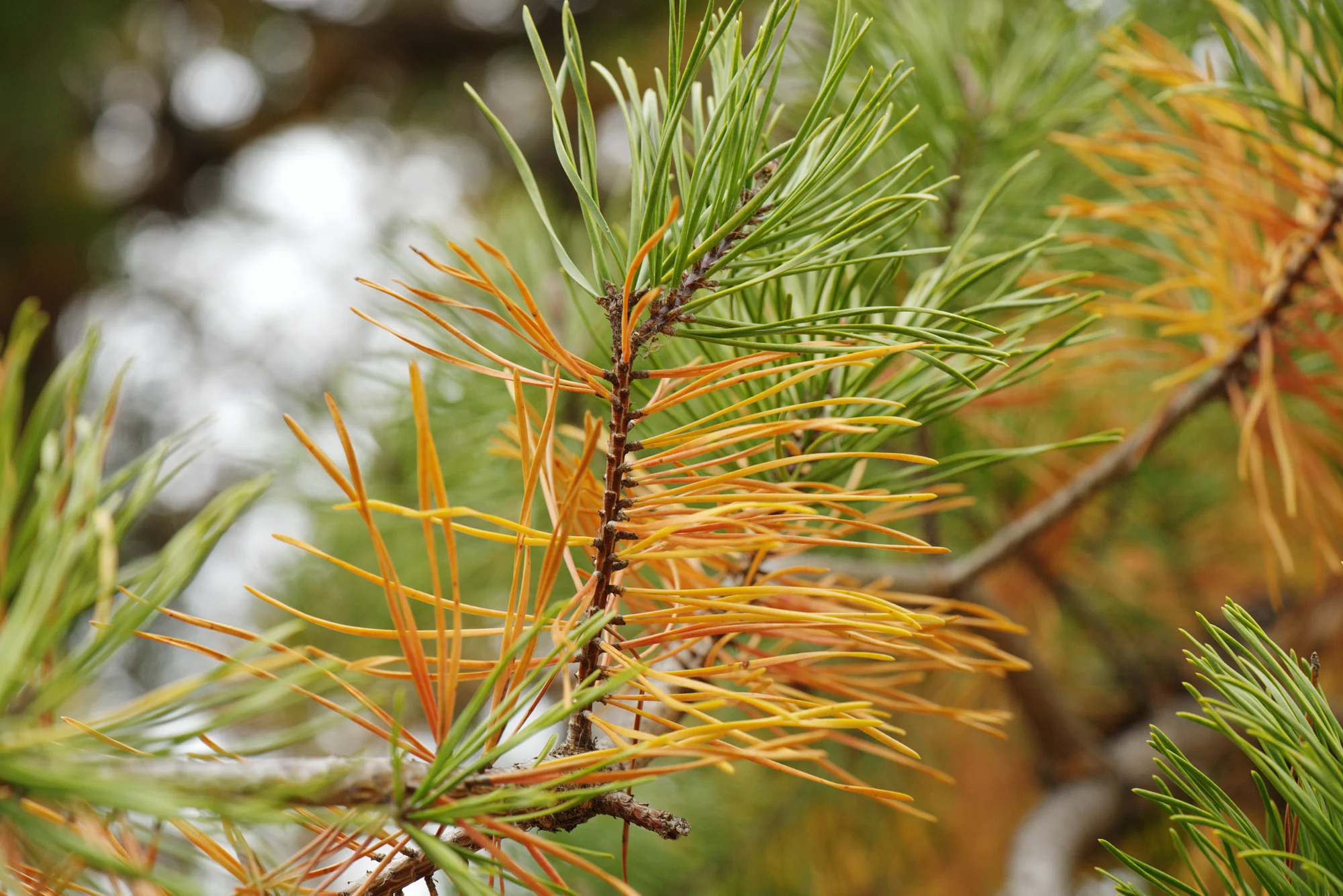
Why are the inside needles on my pine turning orange?
It’s usually normal. Depending on the species, needles stay on 2 to 12 or more years, then the oldest ones, farther in on the branch, turn color and drop, often in fall. Worry when the new growth at the branch tips browns instead.
Can you eat pinyon nuts?
Yes. NC State lists the seeds as edible. Be patient if you plant one, though. Trees may start bearing cones at about 25, but good seed production comes on trees 75 to 100 years old.
Plant nerd fact
The bird that plants a forest
Limber pines get planted by Clark’s nutcrackers, which carry seeds in a pouch under the tongue, up to 125 seeds per bird, and bury them for later. Silvics says they haul seed at least 14 miles. Seeds left in the ground sprout, and after a fire, new limber pines come up largely from nutcracker seed caches. One crossdated limber pine in Utah’s Wasatch Mountains is 1,697 years old.
Pick the pine that belongs in your region, give it more room than you think it needs, and let it be. For more evergreen ideas, see our guide to native evergreen conifers. Happy planting!
Sources
- Flora of North America Editorial Committee. “Pinus,” “Pinus echinata,” “Pinus flexilis” and “Pinus palustris.” Flora of North America North of Mexico, vol. 2. Accessed October 12, 2026.
- NatureServe. “Pinus flexilis” and “Pinus palustris.” NatureServe Explorer. Accessed October 12, 2026.
- NC State Extension. “Pinus strobus,” “Pinus banksiana,” “Pinus rigida,” “Pinus virginiana,” “Pinus echinata,” “Pinus palustris,” “Pinus taeda,” “Pinus ponderosa,” “Pinus contorta,” “Pinus flexilis,” “Pinus edulis,” “Pinus nigra,” “Pinus sylvestris” and “Pinus mugo.” Extension Gardener Plant Toolbox. Accessed October 12, 2026.
- Oregon State University Department of Horticulture. “Pinus ponderosa.” Landscape Plants. Accessed October 12, 2026.
- Rocky Mountain Tree-Ring Research. “OLDLIST: A Database of Old Trees.” Accessed October 12, 2026.
- Rutgers New Jersey Agricultural Experiment Station. “Landscape Plants Rated by Deer Resistance.” Accessed October 12, 2026.
- Shropshire, Kimberley J., and Douglas W. Tallamy. “Lepidoptera of North America North of Mexico: An Annotated List Containing Geographic Ranges and Host Plant Records.” ZooKeys, 2025. Host counts from the UDELep data, May 2025.
- The Gymnosperm Database. “Picea engelmannii.” Accessed October 12, 2026.
- USDA Forest Service. Fire Effects Information System species reviews: “Pinus banksiana” (Carey 1993), “Pinus echinata” (Carey 1992), “Pinus edulis” (Anderson 2002), “Pinus flexilis” (Johnson 2001), “Pinus palustris” (Carey 1992), “Pinus resinosa” (Hauser 2008), “Pinus rigida” (Gucker 2007) and “Pinus serotina.” Accessed October 12, 2026.
- USDA Forest Service, Huron-Manistee National Forests. “Kirtland’s Warbler Habitat.” Accessed October 12, 2026.
- USDA Forest Service, Southern Research Station. “NTFPs from Trees.” Science Update SU-SRS-139, pinyon section by J. Chamberlain, 2020, rev. 2021. Accessed October 12, 2026.
- USDA Forest Service. Silvics of North America, vol. 1, Conifers: “Pinus banksiana” (Rudolph and Laidly), “Pinus contorta” (Lotan and Critchfield), “Pinus echinata” (Lawson), “Pinus edulis” (Ronco), “Pinus flexilis” (Steele), “Pinus palustris” (Boyer), “Pinus ponderosa” (Oliver and Ryker), “Pinus resinosa” (Rudolf), “Pinus rigida” (Little and Garrett), “Pinus strobus” (Wendel and Smith), “Pinus taeda” (Baker and Langdon) and “Pinus virginiana” (Carter and Snow). Accessed October 12, 2026.
Similar plants
Updated Find more: Beginner Guide Deer Resistant Evergreen Evergreen Tree Keystone Tall Tree Tree
The ads on this site help pay real native plant nerds to research and write these guides.
Garden notes
Notes from people who’ve grown it
Tips, wins, and the occasional disaster. If you’ve grown pine, share the advice you’d give to a neighbor.
No notes yet. Yours could be the first.
Grown pine? Tell the next person what you wish someone had told you.
Tap anywhere to close


