
Highlights
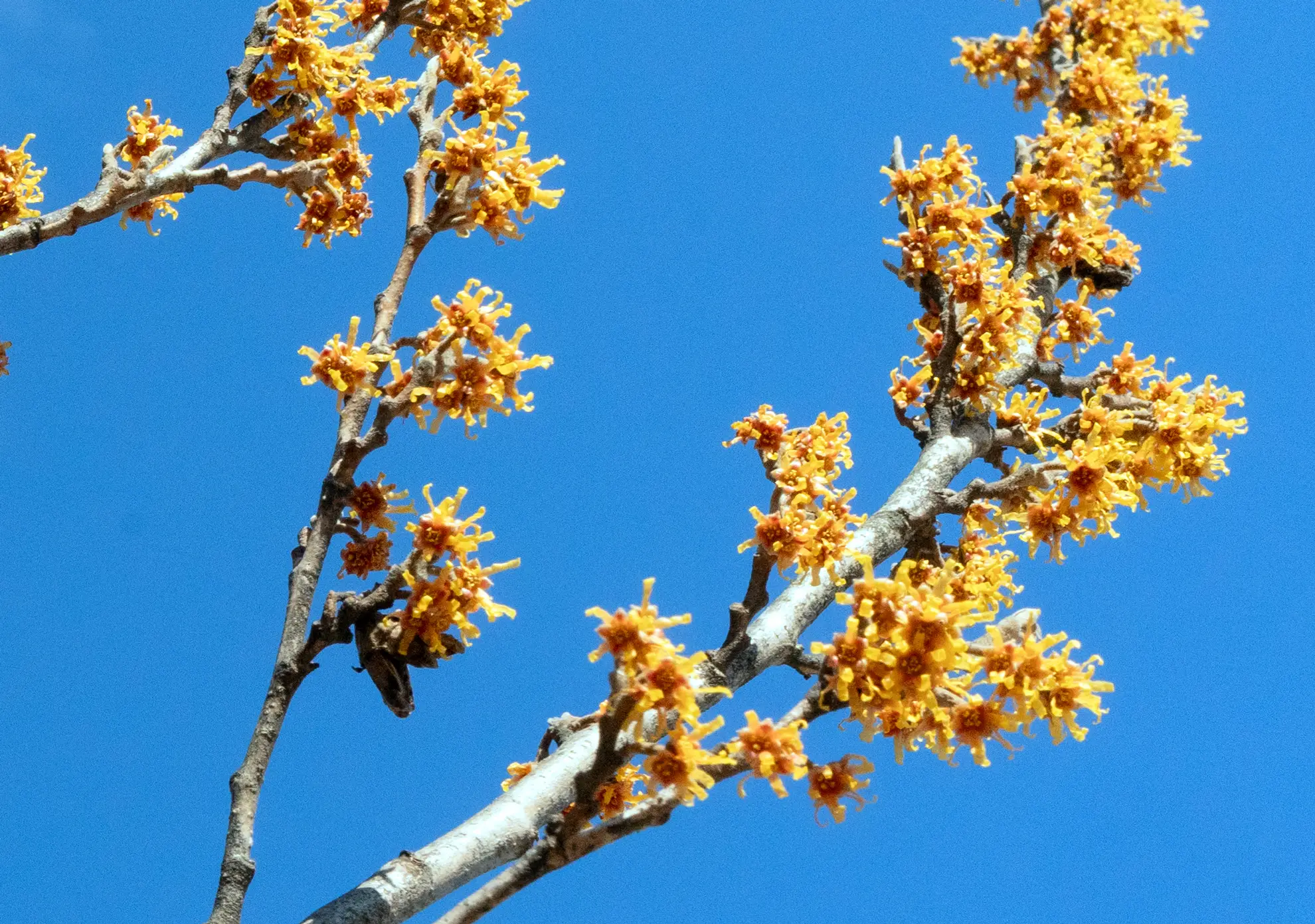
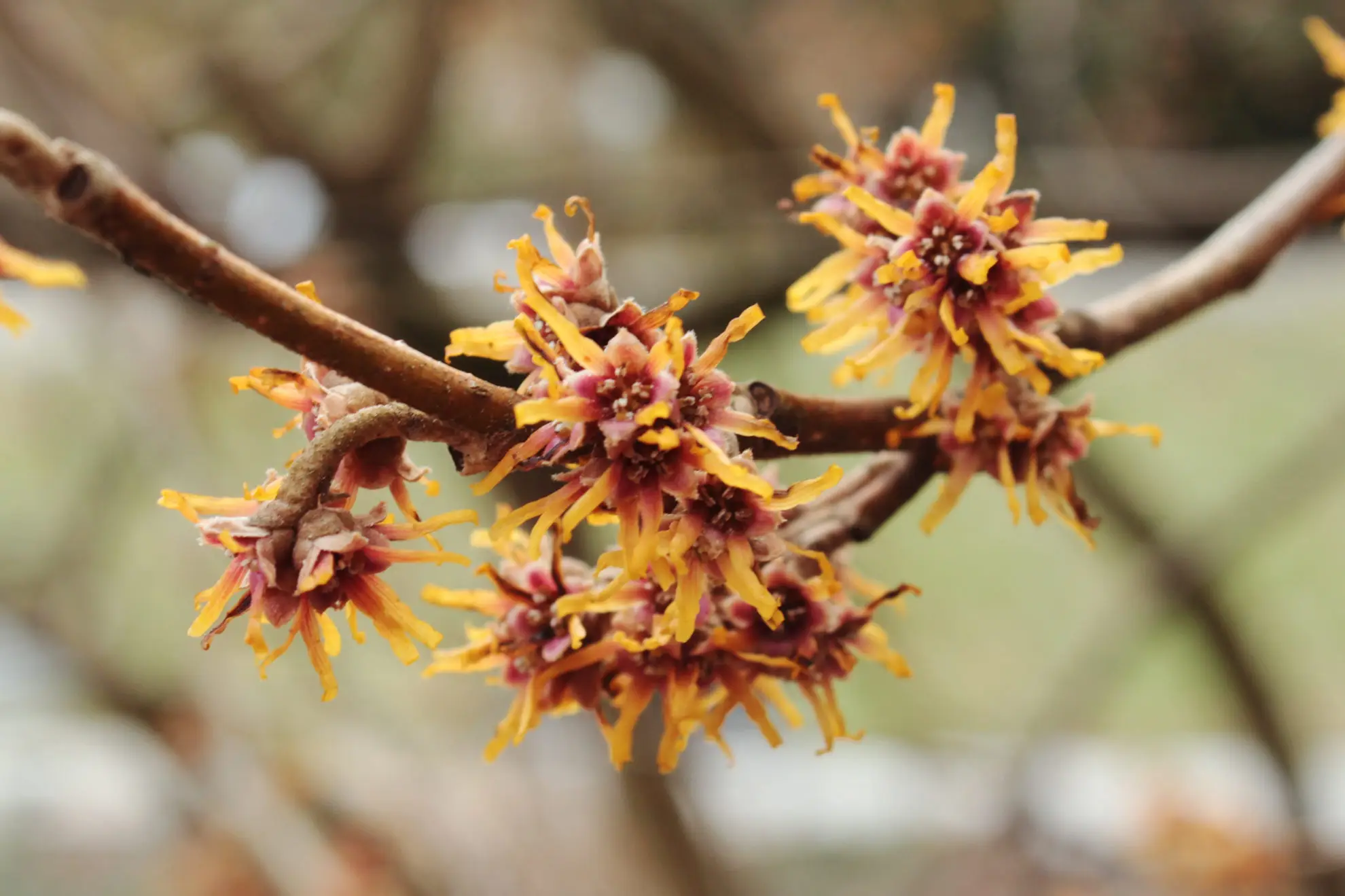
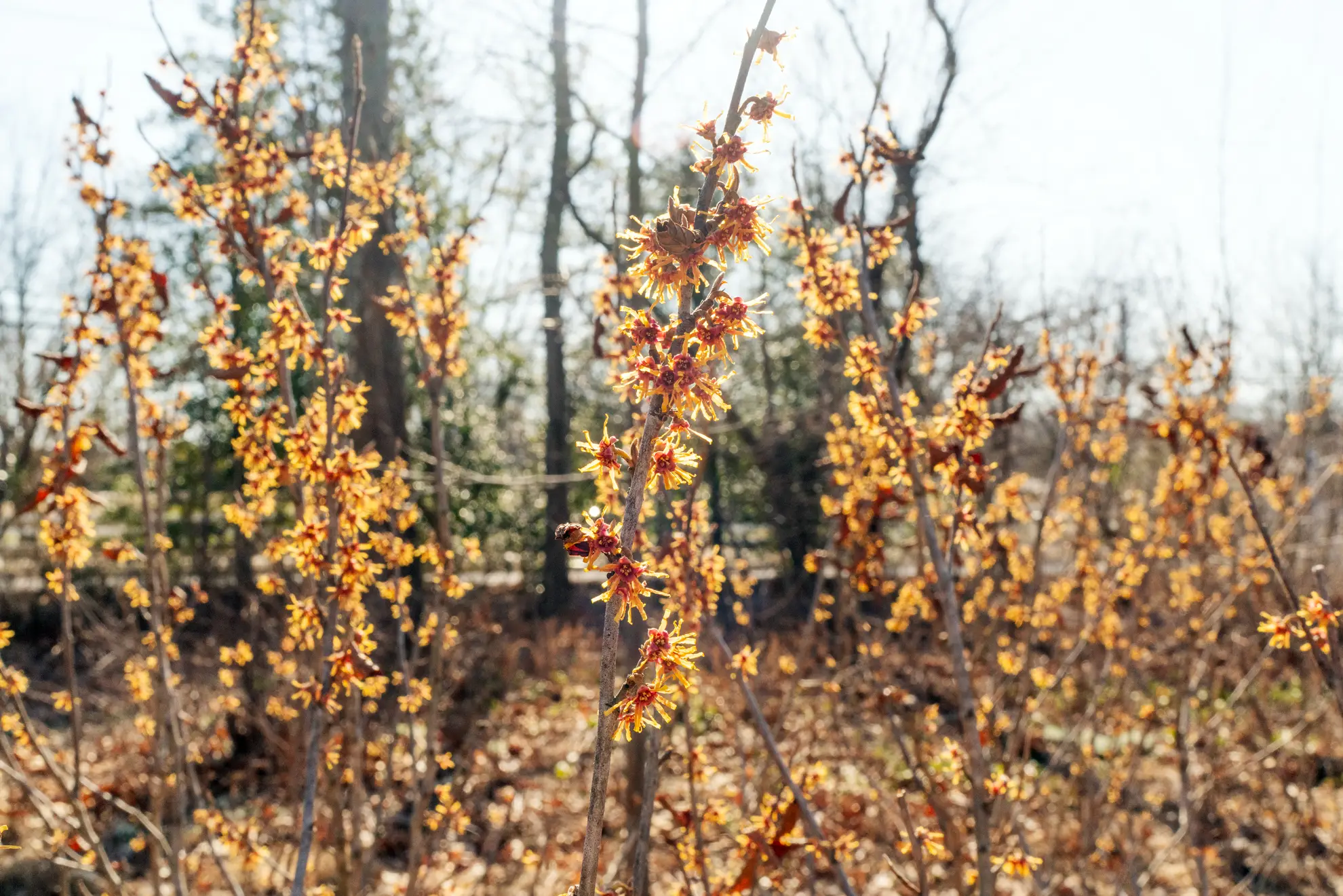
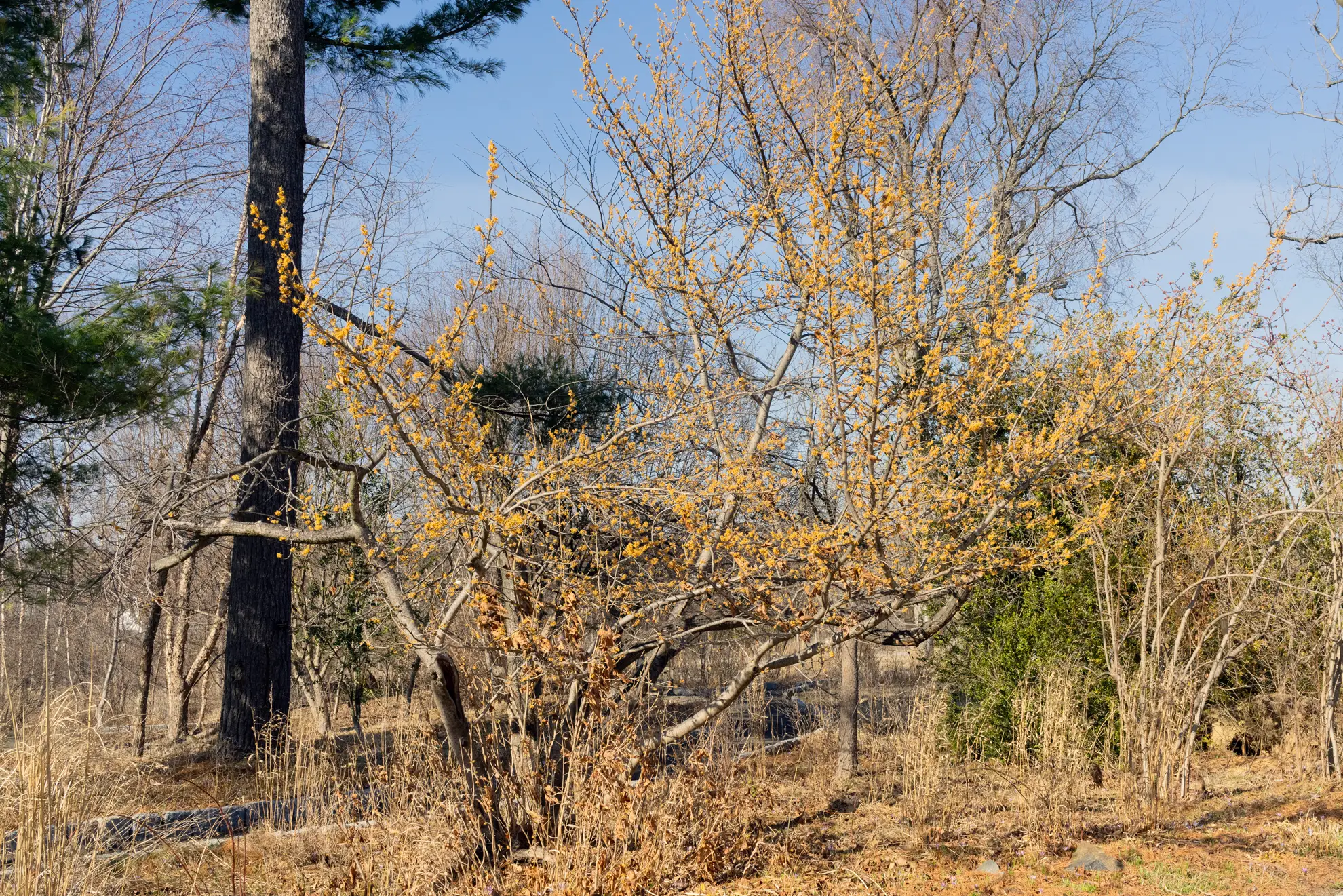
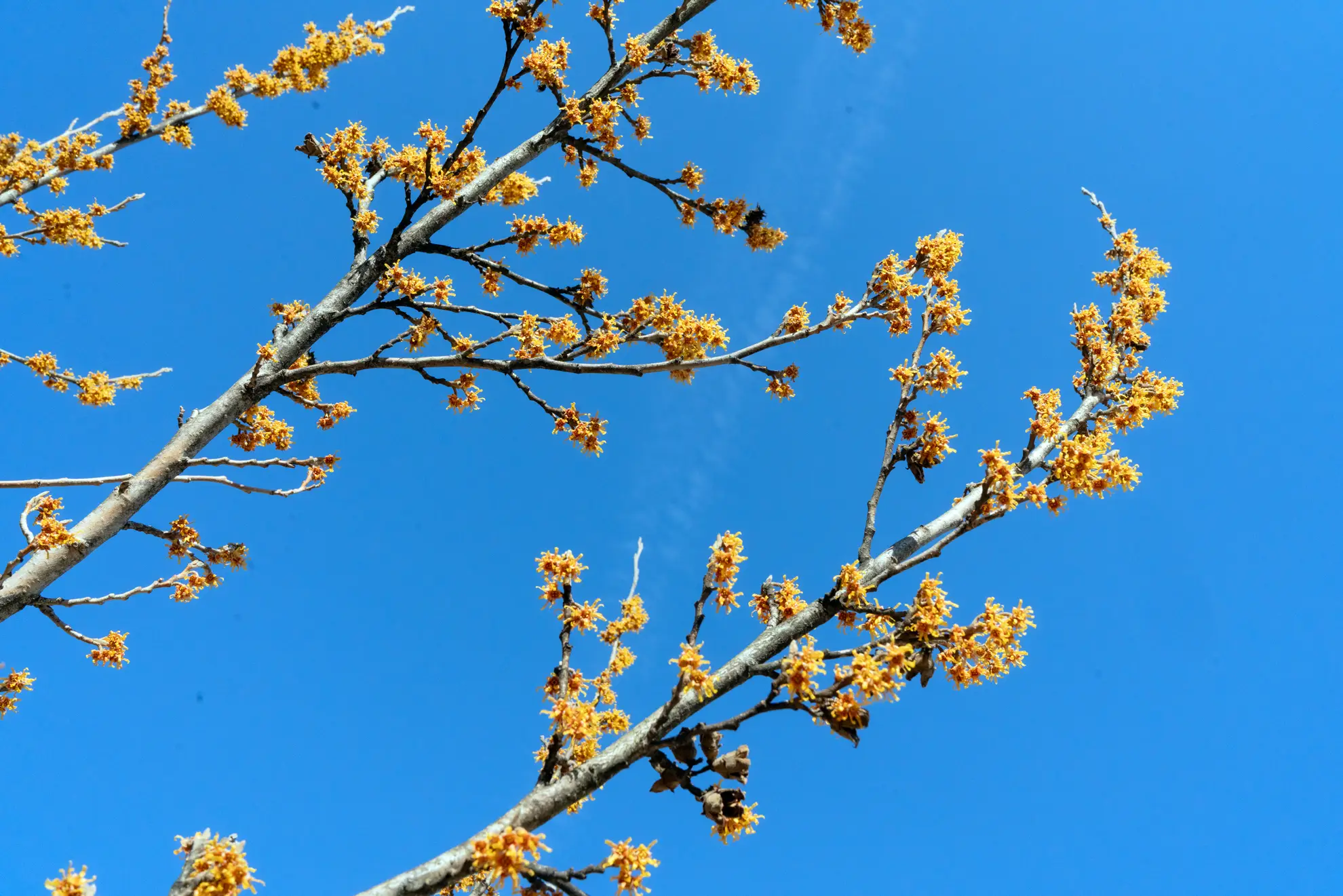
Spring witch hazel (Hamamelis vernalis) blooms in the dead of winter. We’re talking January into March, when those in temperate climates desperately need to see a flower. During this cold stretch, its bare branches light up with hundreds of tiny flowers in orange, copper, red or gold, each one four crinkly petals like a mouse-sized scrap of curled ribbon. On a freezing morning the petals roll up tight, and on the next warm afternoon they open again, so one plant stays in bloom for three to four weeks.
You’ll also see it sold as Ozark witch hazel or vernal witch hazel. It’s a rounded, suckering shrub about 6 to 10 feet tall, native to the Ozarks, and it thrives in clay and wet ground that often scares other shrubs.
Is spring witch hazel a good choice for my yard?
Yes, if…
- You want flowers in January. It’s one of the very first native shrubs to bloom, often with snow still on the ground.
- You have clay, or soil that isn’t acidic. It’s more tolerant of high pH than common witch hazel and handles clay fairly well.
- You have a soggy spot. In the wild it grows on gravel bars that flood often and dramatically, and it handles wet sites in gardens.
- You want a dense, shrub-sized screen. At 6 to 10 feet tall, it fits places a small tree won’t.
- You want the real thing, not an import. Most witch hazels sold for winter flowers are Asian. This one is native.
Skip it if…
- You want a plant that stays put. It suckers to form colonies. Great for a thicket, less great in a tidy foundation bed.
- Your spot is dry and hot all summer. The Morton Arboretum says not to plant it in dry conditions.
- You want fall flowers. That’s common witch hazel, which blooms in October and November.
- You’re in a hurry to find one at a big-box store. You probably won’t, and the witch hazels you will find there are almost all Asian (more on that below).
Where is vernal witch hazel native?
Native to 4 US states
Sources: NatureServe, Royal Botanic Gardens, Kew (World Checklist of Vascular Plants) and the USDA PLANTS Database, compiled by The Plant Native. How we map native ranges
Spring witch hazel’s home is the Ozark highlands of Missouri, Arkansas and Oklahoma, plus a few spots in Texas. There it’s a characteristic shrub of gravel bars along fast Ozark streams. It’s been planted far outside that range, and it’s hardy to zone 4, but if you garden east of the Mississippi, our common witch hazel is the one native to your woods.
On a freezing morning the petals roll up tight, and on the next warm afternoon they open again.
Why spring witch hazel matters
In January, a flower is a rare meal. The sweet scent draws early flies, gnats and midges out on mild winter days, when almost nothing else is available for food.
It’s a host plant
Witch hazels host 78 species of native moths and butterflies. On vernal witch hazel, look for the witch hazel dagger moth and two gall-making aphids that specialize in witch hazels (they’re behind the odd little bumps on the leaves). Wild turkeys and ruffed grouse eat the seeds and flowers.
It holds streambanks together
Those suckering roots are why it thrives on Ozark gravel bars, and why it’s used for erosion control. The Garden Club of America gave it a 2025 Plant of the Year special recognition, and the Missouri Botanical Garden named it a Plant of Merit back in 2003.
Spring witch hazel through the seasons
Winter
This is its time to shine. Flowers open on bare wood from January to March, in colors that run from yellow to reddish, often red at the base and coppery at the tips. Some years the dried leaves hang on into winter and tuck around the flowers.
Spring
New leaves come out bronzy-red and turn dark green.
Summer
A dense, rounded green shrub. Seed capsules quietly ripen through the summer and split open in September or October.
Fall
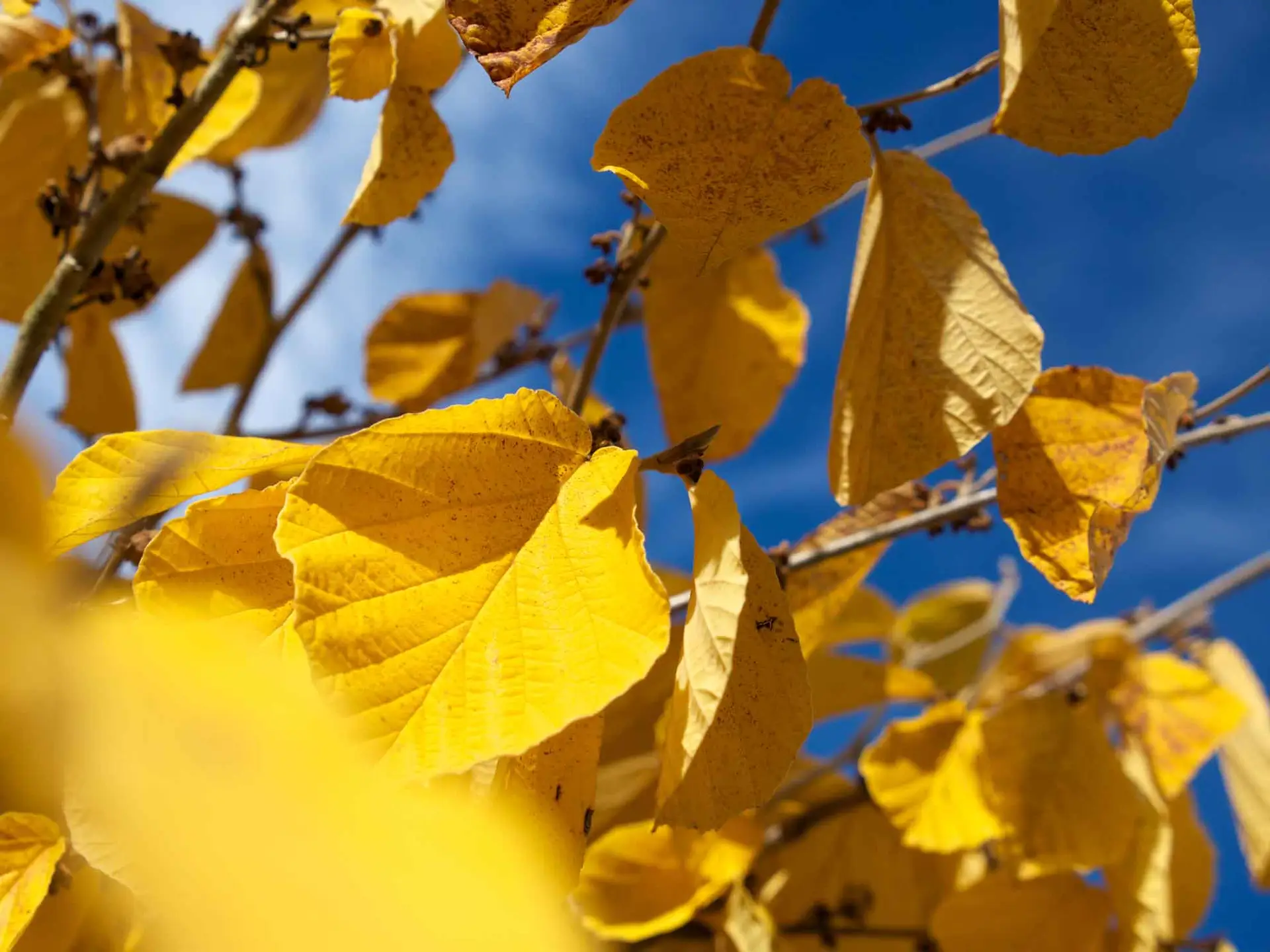
Leaves turn buttery yellow to gold. Some selections go orange, red or plum (see the cultivar round-up below).
Where spring witch hazel shines in your yard
- In view of a window. Writer Carolyn Harstad’s advice is to plant it “where you can enjoy viewing it from inside your warm, cozy house.” In January, that’s where you’ll be (Go Native!, 70–71).
- A wet corner or rain garden. It’s often planted in rain gardens and handles poorly drained clay.
- A streambank or slope. Let it sucker and it holds soil in place.
- A shrub border or hedge. Dense and rounded, it works as a screen or hedge.
- A mass planting. UConn suggests it for mass or group plantings, and a group in bloom reads from across the yard.
- By the front door. Anywhere you walk past every day in winter.
How to grow spring witch hazel
When to plant
Spring or early fall, from a container. Look for a plant grown on its own roots (more on why below).
Sun and soil
Full sun to part shade; in shade it grows more open. It likes moist, well-drained soil but does well in many situations, including clay and soil on the alkaline side.
Watering
Water through the first summer. After that it’s moderately drought tolerant, though a long dry spell is worth a deep soak.
Beginner tip
Bring some inside. Snip a few budded branches in January, put them in a vase of water, and they’ll bloom indoors. It’s the easiest flower arrangement you’ll make all winter, and pruning in late winter is good for the shrub anyway.
Spacing
It spreads 10 to 15 feet wide. Plant about 10 feet apart for a hedge that knits together.
Planting card
Hamamelis vernalis
The trickCut a few budded branches in January and they’ll bloom in a vase indoors.
What are good pairings for spring witch hazel?
In the Ozarks it grows with ninebark and buttonbush, so start there. Ninebark and buttonbush share its taste for damp ground, and winterberry keeps red berries going until the witch hazel takes over. Underneath, Virginia bluebells and golden ragwort pick up the color in spring, and northern sea oats hold the edge of a wet bed.


Where can I buy spring witch hazel?
Sorry for the bummer news, but finding this native plant is more challenging than it should be. Clemson Extension notes vernal witch hazel is harder to find in the trade than the Asian species and hybrids, and those Asian plants bloom in the same January-to-March window. At a garden center, a witch hazel in winter bloom is far more likely to be Chinese or a hybrid than native. Read the tag: you want Hamamelis vernalis. A native nursery is your best bet. Start with our list of native plant nurseries, order online, or watch for a native plant society sale.
How to avoid Chinese witch hazel
Chinese witch hazel isn’t on invasive plant lists. It’s just not from here. Native caterpillars grew up with our own witch hazels, and across the board, introduced plants support far fewer of them than native plants do. Pick the native, and the caterpillars (and the birds that eat them) come with it.
Three things make the Asian plants easy to bring home by accident:
- Its hybrids are everywhere. Chinese and Japanese witch hazel crossed to make Hamamelis × intermedia, first noticed at the Arnold Arboretum in the 1920s. ‘Arnold Promise’ and ‘Jelena’ (also sold as ‘Copper Beauty’) are both hybrids, not natives.
- Some “natives” aren’t. ‘Superba’ can pass for a native pick, but it’s thought to be a cross of Chinese and vernal witch hazel.
- The roots can be native when the plant isn’t. Asian witch hazels are usually grafted onto common witch hazel roots. A native label on the rootstock doesn’t make the top native.
Potential challenges
Not much. The Morton Arboretum lists no serious problems, and most of what you’ll notice is cosmetic.
Suckers
Left alone, it spreads into a thicket. MDC’s advice: keep the root suckers trimmed if you want a single shrub. Dig or cut them at the base in late winter.
Powdery mildew
It shows up now and then and is usually not significant. Give the plant sun and air.
Leaves that hang on
Some plants hold their dried leaves into winter, which can hide the flowers a bit. Pull them off by hand if they bother you.
Pruning
Prune in late winter, right after it blooms, to remove dead stems and keep its shape.
A note on cultivars
We recommend the straight species first. If you want a particular color or size, vernal witch hazel has plenty of named selections, and every one below is Hamamelis vernalis, so it’s still native. Mt. Cuba Center hasn’t trialed witch hazels, so there’s no head-to-head data on which ones the pollinators like best.
For flower color
- ‘Amethyst’: purple flowers in late winter.
- ‘Christmas Cheer’: red-purple flowers with a strong, sweet fragrance. It’s named for blooming early, though UConn warns that a Christmas bloom depends on your zone and the weather.
- ‘Red Imp’: copper-red to maroon petals.
- ‘Tim’s Purple’: purple-red petals.
- Red-flowered forma carnea: a red-flowered form described by Alfred Rehder in the 1920s.
For fall color
- ‘Autumn Embers’: orange flowers and red-purple fall color, upright to 8 to 10 feet. UConn calls it one of the best witch hazels for fall color, especially in colder areas.
- ‘Sandra’: new leaves flushed plum-purple, then orange, scarlet and red in fall, with yellow flowers. It was selected at Hillier Nurseries in England and named for the propagator’s daughter.
For small spaces
- ‘Quasimodo’: a natural dwarf about 3 feet tall and wide, with fragrant amber-orange flowers in February.
- ‘Spring Magic’: a dwarf about 6 feet tall with a 5-foot spread.
- ‘Lombart’s Weeping’: branches that weep to the ground on a small plant about 6 feet tall. UConn notes this one is often mislabeled in the trade.
One more name you may see is ‘Orange Glow’, which grows in the Arnold Arboretum collection. Whatever you pick, check that vernalis is on the tag. Cultivar names are easy to mix up, and plenty of Asian hybrids have orange and red flowers too.
FAQs
When does vernal witch hazel bloom?
January to March, sometimes into April. In Missouri it’s one of the first native plants to bloom every year, and the flowers last three to four weeks.
What’s the difference between vernal witch hazel and common witch hazel?
Timing, size and soil. Vernal witch hazel blooms in late winter, stays around 6 to 10 feet and handles clay and higher pH. Common witch hazel blooms in fall, grows into a small tree and wants acidic soil.
What’s the difference between vernal witch hazel and Chinese witch hazel?
Only vernal witch hazel is native. Chinese witch hazel (Hamamelis mollis) comes from China and has larger flowers and a stronger scent. They bloom at the same time, so the tag is the only sure way to tell them apart at a nursery.
Is ‘Arnold Promise’ witch hazel native?
No. ‘Arnold Promise’ is a Hamamelis × intermedia, a cross of Chinese and Japanese witch hazel. The same goes for ‘Jelena’.
Does vernal witch hazel spread?
Yes, by suckers. It can form colonies. That’s handy on a slope or streambank; in a small bed, cut the suckers back each year.
Do vernal witch hazel flowers smell good?
Most people think so. The Morton Arboretum calls them spicy and very fragrant. An older British reference called the scent “pungent, not very agreeable”, so sniff one before you buy if you can.
Is vernal witch hazel deer resistant?
Not completely. Deer eat the shoots and leaves in the wild. Cage young plants for the first couple of winters.
Plant nerd fact
Ozark water witches used its branches
In the Ozarks, people called “water witches” or “witch wigglers” walked the land holding a forked witch hazel switch, waiting for it to dip toward a good spot to dig a well. Folklorist Vance Randolph wrote the ritual down. Whether it worked is another question.
Vernal witch hazel is the native answer to the January garden: flowers on bare branches, a little scent on a mild day, and something for the first gnats and flies of the year. Just make sure the tag says vernalis. For its fall-blooming cousin, meet common witch hazel, or see the whole family in our beginner’s guide to native witch hazels. Happy planting!
Sources
- Chicago Botanic Garden. “Hamamelis vernalis ‘Amethyst’.” Accessed November 1, 2026.
- Coceano, Josh. “Plants of the Week: February 29.” Scott Arboretum and Gardens, March 3, 2016. Accessed November 1, 2026.
- Dickert, George M. “Witch Hazel.” HGIC 1091, Clemson Cooperative Extension, 2012. Accessed November 1, 2026.
- Gapinski, Andrew. “Hamamelidaceae, Part 1: Exploring the Witch-hazels of the Arnold Arboretum.” Arnoldia 72, no. 2 (2014). Accessed November 1, 2026.
- Garden Club of America. “Hamamelis vernalis, Ozark Witch Hazel.” Plant of the Year. Accessed November 1, 2026.
- Harstad, Carolyn. Go Native! Gardening with Native Plants and Wildflowers in the Lower Midwest. Bloomington: Indiana University Press, 1999, 70–71.
- Missouri Department of Conservation. “Ozark Witch-Hazel.” Field Guide. Accessed November 1, 2026.
- Morton Arboretum. “Vernal Witch-Hazel.” Accessed November 1, 2026.
- NatureServe. “Hamamelis vernalis.” NatureServe Explorer. Accessed November 1, 2026.
- Starbuck, Christopher J. “Witch Hazel.” Missouri Environment & Garden, University of Missouri Integrated Pest Management, January 2009. Accessed November 1, 2026.
- Tallamy, Douglas W., and Kimberley J. Shropshire. “Ranking Lepidopteran Use of Native versus Introduced Plants.” Conservation Biology 23, no. 4 (2009): 941–947. https://doi.org/10.1111/j.1523-1739.2009.01202.x. Host counts from the Shropshire-Tallamy Lepidoptera host plant dataset (2025).
- Trees and Shrubs Online. “Hamamelis vernalis.” International Dendrology Society. Accessed November 1, 2026.
- University of Connecticut Plant Database. “Hamamelis vernalis.” Accessed November 1, 2026.

Similar plants
-
 Common Witch Hazel
-
 Buttonbush
-
 Virginia Sweetspire
-
 Highbush Blueberry
-
 Ninebark
-
 American Elderberry
-
 American Beautyberry
-
 American Plum
-
 Hydrangeas
Updated Find more: Orange Red Yellow Flowering Shrub Winter Full Sun Part Sun Rain Garden Moist Host Plant
The ads on this site help pay real native plant nerds to research and write these guides.
Garden notes
Notes from people who’ve grown it
Tips, wins, and the occasional disaster. If you’ve grown vernal witch hazel, share the advice you’d give to a neighbor.
No notes yet. Yours could be the first.
Grown vernal witch hazel? Tell the next person what you wish someone had told you.
Tap anywhere to close


